
In this blogpost, Queen’s Electrician Nevelle Gahanao tells us how his connection to his home country of Papua New Guinea has inspired work beyond his role in the College. Together with his wife, Ella, he founded Women’s Cancer Prevention PNG, a charity working with remote communities to improve awareness of breast and cervical cancer and, increasingly, access to vaccination and screening.
This Michaelmas Term, Women’s Cancer Prevention PNG is the chosen charity for Queen’s Chapel collections, giving members of the College community an opportunity to support its work.
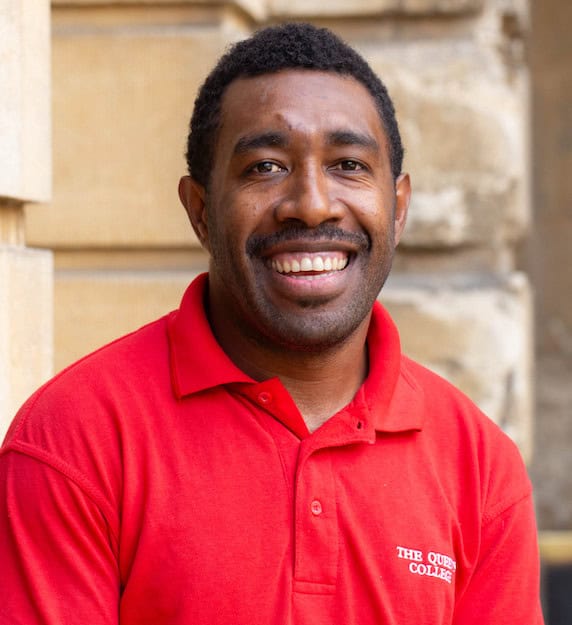
Can you tell us a little about your background in Papua New Guinea and your role here at Queen’s?
I’m originally from Papua New Guinea, and it is very close to my heart – it is where I grew up and all my family are still there. Before coming to the UK, I worked as an engineer on a medical charity ship in PNG, where I met my wife, Ella, who was volunteering as a doctor. We later worked together in a small rural hospital, where I saw first-hand the challenges faced by remote communities in accessing healthcare.
I now live in the UK and have worked at Queen’s as an electrician for nearly two years, but my connection with PNG has always remained very important to me.
What first inspired you and Ella to establish the charity Women’s Cancer Prevention PNG?
The charity grew directly from our experiences working in Papua New Guinea. Ella saw many women presenting with breast and cervical cancer, often when it was already too advanced to treat. This is such a contrast to the UK, where we have established screening services. We knew that many of these deaths could have been prevented through better awareness, screening, vaccination and earlier treatment.
We knew that many of these deaths could have been prevented through better awareness, screening, vaccination and earlier treatment.
Over time, Ella and I both felt that God was calling us to do something about this. We therefore set up Women’s Cancer Prevention PNG. We didn’t know exactly where it would lead, but we felt that this was something we were meant to do, and we are so excited to see how well it has developed and progressed.
Why are breast and cervical cancer such pressing issues for women in remote communities in Papua New Guinea?
Breast and cervical cancer are two of the three most common cancers affecting women in Papua New Guinea. Breast cancer is the leading cause of cancer-related deaths among women, while cervical cancer ranks third in both incidence and mortality. Tragically, many women are diagnosed too late for effective treatment, despite these diseases being largely preventable and, when detected early, highly treatable.
The high burden of breast and cervical cancer in PNG is influenced by a range of interconnected factors, including limited awareness of cancer symptoms, and in some communities, very little understanding of what cancer is or how it can be prevented or treated. Cultural stigma and misconceptions surrounding women’s health, financial barriers, and the challenges of travelling long distances to access healthcare also play a role. As a result, many women delay seeking care and present with advanced disease, when treatment options are more limited.
What does the charity’s work currently look like on the ground, and how do your nurses reach the communities they support?
We currently have two nurses working on the ground in Morobe Province, supported by 20 trained WCP Champions. The nurses travel out to remote communities, sometimes spending many hours travelling by boat and then walking to reach villages that are not easily accessible. The WCP Champions are local people who help us build links within their communities and continue the work between visits from the nurses.
Our current work is focused on education and awareness around breast and cervical cancer. The nurses spend time with communities through both small group discussions and larger teaching sessions. This gives people the opportunity to ask questions, talk openly about their concerns and learn about cancer prevention and early detection.
Our current work is focused on education and awareness around breast and cervical cancer.
However, our work goes beyond providing health education. A big part of what we do is getting to know the communities, building trust and understanding their needs and concerns. Through these conversations, we are also learning about the wider challenges communities face and looking at how we can support them with broader community development.
We will soon build on this work by bringing HPV vaccination and breast and cervical cancer screening directly to the communities we work with. Given the response we have already had, we expect there to be a positive uptake of these services.
Are there particular cultural or practical barriers that make health education and cancer screening more difficult to access?
There are both cultural and practical barriers. Many communities are very remote, and simply reaching them can involve long journeys by boat and on foot. Transport can be difficult and expensive.
There are also challenges around awareness and understanding. As we have seen through our work, some women have very little knowledge about cancer, including what it is, what causes it and what symptoms they should be concerned about. Cultural beliefs, misconceptions and stigma can also make conversations about cancer and women’s health difficult.
Screening presents an additional challenge because it is about finding cancer before there are any symptoms. If a woman feels completely healthy, there may be little reason for her to make a long and expensive journey to a health facility, particularly when screening is not routinely available. This is why education is so important. Women need to understand what cancer is, why screening is important even when they feel well, and why finding cancer early can make such a difference. It is also why bringing screening directly to the communities is so important – it removes one of the biggest practical barriers and makes it much easier for women to access screening.
This is also why building trust is a key part of our work. We want women to feel comfortable asking questions and talking openly about their health. Our WCP Champions are particularly valuable because they are local people who understand their communities and culture and can help make conversations about cancer and women’s health more open and accessible.
Building trust is a key part of our work. We want women to feel comfortable asking questions and talking openly about their health.
What difference have you already seen the charity make, either for an individual woman or within a wider community?
Our nurses are currently working with around 60 different villages, and the response from the communities has been very positive. People have been very welcoming and keen to learn, and there is a strong interest in our plans to bring HPV vaccination and breast and cervical cancer screening directly to the villages.
We have not yet started delivering screening ourselves, as this will be the next stage of our work. However, in a few villages closer to the town, where women can access existing health services more easily, we have encouraged women to travel into town for screening. We have seen an increase in the number of women doing this, which is very encouraging and suggests that the education and awareness work is already having an impact.
The response we are receiving also gives us confidence that there will be a positive uptake when we are able to bring HPV vaccination and screening directly to the villages. For us, it is encouraging to see women becoming more willing to talk about cancer, ask questions and take action about their health.
We are still a young charity and there is a lot more we want to do, but seeing communities engage so positively with the programme has been extremely encouraging. It shows us that there is a real need for this work and a willingness within communities to engage with cancer prevention and early detection.
What are your ambitions for the charity over the next few years, and how can members of the Queen’s community find out more and support its work?
Over the next few years, we want to reach more communities across Morobe Province and eventually expand our work into other provinces of Papua New Guinea. We want to provide more women with cancer education and awareness, and bring HPV vaccination and breast and cervical cancer screening directly to the communities we work with.
Ultimately, we want to help prevent women from dying from cancers that can be prevented or successfully treated when detected early. There is a huge amount still to do, but we are excited about what we can achieve and about seeing the programme continue to grow.
We are very grateful for the support we have received from the Queen’s community. Members of the College can find out more about our work through the Women’s Cancer Prevention PNG website, sign up for our newsletter and follow us on Instagram. We are also particularly grateful for the support of the Queen’s Chapel collection, which is helping us develop and expand our work.
There is a huge need for this work in PNG, and we hope that, with the support of the Queen’s community, we can reach more women, improve awareness and make cancer prevention and early detection more accessible to those living in remote communities.
There is a huge need for this work and we hope that, with the support of the Queen’s community, we can reach more women, improve awareness and make cancer prevention and early detection more accessible to those living in remote communities.
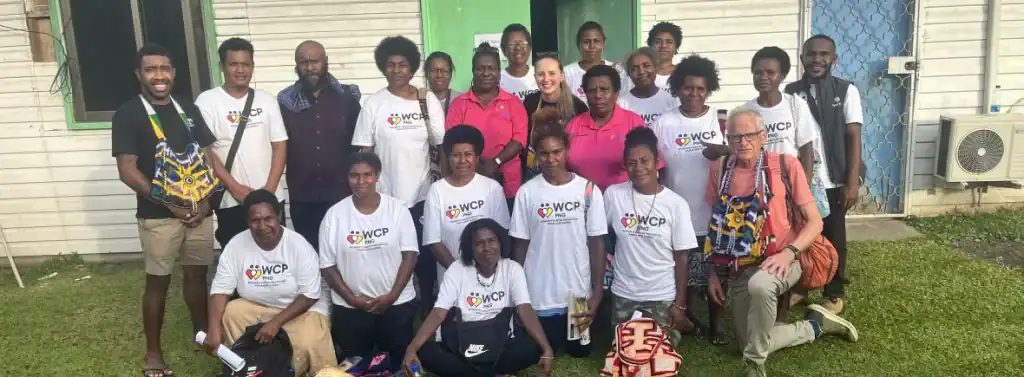
Headshot of Nevelle by David Olds
Header photo of Koki in Port Moresby, Papua New Guinea by GenDeschenes
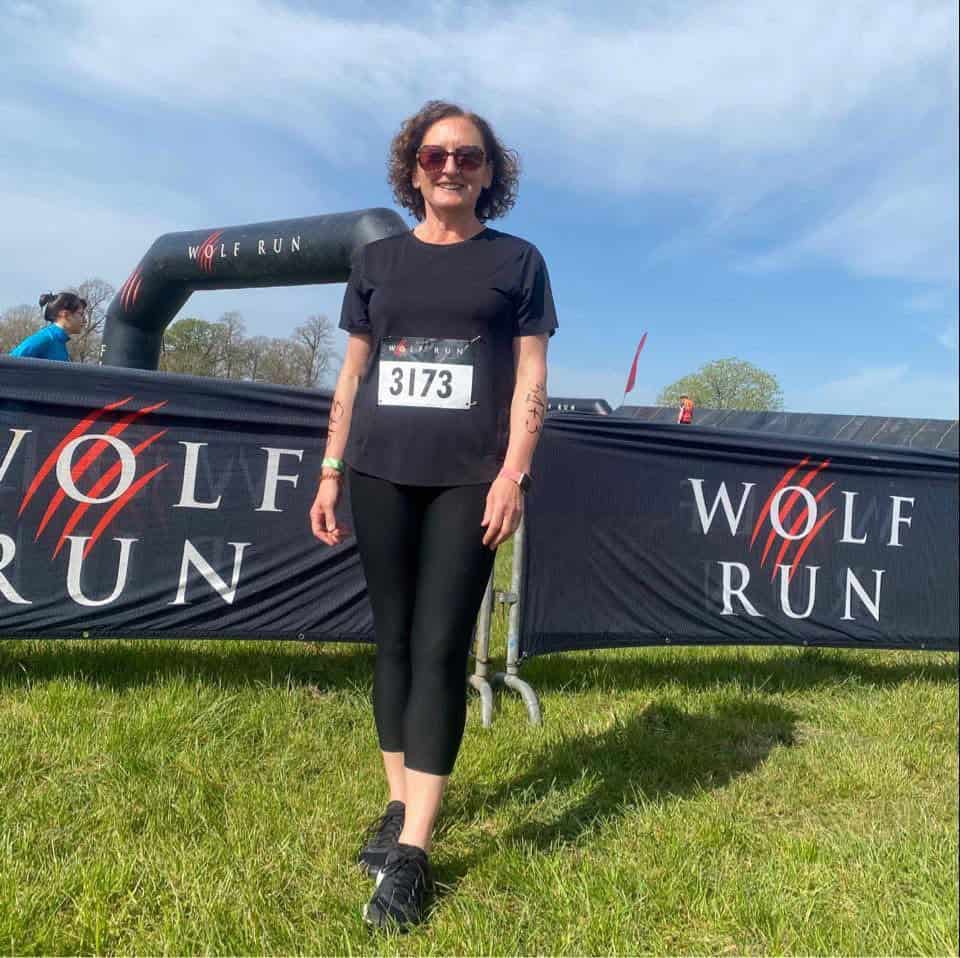
For almost three decades, Accounts Assistant Gillian Hunt has been a familiar face in the Bursary, helping generations of students and supporting the day-to-day running of College behind the scenes. As she retires after 29 years at Queen’s, she shares memories of how College has changed, the colleagues who became lifelong friends, and why she never tired of walking through the door into Front Quad each morning.
Can you remember your first day at Queen’s?
It was Monday 13th October 1997 and I remember the Lodge staff being really kind and friendly. It was the beginning of term so the Bursary was really busy. Alan Parsons was my boss and he was so welcoming and has become a lifelong friend.
You’ve seen the College evolve over three decades; what are the biggest changes you’ve noticed?
We used to have queues of students going out of the door and down the stairs waiting to pay their batells and fees by cheque or cash. Sometimes they would have a pile of money for us to count and we also had to show them how to write out a cheque as for some this was the first cheque they’d ever written.
We used to have queues of students going out of the door and down the stairs waiting to pay their batells and fees by cheque or cash.
We used to know all of the students and have a chat – that’s probably the biggest change as everything is now done online so we don’t get to know them anymore.
We used to issue students with a blue kitchen key that needed to be topped up and books of 12 dinner tickets. To book for the Christmas dinner, students queued in the cloisters all night in December so it was freezing cold – it was very popular.
Weekly wages were delivered in cash to the Steward’s Office who used to sort it for collection by the staff; this was phased out and everyone was changed over to monthly payroll.
For those who may not fully appreciate what the Bursary does, what does a typical day look like and what do you think people might be surprised to learn?
I have to deal with a lots of different things from payroll, fees, conference invoices – it varies so much and is busy all the time. It’s always funny when students think we don’t have to work during the summer: a lovely thought!
I think people would be surprised by how much the College costs to run.
What’s been your favourite thing about working at Queen’s?
The people and the beautiful buildings; walking up the front steps and pushing the door open – the view is something you could never tire of.
I enjoyed watching the College team rowing in the Summer Eights at the boat club and the annual cricket match held at the sportsground, which was a lovely event. I also enjoyed the staff days out an a coach somewhere; I remember going to Portsmouth and getting the hovercraft over to the Isle of Wight.
What’s the most unusual or unexpected situation you’ve had to deal with at the College?
We had a student who was deaf so we wrote everything down, explaining how everything worked; he would read it so quickly, as we were writing, and was already writing his reply. He was so clever and amazing – I’ll always remember him.
What has it meant to you to be part of the Queen’s community?
The people I’ve worked with over the years have always been great; I’ve been very lucky to have had awesome colleagues and the College is very lucky to have such a great team of people looking after it.
I’ve been very lucky to have had awesome colleagues and the College is very lucky to have such a great team of people looking after it.
As you retire, what will you miss most and what are you most looking forward to?
I’ll miss the people and the community and, of course, the food – thanks to Sean and his brilliant team. Now I’m going to have to actually cook for myself! Funnily enough, my first project will be a new kitchen so maybe that’ll give me the incentive to cook.
I do love baking and my coffee cakes and shortbread have become famous at Queen’s…at least if I bake now I can eat it all myself!
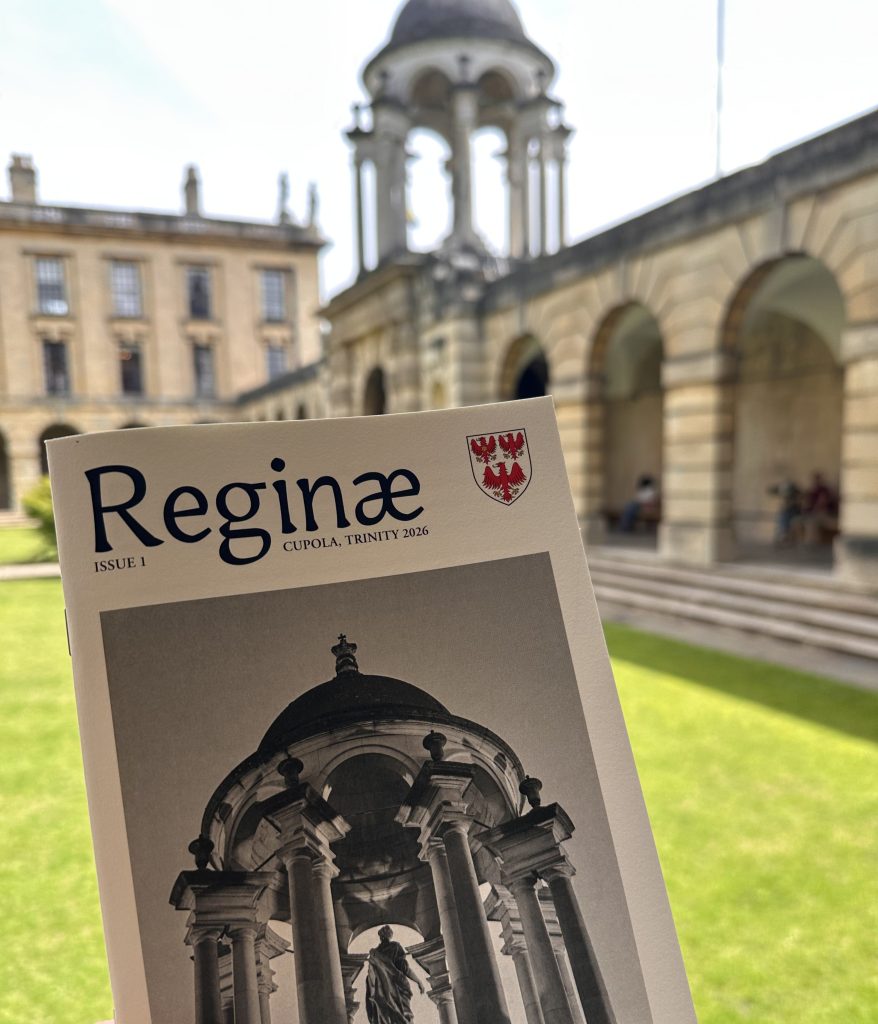
A bus ticket, a stone-carved Queen, and the creative life of the College: these were among the starting points for Reginæ, a new student-edited chapbook bringing together poetry, short fiction, watercolour, and experimental writing by members of Queen’s.
Supported by the Walter Pater Grant, Reginæ takes its name from the Latin for “Queen” and draws on the long tradition of the chapbook: a small, printed booklet of verse, stories and ideas. For its founding editor, graduate student Parth (Master’s in Public Policy), the format offered something more tangible than a PDF and more intimate than a magazine: an object to read between library sessions and Hall and to keep as a piece of College life.
In this interview, we hear from its founder, Parth, how the chapbook came into being and why its editor hopes it might become a new College tradition.
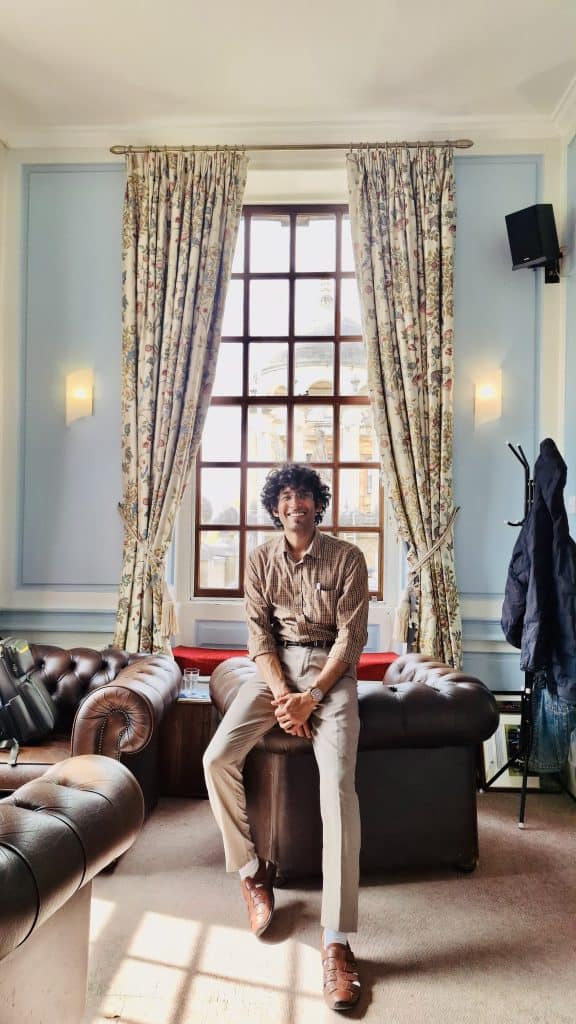
What first prompted the idea for Reginæ, and why did you choose to create a printed chapbook for the project?
A receipt of my bus journey to arrive at Oxford, and the sight of a Queen set in stone from the Middle Common Room. Every student here at Queen’s is talented in their own way, and being creative is such a common denominator. A printed project bringing together their works seemed a suitable way for me to add and build value to the College that truly is like a nursing mother to all its members. Even in changing through the years, since not one stone of the original College remains in situ today, Queen’s has remained true to the spirit of its founders and patrons. In that, it answers the Ship of Theseus argument. Every corner here, and in Oxford at large, has a story, old and new, waiting to be told. Some are included in Reginæ, which literally, and rightly means, Queen.
Every corner here, and in Oxford at large, has a story, old and new, waiting to be told.
What is a chapbook, for those unfamiliar with the term?
A chapbook is an old-fashioned small, stitched booklet of verse, ballads, and short prose that were historically sold by itinerant chapmen. It seemed right for what we were trying to do with Reginæ—something light enough to read, say between a gruelling library session and a Second Hall, sturdy enough to leave in a common-room basket, and beautiful enough to keep and collect. Also, I have always thought of myself as a pedlar, albeit bad, of stories and ideas, and that finally made the term stick. And it’s not half bad to be called the founding editor of what I hope continues as a College tradition.
The chapbook includes poems, short stories, illustrations, and even an AI-generated fiction experiment. How did you decide what belonged in the first issue?
The criterion was simple, even if the editing was not, since each piece had to be short enough to read in a quiet quarter of an hour. Beyond that, I wanted the issue to feel like the College actually feels in conversation. Mixed, a little surprising, the engineer reading verse in three languages (Kirill), the lawyer writing love poems (Arifur), the physicist (Kate) painting watercolours, and the policy student trying to put it all in one cover. The AI piece was the deliberate experiment in seeing how an LLM can perform vis-à-vis its creators.
I wanted the issue to feel like the College actually feels in conversation: mixed and a little surprising.
What did receiving the Walter Pater Grant make possible?
In the most literal sense, bridging the difference between a PDF circulated by email and an object one can hold as a piece of the College. Receiving the Walter Pater grant helped me convert a private experiment into a College project, making it more diverse, equitable, and inclusive along the way.
What was the process of bringing the chapbook into physical form like?
It was an intensive process, since the chapbook had to be delivered within a few weeks of receiving the grant. My experience with my undergrad College magazine in India helped with the editorial work. I really enjoyed designing it. Holywell Press were patient and exacting — they sent four cover alternatives, talked me through paper weights, set the wordmark with the Reginæ æ-ligature in a way that I had hoped for but couldn’t have specified. Kate’s watercolours were scanned at high resolution and threaded as quiet ornaments between the pieces; the Queen’s eagles on the cover came from the College arms; the Finis page closes on a thistle. None of these are large decisions, but each of them is the kind of small choice that makes a chapbook feel like a chapbook and not a brochure.
What would you like Reginæ to become, and what would you say to students thinking of applying for an arts grant?
Thinking about this, I would like Reginæ to outlive its first editor. The hope is for a small annual or termly (though each term hits different) object that is as much a Queen’s tradition as it would be a coming-together of people to foster a creative space. Through this project, generously funded by the Walter Pater grant, I learnt this about creativity at Queen’s: it is there, mostly quiet, and a great deal of it asks only to be asked.
Through this project, generously funded by the Walter Pater grant, I learnt this about creativity at Queen’s: it is there, mostly quiet, and a great deal of it asks only to be asked.
To students wondering whether to apply: please do. The committee is kind and supportive. You don’t need a finished idea, maybe just a real one. Write the application honestly, give an itemised budget, and trust that the people on the other side already want to say yes.
What do you enjoy most about being at Queen’s?
Inviting my friends to a meal in Hall, and afterwards taking them around the College as they watch it wonderstruck. Finally, in the Chapel, once they have fallen in love with the stained-glass windows, I point towards the lectern, and happily translate the Latin on it for them: “The Eagle is Queen of birds, and the bird of the Queen’s.”
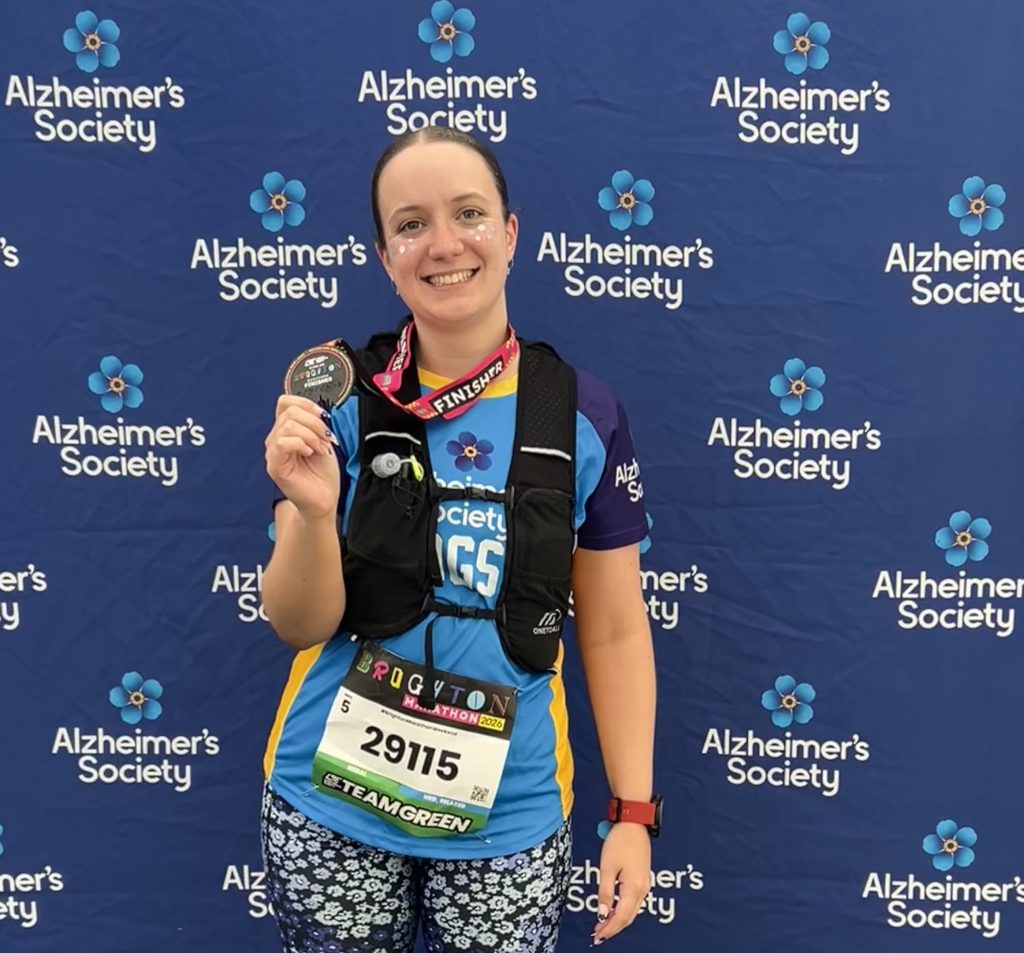
Graduate student Ella (DPhil in Genomic Medicine and Statistics), ran her first marathon this Easter vacation alongside her mum, combining a personal challenge with a cause close to home. Their decision to support Alzheimer’s Society builds on earlier fundraising efforts inspired by Ella’s grandmother’s diagnosis with frontotemporal dementia. Ella tells us more.
What inspired you to take on a marathon in support of this charity?
My mum and I previously fundraised for Alzheimer’s Society back in 2024, when we ran six runs in six months and finished off by running the Great North Run together, a half-marathon. We enjoyed the experience so much that we decided to take on the challenge of running a full marathon together, too!
We initially chose to support Alzheimer’s Society after my Nana was diagnosed with frontotemporal dementia. The work they do with those affected by dementia is invaluable, and they also fund research aimed at finding effective treatments. It feels even more important to be supporting them now that I’ve started a DPhil focused on neurodegenerative disease research.
How have you balanced marathon training with the demands of your course?
Marathon training while working full-time in a lab has meant lots of late-night runs in the dark. I’ve gotten quite good at finding routes with the best streetlights in Oxford!
Do you have a favourite running route in Oxford, and what makes it special?
When it isn’t completely flooded (which I’m beginning to realise is a rare occurrence), I love running from Venneit Close up towards Port Meadow along the Thames Path. It’s nice to pretend you’re out in the countryside, despite still being so close to the city centre.
What advice would you give to someone considering training for their first marathon?
I’m no expert, as this is also my first marathon, but I would definitely recommend following a training plan that includes strength training (your joints will thank you). Plus, don’t underestimate the power of a bit of sugar on a long run – I’ve always got a few jelly beans in my pocket.
What’s your favourite running track when you need a boost?
Hypersonic Missiles by Sam Fender always makes me speed up a little bit.
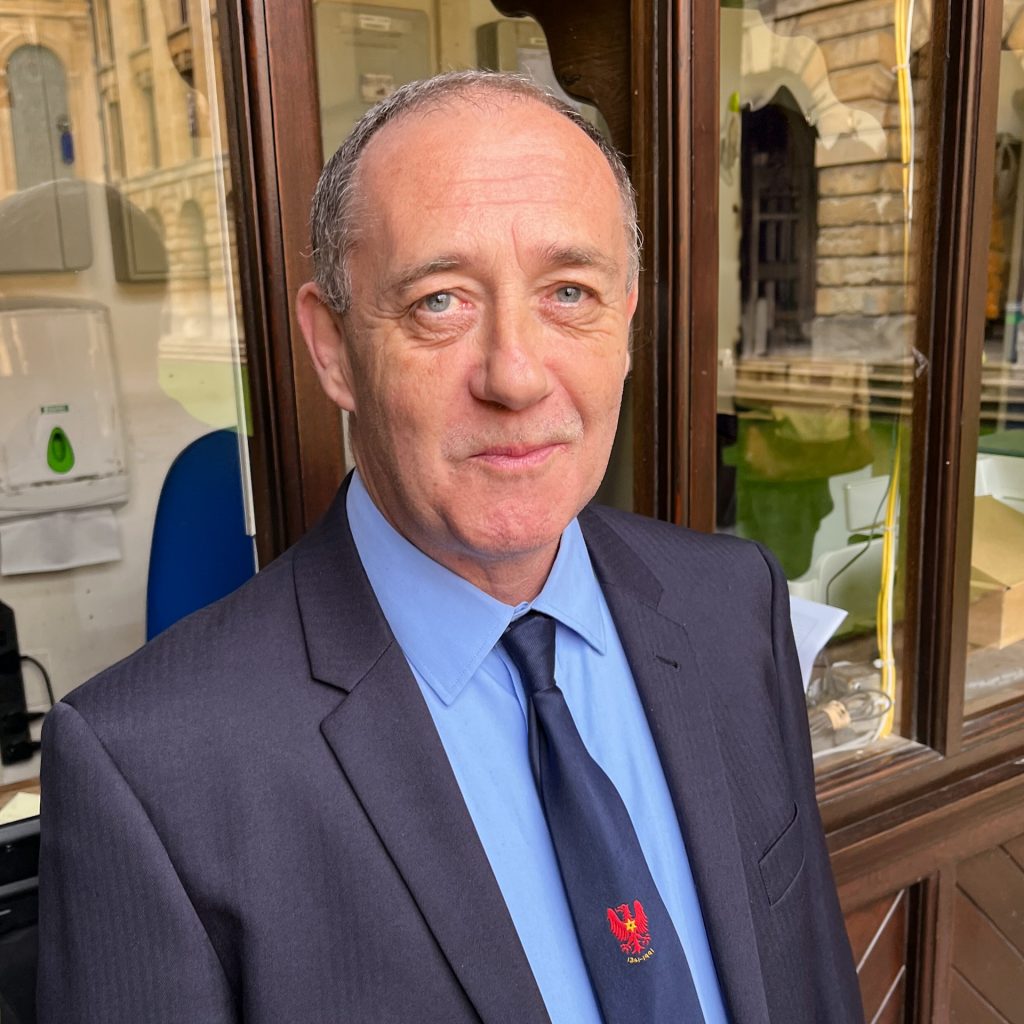
A fond farewell to Sean Meade
After more than 40 years of service, Assistant Steward Sean Meade is hanging up his keys. Having started at the College in 1981 as a sixteen-year-old, Sean has seen the institution evolve from a world of paper tickets and 26p pints to the digital age, all while working as a literal “heavy lifter” of the community.
The First Day: 1981
When Sean first walked up the steps of Queen’s in the summer of 1981, he was greeted with a pile of furniture. Sean recalls:
My first day was spent shifting furniture. I was only sixteen. I remember the filing cabinets: they were full and incredibly heavy. It was a physical start, but it set the tone for a career where no two days have ever been the same.
From those early days, Sean moved into working behind the bar – a part of his job which he remembers with most fondness because of the opportunity it afforded to meet so many different people.
The unseen engine of College life
To many, the College seems to run by magic. But for Sean, that “magic” involves sweat and precision. A typical day involves everything from moving mattresses to setting up lecterns for conferences. He explains:
A lot of what we do in the Steward’s Office happens in the background. Moving paper to offices, setting up the meeting rooms, making sure everything is exactly where it needs to be. If we’ve done our job right, nobody even notices we were there.
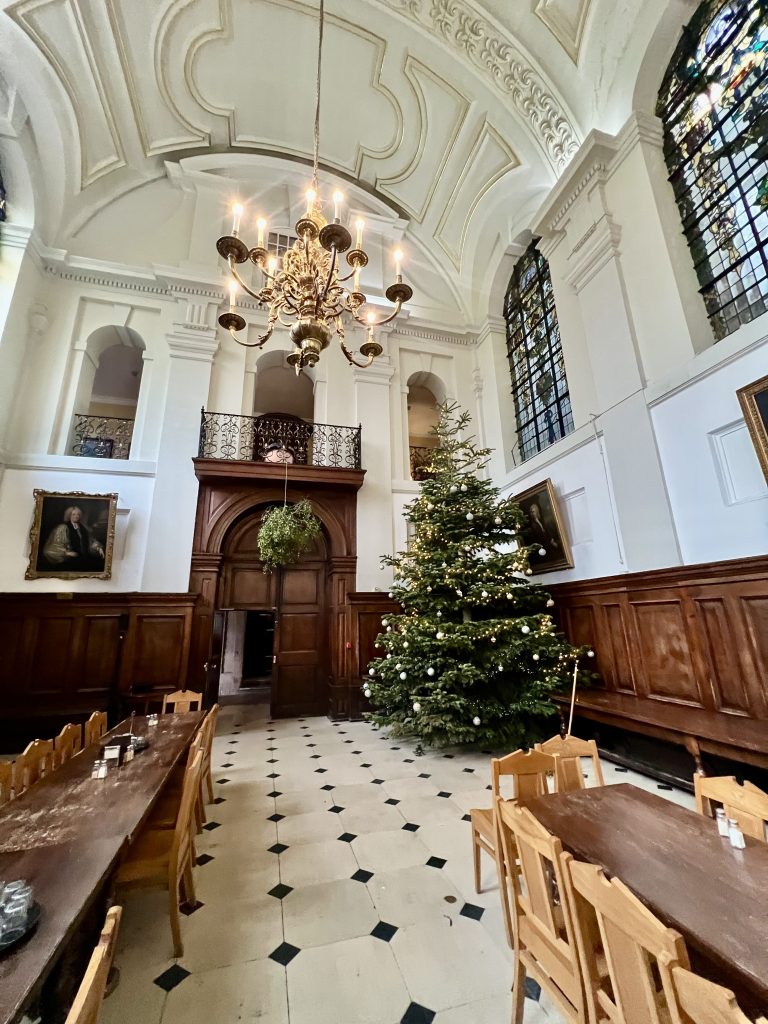
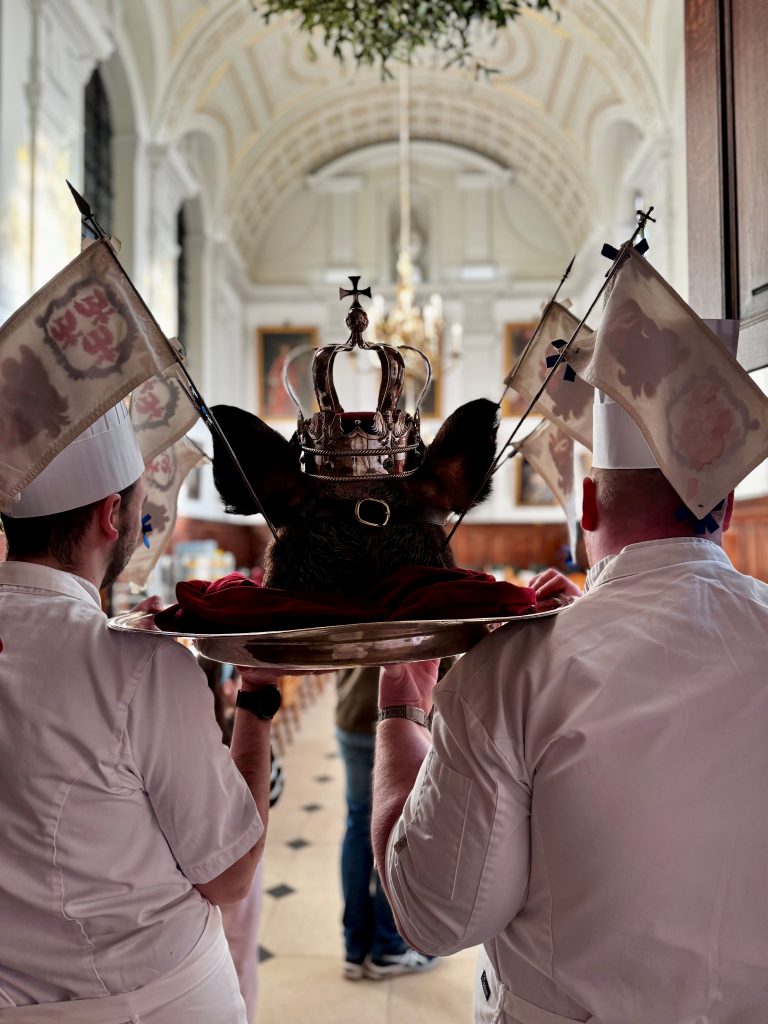
Some of those behind-the-scenes jobs are more festive than others. Sean has been part of the team that manoeuvres the massive College Christmas tree through the front doors, a task that requires six to eight people and a lot of coordination, and he is part of the team responsible for the gold-leaf paint on the trimmings for the Boar’s Head Ceremony each Christmas.
Ducks, tunnels, and hidden spaces
Sean’s role often took him into the “hidden” College. Over 40 years, he has explored the parts that remain a mystery to most: the quiet of the crypt, the winding tunnels beneath the buildings, and the heights of the cupola when raising the College flag.
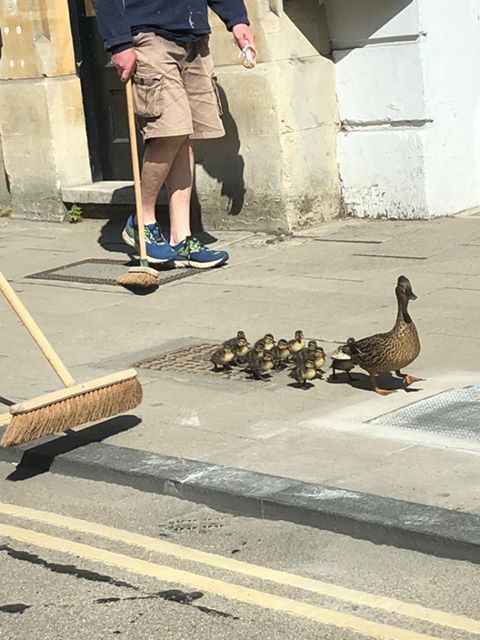
One of his most legendary recurring tasks, however, takes place at ground level. Every year, Sean and colleagues become temporary shepherds for the College’s resident ducks. “We round up the mother duck and her ducklings, and we walk them all the way down the High Street to the river,” Sean says.
The changing face of the College
When Sean first started at Queen’s, some of the tools of the job were unrecognisable by today’s standards. Before computers arrived, everything was done by hand. Sean remembers the days of “purchase tickets”: physical slips of paper students used to pay for their lunch or a beer. He says:
I remember counting out thousands of pounds in cash by hand to prepare the staff pay packets. Back then, a beer was only 26p. The automation has changed everything, except the importance of the people.
For Sean, the social heart of the College was always found during Summer Eights. He fondly remembers heading down to the river to cheer on the rowing teams, enjoying a drink by the water, and catching up with Old Members who would return for the annual cricket match held the same week. “I still meet up with some of those old friends twice a year in Oxford,” he says. “I really look forward to those catch-ups.”

The final flag
One of Sean’s most adventurous duties involved raising the College flag, requiring a walk across the roof.
As he prepares for retirement, Sean is looking forward to trading the College’s grand architecture for his own garden and a slower pace of life:
I’ve seen people wait until they are too old to enjoy retirement. I’m still healthy, and I want to enjoy it while I can. I’ll miss the staff, definitely. It’s been a huge part of my life.
Happy retirement, Sean!
Header photo: David Olds
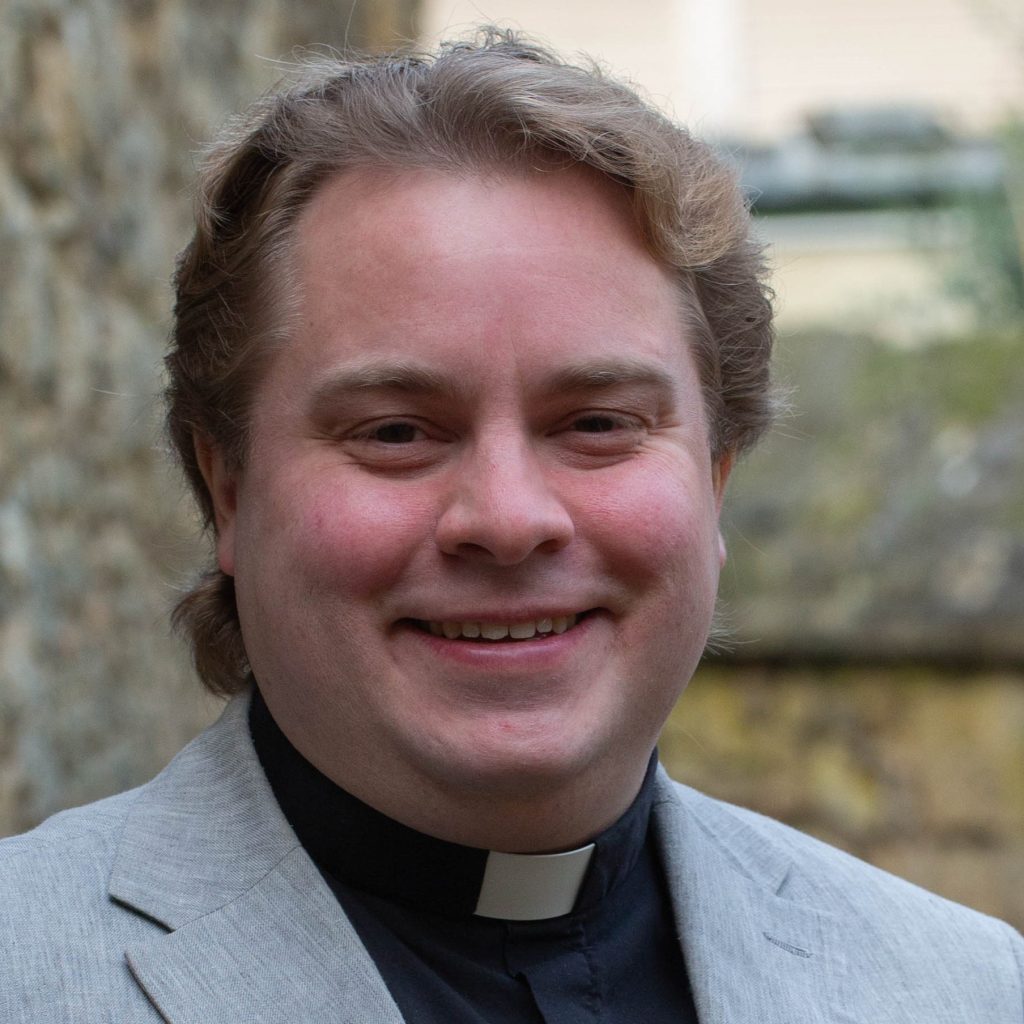
In September 2025, The Revd Liam Cartwright joined Queen’s as our new College Chaplain. At the end of his first term we asked him about his Michaelmas experience, and what he is looking forward to in 2026.
How would you describe your first term at the College, and what has stood out to you the most so far?
It has been a bit of a whirlwind – I hit the ground running with the Old Members’ Evensong and Dinner on my second day in post and the pace didn’t slow until after the Boar’s Head Gaudy!
It’s been great to join in with the rhythms and traditions here at Queen’s. I really enjoyed meeting all the Freshers in October, and my official licensing service was a really special occasion – it was lovely that members of my family, as well as friends and colleagues from various different parts of my life, could join us too.
Much of this term has been spent getting to know people and how the College works. In many ways it’s a very different job to being a parish priest, but I’ve quickly realised that an Oxford college is very similar to a parish in as much as you have a geographical location which is home to a diverse community for whom you have pastoral and spiritual care. I still have much more to learn, but as Hilary Term approaches I feel like I’m starting to get the measure of the place and my role within it.
What have you enjoyed most about joining the College community?
It’s very humbling to be part of a community in which I’m surrounded by such inspiring people – people who are or who aspire to be the brightest and best in their field and with whom I get to interact on a daily basis. I’ve loved getting to know members of the student community – especially the Freshers, the student presidents, the choir, and the welfare reps, and I hope I’ve begun to establish myself as a supportive presence. I’ve really enjoyed the various dinners – whether it’s been meeting Old Members, learning about the lives and work of the academic staff, or chatting with current students, it’s a really enriching part of the job. I also really enjoy the conversations I have with the many dedicated people who enable the College to function on a day-to-day basis, whether it’s by cleaning the rooms, preparing the food, or keeping the site running. It’s striking how many of these people have worked here for very many years, which I think is testament to the sense of wellbeing and community here at Queen’s.
Have there been any particular moments, events, or interactions that have helped you feel settled in?
I’ve found Queen’s to be a place in which it’s very easy to feel at home very quickly. I’ve been really touched by how welcoming everybody has been. The lodge team, academics, and senior officers have made such an effort to get to know me and to help me navigate the College and its systems and traditions, which I think it’s fair to say are sometimes idiosyncratic to say the least!
It’s been helpful starting alongside the new Provost, Domestic Bursar, and others – we’ve enjoyed a great sense of camaraderie as we try to figure out our new environment together! I’m really impressed with the emphasis the College puts on welfare and it’s brilliant working alongside Luke Young, from whom I have already learnt from so much. I’ve especially enjoyed spending time with the student welfare reps who’ve helped me understand the student experience here and respond to it. Owen Rees and the choir put me at ease right from the start and have been so kind and welcoming. After my first evensong one of the choir members told me it felt as though I’d always been here, which was such a positive affirmation. Prior to ordination I pursued a career as a professional organist, choral conductor, and church musician, so it’s a privilege to be working alongside such gifted musicians on a day-to-day basis at Queen’s.
What are you hoping to bring to the role of Chaplain as you continue into the year?
I hope to continue getting to know the community through listening, deepening existing relationships, and forging new ones; being present and building trust; and ensuring that welfare support as well as pastoral and spiritual provision for the whole College is as inclusive, accessible, and effective as possible.
Is there anything you would like the wider college community to know about you or your hopes for 2026?
The most important thing I’d like to reiterate is that I’m here for everyone – whoever you are and whatever you do here, and wherever you are in terms of beliefs – whether you’re a scout, student, domestic, administrative or academic member of staff – I’ll always be happy to see you for a chat and a coffee.
Similarly, the chapel is there for the whole community. There’s no right or wrong reason to come – whether you want some quiet contemplative space, or to attend a concert, or to come to a service – please make use of it whenever you like. My hope is to see the chapel being used for a broader range of events and activities, and that in doing so a more diverse cross section of the community will enjoy it.
We’re incredibly privileged at Queen’s to have one of the best choirs in the world right here in our midst, singing Evensong in the Chapel every Wednesday, Friday, and Sunday evening. Wherever you are on the spiritual journey, it’s a truly wonderful antidote to the busyness of college life – a chance to unwind at the end of the day, perhaps before going to dinner – and to experience world class music and timeless liturgy within the awe-inspiring surroundings of our chapel. It’s an experience unlike any other; please do come along – you can always be assured of a warm welcome.
Dr Matthew Shaw, Librarian
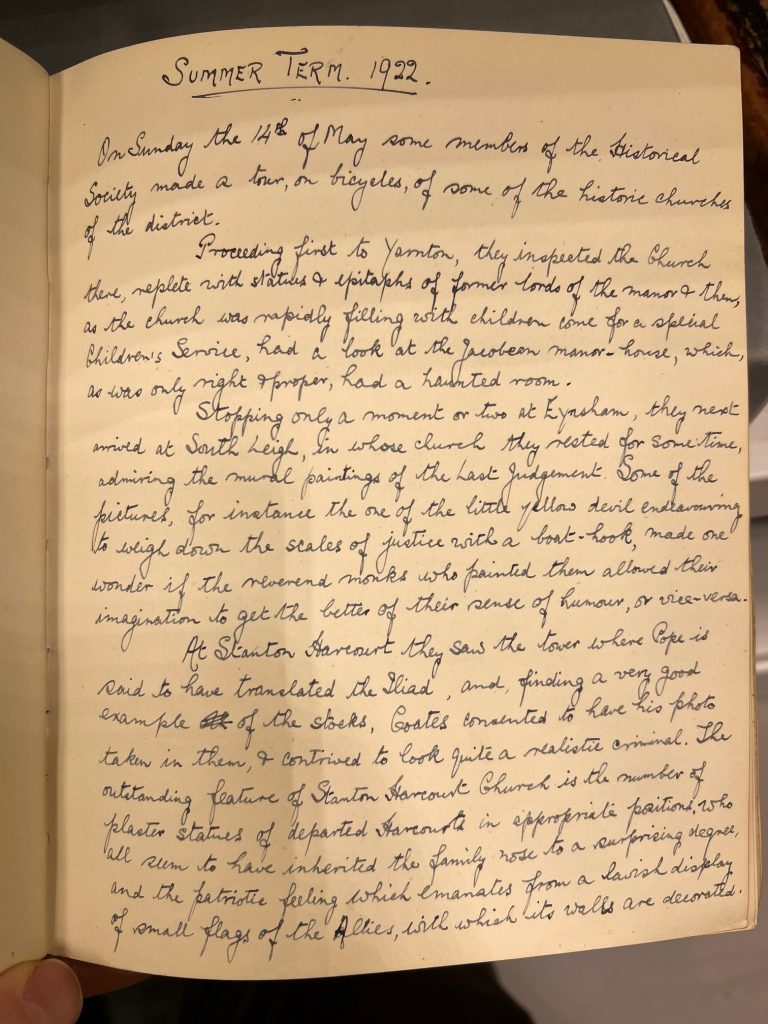
‘On Sunday 14 of May some members of the Historical Society made a tour, on bicycles, of some of the historic churches of the district…’ So begins a record of cycle ride undertaken in 1922 by several members of the College, including the future provost, R.H. Hodgkin (who enjoyed exploring the countryside on both horseback and bicycle; his widow later blamed the exertions on the latter for his blindness in one eye). The account, which can be found in a minute book kept in the Library, details the route from the College, to Yarnton, South Leigh, Stanton Harcourt and Bablock Hythe. Could, I wondered, the route be recreated a hundred years later?
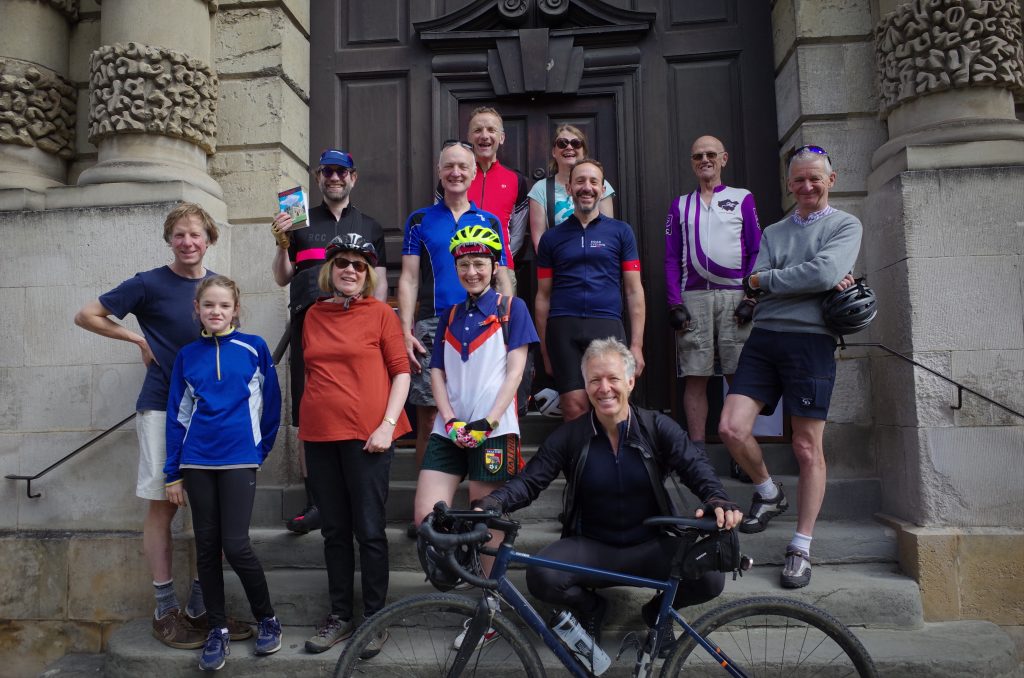
On a sunny and nearly cloudless 11 June 2022, the College provided a positive answer. Marking Bike Week, the recent revival of the Historical Society, and, most importantly, the centenary of the ride, over a dozen Staff, Fellows, Old Members, offspring, friends and partners gathered at 10am in front of the College. There was perhaps more Lycra and carbon than was present in 1922, but a copy of Pevsner was sighted, along with several sturdy steel bikes and woollen jerseys.
The route began with what was probably a variation on the 1922 course, following the canal north to the A44; presumably our precursors took the then-quieter Woodstock Road. St Benedict’s Church in Yarnton offered the first stop. A century after the building ‘rapidly fill[ed] with children come for a special Children’s Service’, today’s parishioners had arranged a flower show, along with a coffee and cake stall. The Rev. Petters was also there, and gave a very brief introduction to the history of the church, the status of the Jacobean Manor House (now being turned into a theological centre, and so we were unable to verify the presence of the ‘haunted room’ identified in 1922), and led the group into the usually closed chapel, with its fine armorial painted glass and tombs of the Lords of the Manor.
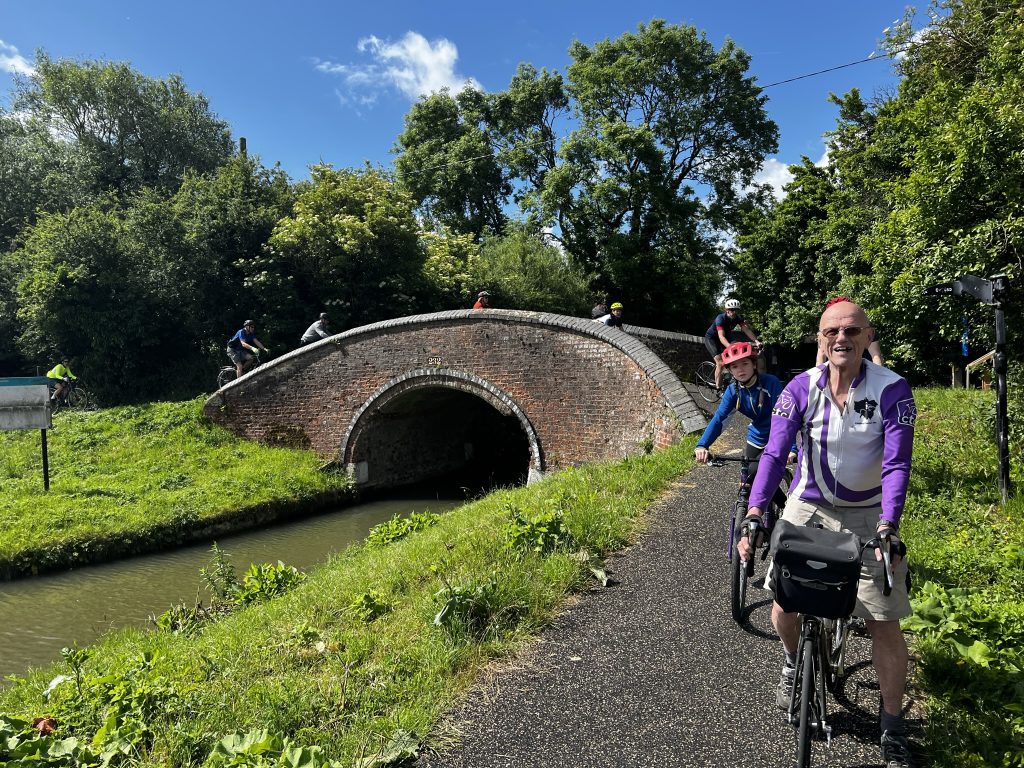
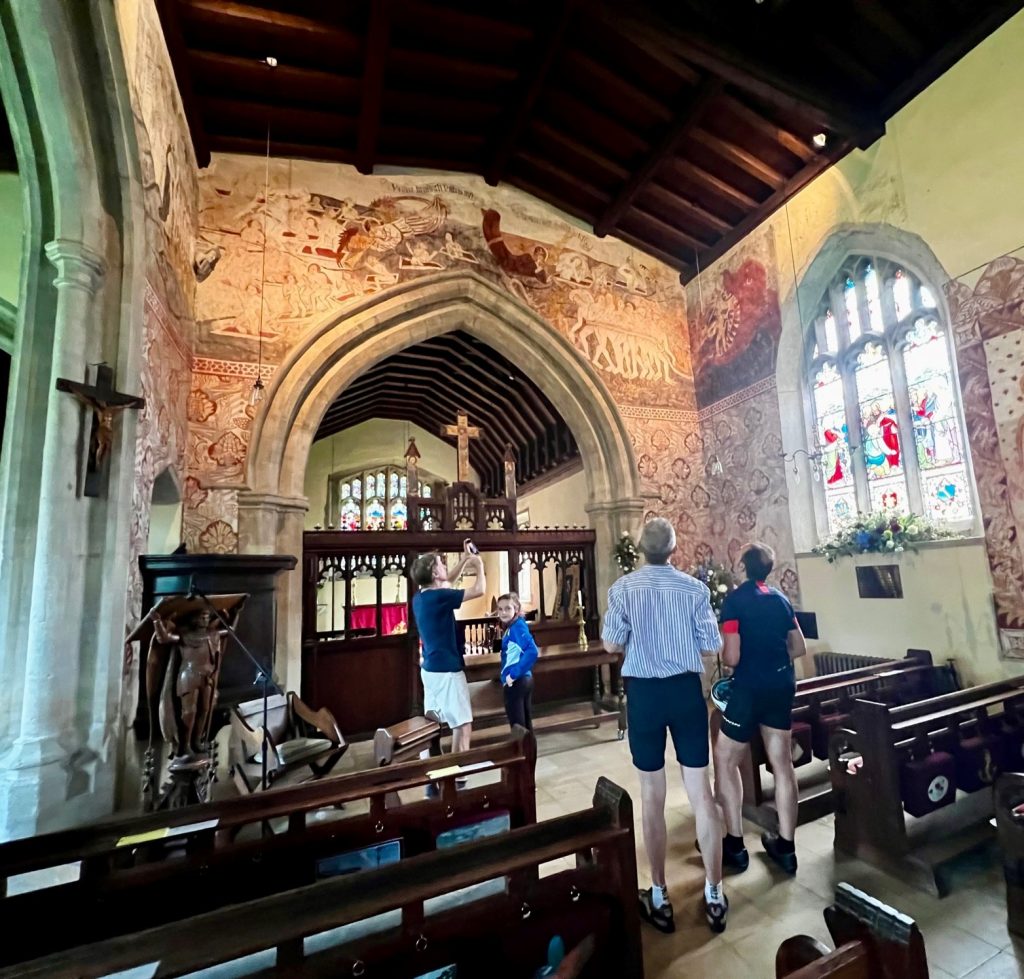
Almost immediately after this stop, came a contemporary addition to the route: Worton Kitchen Gardens. Along with further coffee and cake, some further novelty was unveiled, as Prof. Morten Kringelbach launched ‘Serafina’, a drone camera for an aerial group photograph and video. Supplies for supper were also purchased. Initially, this was to be the end of the ride for those wishing to do a shorter route, but spirits remained high and legs were fresh, so a complete peloton continued towards Eynsham making use of the quiet old road. Just before the town, two participants peeled off, one to attend the launch of a kiln in Wytham Wood. The main group continued via Queen’s Street, noting the Queen’s Head and Queen’s Lane along the way. Heading across country, a bridleway led to South Leigh, which given the imaginative use of bunting and royal mannequins on view had clearly celebrated the Platinum Jubilee with some enthusiasm. A sprint up the hill, and into the church of St James the Great, with its door left open for swallows. Inside, the Doom Painting, restored in the nineteenth century and showing a ravenous hell mouth and enthusiastic devil attempting to weigh down souls as they were weighted impressed the group. Outside, the clock dial offered a warning, ‘Ye Know Not What Hour Your Lord Doth Come’.
Continuing with the theme, an addition to the route: the Devil’s Quoits, hidden alongside a large recycling centre near Stanton Harcourt (Pope’s Tower remained unsighted on this tour; perhaps something for 2122). Partly destroyed during the preparations for an R.A.F. runway during the Second World War and restored in 2008, the Devil’s Quoits are a large Neolithic henge (or stone circle). Seraphina again took flight, leaving no hiding place for terrestrial beings below.
Hunger now became something of concern for the group. Our antiquarian rather than athletic pace meant we had missed the kitchen at the planned stop at a public house in Northmoor. The Ferryman at Bablock Hythe had a similarly closed kitchen, so the decision was taken to refuel on crisps, nuts and other bar snacks, washed down with some shandy while we contemplated the River Thames and the loss of the ferry in the 1960s.
The spot, of course, appears in Matthew Arnold’s The Scholar Gypsy, which references Joseph Glanvill’s The Vanity of Dogmatizing (1661). In preparation, I inspected our copy – a slightly later, second edition (1665). Perhaps anticipating the loss of the ferry, the tale of the scholar gypsy had been edited out. Arnold clearly had access to the 1661 text.
While a couple of wild water swimmers suggested a possible method of crossing the river, we instead headed along the banks of the Isis (with one Old Member making his farewells at this point), crossing at a lock. It began to feel as though we were on the home stretch as we arrived at Appleton, then Cumnor and then via bridle path ascended the heights of Harcourt Hill, and substantial views across the county and city.
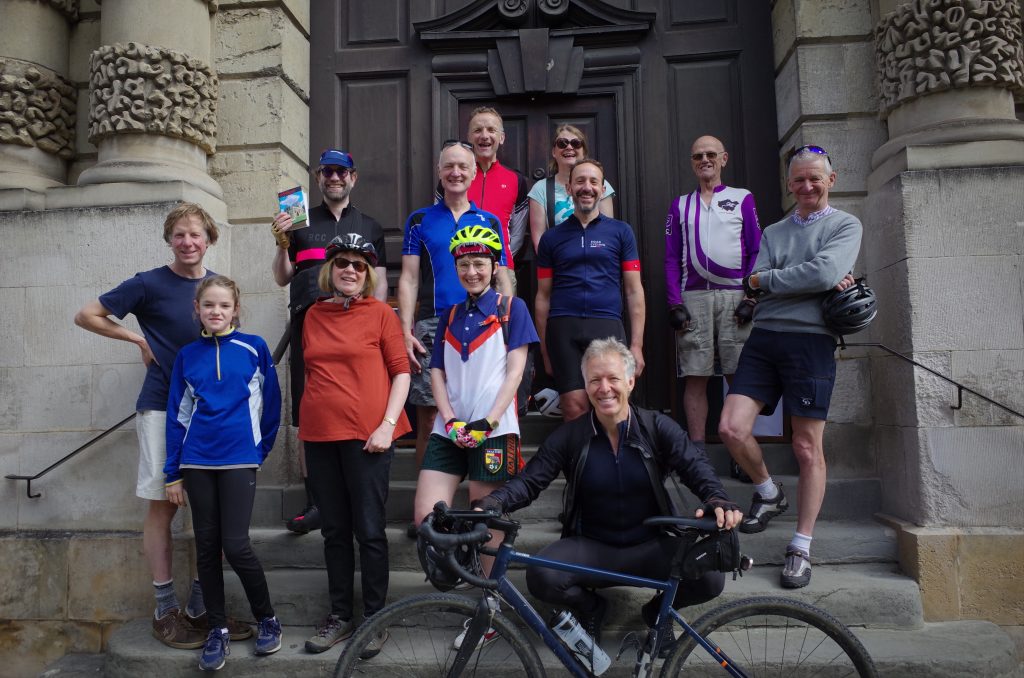
The professional riders of the 2022 Women’s Tour had arrived ahead of us as we descended into Oxford, leaving the city bustling with visitors and cyclists, with some race signs and apparatus appropriately marking the end of the route. Almost at the strike of 4pm, the group returned to the front of College, and then retired for a welcome drink in the Provost’s Garden, sitting almost directly above the vault in which the minute book containing the account of the 1922 ride is stored. Where, we wondered would the College’s peloton go in 2122?