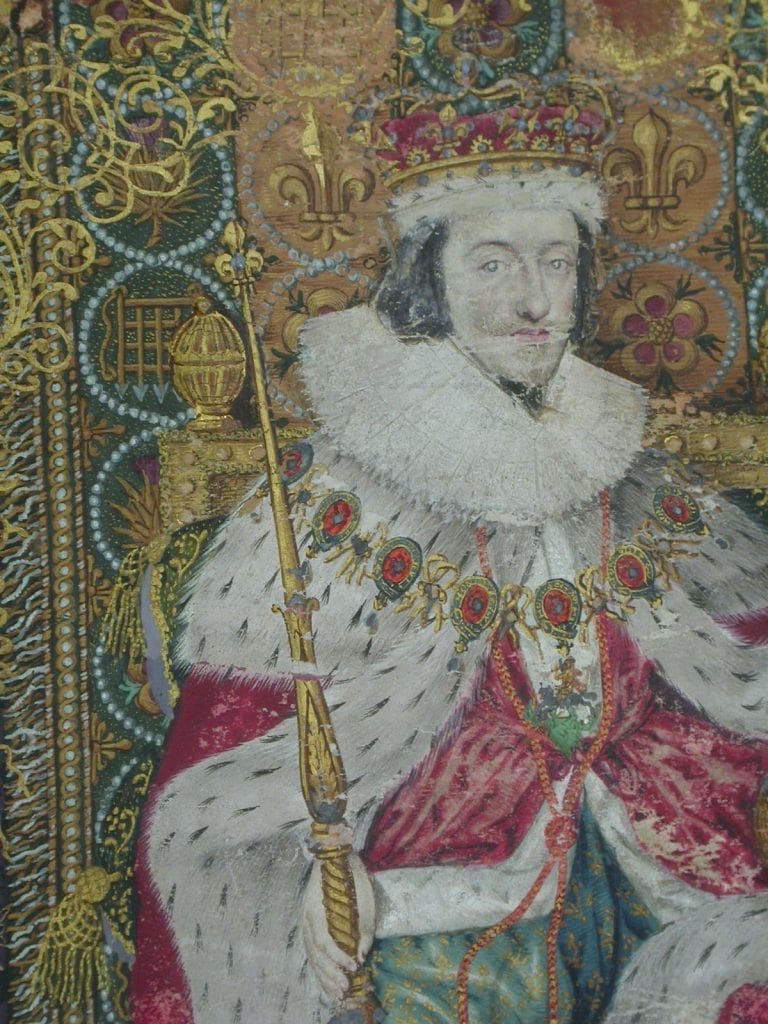
This year is the 400th anniversary of one of the more notable royal benefactions in the College’s history – the gift of six advowsons in Hampshire and the Isle of Wight by Charles I.
In the summer of 1626, the College successfully petitioned Charles I and his wife, Henrietta Maria, for the gift of six advowsons in Hampshire and the Isle of Wight. An advowson is the right to appoint a vicar or rector to a vacant benefice. Instigated by Christopher Potter, who had been elected Provost of Queen’s just a few months earlier, the benefaction was intended to give the Fellows an incentive to leave Oxford and minister to the people – though it didn’t quite turn out as Potter envisaged!
We can piece together the history of the benefaction through various documents and books in the Archive. This exhibition highlights some of the more important of these and the context in which they were created: a fascinating conjunction of college politics, religious anxiety, and desire for royal favour.
2V26: Letters Patent of Charles I, 1626
One of the most beautiful and ornate documents in the Archive is the Letters Patent which Charles I granted to the College on 12 November 1626.
In the document, Charles grants to Queen’s in perpetuity the advowsons of the rectories of Headley, Nighton, and Weyhill, and the vicarages of Milford, Godshill, and Carisbrooke, all in the diocese of Winchester. The College already had extensive estates in the area, most notably at Southampton. The King also states that he expects the College to appoint worthy and learned theologians to the livings. In theory there would always be a large pool of potential candidates from within Queen’s itself, since theology was a mainstay of the University curriculum during this period and the majority of Fellows took Holy Orders. In practice, however, it proved tricky to persuade the Fellows to give up their positions at Queen’s and take up these rather small and impecunious livings away from Oxford.
The Letters Patent is distinguished by several striking physical characteristics. It is a relatively large document, measuring nearly a metre across, and the Great Seal of the Realm is attached to the bottom, giving the document its binding legal force. But the document’s vivid colours and brilliant illuminated decorations are also full of symbolism, bringing additional beauty and meaning to the benefaction conveyed in the text of the Letters Patent itself.
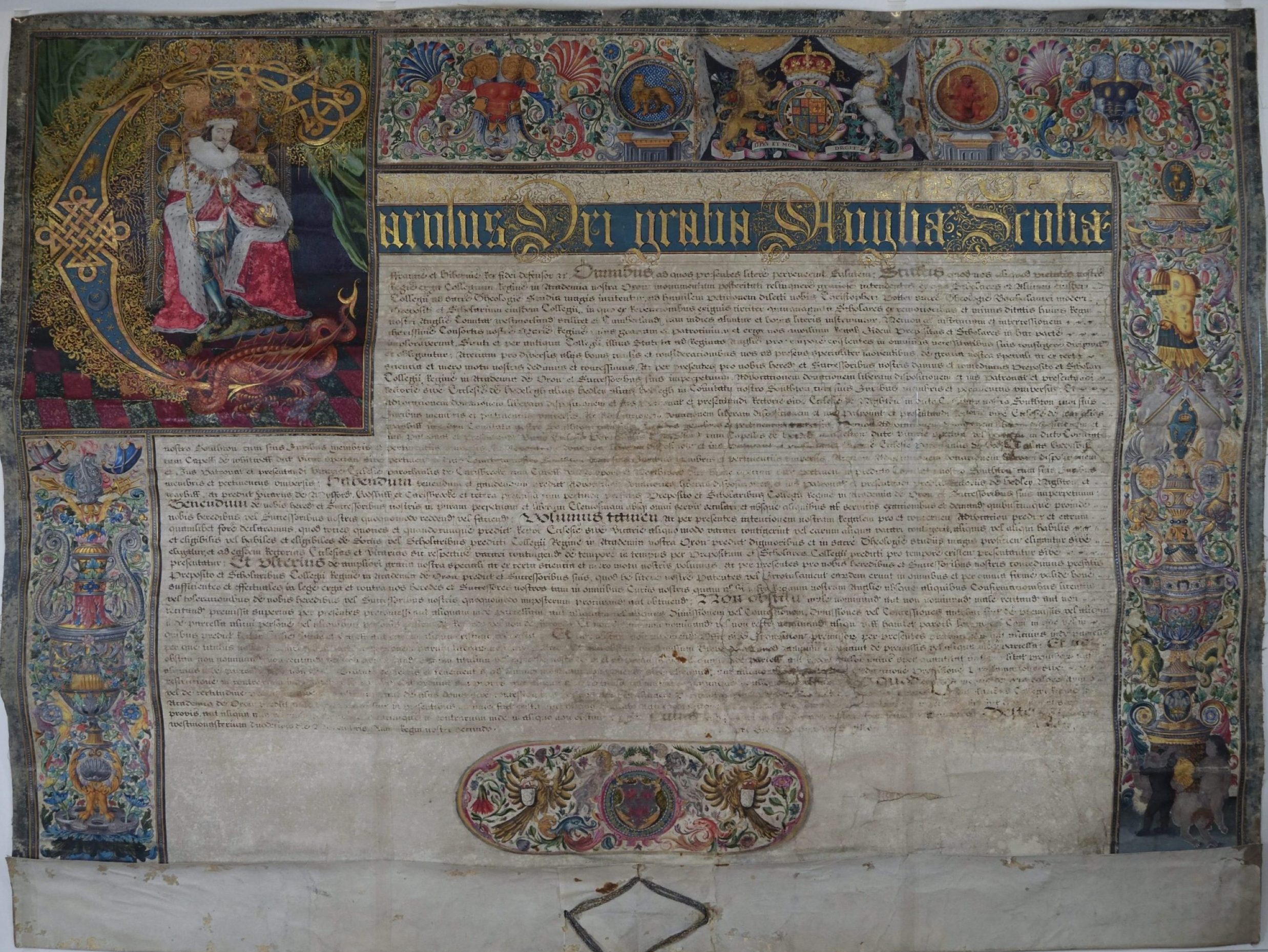
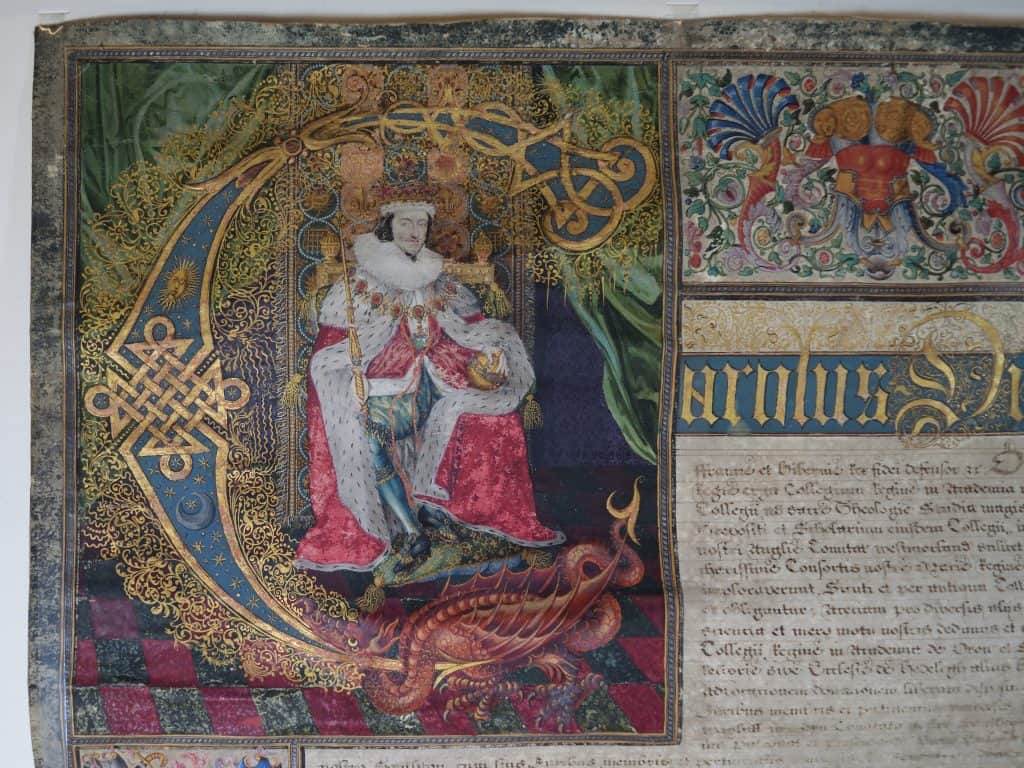
Illuminated initial depicting Charles I
The illuminated initial in the top-left corner of the deed depicts Charles enthroned, surrounded by the traditional symbols of kingship: the crown, and the orb and sceptre. This is a remarkably detailed and lifelike portrait of the King, far more so than those which appear on most other Letters Patent, and it would have cost a lot of money.
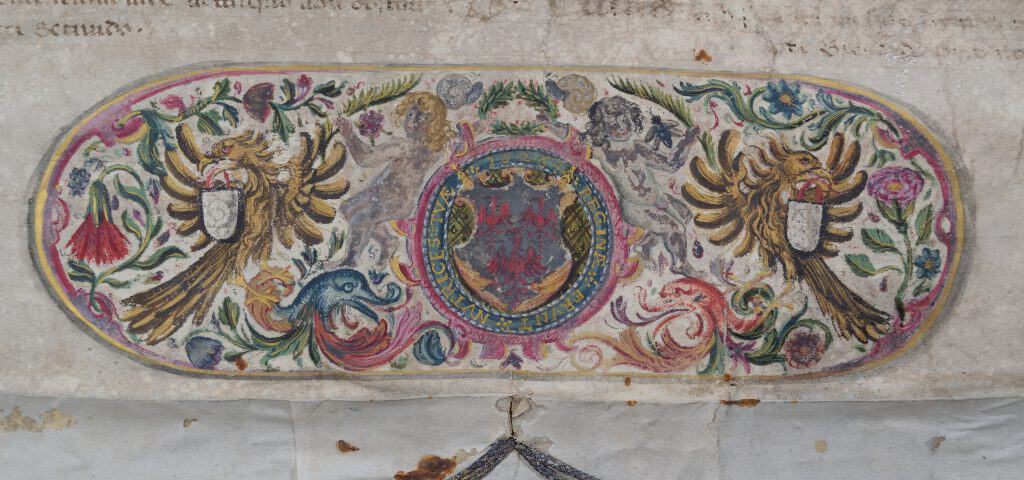
Coat of Arms and Motto
The coat of arms at the bottom of the Letters Patent is that of the College: three eagles on a field, a visual pun on the surname of the Founder (Eglesfield). The coat of arms is encircled by the College’s motto: Reginae erunt nutrices tuae, which translates to ‘Queens shall be thy nursing mothers’. This is the earliest surviving appearance of the motto, derived from the Book of Isaiah. It hints at the College’s growing expectation that its members would remember, and make good upon, the benefits afforded them by their education.
Illuminated initial depicting Charles I
<p>The illuminated initial in the top-left corner of the deed depicts Charles enthroned, surrounded by the traditional symbols of kingship: the crown, and the orb and sceptre. This is a remarkably detailed and lifelike portrait of the King, far more so than those which appear on most other Letters Patent, and it would have cost a lot of money.</p>
Coat of Arms and Motto
<p>The coat of arms at the bottom of the Letters Patent is that of the College: three eagles on a field, a visual pun on the surname of the Founder (Eglesfield). The coat of arms is encircled by the College’s motto: <em>Reginae erunt nutrices tuae</em>, which translates to ‘Queens shall be thy nursing mothers’. This is the earliest surviving appearance of the motto, derived from the Book of Isaiah. It hints at the College’s growing expectation that its members would remember, and make good upon, the benefits afforded them by their education.</p>
These characteristics of the Letters Patent reveal a great deal about how Charles wanted to be seen, especially his desire to convey the enormity of his power: indeed, his ‘divine right’ to rule. But they also hint at the splendid and benevolent light in which Queen’s wished to portray him as a benefactor, all the better to emphasise the magnificence of the gift and the scale of the College’s gratitude.
2S17: Draft Petitions to the King and Queen, 1626
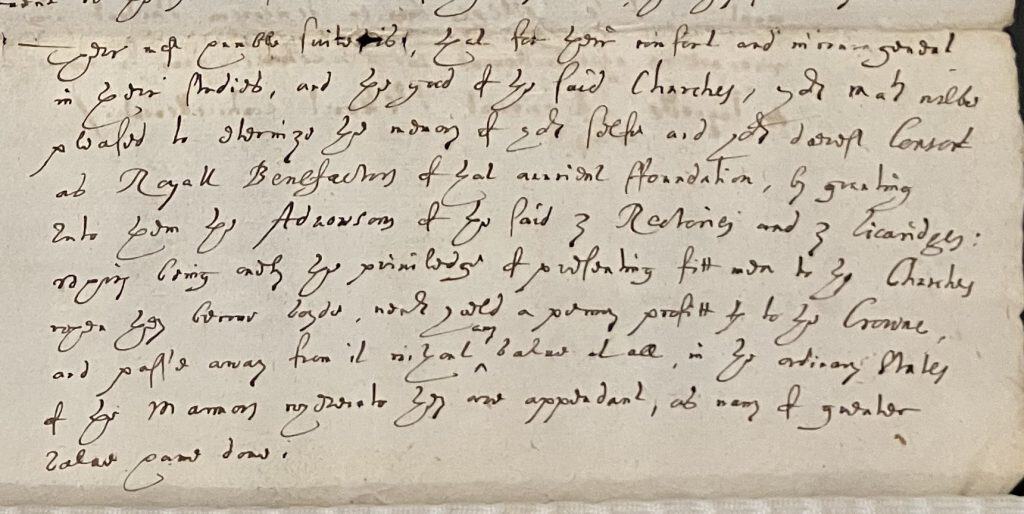
Charles’s bequest was not spontaneous: the College formally petitioned him to make a gift of these six advowsons. This document is a rough draft of two petitions in the hand of the Provost, Christopher Potter, with crossings-out and marginal interpolations. It tells us why Queen’s wanted the advowsons: Potter writes that the College statutes require the Fellows ‘to professe divinity’ and ‘to serve God and your Majesty abroad in the Church’, but that they cannot do this ‘for want of Advowsons’, much to their ‘great griefe and discouragement’. He therefore asks Charles to grant the six advowsons, so that Queen’s can enjoy ‘the priviledge of presenting fitt men to the Churches’. In short, Potter cast his plea for advowsons as an act of genuine piety.
The document also contains a draft of a second letter. It addresses Charles’s wife, Henrietta Maria, and asks her to support the College’s petition for the advowsons. Written in her native French, this petition reminds Henrietta Maria that Queen’s had been founded with the support of another Queen Consort – Philippa of Hainault, wife of Edward III – and asks her to show similar favour to the College by interceding with her own husband.
Register H: Royal Petitions, 1626
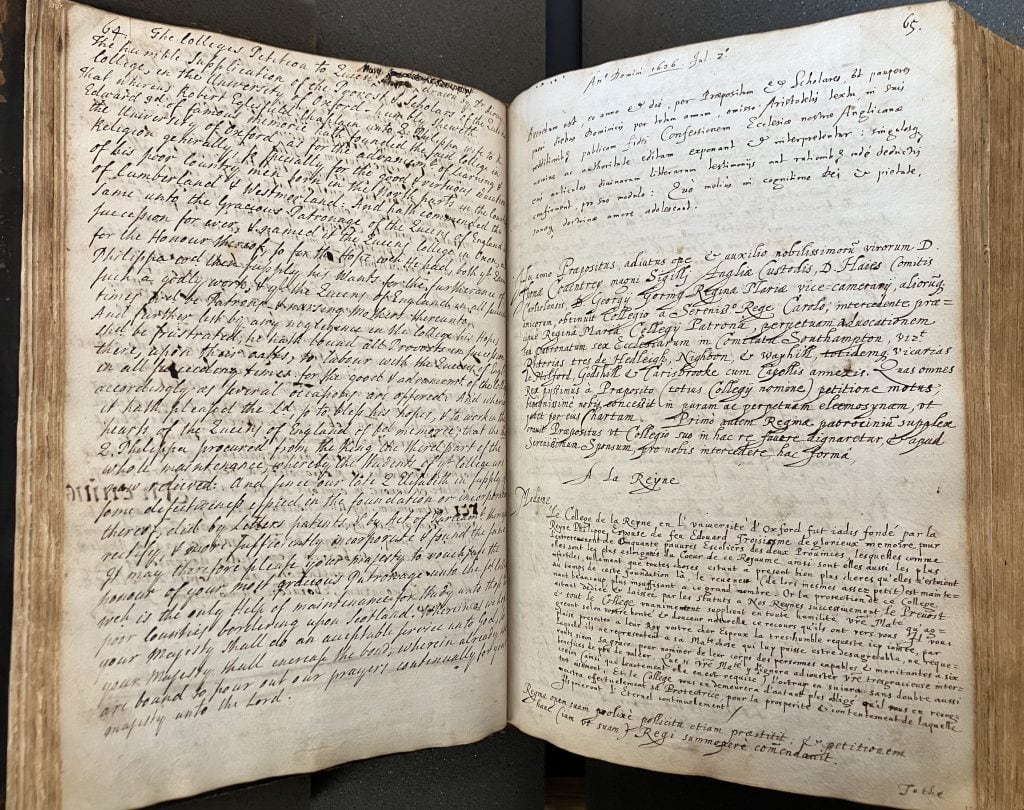
As well as being sent to Court, both royal petitions were also copied into the College Register. From the 1570s onwards, the Governing Body kept a Register as a memorandum book of all the important decisions they took.
The entry in the Register which immediately precedes the two petitions describes the events surrounding the benefaction in terms which emphasise the intercessory role played by Henrietta Maria. The College clearly wished to cast her in the same role as previous Queens Consort who – like Philippa of Hainault – interceded with their husbands to secure gifts and patronage. In a direct reference to the College’s new motto, the petition to Henrietta Maria beseeches her to act as a ‘patron […] and nursing mother’ to Queen’s.
On the opposite page of the Register, there is further evidence of this self-conscious tradition of queenly intercession. Copied into the Register is the letter to Henrietta Maria in which she was invited to become Patroness of the College. Not only does the letter set out the Patroness’s role in greater detail, but it also shows the letter to Henrietta Maria was based on one sent to her predecessor, Anne of Denmark, whose name is crossed out at the head of the page.
LRA: Accounts, 1605-6
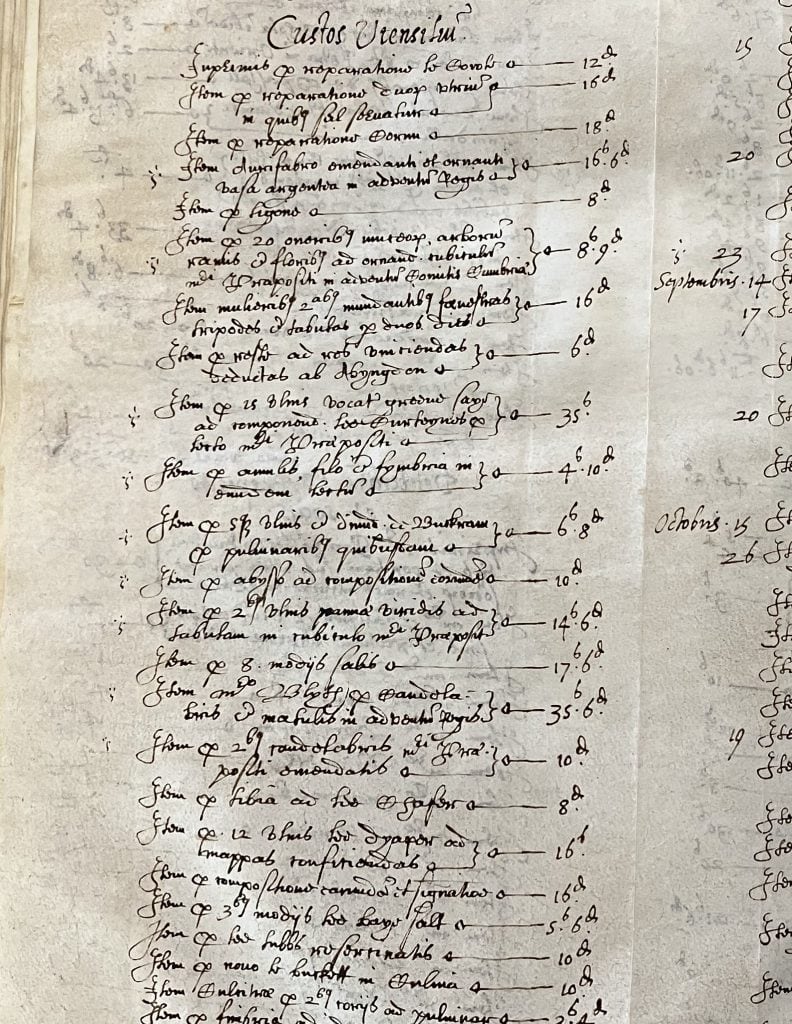
‘Item: For the repair and ornamentation of a silver vase for the King’s visit (Item Aurifabro emendanti et ornanti vasa argentia in advotum Regis), 16s 6d.
‘Item: For twenty branches of rushes from various trees and flowers to decorate Mr Provost’s chamber for the visit of the Earl of Cumberland (Item pro 20 oneribus iunceorum arborum variis et floribus ad ornandum cubiculum Magistri Praepositi in adventum Comitis Cumbriae), 8s 9d…’
‘…Item: For 15 ells of what is called ‘green saye’ to make curtains for Mr Provost’s garden (Item 15 ulvis vocatus greene Saye ad componendum [?] Curteynes pro horto Magistri Praepositi), 3s 1/2d.
Item: For all the twine and borders in each and every garden (Item pro omnibus filo et fymbria in omnium omne hortum), 4s 10d.
Item: For five and a half ells of buckram for some cushions (Item pro quintus ulvis et dimidi de Buckram pro pulvinaribus quibusdam), 6s 8d.
Item: For making a hole to be used for a commode (Item pro abysso ad compositionem commode), 10d.
Item: For two ells of green cloth for the table in Mr Provost’s chamber (Item pro duobus ulvis pannam viridis ad tabulam in cubiculo Magistri Praepositi), 14s 6d…’
‘…Item: For Mr Blyth for candleholders and candle-pots for the King’s visit (Item Magistro Blyth pro candelabris et matulis in adventum Regis), 3s 6d.
Item: for the repair of two of Mr Provost’s candleholders (Item pro duobus candelabris Magistri Praepositi emendatis), 10d.’

‘Item: For the purchase of two pairs of gloves for the most serene Queen (Item deliberatum pro duobus paribus chorithecarum [sic] Serenissimae Reginae), £14 10s‘
Other archival records support the theory that the College had previously tried to seek Anne of Denmark’s patronage, although we have to look very hard to find a record of the benefits she brought to Queen’s – probably because they were few and far between!
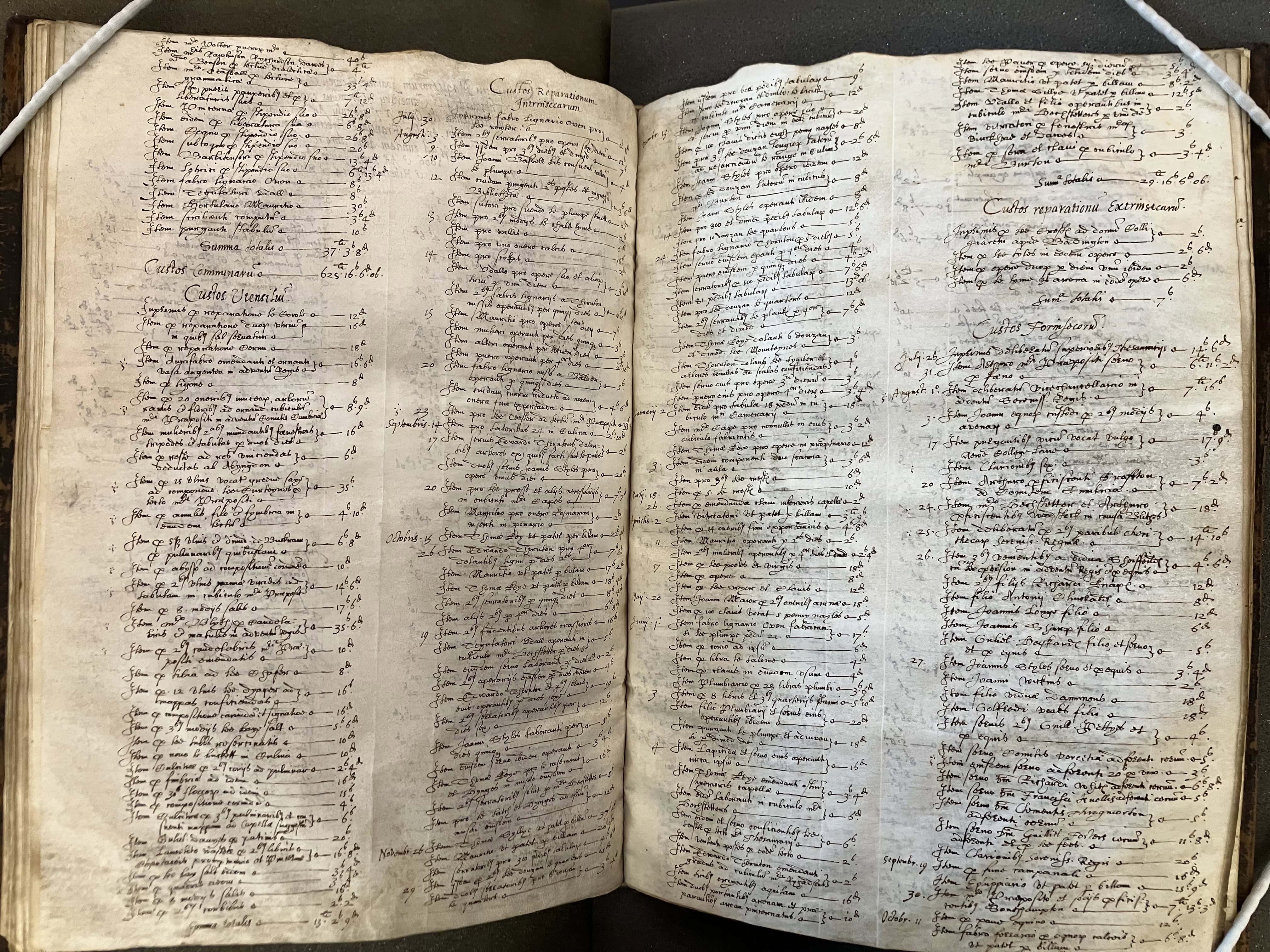
As Register H shows, the College invited Anne to become Patroness shortly after her husband, James VI and I, succeeded to the English throne. The College went to considerable expense to impress Anne and her retinue during a royal visit to Oxford in the summer of 1605. This book, which contains the annual accounts, records some of these expenses in more granular detail.
Among other expenses, the College paid £14 10s for two pairs of gloves that were presented to Anne; and £1 13s 4d for a tester and 3s sixpence for ‘green saye’ for the Provost’s bed, plus 8s 9d for twenty branches of different trees and flowers to decorate the Provost’s chamber, where the Earl of Cumberland stayed during the visit. They also record that 10d was spent on the digging of a hole for a new commode, perhaps to accommodate the much higher number of people in College during the visit. All of the costs associated with the royal visit are distinguished by a small mark in the margin, so they are easy to spot.
Despite going to such trouble and expense, it seems Queen’s received relatively little from Anne in return. Nonetheless the experience did not deter Potter and the Fellows from approaching her daughter-in-law Henrietta Maria two decades later.
5. 2T63: Letter from Provost Airay to Bishop Robinson, 1615
As Potter emphasised in his petition to Charles, the College statutes envisaged that Queen’s would serve as a kind of seminary for poor young men. The College would provide the theological education required to teach and preach in rural communities far away from Oxford, not unlike those from which most of the students themselves came.
These high aspirations were not always realised. Although many students took Holy Orders, many others considered a life of scholarship in Oxford to be more alluring than the prospect of Christian ministry. Either way, there were neither enough Fellowships nor enough livings to meet demand, and the College struggled to strike a balance between those who wanted livings and those who wanted to stay at Queen’s.
The problem also affected the Fellows, many of whom retained their fellowships far longer than the handful of years which the statutes envisaged. This created a bottleneck for prospective Fellows, who sometimes waited several years for the opportunity to progress. To mitigate the problem, Queen’s had begun acquiring livings and advowsons during the Provostships of Henry Robinson (1581-98) and Henry Airay (1598-1616). Both men were enthusiastic educational reformers and keen proponents of the idea that the Oxford colleges should train up ‘painful preachers’ to minister to congregations across England.
‘But knowing, that what they do procedeth “ex amore caeca habendi”, without regard of posterity, and that what I do procedeth from an honest desire to discharge a good conscience and to show such love unto posterity by some addition of revenues, or benefices, as our goodly predecessors showed unto us… I do resolve rather to endure whatsoever murmurings and gainesayings than to yield to buy me dividends…’
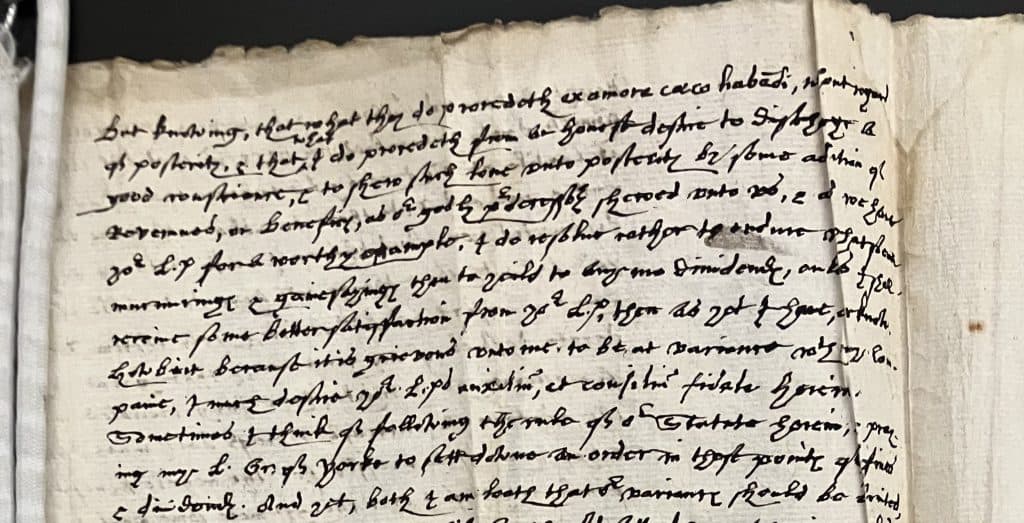
This letter, sent by Airay to Robinson after the latter became bishop of Carlisle, complains that the Fellows preferred to pay themselves dividends from the common chest, rather than to support poor students or purchase more livings. It is clear from the letter that not all the Fellows agreed with Airay, and that he found it hard to resist their refusal to put the funds aside for other purposes.
6. 2T67: Letter from the Fellows to the Visitor, 1626
Of course, the Fellows had their own views about Airay’s complaints: doubtless many of them would have challenged his rather unflattering accusations of greed and self-interest. Indeed, it appears that some of them genuinely aspired to be elected to a living — though perhaps not always for pious reasons.
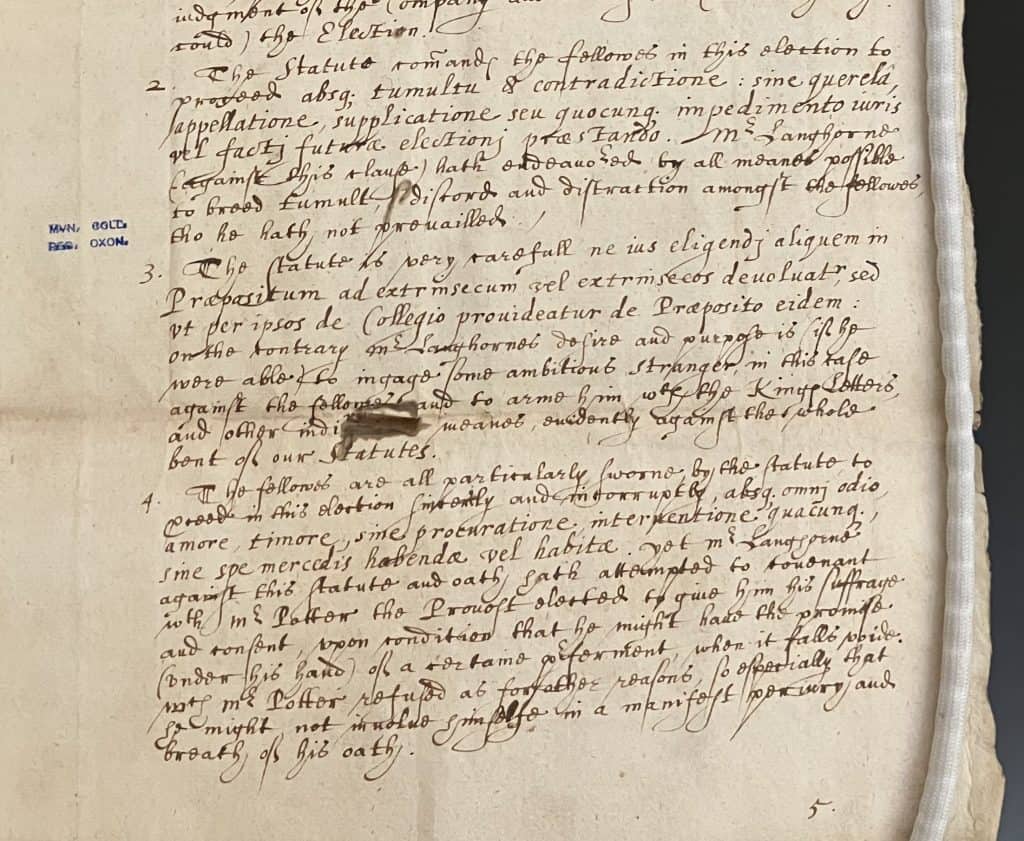
Thirteen Fellows wrote this letter to the Visitor, the Archbishop of York, shortly after they had elected Christopher Potter to be Provost in the summer of 1626. They ask the Archbishop to intervene in a dispute between them and the fourteenth Fellow, John Langhorne, whom they accuse of attempting to derail Potter’s election by failing to appear to cast his vote. They also accuse Langhorne of more serious charges: stealing money from the common chest for his own ‘illicit purposes’, and trying to bribe Potter by offering his vote in exchange for preferment to one of the College livings.
It is unclear whether Langhorne was actually guilty of these crimes, although this letter implies that some Fellows did regard a few of the College’s livings as relatively desirable: to the point that it might have been worth bribing the Provost to secure one of them!
7. 2R46: List of Hampshire Livings in the King’s Gift, c.1626
The Langhorne case also indicates that the Fellows tended to regard some of the College’s livings as more desirable than others – and a living’s projected income was an important consideration!
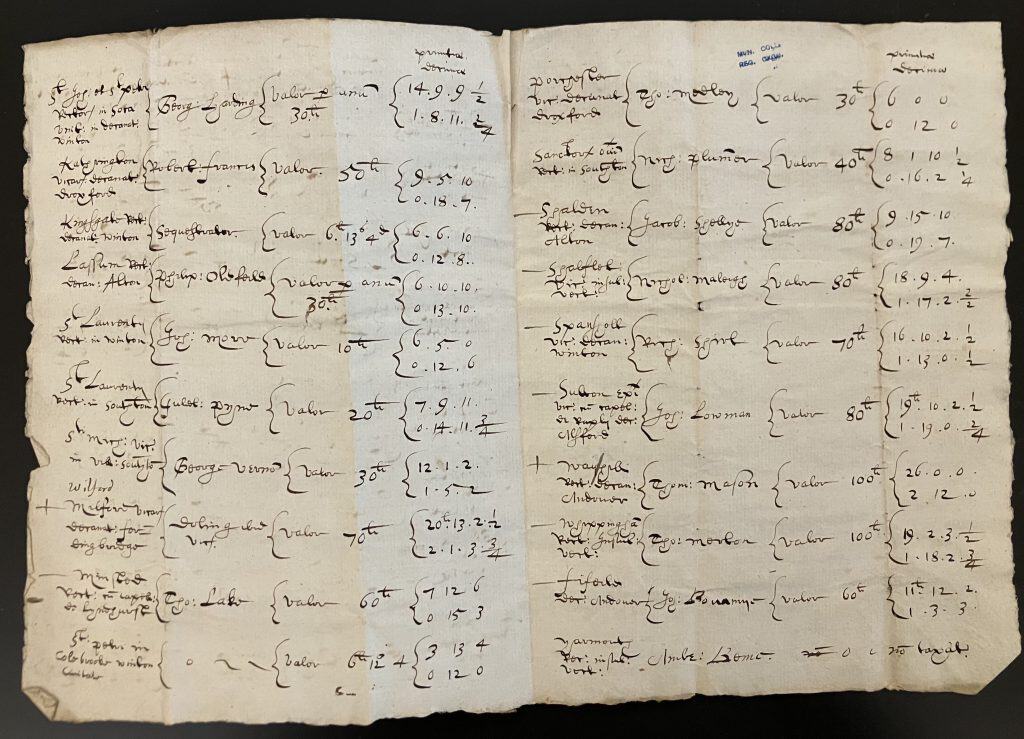
When Christopher Potter petitioned Charles in 1626, he specified which livings the College wanted – Headley, Nighton, and Weyhill; and Milford, Godshill, and Carisbrooke. The request made sense: the livings were all located in Hampshire and the Isle of Wight, where the College already held fairly substantial estates. But this list shows how carefully these six were chosen: it includes all of the Crown’s livings in Hampshire, alongside the value which they had been assigned in the Valor ecclesiasticus of 1535. It also lists the taxes (known as ‘First Fruits and Tenths’) owed by the incumbent in the first and subsequent years.
Potter did not choose the six most valuable benefices – perhaps he worried that this would make him appear greedy – instead opting for those in the middle of the range. Nonetheless he wrote to Charles that he was satisfied that each of these would be enough to support a former Fellow.
8. 2S22: The King’s Answer, 1626
The Letters Patent is the instrument by which Charles officially granted the six advowsons to the College, but we should remember that it was the culmination of a much longer bureaucratic process. It wasn’t the case that the College asked, and the King granted at his leisure. This letter is a further reminder of the bureaucracy involved: it was sent to the College by Edward Conway, the Secretary of State, who wrote on the King’s behalf.
‘His Majesty is pleased to grant you upon the motives above mentioned, not intending that any other shall make it into example to importune his majesty to depart with others of his advowsons, which his Majesty holds fit (except in this particular case) to retain in his own hands for the preferment of religious and learned churchmen.’
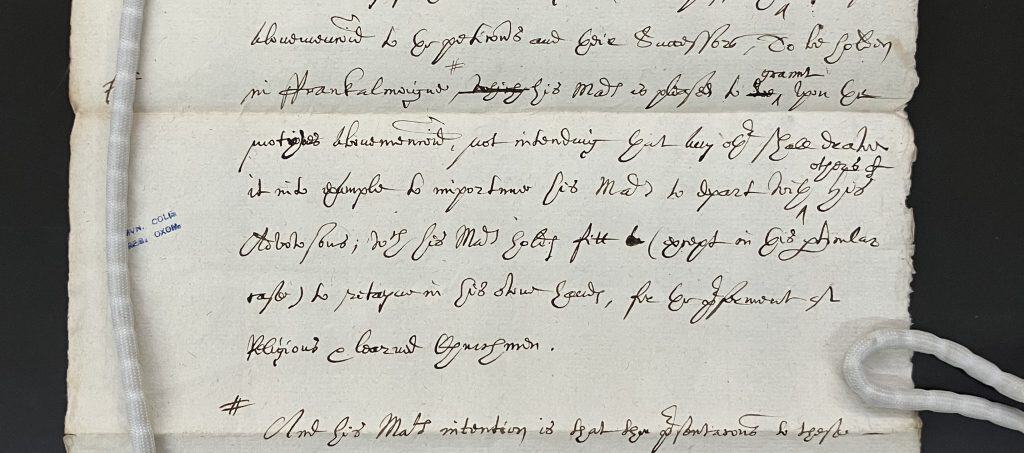
Conway notes that Queen’s was to hold the advowsons in frankalmoign – that is, in perpetuity and on the condition that the College would always remember Charles in its prayers. He also carefully stipulates that, while ‘His Majesty is pleased to grant you upon the motives above mentioned’, nonetheless the King had no intention that ‘any other shall make it into [an] example to importune His Majesty to depart with others of his advowsons’. In other words, Conway rather sternly reminds Potter not to expect any further favours from the King!
9. Christopher Potter’s Memorandum Book, 1626-46
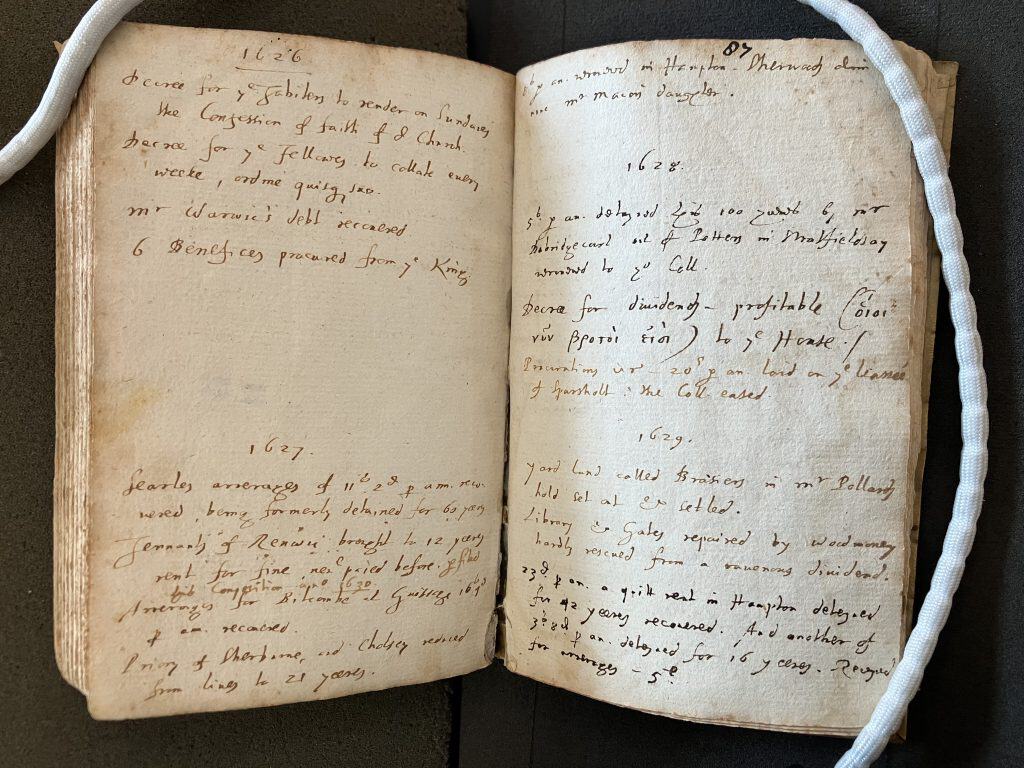
This little book belonged to Christopher Potter, and contains his notes and other personal memoranda concerning all manner of issues relating to the management of the College and its estates. It gives some idea of the range and scale of the work which Provosts had to do to ensure that Queen’s was properly managed.
In the latter pages, Potter records the most important events to have taken place during each year of his Provostship. Naturally, the royal benefaction made his list for 1626. Other highlights from that year include the decision to cancel a longstanding bad debt, as well as the decision that the Fellows should meet every week. These were just some of the wide variety of matters in which the Provost was required to interest himself.
While ostensibly the benefaction was sought ‘in the name of the whole College’, nonetheless Potter’s personal role should not be downplayed. He was already an influential figure at Court, having served as a chaplain for the Earl of Coventry; and he later served in the Chapel Royal as one of the King’s chaplains, in which capacity he spent each summer at Court preaching and dispensing religious guidance. He was undoubtedly a devout man who, like Robinson and Airay, sincerely believed in the importance of educating preachers and ministers to serve communities across England. The benefaction allowed him to pursue this mission, while also providing a gift with long-term benefit for Queen’s.
10. 2T90: Letter from Henrietta Maria, 1639/40
It might be wondered why the College expected Henrietta Maria – a young, French Catholic who was only newly arrived in England – to show an interest in improving the quality of Anglican preachers and ministers in rural Hampshire. In theory, she interceded with Charles in exchange for being remembered evermore in the College’s prayers; and it is certainly true that Queen’s upheld this side of the bargain. In practice, however, the Queen also expected far more prosaic compensation for her help, as this letter shows.
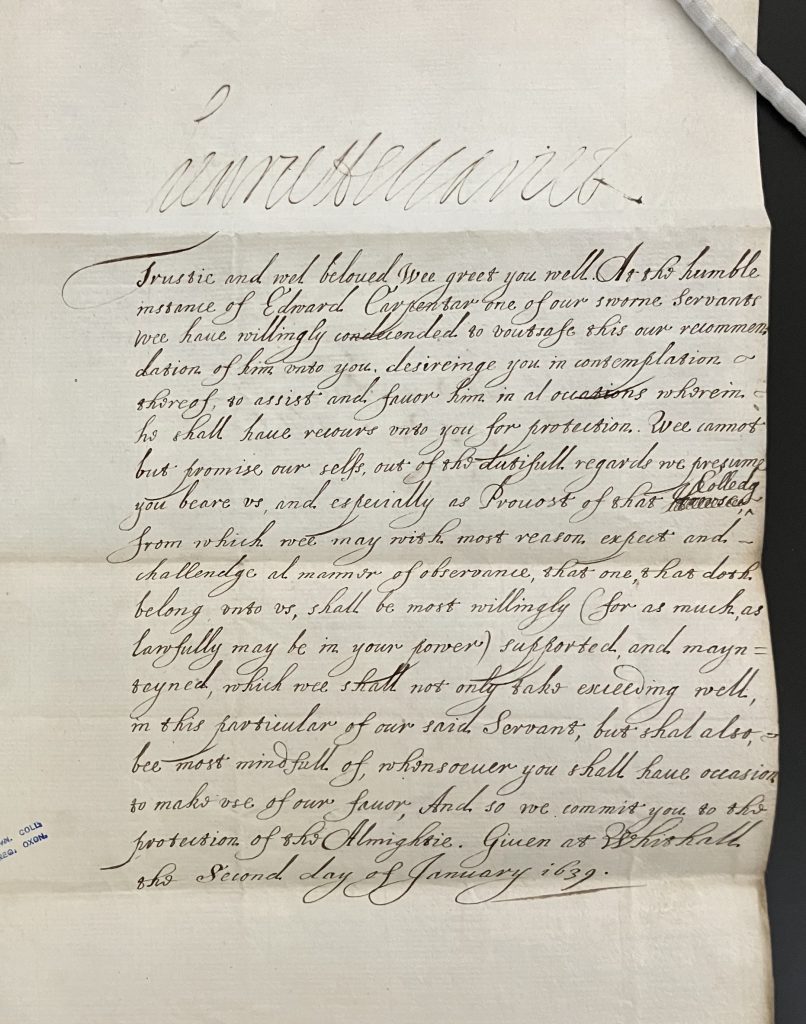
More than a decade after Charles granted the six advowsons, Henrietta Maria writes to ask Potter and the Fellows ‘to assist and favor’ her ‘sworne servant’, Edward Carpenter, whenever he might ‘have recours unto you for your protection.’ It is not clear why Carpenter should have needed to make such recourse, nor whether he ever did. But Henrietta Maria takes care to emphasise her special affection for Queen’s, and to underscore the reciprocal benefit that she and the College could enjoy from their relationship.
11. 2V29: The Benefactors’ Prayer, c.1626
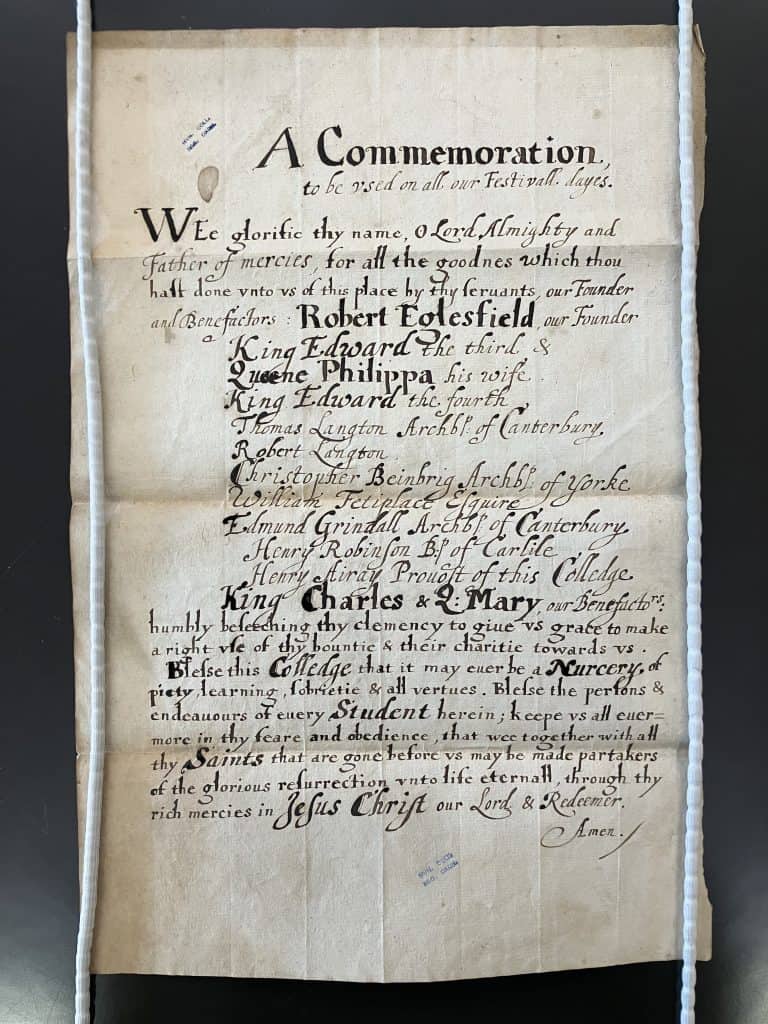
Both Charles and Henrietta Maria sought to be recompensed in a more traditionally religious sense, too, and Queen’s was careful to fulfil that part of the bargain. This final document is a seventeenth-century copy of the Benefactors’ Prayer. As the name suggests, the prayer commemorates the men and women whose gifts to the College have contributed most significantly to improving its fortunes.
While the document is undated, we know it was written only a short period after the benefaction of 1626 – most obviously because it lists the benefactors’ names in chronological order, and Charles and Henrietta Maria appear at the bottom of the list as the two most recent. Their names are written so that they appear larger and more prominent than those of other benefactors, suggesting that the document was created to draw attention to their recent largesse.
The document itself is a bit of a mystery. It is quite elaborately designed and may have been intended for public display somewhere in the College. However, there are no obvious signs that it has been affixed to a surface, and it is in remarkably good and clean condition. No matter whether it was created for a practical or ceremonial reason, it shows that Queen’s kept the promise which Potter had made in his initial petitions to Charles and Henrietta Maria: that the College would continue to remember them in its prayers.
Assessing the King’s Gift
This exhibition has spoken relatively little about the advowsons themselves, and this is because most of them have left far less of an impression in the College’s records than the benefaction itself: Potter’s strategy of seeking out livings of fairly middling value was, perhaps, a little too successful! In fact, by 1626 several of the livings had already declined in value since they were assessed during the 1530s, and within just a few decades the six Hampshire advowsons were among the least desirable of those held by Queen’s. We know this because they were often turned down by each of the Fellows in turn, and eventually offered up to candidates who had no prior connection to the College.
Yet the benefaction itself is still worth remembering, not least because it generated the beautiful Letters Patent which is now one of the Archive’s most striking objects. Granted just a few decades before the Civil Wars, when Queen’s emerged as one of the wealthiest and most secure of all the Oxford and Cambridge colleges, the benefaction provides unparalleled insight into the way the College was run during a period of great transition. Still governed by medieval statutes which emphasised the importance of theology and religious learning, the College hungered for growth and stability, to which end it increasingly looked towards London and the wealth, power, and influence to be gained at Court.
Finally, the benefaction provides insight into the rather remarkable man whose idea it appears to have been: Christopher Potter. A devoutly religious man in the mould of the College’s founder Robert de Eglesfield, as well as his more immediate predecessors Henry Robinson and Henry Airay, nonetheless Potter was a deeply pragmatic head of house. The benefaction of 1626 shows both his diplomacy and his ambitions for the College: he was a learned man who knew how to be the administrator of a thriving urban community; a churchman who sought worldly influence in royal circles; and a diplomat who knew how to balance the interests of his role as Provost with the in-fighting and petty jealousies of the Fellows. All of these qualities make him a strong candidate to be described as the first modern Provost of Queen’s.
Explore more of our exhibitions
War Memorial: an exhibition

Perception: an exhibition
‘From the author’