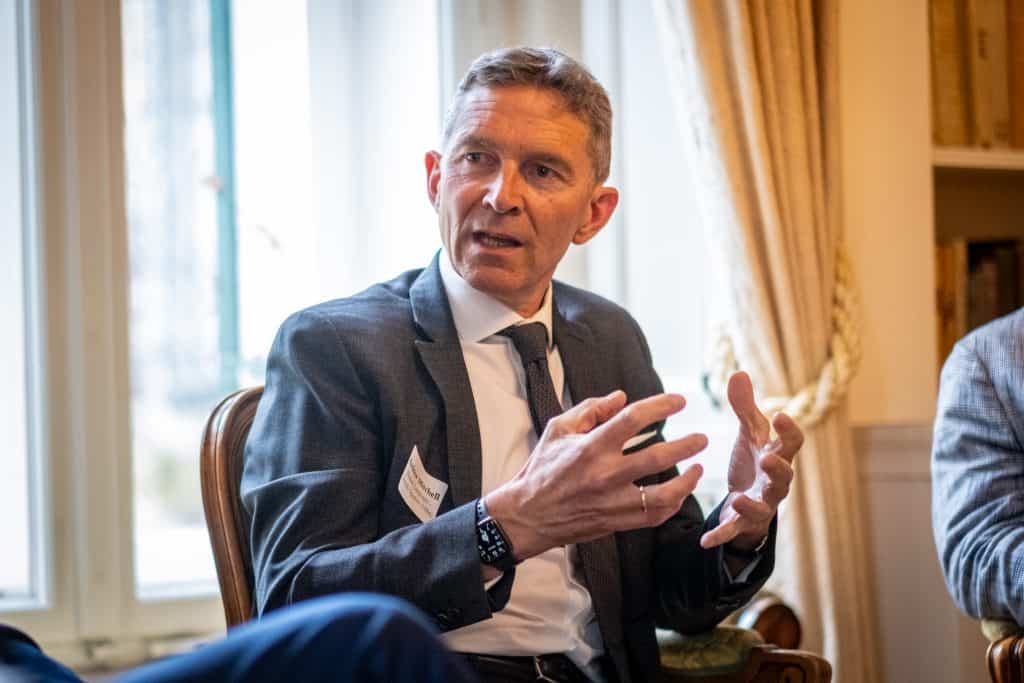
The College is delighted to announce the election of Andrew Mitchell CMG (Modern Languages, 1986) as an Honorary Fellow. Andrew is the current HM Ambassador to Germany; we spoke to him about his memories of Queen’s, the power of language-learning, and the curiosity that has guided his diplomatic career. Above all, he reflects on one enduring lesson: it’s always about the people.
Your election as an Honorary Fellow marks a new chapter in your longstanding connection with Queen’s. What does this recognition mean to you at this stage in your life and career?
It means a very great deal. Queen’s was a turning point in my life. For that relationship still to be developing and deepening over so many years is a source of great satisfaction. That satisfaction is also about the rootedness that the relationship with Queen’s has always offered – a source of sandstone solidity in this whirligig world we live in.
That satisfaction is also about the rootedness that the relationship with Queen’s has always offered – a source of sandstone solidity in this whirligig world we live in.
What are your strongest memories of your time as a Modern Languages student at Queen’s, and are there particular people or experiences that have stayed with you?
So many people. In the end it’s always about the people. The camaraderie of the tutorial group. The encouragement that I always felt from my tutors to be better, to think more deeply. But also, the deep privilege of learning. Of being bewitched by the idea that poetry could change the world. That languages were an invitation to see things from a different angle.
The experience of my undergraduate years feels to me now like a kind of 1980s Noah’s Ark. In we went, a proper menagerie. The journey was a kind of conversion. Not many went in two-by-two, lots came out that way!
Do you have a favourite place in Queen’s and Oxford?
It’s the combination of places and experiences, really. Queen’s College Chapel on the night of the Christmas Carol Concert. The beautiful autumn day of our first football match at the College sports ground. Saturday mornings were a cup of arrestingly strong tea at Brown’s Café in the Covered Market; Sunday evenings eating chips on the cold stone wall opposite the Carfax chip shop. And then there were the memorable conversations. The fierce debate around the table in the King’s Arms as to whether we’d see the Berlin Wall fall in our lifetime. In 1988, a year before the fall of the Wall! And all of this of course with the friends that made the experience what it was. As I say, it’s always about the people.
It’s always about the people.
What do students learn by learning a language?
I still find languages totally fascinating. I used to think of them as being a bit like a crossword. There was an answer. You just had to know it. I now think about languages as a kind of emotional cloud that encodes a whole way of looking at the world. Language is not neutral. It’s tricky. It conditions how you express what you experience. You come to language. It doesn’t come to you.
So, what you really learn is how to see the world differently. That’s what’s so rewarding about a language. But that’s not all of course. It’s still true that interpreting or translating brings immense intellectual pleasure, like the crossword clue. But having to speak when your language isn’t quite up to it teaches a particular kind of courage and humility. And then the confidence to go out and do it again.
What you really learn is how to see the world differently. That’s what’s so rewarding about a language.
I remember for instance my first technical negotiation in the German Interior Ministry shortly after I arrived in Berlin. It was a seismic struggle. It felt like balancing on very shaky scaffolding. But the next time was better. And the next better yet. You feel sometimes like you’re crossing one of those wooden slatted bridges in the Andes. But the risk of the deep and unexpected plunge focuses the mind!
This is of course why I’m such a fan of the brilliant work of Charlotte Ryland and the Queen’s Translation Exchange. To open even one young mind to these gifts is remarkable. To be doing it with the ambition and scale that QTE is achieving is breathtaking. We simply have to be bold enough to take on the challenge of reversing the decline in language learning in this country. For all the reasons that I’ve described – but also because our most effective operators in business, in diplomacy, in the world of international affairs are so often also adept at languages and slip easily from one context to the next, but with a more subtle understanding of the whole. The world is becoming more connected and more divided at the same time. So many of the challenges that we face need smart people who can build bridges to Germany, China, Russia, Saudi Arabia, Türkiye. And the list goes on.
Do you have any advice for students interested in an international career?
International careers take many forms. Sometimes a job just takes you overseas. Sometimes – if you’re a foreign correspondent, for instance, or teaching in an international school – overseas can really be the main point. If it’s an overseas career that interests you, then I’d say: first, find out first-hand. Search out people on social media or through personal networks that do what you’d want to do and ask them what it’s like. I answer a lot of enquiries of that kind.
Second, don’t have too many preconceptions. I’m not sure I’d have gone to all the places I’ve been posted if I’d had the choice, but I’ve loved each of them, for different reasons. Third, take your chance. Don’t wait for the perfect moment; grab your opportunity when it presents itself. It’s almost always better to build from something concrete. And there’s no substitute for experience.
Germany is home to the third-largest community of Old Members. Last year you welcomed members of the Queen’s community to the Ambassador’s Residence in Berlin for an evening exploring ‘Germany in the World’. What did you particularly enjoy about this event?
It was a wonderful occasion. An Ambassador’s Residence is a particular creature. At once a public building and a private home. Where breakfasts and dinners, receptions and events constantly whirr through; and where, at the weekend, you can sometimes be quite alone. But the house, which was built in 1929, was designed for sharing. And to be able to share – great discussions, hospitality and conversation – with a group from Queen’s was a lovely experience. I hope for everyone!
What aspects of your role as Ambassador do you find most enjoyable?
It’s an immense privilege representing your country as an Ambassador. I never forget that. But I also never forget that the privilege is owed to the position and not to the person. As in every leadership position, you work every day for the right to be respected.
One way of looking at the job is that it is about managing a vast and varied relationship. But in any complex task you can quickly get lost if you wander into the vast and the varied! So, you have to do two things. First make it simple. And second, stay strategic. Which means deciding what matters, doing it, and not getting distracted.
In this job you have to interpret the German world to the British world – and vice versa – and find smart ways to get new things done. And for that, the most valuable commodity is curiosity. Genuine interest in how other places work and other people think and live. The ability to get under the surface and understand not just what you see but where that comes from. Only by understanding what’s motivating a particular intent can you hope to design the right approach to accommodate it. Or sometimes change it. The best diplomats are professionally curious, ask lots of questions and listen well. It’s a good skill more generally in life!
The most valuable commodity is curiosity.
Probably the best aspect of living and working overseas is the opportunity to meet people. And the vast variety in what you do. Today I switched from a tricky discussion with a Minister to handing out 140 Duke of Edinburgh Awards. Somewhere along the way we made a video for our Instagram channel. There was a defence industry reception and a fascinating dinner discussion on transatlantic relations. I personally get a lot of energy from the constant refresh of perspective. But my favourite moment of the day was definitely the brilliant young people at the DoE awards; the connections that we build have human consequences and that’s hugely rewarding. It’s always about the people.
Your career spans diplomacy, international trade, and major global events, including the London 2012 Olympics. Are there particular skills or qualities you’ve found yourself drawing on time and again?
Yes; though it’s also true that skills develop with time. In particular, and more than anything else, experience teaches you that you will have moments of darkness but that the sun will come up the next day. Knowing this has got me through many difficult moments. As to the qualities, and perhaps the approaches, that I have found important: first, be honest and authentic. If it’s a problem, call it out – constructively, with kindness – and focus on solving it. Give straightforward advice and don’t compromise on what you think right. Second, stay positive whenever you can. Be generous with people, solve problems constructively and look for the opportunities, even when you have a right old challenge in front of you. Finally, be good to the people around you. You’ll almost always be part of something bigger that depends on lots of people. Kindness and consideration always repay in the end.
Kindness and consideration always repay in the end.