Extraction: the environmental legacy of imperialism
They took all the trees and put ’em in a tree museum And they charged the people a dollar and a half to see them
Joni Mitchell, 'Big Yellow Taxi' (Ladies of the Canyon, 1970)
The theme
How has the extraction of natural resources shaped economies, societies, the built environment, the natural world, human health, ecosystems? How has imperialism shaped these processes? What do we mean by environmental justice? How has the damage wrought on the planet and its inhabitants been represented—across time and space, across forms and genres? How are production and pollution linked? What innovations—scientific, social, political, or economic—will change the future of environmental extraction? Who gets to take what, in the name of what authorities or goals, to what aims, and at what price?
Call for objects
As part of our 25/26 academic theme, Extraction, the College is launching a project to analyse selected objects from around College. In an interdisciplinary effort, we’ll investigate the materials they’re made from, how those materials were ‘extracted’, and how the objects came to be at Queen’s. By looking closely at familiar things, we’re aiming to reveal fresh stories about the College’s relationship with the wider world, and how that relationship has changed over the centuries.
8–10 pairs of objects will be chosen with the pairs spanning the College’s history and a wide range of materials. The items may look alike but tell strikingly different stories of origin, extraction, trade, craft, or use.
How you can get involved
Do you have an object in mind, large or small, ceremonial or everyday, that could be explored? We’d love to hear suggestions from students, staff, Fellows, and Old Members.
Email: news@queens.ox.ac.uk with your suggested object
Subject line: Object for extraction theme
Please include: name/title of the object, a short description, a brief explanation of why it’s relevant to the theme of Extraction.
Optional: suggest an object that would pair well with the item.
We’ll share the chosen pairs and accompanying research through the year so watch this space!
Example: the Horn and the Cup
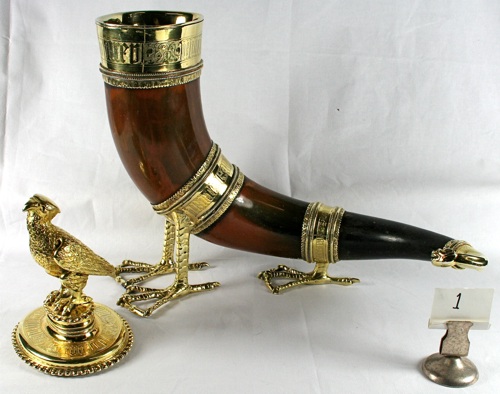
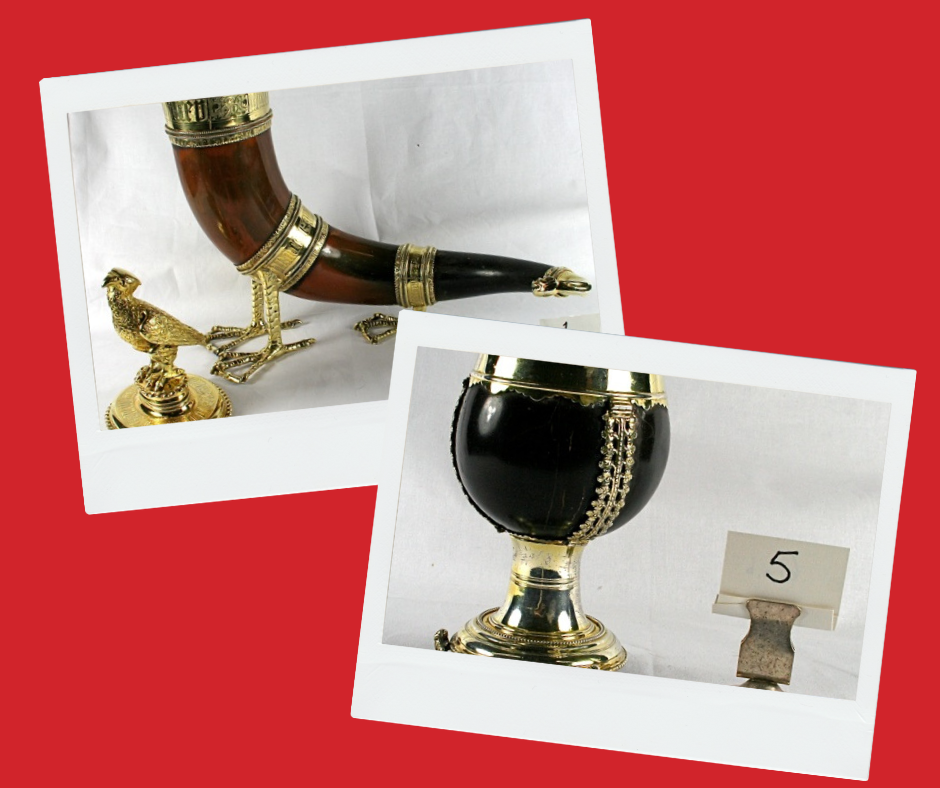
We have two early drinking cups in the College: one is made from a single horn and the other from a coconut. They both seem rather exotic, but one is linked to Anglo-Saxon traditions of the Hall, while the other is linked to the beginnings of Empire. We propose to find out as much as we can about both of them. For example, it has been suggested that the horn might have once belonged to an extinct auroch: massive wild cattle that once roamed Europe, as has been proved for a similar vessel in a Cambridge College. DNA testing can be used to establish whether or not our vessel is auroch, cattle, or potentially a hybrid animal and we have reached out to an expert in this field (Professor Greger Larsen) who has agreed to help with the project by conducting DNA analysis. The coconut cup is rumoured to be one of the first of its kind in Britain, but is that true? And what is its provenance?