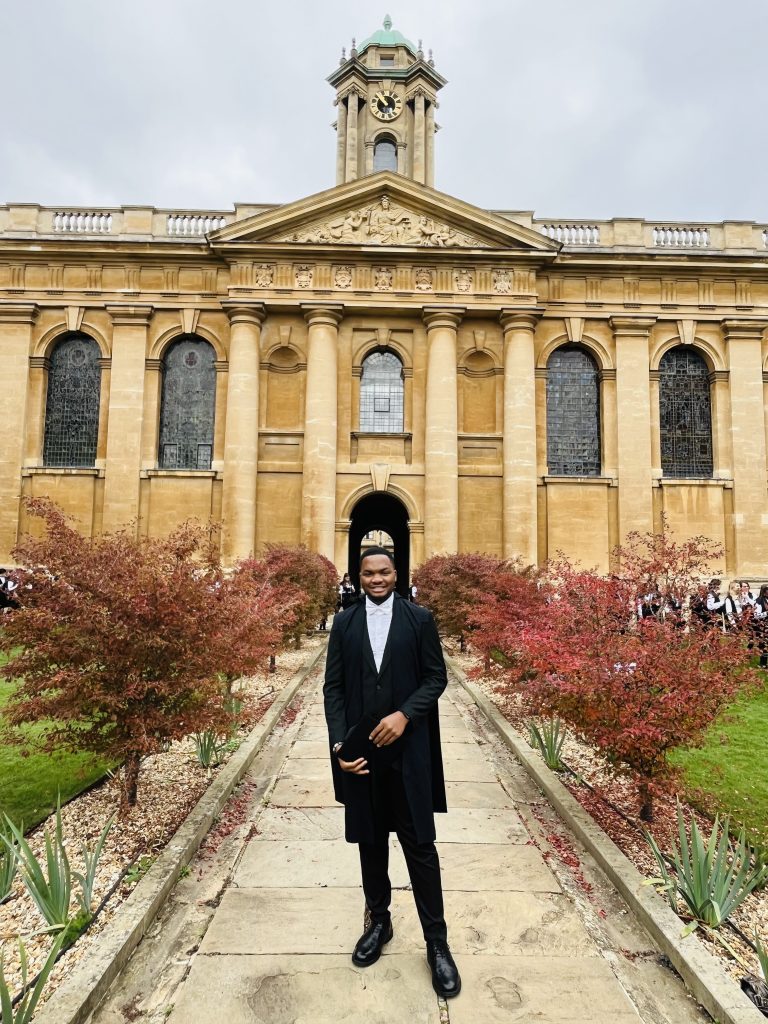
When he arrived at Queen’s to begin graduate studies in Economics, Great expected intellectual intensity and ancient traditions but what he did not fully anticipate was how his presence as the only Nigerian in his cohort would reshape his understanding of belonging. In this conversation he reflects on studying Economics at Oxford and what it means to act as a bridge between continents, perspectives, and generations.
What made you choose to leave your home country and pursue an MPhil in Economics at Oxford?
My intellectual curiosity led me to Oxford. I learned, at a very young age, about the depth of training and exposure that Oxford students gain, and I knew I wanted to be in an environment that would stretch me intellectually and as well refine my thinking. I made the decision to study Economics at Oxford while wrapping up an MPhil in Development Studies at Cambridge. My interest in the programme stemmed from the rigour and quality of its academics, particularly in Development Economics, which remains my core area of interest. I had read papers by professors in the Department of Economics and sensed that there was much more to learn here. I’m five months in and I can tell I made the right decision.
What did you imagine Oxford would be like?
I imagined Oxford to be ancient, slightly intimidating, and hyper-competitive. In many ways, that has proven true. But I have also discovered a diverse and thoughtful community that has challenged me to grow academically and personally.
I knew I wanted to be in an environment that would stretch me intellectually and as well refine my thinking.
Can you describe a moment in your first term when you felt like an outsider or unexpectedly at home?
I was stunned when I realised I would be the only African in a class of 90, and even more intrigued when I discovered I was the only Nigerian joining the Queen’s MCR last year. At first, I wondered how I would adjust. “How would I relate? Would I fit in?”, I often asked myself. My line of thought only drifted when I did some research on Oxford’s diversity. I discovered international students make up 43% of student’s population. In a university with students from over 130 countries, I knew I could not possibly be the only one navigating unfamiliar terrain. That awareness shifted my posture and instead of focusing on being different, I focused on building connections.
I have enjoyed the richness of plurality more deeply here because I now have friends from Mongolia, Thailand and China. I also felt so welcomed when the College Provost invited students who could not travel during the Christmas break for dinner in his Lodgings. It’s one of those very quiet gestures that that can be easily overlooked but says a lot about how the collegiate community can enrich one’s experience.
Economics is often framed as universal but lived experience shapes how we interpret data and policy. How has your background influenced the kinds of economic questions you find most meaningful?
Economics is often presented as a universal science, with principles that apply across time, culture, and geography. That idea has been debated in the field, and while I understand the appeal of what some call “monoeconomics,” I have come to believe that context matters far more than we sometimes admit.
My experience growing up in Nigeria drew my attention early to Development Economics and its practical relevance. Indeed, it shaped the kinds of questions I find meaningful. How should policy be designed in economies where institutions are weak? How can growth be inclusive in contexts marked by inequality and informality? How can development strategies respect political and cultural realities rather than assume uniform conditions? I am also particularly interested in how developing countries can industrialise responsibly in an era of climate change, and how structural transformation can occur without repeating the environmental costs of earlier industrialisers. At the same time, my exposure at Oxford has broadened my approach. I am learning to appreciate the analytical discipline of economics more deeply, and to engage with its tools with greater rigour. My perspective is evolving.
I am particularly interested in how developing countries can industrialise responsibly in an era of climate change, and how structural transformation can occur without repeating the environmental costs of earlier industrialisers.
Oxford carries strong institutional traditions. How have you navigated your own identity within that environment?
Oxford’s unique traditions are part of why I love it here. They do not clash with my identity, and I’d rather say they have expanded it. I have immersed myself in them because I believe one should allow their environment to shape them positively. There is really something grounding about participating in rituals that have endured for centuries. Sometimes, I imagine going back in time and conversing with renowned Economists who were at Oxford like Francis Ysidro Edgeworth. While we may have many contemporary or historic Economic issues to discuss, we will sure have a lot to say about our experience with Oxford’s traditions.
Oxford’s unique traditions are part of why I love it here. They do not clash with my identity, and I’d rather say they have expanded it.
Throughout my years of study, I had never worn formal academic dress to sit an examination. Oxford’s sub fusc culture therefore gave me a new perspective. I genuinely enjoy the solemn, almost ceremonial feeling of writing exams in sub fusc. It creates a sense of continuity as though one is momentarily connected to generations of scholars who once sat in similar rooms under similar expectations. It also gives me a glimpse of how serious and exacting academic life must have been for those who came before us. I must admit, however, that I am still adjusting to the use of carnations. One other thing I struggled with initially was the food. For a fussy eater, multiple formals and College dinners have gradually stretched my palate. It has been an unexpected but meaningful part of my adaptation.
International students often have to construct their support networks from scratch. What practical steps did you take to build community at Queen’s or beyond?
I have been in the UK for roughly 18 months, and I must confess that building one’s community requires a great deal of effort. You have to show up, stay present, and sometimes push yourself a little. But surprisingly, there are more communities at Oxford than I anticipated. At Queen’s, the MCR has been a beautiful community for me. I have enjoyed spending time with my flatmates, attending the College Symposium, and meeting new faces at College dinners. In the Economics Department, I joined the EDI and Library Committees, and I have been able to take part in key discussions and decisions in both. The Oxford African Society and Heritage of Faith Church, Oxford, have also been two homely communities that made navigating Oxford less daunting. Although joining these spaces required deliberate effort, I was pleasantly surprised by how naturally I was able to fit in and find my feet once I did.
At the recent Postgraduate Storytelling Series, ‘Journeys of Hope: The International Student Experience and the Making of Global Scholars’, postgraduates were framed as global bridge builders. In your view, what does that mean in practice?
At this point in my life, I see myself as a bridge of possibilities. More as proof that certain pursuits are possible. I could tell that my Oxford story has widened the imagination of many students back home and that means a lot to me. When I started out, Oxford felt distant and almost abstract. I questioned whether dreams like that were practical or even responsible.
Today, studying here signals to younger students in Nigeria and across Africa that spaces like this are not reserved for a select few. Through the African Economic Scholars Program (AESP), which I founded and lead, I try to make that bridge more visible. If I can study here, ask questions here, struggle here, and grow here, then others can too. Many young students are ambitious, but they lack guidance on how to position themselves to build analytical depth and command value in global spaces. My experience at Oxford which connotes the doubts, the discomfort, and the persistence allows me to speak honestly about what it takes, through the mentorship platform at AESP. If someone looks at my path and dares to attempt their own, then the bridge is already active. In a few years, I hope to be even better equipped to build stronger and wider bridges that will allow me to make deeper and more lasting impact in economics and beyond.
If you think about ‘Journeys of Hope’, what does this mean for you now compared to when you first arrived in Oxford?
Upon arrival, my thoughts on ‘journeys of hope’ were largely centred on what I stood to gain, like the knowledge, exposure, ideas, and intellectual formation that would prepare me for the future. At that stage, it was more about acquisition and how Oxford would shape me to change the world. Recently, however, my understanding has widened. I now find myself asking different questions like “What will change in Oxford because I came?” “How will my presence, perspective, and participation contribute, however modestly, to this institution?” This paradigm shift is the reason I have taken the initiative to participate in committee activities. So, “hope,” in my purview, has tilted from my personal advancement to more about mutual transformation. My aspirations are still well intact, but I have decided to couple this with some responsibility.
What will change in Oxford because I came?
What’s your favourite thing about Queen’s?
The library. I spent a good part of my Michaelmas holiday there and thoroughly enjoyed it. Aside from the richness of its collection, what fascinates me most is how seamlessly it blends the old and the new, spanning three centuries. The Upper Library gives me a vivid sense of what studying at Queen’s must have felt like in the seventeenth century. I once spoke with a professor who said it had been his favourite spot during his time here, and that came as no surprise to me. The architectural design is simply beautiful, and I often boast about the library to my friends. I also admire the other floors, especially the New Library, which offers more communal reading spaces that I value during collaborative study sessions and lighter academic days.