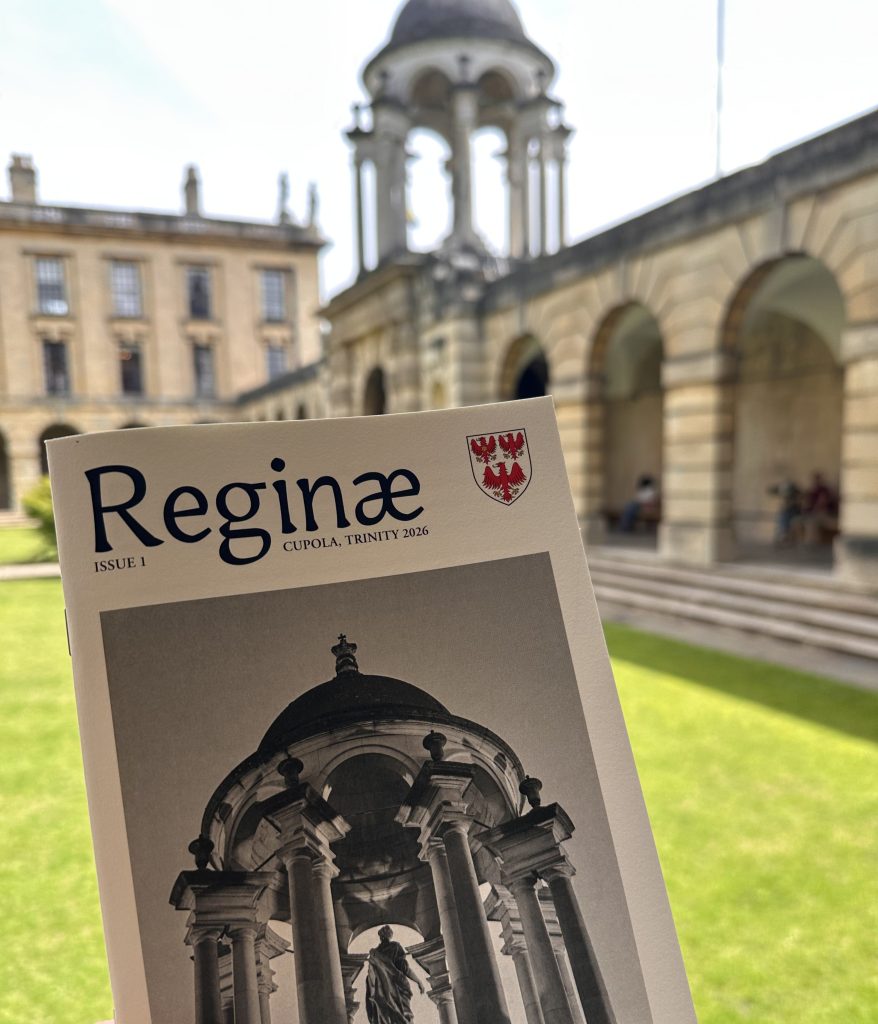
A bus ticket, a stone-carved Queen, and the creative life of the College: these were among the starting points for Reginæ, a new student-edited chapbook bringing together poetry, short fiction, watercolour, and experimental writing by members of Queen’s.
Supported by the Walter Pater Grant, Reginæ takes its name from the Latin for “Queen” and draws on the long tradition of the chapbook: a small, printed booklet of verse, stories and ideas. For its founding editor, graduate student Parth (Master’s in Public Policy), the format offered something more tangible than a PDF and more intimate than a magazine: an object to read between library sessions and Hall and to keep as a piece of College life.
In this interview, we hear from its founder, Parth, how the chapbook came into being and why its editor hopes it might become a new College tradition.
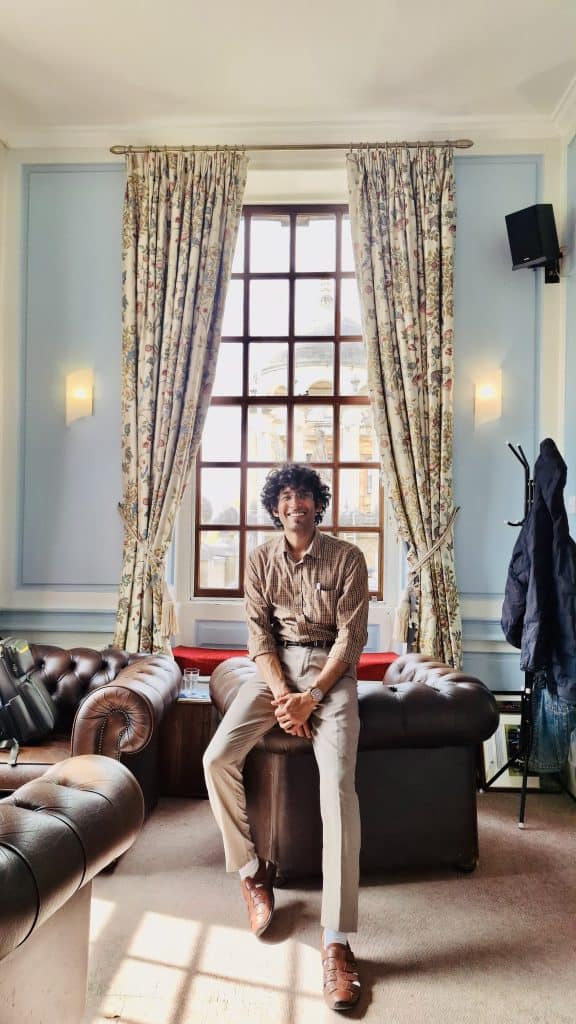
What first prompted the idea for Reginæ, and why did you choose to create a printed chapbook for the project?
A receipt of my bus journey to arrive at Oxford, and the sight of a Queen set in stone from the Middle Common Room. Every student here at Queen’s is talented in their own way, and being creative is such a common denominator. A printed project bringing together their works seemed a suitable way for me to add and build value to the College that truly is like a nursing mother to all its members. Even in changing through the years, since not one stone of the original College remains in situ today, Queen’s has remained true to the spirit of its founders and patrons. In that, it answers the Ship of Theseus argument. Every corner here, and in Oxford at large, has a story, old and new, waiting to be told. Some are included in Reginæ, which literally, and rightly means, Queen.
Every corner here, and in Oxford at large, has a story, old and new, waiting to be told.
What is a chapbook, for those unfamiliar with the term?
A chapbook is an old-fashioned small, stitched booklet of verse, ballads, and short prose that were historically sold by itinerant chapmen. It seemed right for what we were trying to do with Reginæ—something light enough to read, say between a gruelling library session and a Second Hall, sturdy enough to leave in a common-room basket, and beautiful enough to keep and collect. Also, I have always thought of myself as a pedlar, albeit bad, of stories and ideas, and that finally made the term stick. And it’s not half bad to be called the founding editor of what I hope continues as a College tradition.
The chapbook includes poems, short stories, illustrations, and even an AI-generated fiction experiment. How did you decide what belonged in the first issue?
The criterion was simple, even if the editing was not, since each piece had to be short enough to read in a quiet quarter of an hour. Beyond that, I wanted the issue to feel like the College actually feels in conversation. Mixed, a little surprising, the engineer reading verse in three languages (Kirill), the lawyer writing love poems (Arifur), the physicist (Kate) painting watercolours, and the policy student trying to put it all in one cover. The AI piece was the deliberate experiment in seeing how an LLM can perform vis-à-vis its creators.
I wanted the issue to feel like the College actually feels in conversation: mixed and a little surprising.
What did receiving the Walter Pater Grant make possible?
In the most literal sense, bridging the difference between a PDF circulated by email and an object one can hold as a piece of the College. Receiving the Walter Pater grant helped me convert a private experiment into a College project, making it more diverse, equitable, and inclusive along the way.
What was the process of bringing the chapbook into physical form like?
It was an intensive process, since the chapbook had to be delivered within a few weeks of receiving the grant. My experience with my undergrad College magazine in India helped with the editorial work. I really enjoyed designing it. Holywell Press were patient and exacting — they sent four cover alternatives, talked me through paper weights, set the wordmark with the Reginæ æ-ligature in a way that I had hoped for but couldn’t have specified. Kate’s watercolours were scanned at high resolution and threaded as quiet ornaments between the pieces; the Queen’s eagles on the cover came from the College arms; the Finis page closes on a thistle. None of these are large decisions, but each of them is the kind of small choice that makes a chapbook feel like a chapbook and not a brochure.
What would you like Reginæ to become, and what would you say to students thinking of applying for an arts grant?
Thinking about this, I would like Reginæ to outlive its first editor. The hope is for a small annual or termly (though each term hits different) object that is as much a Queen’s tradition as it would be a coming-together of people to foster a creative space. Through this project, generously funded by the Walter Pater grant, I learnt this about creativity at Queen’s: it is there, mostly quiet, and a great deal of it asks only to be asked.
Through this project, generously funded by the Walter Pater grant, I learnt this about creativity at Queen’s: it is there, mostly quiet, and a great deal of it asks only to be asked.
To students wondering whether to apply: please do. The committee is kind and supportive. You don’t need a finished idea, maybe just a real one. Write the application honestly, give an itemised budget, and trust that the people on the other side already want to say yes.
What do you enjoy most about being at Queen’s?
Inviting my friends to a meal in Hall, and afterwards taking them around the College as they watch it wonderstruck. Finally, in the Chapel, once they have fallen in love with the stained-glass windows, I point towards the lectern, and happily translate the Latin on it for them: “The Eagle is Queen of birds, and the bird of the Queen’s.”