Blog by Rudro Guha, Educational Outreach and Communications Intern at the Queen’s Translation Exchange
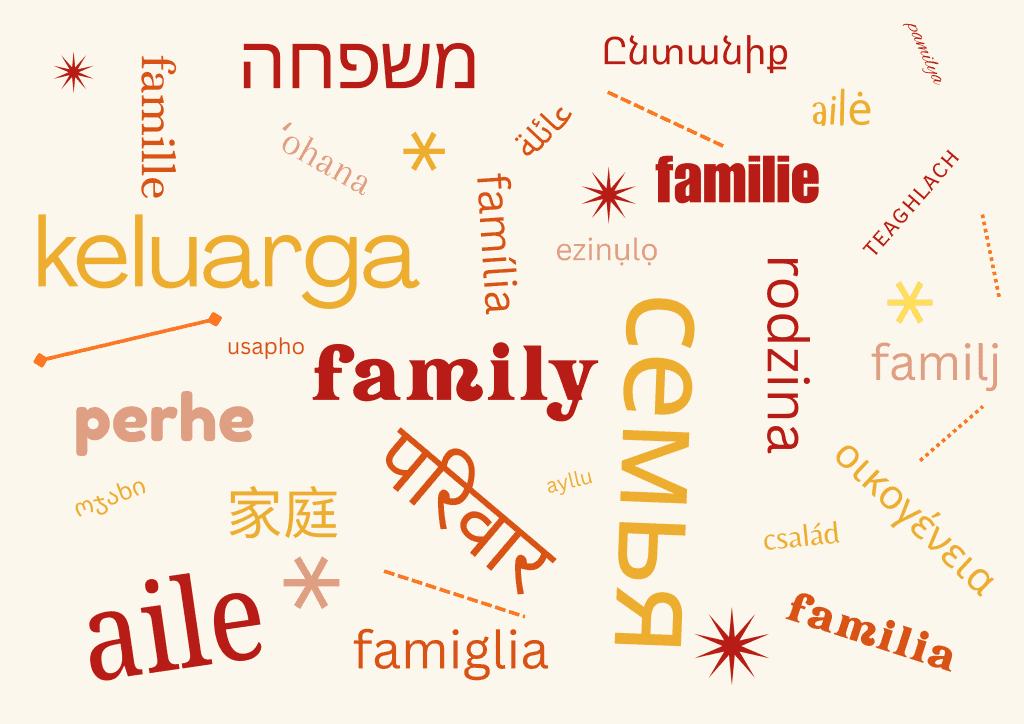
If someone says to you ‘my uncle is drinking water’, it might seem like a perfectly clear sentence. But there’s actually a lot of information missing here. Is it your uncle on your dad’s side or your mum’s? Is this person your uncle by blood, or by marriage? Different languages have vastly different ways of talking about family members, and this raises interesting questions about culture, translation, semantics, interpretation, and communication.
Different languages have vastly different ways of talking about family members, and this raises interesting questions about culture, translation, semantics, interpretation, and communication.
In English, the term ‘uncle’ is known formally as a ‘classificatory’ term. This means that the word ‘uncle’ does not describe only one specific type of family relationship, but multiple (i.e. uncles on either side of the family, by blood or by marriage). In contrast, the word ‘sister’ is what’s known as a ‘descriptive’ term: it can only be used to refer to a sibling who is a woman or girl. It’s interesting to look at how languages across the globe use different systems of terminology to describe the family.
Traditional Hawaiian, for example, uses a highly classificatory system – there really aren’t that many terms at all. For example, the language doesn’t differentiate between family members of the same generation. The word for ‘mother’ – makuahine (often shortened to māmā) is also the word for ‘aunt’. The same term is used for ‘father’ and ‘uncle’: makuā kāne. A similar system is used for siblings and cousins – someone addresses a male cousin using the same term they use to address their brother. The same goes for sisters and female cousins: there is no difference in the language.
And then, of course, there are languages that are on the complete opposite end of the spectrum. Let’s use my mother tongue, Bengali, as an example. Bengali uses extremely descriptive kinship terminology – there are different terms for relatives based on their gender, side of the family, age relative to you, and more. For example, there are distinct words for ‘older brother’ and ‘younger brother’ (dada vs bhai) and ‘older sister’ and ‘younger sister’ (didi vs bon). Things get even more specific when talking about relatives in older generations. Staying with the ‘uncle’ example, take a look at the following Bengali words:
Jethu: father’s older brother.
Kaku: father’s younger brother.
Mama: mother’s brother.
Mesho: uncle by marriage (mother’s side)
Pishe: uncle by marriage (father’s side)*
*Most of these are the shortened, more commonly used forms of the full nouns, and are also often used to describe friends of your parents as well as family members.
These differences between languages are also useful because they give us information about the history of these cultures, their customs, and what they prioritise. We’ve seen that traditional Hawaiian addresses members of the older generation in the same way (father=uncle, mother=aunt). These terms stem from real cultural practice. Historically, raising and taking care of children in Hawaiian families was very much a collective endeavour, undertaken by the whole extended family (the ‘ohana). Responsibility was shared between mothers, fathers, uncles, and aunts. Everyone in the older generation was seen as a parent, and this is reflected in the language. As well as this, land, resources, and food were often shared among the extended family, and so large families would often live together. There was no linguistic distinction between the nuclear and the extended family, because there didn’t need to be. As for Bengali, the multiple distinct terms for family members take us back to the Sanskrit-speaking societies in Ancient India, when a relative’s age, side of the family, and gender determined many of their rights and responsibilities.
Given these differences, you can imagine the challenge when trying to translate between languages that use different kinship terms. Here’s an example from Bengali:
Amar bhai ar amar jethu jol khachhe.
Literally translated, this means ‘My younger brother and my father’s older brother are drinking water.’ This is accurate, but sounds completely unnatural in English, and makes for somewhat difficult reading. Of course, we could just say, ‘My brother and my uncle are drinking water’, which sounds more natural in English, but leaves out two pieces of information that were there in the Bengali. Even a sentence as simple as this one becomes difficult to translate concisely. And, as we know, these difficulties extend beyond just remaining concise. Terms also carry important cultural and historical information with them, which can very quickly get lost in translation.
Difficulties like these are why translation, and language learning in general, build skills that we should all try and develop, irrespective of our profession, aspirations, or age.
This is just one example of many interesting challenges you might encounter when translating between languages. Difficulties like these are why translation, and language learning in general, build skills that we should all try and develop, irrespective of our profession, aspirations, or age. Working through these challenges forces us to become more analytical, open-minded, and ultimately, to see the world in a new light.