Second-year Music student Tom Constantinou was Musical Director for Sondheim’s Company, which ran at the Oxford Playhouse this January. Stepping into a professional theatre space while still an undergraduate, Tom describes the experience as “wonderfully terrifying” as he balanced the heightened scale and expectations of the Playhouse with the creative freedom of student theatre.
We asked Tom to tell us more about conducting, collaboration, and finding your footing, on stage and beyond.

How does your academic work connect or contrast with your life in the theatre?
My degree has much less to do with musical theatre than one might actually think! Much to my dismay, I’m yet to encounter any Sondheim in lectures or tutorials. Saying that, on any Queen’s open day you might overhear me telling of writing a personal statement on Into the Woods, another one of Sondheim’s musicals (and admittedly my favourite).
You’ve described being Musical Director at the Oxford Playhouse as “wonderfully terrifying.” What felt most daunting about stepping into a professional theatre space, and when did it start to feel exhilarating instead?
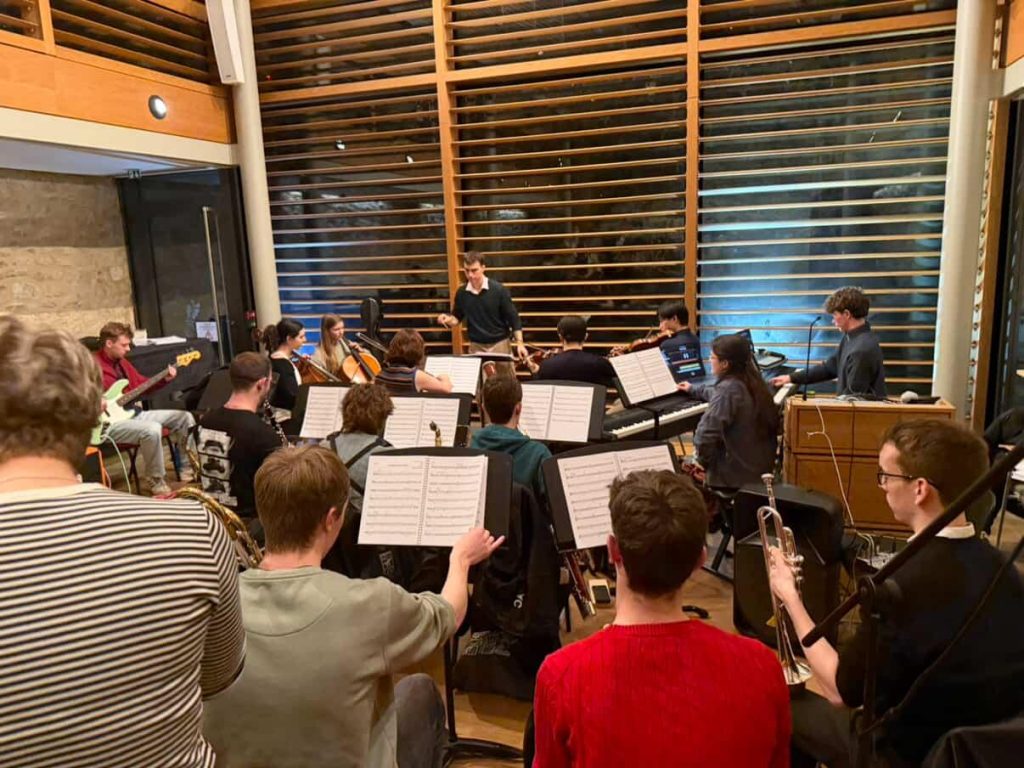
So much of conducting is about choreography, co-ordination, and responsiveness to the orchestra, much of which changes with each rehearsal room and its different acoustics. As the band were in the ‘pit’ at the Playhouse (a basement level beneath the stage), you suddenly get a completely different acoustic world. You might hear the strings ‘live’ as they play directly in front of you, but for instruments further away you’ll only hear them through the general mixed output (i.e. what the audience hears overall). As the Playhouse normally functions as a professional theatre, there’s also the pressure of being watched by the Artistic Director and of course a paying audience (which on one night included a West End MD who had worked on the 1995 London staging of Company, and several West End producers).
I suppose the state you get in whilst conducting isn’t quite exhilaration, because to maintain that emotion for two and a half hours over five shows would be draining. It’s more of an intense focus to help the 30-40 cast and band make great music. The few brief moments of intense musical exhilaration were always in the final numbers ‘Ladies Who Lunch’ and ‘Being Alive’, some performances of which were the most emotionally involved I’ve ever been in making music. One rather kind reviewer spoke about sitting directly behind me on one evening and seeing the lifeblood of music run through the pit! I suppose what you feel and show are often different things, especially when conducting.
How did working in a venue like the Playhouse change the way you approached musical decision-making, compared to student productions you’ve worked on before?
On the Playhouse stage, the scale of everything has to be multiplied by tenfold. There’s a fine balance between keeping enough subtlety that the audience isn’t bombarded with your artistic choices, whilst keeping them large enough to be understood from the back of the theatre. Musically, I took lots of inspiration from singing in the choir at Queen’s, which often faces the similar acoustic challenges in large concert halls and cathedrals of sending emotion and meaning all the way to the back rows. For me, this often meant going overboard with diction exercises and text projection (a favourite warm-up was making the cast repeat sequences of consonants which appeared frequently in the show ad nauseam). This did amusingly lead them to nickname the show “wet ‘k’ Company” after my insistence that the show was ‘company’ not ‘gumpenny’.
Musically, I took lots of inspiration from singing in the choir at Queen’s, which often faces the similar acoustic challenges in large concert halls and cathedrals of sending emotion and meaning all the way to the back rows.
Company is a musical with a devoted following. How did you balance honouring Sondheim purists while also making the show accessible to audiences who might be seeing live musical theatre for the first time?
It’s such a tricky balancing act—Company doesn’t have a linear plot, and there certainly aren’t as many tunes you might go away humming as other classic musicals. We kept the Sondheim purists happy by keeping pretty true to the original libretto and script, something that hasn’t been done recently as the last major production of Company (London, 2018) gender-swapped the lead and his girlfriends. Sondheim sometimes gets criticised for being less accessible to those seeing live musical theatre for the first time, as his musicals have fewer easily singable tunes. However, I’m of the opinion that his collaboration with George Furth creates libretti and music that are genuinely funny, with enough sprinkling of ‘good hummable tunes’ to keep everyone happy. There was also a lot of non-musical joy to be had – Holly Rust’s set design of a large-scale soft play centre and Hannah Walton’s strikingly 70s costumes created a refreshingly fun visual style. I’m sure getting to fire an industrial confetti cannon at the start of act 2 (much to the surprise/terror of row A) retrieved some high-camp musical theatre joy, whilst probing the notion of plays and playing.
You mention incorporating music often omitted since the show’s premiere. What drew you to those choices, and what did they add to this particular production?
‘Tick Tock’ is one of the more problematic areas of Company when done in original format, for it is essentially a four-minute exaltation of how sexually satisfying the protagonist Bobby is to various women. It has most famously been staged as a dance number for one of Bobby’s girlfriends, an artistic choreography of sexual activity. The song was mostly dropped since its premiere, perhaps due to the difficulty of finding a suitably excellent dancer, singer, and actor in one, or perhaps due to the fairly explicit dialogue which runs over the top.
It was actually the director Joshua Robey who suggested we include it, and upon first listening to the score I could well understand why – ‘Tick Tock’ is arguably some of the best music Sondheim wrote. Working with choreographer Alex Jefferies, we refashioned the staging as Bobby’s surprise birthday party (which is the catalyst for the show’s opening number), descending into a fabulously fluid dream ballet sequence which hinted at some of the original production’s eroticism.
The songs in Company are quite realist, often describing the action of the scenes around them rather than being the action, and so this dream ballet sequence was really an opportunity to tease out more abstract artistic choices and stakes that are otherwise missing from the material.
What was it like leading a 14-piece jazz band as a student, and how did that responsibility shift your sense of yourself as a musician and collaborator?
So, so much fun! I was fortunate enough to get my first fix of big band jazz at school under the fabulous mentorship of Andy Bush and Phil Chevassut, and soon after became obsessed with the great conductor Jules Buckley who often fuses orchestral and big band jazz orchestras. Since then, I’ve really been hunting out opportunities to conduct the jazzier side of orchestras, and Company got very close to scratching that itch! It was my first time conducting such a drum-centred show, which sort of upsets the traditional narrative of the conductor as time-keeper because the drummer ends up doing this job for you. It really encourages you to hand over the reins to the musicians in your band, as they will instinctively (and correctly) respond to the percussion beat. This was a very liberating experience as a conductor, as you can focus on shaping expression rather than having to be consistently metronomic. There’s often a (very true) joke in jazz big bands that the conductor’s only job is starting the piece, after which they walk off the stage. Back playing in a big band, I always remembered the enjoyment of seeing our conductor do the aeroplane-esque arm dance when things were really ‘in the pocket’—as a jazz MD you just need to sit back and let the band be the true artists.
Beyond the confetti, balloons, and boisterous fun, Company asks big questions about relationships and commitment. What do you hope audiences, especially students, leave thinking about after the final note?
I’m interested in the idea of the ‘final note’—there’s many to choose from: the final note of ‘Being Alive’ (what feels like the finale), the final note before the curtain (a short trumpet solo), the final note after the curtain (the curiously sung orchestration of the bow music), the final note of the exit music (which most of the time the audience miss), or the final note of each of the above on the final night.
In true Sondheim-fashion, we never quite know where the show ends, if it ever does. Part of this really forces you to step back from the role of director, because you can’t predict or impose what the audience will treat as the pervading ‘final note’. I also didn’t really think there was a definitive final note, and in fact hearing people’s interpretations of the ending where Bobby finally exits through the rather Chekhovian fire exit (present but never interacted with for the whole show) provoked questions of a final note I hadn’t thought of before.
I’m sure he won’t mind me mentioning this, but Aaron Gelkoff’s (Bobby) performance of the infamous ‘Being Alive’ on the final night inspired such a raw ending of the show which really loosened and questioned the boundary of whether we ever stop playing as audiences, directors, or actors. Minutes of applause erupted immediately after finishing the song, during which Aaron/Bobby stood still on stage and sobbed in front of 600 people – a real and raw emotionality that I’m not sure anyone could have anticipated or directed. This ‘final note’ in many ways made tangible the terror, excitement, anxiety, and isolation that the future conjures.
What happens after this final show, when audiences and the full company leave the theatre and return to the messy, busy realities of Oxford student life? What happens when we graduate, when this world of performing and playing that we inhabit for several years grows distant from us? In a world that is the most globalised yet lonely it has ever been, where politics domestic and internationally is depressingly certain yet ambiguous, how can we ever approach the future with alacrity and hope? Company, like life, offers no answer to what role we play after this one finishes.
What happens after this final show, when audiences and the full company leave the theatre and return to the messy, busy realities of Oxford student life?