Library book recommendations in translation
To celebrate World Book Day 2026, we asked the Library team to recommend their favourite books in translation. The selection resonates particularly strongly at Queen’s, home to the Queen’s Translation Exchange (QTE), which champions the study and practice of translation as a vital form of cross-cultural exchange.
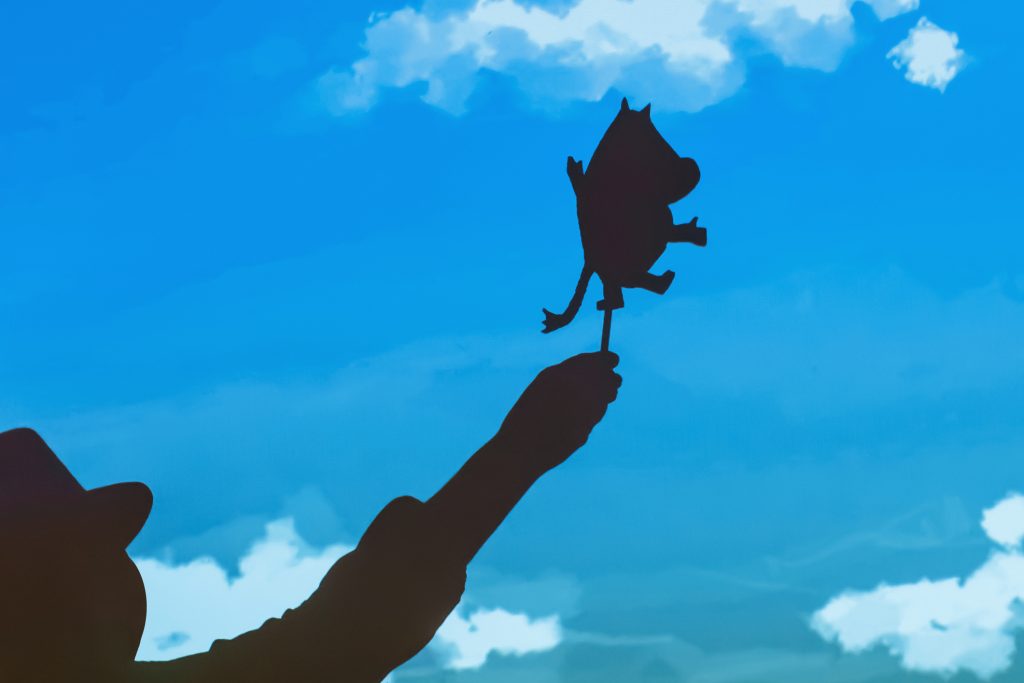
Puppet theatre silhouette of Moomin troll
Sarah Arkle, Deputy Librarian
Come with me this World Book Day to the Nordic countries. I am a big fan of this region of northern Europe, partly because I often don’t fare so well in hotter climes, but mainly because – whilst by no means perfect – there is a lot to admire about the countries in the area: Finland has given us Moomins and sauna culture, and Sweden has blessed the world with affordable flat-pack furniture and the music of ABBA. We can thank Norway for brown cheese and the Nobel peace prize, whilst Denmark could certainly teach Oxford a thing or two about bicycle infrastructure, and Iceland we thank you for Björk. (I have yet to visit Greenland or the Faroe Islands.)
There is also a wealth of Nordic literature to consider. Here I have outlined some recommendations for works in translation that we have copies of in the library.
We’re starting in Finland. Tove Jansson was born to a Swedish-speaking Finnish family in Helsinki in the early 20th century, and remains most famous for creating Moominvalley and its many charming inhabitants. She was, however, also an author of fiction for adults, and my first recommendation is her lovely short novel The Summer Book (translator: Thomas Teal). With characters inspired by her real-life family, it tells the story of a six-year-old girl and her grandmother, spending summer exploring a small island in the Gulf of Finland. Rarely mentioned, but underpinning the narrative, is the recent death of the young girl’s mother. Over the course of the summer, the girl and her grandmother bond and ponder life’s many mysteries. The book is tender, but never saccharine, and you can find it shelved at Gen Jan in our ‘General’ collection on the ground floor.
Onto Denmark, to meet another Tove born in the early 20th century. This time, Tove Ditlevsen, the Danish author and poet, whose Copenhagen Trilogy (translators: Tiina Nunnally and Michael Favala Goldman) is my next recommendation. The three books which make up the trilogy (Childhood, Youth, and Dependency) are memoirs pertaining to periods of the author’s life. Ditlevsen writes with clarity and honesty about her experiences of marginalisation, class, relationships, and addiction. Although well known in her native Denmark during her lifetime, her work has only more recently begun to gain popularity in English speaking countries, with the Copenhagen Trilogy being named one of the best books of the 21st century in 2024, leaving me feeling quite smug about having read them back in 2019 when they were newly published! We have all three collected as one volume, available at Gen Dit.
Lastly to Norway to discover a contemporary Norwegian author, Vigdis Hjorth, tinged with scandal. Hjorth’s novel Will and Testament, (published in English in 2019, translated by Charlotte Barslund), is a work – Hjorth maintains – of fiction, where siblings fall out over inheritance, complicated by one sibling’s (the novel’s narrator) allegations of abuse at the hands of their deceased father. The novel was a best-seller in Norway, but not everybody liked it. Hjorth’s sister published a novel of her own in response, refuting the events of Will and Testament, whilst her mother took legal action against a proposed stage adaptation. Hjorth herself maintains that the novel is a work of fiction, and that any real experiences drawn upon the novel were done with consent. Hjorth then followed up with another novel titled Is Mother Dead (also translated by Charlotte Barslund), which looks at the permanence of our relationships with our mothers, as the protagonist Johanna – long estranged from her family – returns to her native Oslo and begins both a real and imagined stalking of her mother, trying to make sense of her childhood. Scandal aside, both novels are a bleak but effective portrayal of fractured family dynamics, both of which can be found shelved at Gen Hjo.
The Charles bridge in Prague

Matt Shaw, Librarian
I was tempted to suggest the Old and New Testament for this task, but presume, like Desert Island Discs, that those most translated of all volumes are a given. Instead, I have three suggestions from either side of the European continent. The earliest is The Good Soldier Švejk by Jaroslav Hašek, first published between 1921 and 1923, and answers the insanity of the First World War, the collapse of the Austro-Hungarian Empire, and a world run by an inexhaustible bureaucracy with the appropriate mode of comic humanism. It is also the most translated work in the Czech language. Cecil Parrott – a former ambassador to Czechoslovakia – is the translator of the edition I’ve read. The Radetzky March (1932) by Joseph Roth takes a slightly longer view of the collapse of the Empire, and the tone is more elegiac than comic. Joachim Neugroschel was the (prolific) translator. Finally, something from Spain by the author and translator Javier Marías: The Infatuations (2011), a murder mystery drawing on the always puzzling nature of life and literature. Margaret Jull Costa is the translator.
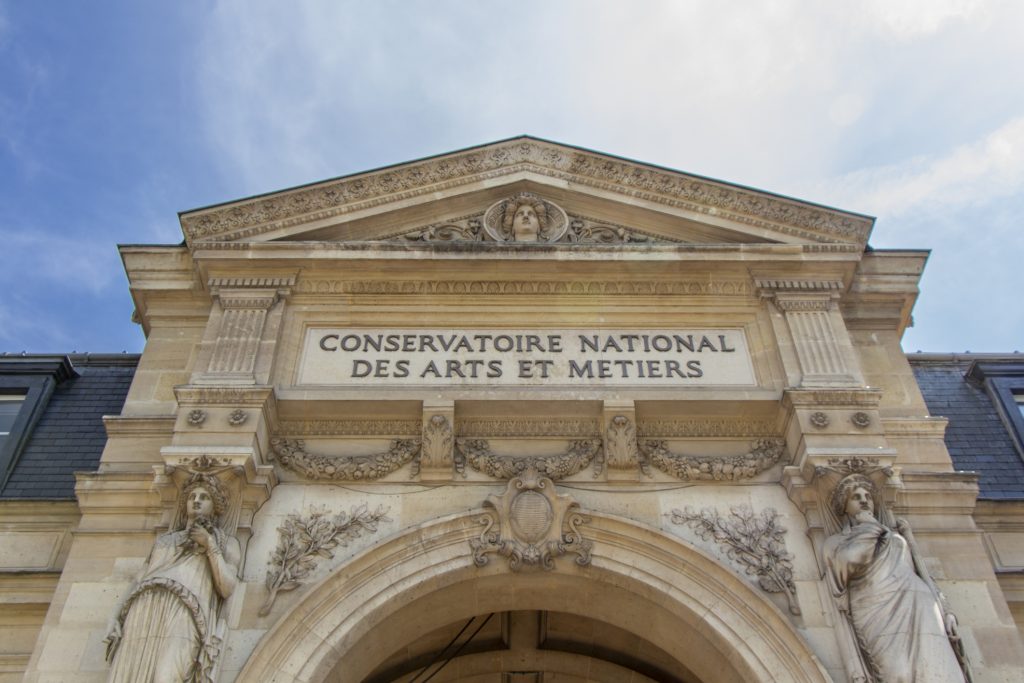
Facade of the Conservatoire national des arts et métiers (English: French National Conservatory of Arts and Crafts), Paris
Felix Taylor, Library Assistant
My assumption has always been that Umberto Eco was such a genius that he wrote his novels (including his first, and best-known work, The Name of the Rose) in English. But this is not the case: he wrote them all in his native Italian, translated admirably into English by American academic William Weaver [who dubbed the extension to his house paid for by that book’s success the ‘Eco Chamber’ – ed.]. Foucault’s Pendulum (1988) is often described as the thinking man’s Da Vinci Code: it may well be that, but if anything it presaged the rise in popular conspiracy thrillers like Dan Brown’s. Its characters are the very types of people who would consider writing a mystery linking the Holy Grail with the child of Mary Magdalen.
The novel has nothing to do with Michel Foucault; the pendulum in question is a device invented by French physicist Léon Foucault to demonstrate the rotation of the earth. In Eco’s book the real-life pendulum at the Musée des Arts et Métiers in Paris becomes the focal point of a conspiracy theory, the meeting place of various occult parties who have supposedly lain in wait for hundreds of years to get a glimpse of a certain beam of sunlight that will reveal to them the powers of the Earth’s telluric currents (if I’ve understood the book correctly). The narrator, a man named Casaubon, believes his friend Jacopo Belbo has been kidnapped by the conspiracists and hides in the museum after hours, reflecting on the years leading up to this moment. Casaubon had been a graduate student in the 1970s in Milan; his thesis was on the history of the Knights Templar, a Catholic military order operating in the twelfth and thirteenth centuries. He becomes associated with a small publishing house run by the mysterious Mr Garamond, who desires to attract gullible and wealthy authors willing to pay for their monographs to be published. To sweeten the pot, Garamond enlists Jacopo and Casaubon to invent ‘The Plan’, an all-encompassing scheme of occult influence running through world history. The men begin to believe their own fiction.
Eco clearly has a broad knowledge of the world of secret societies, and many pages are devoted to characters explaining the history of a particular group – the Illuminati, the Rosicrucians, the Cathars – which can often be interesting, overwhelming, or simply boring. All of it contributes to the heady labyrinth of fact, imagination and intrigue set against the backdrop of a politically charged Italy. Not quite as magisterial or as well-received as something like The Name of the Rose, but still an enthralling and intellectual thriller, and the perfect bookish book for World Book Day.
Aran Valley in the Catalan Pyrenees

Lauren Ward, Assistant Librarian
During the course of my long-term project to read a book from every nation on earth (I’m 66 states down, for anyone curious) I’ve encountered a great deal of translated writing and developed a fondness for Spanish and Latin American fiction in particular. Some of the most interesting and arresting new writing is coming from these parts of the world, so that’s where I’ll be focussing my recommendations!
My first recommendation is When I Sing, Mountains Dance by Irene Solà, translated from the original Catalan by Mara Lethem. Beginning with Domènec, a farmer with the soul of a poet who is struck down by lightning as he surveys his land, a polyphonic chorus of voices — from civil war ghosts who wander the Pyrenees, a clutch of chanterelle mushrooms, the very land itself — tell the story of Domènec’s descendants and the landscape they call home. It’s an enchanting narrative that weaves each small, solitary voice into the wider web of life thrumming around them, while communicating the history and folklore of the Spanish-French borderlands in an idiosyncratic but immersive way. A little disorientating to begin with as you try to figure out whose perspective each new chapter is from (a deer? A storm cloud? A trio of witches?), Solà’s novel is a whirling, hopeful portrait of a land and its people that will appeal to Max Porter fans.
Next, from Argentine art critic and writer María Gainza, I recommend Optic Nerve (trans. Thomas Bunstead). In this quiet, contemplative series of auto-fictional vignettes, an unnamed female narrator tours the art galleries of Buenos Aires and reflects on what she finds there. Like the best fiction about art, Gainza manages to capture the particular magic of standing before a piece that resonates with you and all the connections and digressions that sparks off, invisible to an outside observer. The narrator’s anecdotes are generous and digressive but always come back to her native Buenos Aires, gradually building to a realisation at the end of the book, via some excellent and engaging art history. Certainly one for the ‘no plot, just vibes’ fans, but worth a try for anyone!
Little Eyes by Samanta Schweblin (trans. Megan McDowell), another Argentine author perhaps better known for her strange short story collections, is my final recommendation. It’s set in a near future where new interactive technology in the form of toys, called kentukis, quickly becomes a vehicle for voyeurism, narcissism, and clandestine control. So, not familiar to us at all, right? The story is an unsettling and compelling examination of our ever-more connected world and all the pitfalls and benefits that come with it. Looking back to when I first read it in 2021, I also now see it as a prescient commentary on our willingness to participate in our own surveillance if it’s sold to us as even mild novelty or convenience. Perhaps it’s time for a reread?
![A book page from 1613 with the title 'Double books to be exchanged according to [the] pleasure of...'](https://www.queens.ox.ac.uk/wp-content/uploads/2025/12/Double-Books-cropped.png)