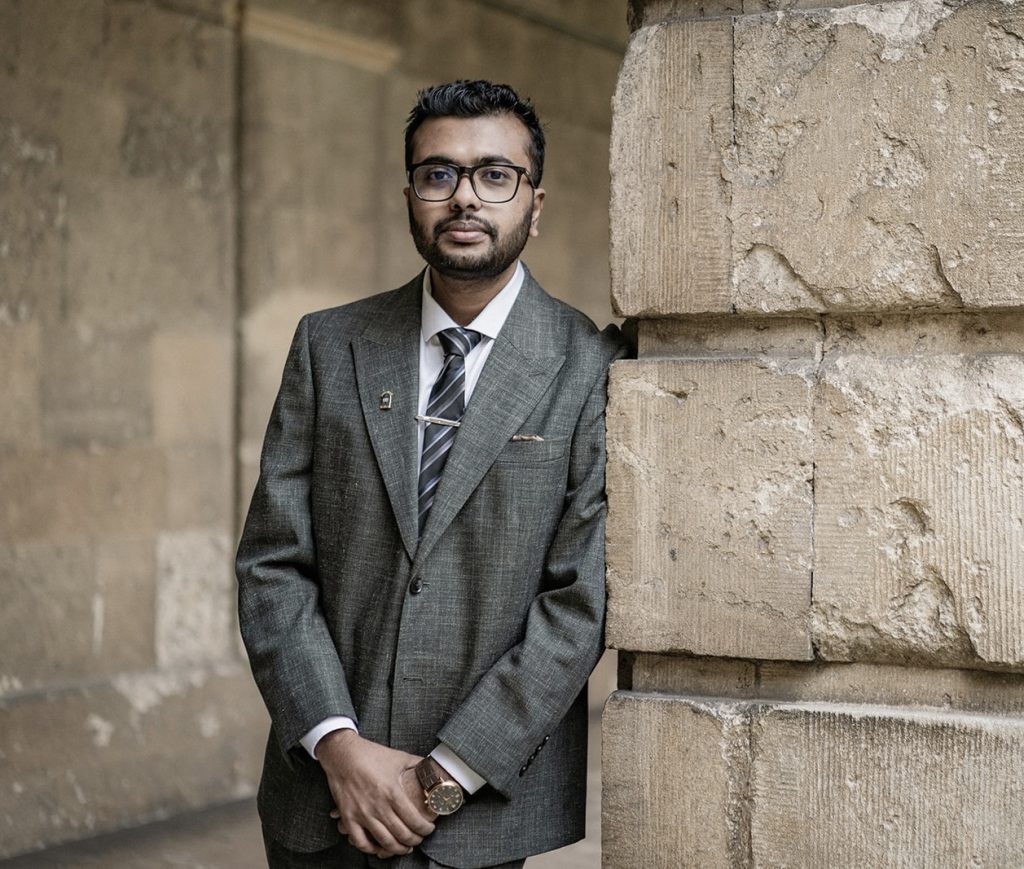
Universities celebrate open inquiry, yet some of the most difficult questions can remain quietly sidestepped. The Uncomfortable Conversations series was created by graduate student Arifur (DPhil in Law) at Queen’s to make space for discussions that feel uneasy.
Inspired in part by the stark reframing of Oxford’s history offered by the ‘Uncomfortable Oxford Tours’, and shaped more personally by the experience of academic censorship, the series responds to a pressing need within scholarly communities. It recognises that researchers and students alike navigate not only external constraints on speech, but also the subtler pressures of self-censorship. By inviting the MCR (graduate) community to sit with ideas that unsettle prior assumptions, the series positions discomfort not as a threat to intellectual life, but as one of its necessary conditions. We asked the series founder, Arifur (DPhil in Law), to tell us more.
What prompted the creation of the Uncomfortable Conversations series?
In late October last year, when I had just started my DPhil in Law, I took a tour called ‘Uncomfortable Oxford’ that reveals to you what Oxford hides beneath its honeyed stone and golden late-afternoon buildings: a complex past that intersects power, privilege, and exclusion. The title of the series is inspired by this tour, but the idea of engaging in conversations that bring discomfort is rooted more deeply in my own experience of censorship.
The idea of engaging in conversations that bring discomfort is rooted more deeply in my own experience of censorship.
In late 2024, my op-ed on queering constitution-making in Bangladesh was censored by a leading daily due to the social backlash it generated. That experience made me realise the importance of creating spaces for conversations that challenge us, particularly for researchers who not only often deal with direct censorship but also internalise the pervasive practice of self-censorship as a way of responding to perceived resistance and backlash. As the MCR Equalities Officer, I designed the Uncomfortable Conversations series to provide the MCR community with an opportunity to sit, listen, and engage with conversations that are uneasy, provocative, or even feel “too much”.
One of our Honorary Fellows contrasts universities that are ‘uncomfortable and empowering’ with those that are ‘comfortable but enfeebling’. How does this series help students develop, both as individuals and members of a community?
The Uncomfortable Conversations series invites students to engage in a reflexive exercise of asking what they have learnt, by what means, and for what purpose. In doing so, it becomes obvious (at least to me) that learning is not self-evidently a complacent practice. Rather, it requires engaging with its twin processes: unlearning and relearning. The series creates a liminal space in which students sit between certainty and doubt while trying to recognise what they know and what they do not yet know. It can certainly be an uncomfortable experience, but one’s intellectual maturity can be shaped in this fashion. Throughout the conversations, as students practise intellectual humility and self-critique, they also, as members of a community, cultivate the habit of disagreeing with respect and listening even when they struggle with the urge to resist. In this sense, the Uncomfortable Conversations series is empowering because our discomfort, instead of constraining us, strengthens our epistemic development, both individually and collectively.
The series creates a liminal space in which students sit between certainty and doubt while trying to recognise what they know and what they do not yet know. It can certainly be an uncomfortable experience, but one’s intellectual maturity can be shaped in this fashion.
What does discomfort mean in an academic context and when is it productive?
I understand discomfort in an academic setting as the experience of intellectual anxiety. It happens when you resist the speaker’s position because you think it would unsettle your prior assumptions and threaten your intellectual security. This fear of destabilisation is the source of your discomfort that subjects your epistemic capacity to vulnerability. Yet such an experience could be productive when the method of handling the vulnerability is not defensive but transformative. To respond defensively is to dismiss another’s position without serious intellectual engagement so as to safeguard your prior belief at any cost. I do not think that is useful. However, if experiencing discomfort leads you to re-evaluate, if not revise, your framework of understanding, it becomes, or at least holds, transformative potential.
How do you decide which topics or speakers to include? What principles guide those choices?
Having conversations that are unsettling is the decisive factor, as long as the conversations cut across matters of equality, broadly understood. Representation definitely matters, both in terms of who is speaking and which issues are addressed. At the same time, logistical realities weigh in. To seal the deal, I ultimately have to consider who is available and willing to speak, often in an informal setting. In some cases, speakers join us via Zoom. My experience has been that while a number of scholars work on difficult or controversial issues, fewer are prepared to discuss them publicly, and not all topics are entertained, even within an academic context. Despite these challenges, I try to curate events across a diverse range of topics. In the past, we have hosted talks on “Palestine as a Queer Issue” and “Gender-Critical Feminism.” Upcoming events include discussions on “The Right to Sex of People with Intellectual Disability”, “Can Men Do Women’s Rights?” and“Sexual Violence Against Men.” Ensuring diversity of perspectives, at the very least in terms of subject matter, is something I consider essential.
Universities are both places of open inquiry and caring communities. How does the series navigate that tension?
The Uncomfortable Conversations series is intended to allow students to raise questions that are otherwise avoided, while ensuring that these discussions take place in a supportive and respectful collegiate environment. We do not promise that the conversations will be easy; quite the opposite. At the same time, we remain mindful that these discussions are not detached from people’s lived experiences. I always try to begin the Conversations by clarifying that the goal is not to reach mutual agreement between speakers and the audience, but to allow space for principled disagreement, if that is where the discussion leads. By learning to remain present in situations of principled disagreement, I think, we can actually ward off the political evil of intolerance. My approach is influenced by David A.J. Richards, my former supervisor at NYU Law, whose work led me to believe that free speech reflects our moral sovereignty and therefore demands respect, above all in allowing others to speak, even when we disagree.
What does a successful event look like to you?
Without relying on the binary agreement/disagreement, the success of the Uncomfortable Conversations series rests on what I call ‘constructive ambivalence’, by which I mean to remain wary of the intrinsic limits of the very ideas, projects, or even the systems in which we retain faith. So as long as there is room for reflections, I think the conversation has done its job. It is more about growing a sense of awareness of limits we might otherwise never recognise than about calling for resolution.
Have you learned anything from the conversations so far that has shifted or challenged your own thinking?
One key takeaway for me is that ideas can survive in an environment that is full of tension and contestation. I used to think that any idea that falls under the category of “controversial” makes mutual engagement impossible and therefore always carries the risk of being shut down. But the last few events of the Uncomfortable Conversations series at the Queen’s MCR have proven me wrong. In fact, I have come to realise that true intellectual growth lies in our willingness to stay in “uncomfortable” conversations which should be the intellectual demand of our time.