Old Member Ollie Randall (Ancient and Modern History, 2012; Creative Writing, 2015) undertook a research commission during the pandemic which has grown into a new book that uncovers an overlooked chapter of literary history. Ollie traces a network of British writers whose friendships on the cricket field shaped literary careers and the cultural landscape of the time.
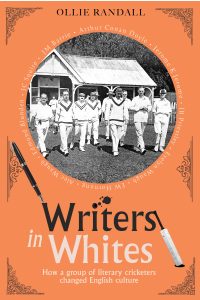
Your book explores an 80-year network of prominent British writers who bonded through playing in cricket teams together. What first drew you to this intersection and was there a particular moment or discovery that resonates with you?
I got very lucky – I initially fell into the project by sheer chance. In April 2020, as the pandemic killed off all my other sources of income, I got offered £500 by the Authors Cricket Club (est. 2012) to do some research on the history of writers who’d played cricket together in the past. I quickly realised that I had a tremendous untold story on my hands: there was a huge amount of fascinating material, dating from the 1880s to the 1960s, but nobody had joined the dots before.
At first, there appeared to be three separate groupings at different points in time – prewar, interwar and postwar. The standout moment of discovery came when I found a reference to a match in 1920 which featured both E.W. Hornung – a key part of the prewar network – and Edmund Blunden, who was a major figure in the postwar network. I suddenly realised that the whole thing was a single continuous tradition… And yet nobody had ever commented on this. Existing books and scholarship completely ignored it.
The standout moment of discovery came when I found a reference to a match in 1920 which featured both E.W. Hornung – a key part of the prewar network – and Edmund Blunden, who was a major figure in the postwar network.
I became convinced that the cricket wasn’t just a bit of pointless fun – it really mattered to these writers, and it mattered to our understanding of what they wrote. So I turned it into a PhD project, and – to my great relief – I managed to prove that my hunch was right!
Many of the figures in your book are well known individually. What does viewing them as a network reveal that traditional literary history tends to overlook?
There are various fun connections – such as my discovery that J.M. Barrie modelled the pirates in Peter Pan on his cricket teammates. But above all, I think the lesson is that these writers weren’t just cooped up in their studies. They had multifaceted lives, and their recreations and their friendships inevitably helped to shape what they wrote. This is especially the case with cricket, where there are particularly good opportunities for bonding, and the sport has a great deal of symbolic and cultural baggage which the literary cricketers were accessing.
J.M. Barrie modelled the pirates in Peter Pan on his cricket teammates.
It also shows how invaluable networking was for a successful literary career. It really helped to be the right sort of chap – and to be a man. This is hardly a surprise, but it’s not often that there’s such a colourful way of demonstrating how this kind of gatekeeping actually worked in practice. It is, of course, easier to get published when your captain runs a literary journal, your best bowler is a literary agent, your wicketkeeper is a publisher and your batting partner writes bestsellers.
Edmund Blunden, another Old Member of Queen’s, features prominently. How did his time at Queen’s shape the way he connected with other writers?
Yes, Blunden is one of the book’s major characters! It’s an interesting point, because his Queen’s experience was very atypical. He got a scholarship to Queen’s, but before he could take it up, he was sent to the Western Front in the First World War. During the war, when he expected to die, he impulsively married a girl whom he met on leave. Then, when the war ended, the Governing Body initially refused to honour his scholarship because there was a rule against undergraduates being married. The College relented and let him in, but his student experience was certainly shaped by the fact that he was older and had a wife.
Blunden was deeply traumatised from the war, and I think that his time at Queen’s was a period of healing for him, as he readjusted to normal life. It was also the time when he started to network with other writers – partly, I think, because he felt disconnected from most of his undergraduate peers, so he threw himself into Oxford’s literary scene instead. Then his writing career took off and he got too busy for his studies, so he left Queen’s without his degree – not that this stopped him becoming a professor at Merton a decade later.
This project grew out of your doctoral research. How did it evolve from thesis to book, and what did you have to reshape for a wider audience?
This was actually the easiest part – I’d always known that I wanted to turn it into a book, and I think I’d been writing it in the back of my mind as I went along. In general, I simply took out all the historiographical debates and put in all the good anecdotes and human touches that I couldn’t squeeze into the thesis. The personalities are much more present in the book, but I’ve tried not to lose sight of the bigger picture: the reasons why this mattered; the reasons why I was allowed to do a PhD on it!
Also, a lot of the primary sources were really funny. For instance, Evelyn Waugh got roped in a few times by his extremely keen brother. He wrote a hilarious article for the Cherwell about a chaotic cricket match that he got dragged along to while he was still an Oxford student. I was able to include his full account in the book, which I never could have done in the thesis. The humour was obviously a vital part of the literary cricket experience, so I did write about it in the PhD – but it was much easier in the book simply to include the jokes without having to justify why they were there.
You studied both Ancient and Modern History and Creative Writing at Queen’s. How did that combination influence the way you approached researching and writing the book?
Yes: I was the first Creative Writing student at Queen’s, and – as far as I’m aware – still the only one. And it’s been an invaluable combination of degrees throughout this project. Obviously when I was writing the book, I was deploying both my history skills and my creative writing skills. But also, earlier in the research phase, I think that my Creative Writing degree gave me a different way of looking at the project. I was thinking about the practice of writing, and what it means to construct a lifestyle as a writer – things that we discussed a lot on the Creative Writing course – and viewing the literary cricketers in this light.
You highlight the importance of friendship and informal networks. Where do you see a modern equivalent of this kind of creative community today (still in cricket?) and how does it differ?
I’ve been thinking about this a lot over the past few years, and I still don’t have an entirely satisfactory answer. I think that our society is much more pluralistic in terms of values, recreations, and backgrounds, so no single group can claim such a large chunk of the literary world for themselves. The modern Authors Cricket Club is more niche, not least because cricket means something different now – it’s not as resonant as it was a hundred years ago. Fundamentally, I think creative communities look different today: less structured, more online.
Looking back, is there an experience from your time at Queen’s that you can trace directly to your development as a writer?
I always wanted to be a writer. As an undergraduate, I loved the drama and the human moments that constantly cropped up in the Ancient and Modern History degree. When I was in the library revising for Finals, lots of my revision notes had little jottings on them, about details that would work well in a book. I think those comments reflected my drive to combine learning about the past with writing. It was also a fellow Queen’s student who told me to go to a careers talk about the Creative Writing Master’s course, which immediately inspired me to apply.
What is your favourite place in College?
My favourite spot has got to be the Beer Cellar. It’s the most atmospheric of any college bar that I went to, and I loved the sense of college community that I always found in there. It was a great place for chatting to people I didn’t necessarily know very well, and building friendships. Which, now that I think of it, is a neat way to end a discussion about literary friendships and creative communities!
The Beer Cellar

Header image: Dominic Turner