Viewing archives for Community stories

In September 2025, The Revd Liam Cartwright joined Queen’s as our new College Chaplain. At the end of his first term we asked him about his Michaelmas experience, and what he is looking forward to in 2026.

How would you describe your first term at the College, and what has stood out to you the most so far?

It has been a bit of a whirlwind – I hit the ground running with the Old Members’ Evensong and Dinner on my second day in post and the pace didn’t slow until after the Boar’s Head Gaudy!

It’s been great to join in with the rhythms and traditions here at Queen’s. I really enjoyed meeting all the Freshers in October, and my official licensing service was a really special occasion – it was lovely that members of my family, as well as friends and colleagues from various different parts of my life, could join us too.

Much of this term has been spent getting to know people and how the College works. In many ways it’s a very different job to being a parish priest, but I’ve quickly realised that an Oxford college is very similar to a parish in as much as you have a geographical location which is home to a diverse community for whom you have pastoral and spiritual care. I still have much more to learn, but as Hilary Term approaches I feel like I’m starting to get the measure of the place and my role within it.

What have you enjoyed most about joining the College community?

It’s very humbling to be part of a community in which I’m surrounded by such inspiring people – people who are or who aspire to be the brightest and best in their field and with whom I get to interact on a daily basis. I’ve loved getting to know members of the student community – especially the Freshers, the student presidents, the choir, and the welfare reps, and I hope I’ve begun to establish myself as a supportive presence. I’ve really enjoyed the various dinners – whether it’s been meeting Old Members, learning about the lives and work of the academic staff, or chatting with current students, it’s a really enriching part of the job. I also really enjoy the conversations I have with the many dedicated people who enable the College to function on a day-to-day basis, whether it’s by cleaning the rooms, preparing the food, or keeping the site running. It’s striking how many of these people have worked here for very many years, which I think is testament to the sense of wellbeing and community here at Queen’s.

Have there been any particular moments, events, or interactions that have helped you feel settled in?

I’ve found Queen’s to be a place in which it’s very easy to feel at home very quickly. I’ve been really touched by how welcoming everybody has been. The lodge team, academics, and senior officers have made such an effort to get to know me and to help me navigate the College and its systems and traditions, which I think it’s fair to say are sometimes idiosyncratic to say the least!

It’s been helpful starting alongside the new Provost, Domestic Bursar, and others – we’ve enjoyed a great sense of camaraderie as we try to figure out our new environment together! I’m really impressed with the emphasis the College puts on welfare and it’s brilliant working alongside Luke Young, from whom I have already learnt from so much. I’ve especially enjoyed spending time with the student welfare reps who’ve helped me understand the student experience here and respond to it. Owen Rees and the choir put me at ease right from the start and have been so kind and welcoming. After my first evensong one of the choir members told me it felt as though I’d always been here, which was such a positive affirmation. Prior to ordination I pursued a career as a professional organist, choral conductor, and church musician, so it’s a privilege to be working alongside such gifted musicians on a day-to-day basis at Queen’s.

What are you hoping to bring to the role of Chaplain as you continue into the year?

I hope to continue getting to know the community through listening, deepening existing relationships, and forging new ones; being present and building trust; and ensuring that welfare support as well as pastoral and spiritual provision for the whole College is as inclusive, accessible, and effective as possible.

Is there anything you would like the wider college community to know about you or your hopes for 2026?

The most important thing I’d like to reiterate is that I’m here for everyone – whoever you are and whatever you do here, and wherever you are in terms of beliefs – whether you’re a scout, student, domestic, administrative or academic member of staff – I’ll always be happy to see you for a chat and a coffee.

Similarly, the chapel is there for the whole community. There’s no right or wrong reason to come – whether you want some quiet contemplative space, or to attend a concert, or to come to a service – please make use of it whenever you like. My hope is to see the chapel being used for a broader range of events and activities, and that in doing so a more diverse cross section of the community will enjoy it.

We’re incredibly privileged at Queen’s to have one of the best choirs in the world right here in our midst, singing Evensong in the Chapel every Wednesday, Friday, and Sunday evening. Wherever you are on the spiritual journey, it’s a truly wonderful antidote to the busyness of college life – a chance to unwind at the end of the day, perhaps before going to dinner – and to experience world class music and timeless liturgy within the awe-inspiring surroundings of our chapel. It’s an experience unlike any other; please do come along – you can always be assured of a warm welcome.

Dr Matthew Shaw, Librarian

 ‘On Sunday 14 of May some members of the Historical Society made a tour, on bicycles, of some of the historic churches of the district…’ So begins a record of cycle ride undertaken in 1922 by several members of the College, including the future provost, R.H. Hodgkin (who enjoyed exploring the countryside on both horseback and bicycle; his widow later blamed the exertions on the latter for his blindness in one eye). The account, which can be found in a minute book kept in the Library, details the route from the College, to Yarnton, South Leigh, Stanton Harcourt and Babcock Hyde. Could, I wondered, the route be recreated a hundred years later?
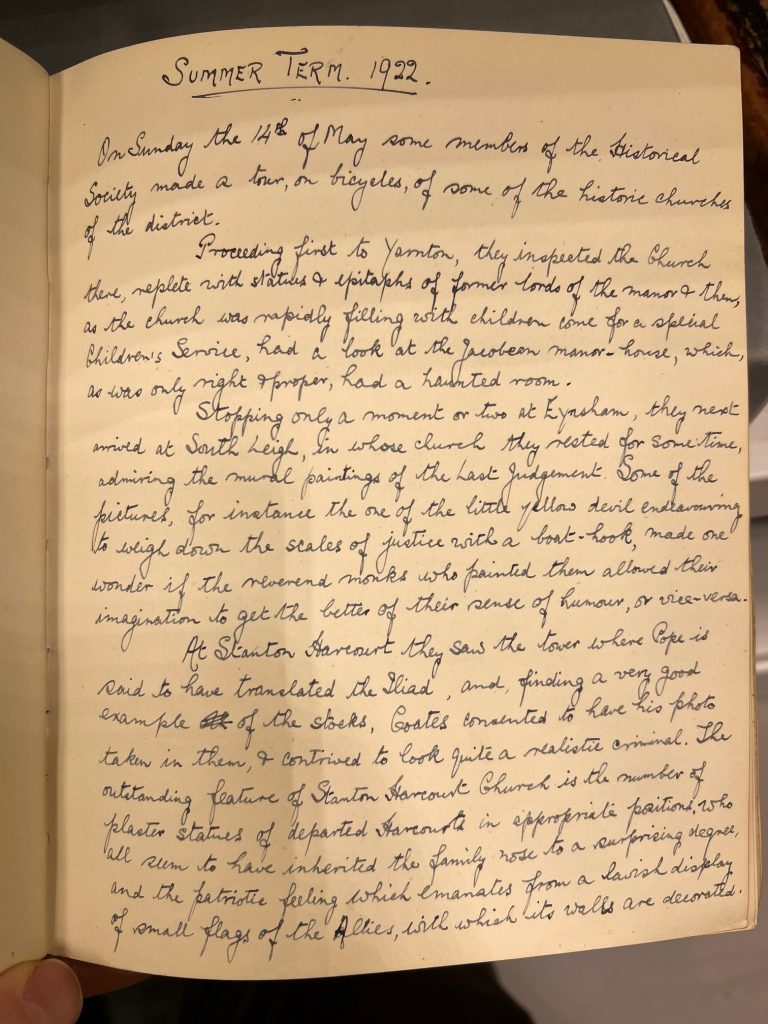
The note from Summer Term 1922

On a sunny and nearly cloudless 11 June 2022, the College provided a positive answer. Marking Bike Week, the recent revival of the Historical Society, and, most importantly, the centenary of the ride, over a dozen Staff, Fellows, Old Members, offspring, friends and partners gathered at 10am in front of the College. There was perhaps more Lycra and carbon than was present in 1922, but a copy of Pevsner was sighted, along with several sturdy steel bikes and woollen jerseys.

The route began with what was probably a variation on the 1922 course, following the canal north to the A44; presumably our precursors took the then-quieter Woodstock Road. St Benedict’s Church in Yarnton offered the first stop. A century after the building ‘rapidly fill[ed] with children come for a special Children’s Service’, today’s parishioners had arranged a flower show, along with a coffee and cake stall. The Rev. Petters was also there, and gave a very brief introduction to the history of the church, the status of the Jacobean Manor House (now being turned into a theological centre, and so we were unable to verify the presence of the ‘haunted room’ identified in 1922), and led the group into the usually closed chapel, with its fine armorial painted glass and tombs of the Lords of the Manor.
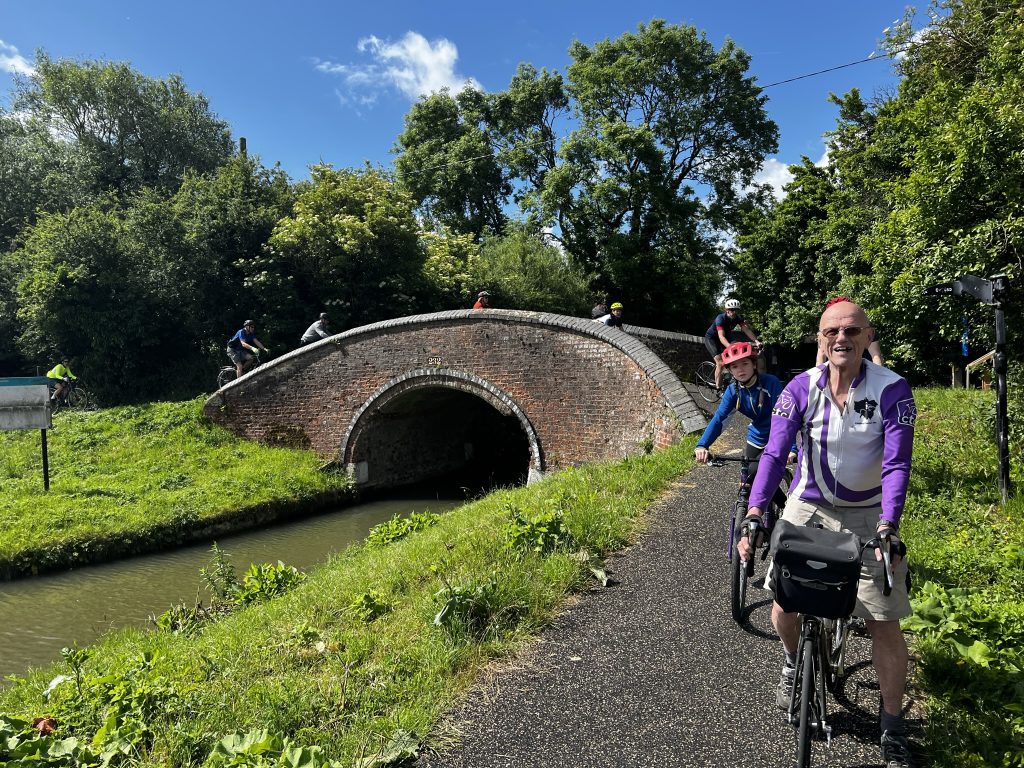
a bridge along the cycle route

Almost immediately after this stop, came a contemporary addition to the route: Worton Kitchen Gardens. Along with further coffee and cake, some further novelty was unveiled, as Prof. Morten Kringelbach launched ‘Serafina’, a drone camera for an aerial group photograph and video. Supplies for supper were also purchased. Initially, this was to be the end of the ride for those wishing to do a shorter route, but spirits remained high and legs were fresh, so a complete peloton continued towards Eynsham making use of the quiet old road. Just before the town, two participants peeled off, one to attend the launch of a kiln in Wytham Wood. The main group continued via Queen’s Street, noting the Queen’s Head and Queen’s Lane along the way.  Heading across country, a bridleway led to South Leigh, which given the imaginative use of bunting and royal mannequins on view had clearly celebrated the Platinum Jubilee with some enthusiasm. A sprint up the hill, and into the church of St James the Great, with its door left open for swallows. Inside, the Doom Painting, restored in the nineteenth century and showing a ravenous hell mouth and enthusiastic devil attempting to weigh down souls as they were weighted impressed the group. Outside, the clock dial offered a warning, ‘Ye Know Not What Hour Your Lord Doth Come’.
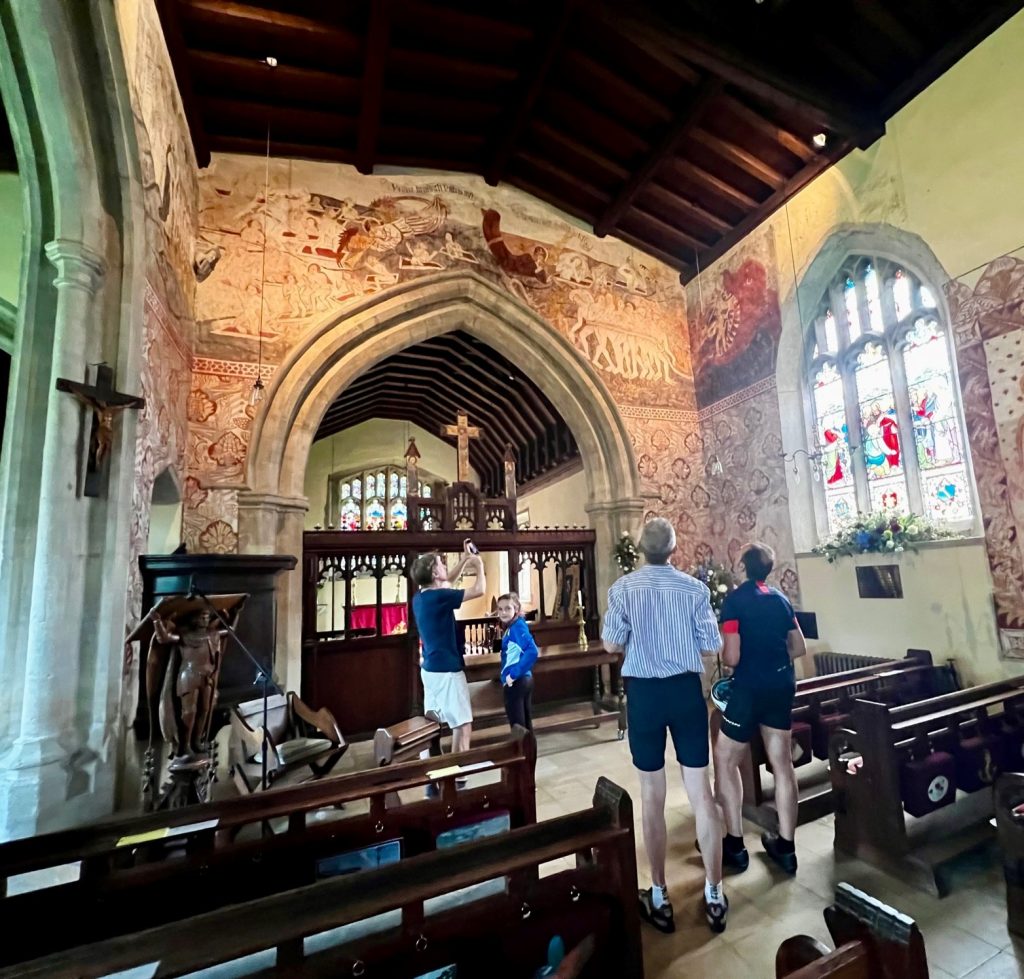
South Leigh Church interior

Continuing with the theme, an addition to the route: the Devil’s Quoits, hidden alongside a large recycling centre near Stanton Harcourt (Pope’s Tower remained unsighted on this tour; perhaps something for 2122). Partly destroyed during the preparations for an R.A.F. runway during the Second World War and restored in 2008, the Devil’s Quoits are a large Neolithic henge (or stone circle). Seraphina again took flight, leaving no hiding place for terrestrial beings below.

Hunger now became something of concern for the group. Our antiquarian rather than athletic pace meant we had missed the kitchen at the planned stop at a public house in Northmoor. The Ferryman at Bablock Hythe had a similarly closed kitchen, so the decision was taken to refuel on crisps, nuts and other bar snacks, washed down with some shandy while we contemplated the River Thames and the loss of the ferry in the 1960s.

The spot, of course, appears in Matthew Arnold’s The Scholar Gypsy, which references Joseph Glanvill’s The Vanity of Dogmatizing (1661). In preparation, I inspected our copy – a slightly later, second edition (1665). Perhaps anticipating the loss of the ferry, the tale of the scholar gypsy had been edited out. Arnold clearly had access to the 1661 text.

While a couple of wild water swimmers suggested a possible method of crossing the river, we instead headed along the banks of the Isis (with one Old Member making his farewells at this point), crossing at a lock. It began to feel as though we were on the home stretch as we arrived at Appleton, then Cumnor and then via bridle path ascended the heights of Harcourt Hill, and substantial views across the county and city.
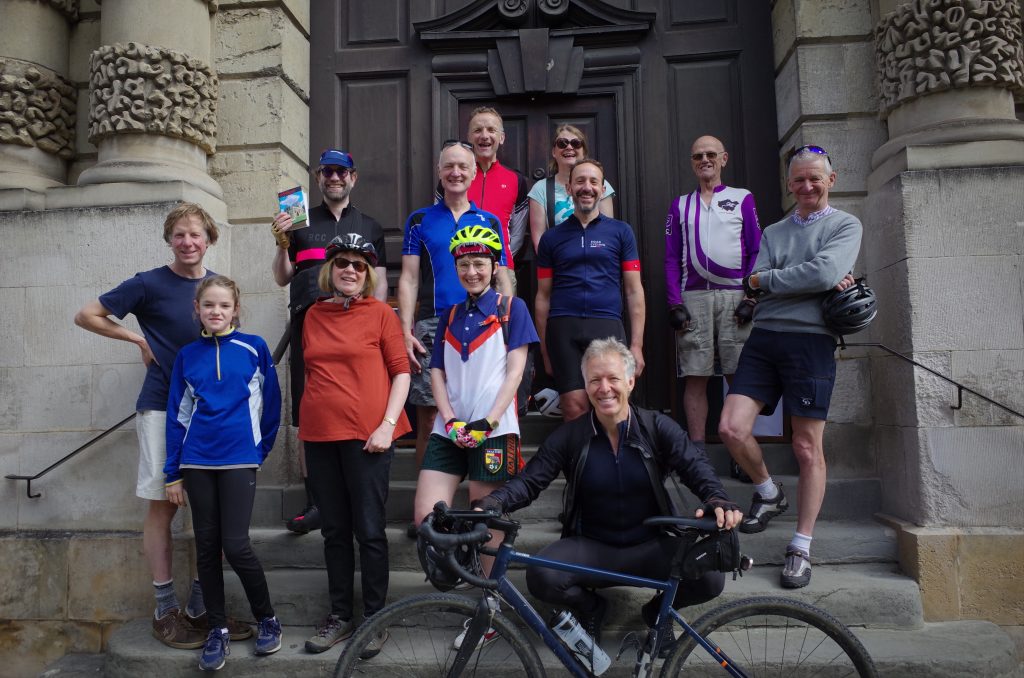
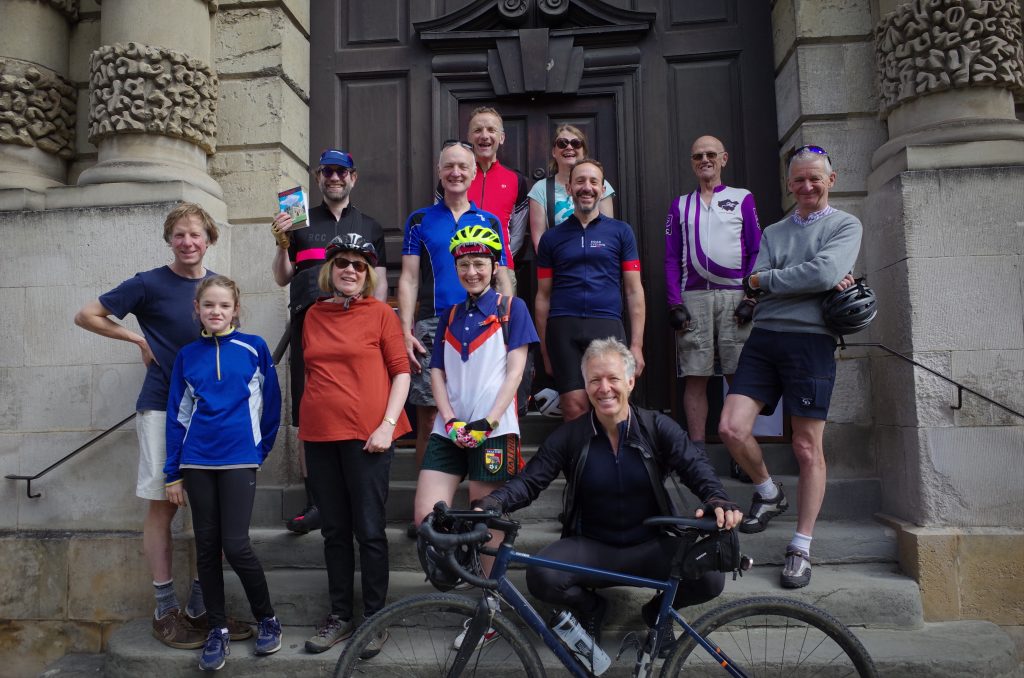
The College team on the stone entrance steps

The professional riders of the 2022 Women’s Tour had arrived ahead of us as we descended into Oxford, leaving the city bustling with visitors and cyclists, with some race signs and apparatus appropriately marking the end of the route. Almost at the strike of 4pm, the group returned to the front of College, and then retired for a welcome drink in the Provost’s Garden, sitting almost directly above the vault in which the minute book containing the account of the 1922 ride is stored. Where, we wondered would the College’s peloton go in 2122?