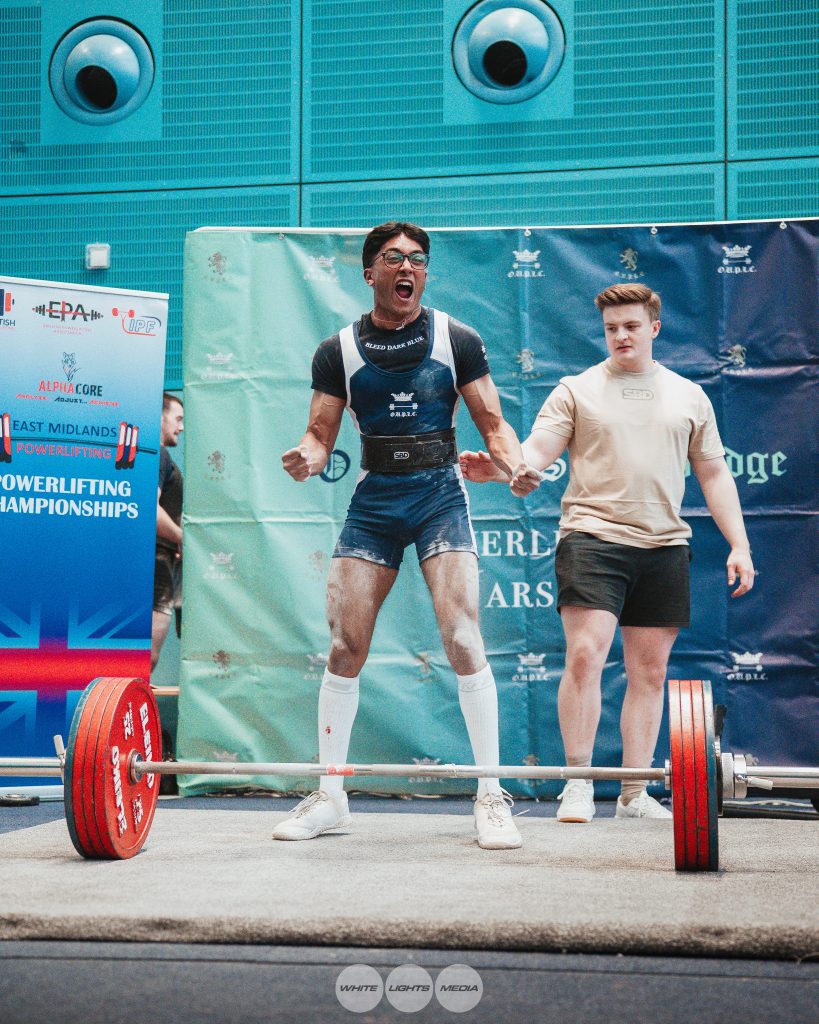
The College congratulates 6th-year Medical student Karthik Saravanan who has broken three University records at the Varsity powerlifting competition and qualified for BUCS (British Universities and Colleges Sport). We asked him how it feels and how he fits in all the training alongside his Medical degree.
Congratulations! What was going through your mind at the Varsity competition?
There were all sorts of things going through my mind. Many of them were also extra surprises that I definitely didn’t intend to happen! Amidst all the rush of travelling to Cambridge, cutting weight, and competing immediately after finals, I completely forgot all my powerlifting kit at Oxford! So the first thing on my mind was obviously, where on earth do I find some kit that I can use on the day, and will it even fit me (I’m significantly lighter than all the other men at OUPLC)? There was also the worry about making weight, because I’ve never done a proper weight cut for a competition before, and needed to be below 66kg for any of my record attempts to count. In the end, I weighed in at a very comfortable 64.6kg which was a pleasant surprise! Thanks to the generosity (and organisation) of one of the other club members who was volunteering on the day, Byron, he lent me his belt and knee sleeves to use on the day. Despite me having some kit to compete with, Byron’s knee sleeves were massive on me so I hit a much lower squat than what I’d originally planned, leaving a lot of pressure on me to hit a big bench and deadlift to secure the 3 OUPLC records in the 66kg weight class.
With my girlfriend watching me in the stands, and my coach handling me, the only thing I wanted to do was to make myself and everyone else proud, after all the months of hard work I put into preparing for this meet. On my second attempt bench I then hit 117.5 which secured a +5kg OUPLC record. For deadlifts it was all or nothing for me at that point… By my second attempt with 212.5kg I’d already broken the previous OUPLC record of 205kg.
However, my goal going into Varsity was also to take the U66kg total record too. In training the week before, I’d actually failed a 215kg deadlift before competition. To secure the OUPLC total record, and hit a 475kg total however, I needed to hit 220kg on my third attempt. When the bar was loaded for my final attempt, the only thing going through my mind was to leave absolutely everything out on the platform no matter what. I dug deep, and with massive crowd support from my friends at OUPLC cheering me on, I smashed the 220kg deadlift on my final attempt, breaking my third U66kg OUPLC record!
I dug deep, and with massive crowd support from my friends at OUPLC cheering me on, I smashed the 220kg deadlift on my final attempt, breaking my third U66kg OUPLC record!
How did you first get into powerlifting, and how has your skill developed alongside your medical studies?
I first got into powerlifting via the Cuppers competition ran by OUPLC towards the end of my 4th year. I originally entered a team for Queen’s with a few of my mates, and Alisa (the VP of the club at the time) in particular was really encouraging! She was the main person who supported my application to dev squad at the start of my 5th year, and helped a lot with getting me into the sport and prepping for my first ever competition this time last year. Between 5th year and 6th year, I’ve overall made lots of progress thanks to the club coaches at OUPLC, but this wasn’t without challenges. I took a break from powerlifting during my 5th year exams, and got ill for a few weeks during the summer before the start of 6th year, so I had a couple of minor setbacks. Otherwise, my strength has skyrocketed since joining OUPLC!
Medical degrees are obviously demanding. What does a typical training week look like for you, and how do you make it work?
I train three times a week for powerlifting, with each session taking around 2-2.5h in the gym. Due to my clinical placements that take place in mornings/afternoons, I typically tend to train either in the evenings or weekends – oftentimes these also coincide with OUPLC club sessions which gives me a nice community of people to train alongside too. I usually then organise my degree commitments around my training with the spare time before my sessions, which is fairly easy to manage.
However, during the run up to Varsity things were FAR more hectic than usual, since Varsity was scheduled for just three days after my final year medicine exams. Balancing CNS fatigue from doing heavy training sessions often meant that I was very cognitively taxed after training in the gym, making it really difficult to focus in the library during my finals revision. My heaviest training week (one week out from Varsity) also directly coincided with my first week of OSCE examinations. This meant that I would often have to go to the gym either between or after an exam during two of my toughest powerlifting sessions – both of which I did on significantly poorer amounts of sleep than usual due to late night revision in the library and early exams in the morning. During my last exam week especially, it became increasingly difficult to manage sleep debt alongside Varsity prep and finals revision all at once. I just tried my best to visualise the end goal once it was all finished to keep myself motivated throughout difficult times.
I just tried my best to visualise the end goal once it was all finished to keep myself motivated throughout difficult times.
Does your medical degree influence how you approach strength, recovery, or performance?
Doing a medical degree definitely makes me quite introspective with the way I approach strength training in general – even before starting powerlifting. I have always had an interest in orthopaedics and sports medicine even before starting powerlifting, this has only grown since!
What have you learned from powerlifting that makes you a better future medic?
In powerlifting, progression often isn’t linear. Even when you’re on a program which is designed for you to get incrementally stronger week by week, this is often idealistic and never the case in reality. A medical career often has the same sort of roadmap and progression. From dealing with setbacks in powerlifting (e.g. illness/injury), it has taught me that there is always a way to eventually achieve a positive end outcome if you keep staying consistent and putting in hard work. I imagine my medical career will very much be the same with its own set of unique challenges along the way.
What would you say to prospective students who worry they won’t be able to pursue serious sport alongside an Oxford degree?
You will never know whether or not you’ll be able to pursue a sport alongside your degree unless you try it! Once you try it, and fall in love with the process, you’ll also surprise yourself with the amount of time you can create for yourself to follow a newfound sporting passion. Even if it’s something you’ve never done before at all before university (like in my case, starting powerlifting as a 5th-year).
In spite of qualifying, you won’t be able to compete at the British Universities and Colleges Sport as you’ll be abroad on your medical elective. So, what’s your plan for continuing with the sport?
Whilst I can’t compete at BUCS, I have my eyes set on other national competitions. I hope to compete in a regional competition after I return back to the UK, to further extend my OUPLC records and qualify for All Englands. Provided I qualify, I would then hope to secure a half or full blue award at All Englands. I have just now restarted training here in Barbados, which I hope to continue throughout the rest of my elective period.
What’s your favourite thing about Queen’s?
The student community and the friends I’ve made along the way. Several of my favourite moments throughout this degree have either happened on College grounds, with my closest friends at Queen’s, or both. Having people that believe in me and understand me has really helped me enjoy my time at Oxford, and have the confidence to throw myself into as many new challenges as possible.
Having people that believe in me and understand me has really helped me enjoy my time at Oxford, and have the confidence to throw myself into as many new challenges as possible.
Header photo: White Lights Media UK