Hidden in plain sight: medieval fragments reveal Guernsey’s lost literary culture
17 fragments of medieval manuscripts, preserved for centuries in an unexpected place, are transforming our understanding of Guernsey’s literary history.
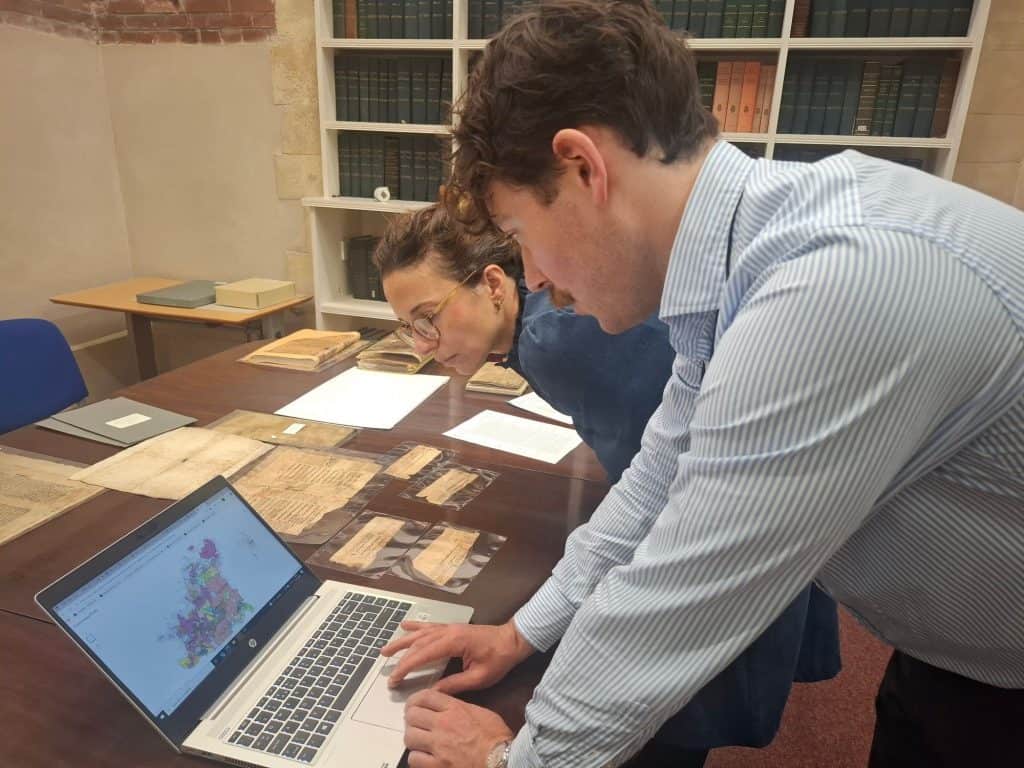
The fragments, quite literally hidden in plain sight, were identified by the team at Guernsey’s Island Archives working with Fellow in English at Queen’s Professor Tamara Atkin and manuscript expert Dr David Rundle of the Centre for Medieval and Early Modern Studies at the University of Kent.
Centuries ago, these pieces of old medieval manuscripts were recycled as covers for administrative notebooks recording the island’s feudal holdings and have been preserved among the collections of Guernsey’s Island Archives and in His Majesty’s Greffier’s Strongroom.
Until now, remarkably little was known about the books being read and circulated in medieval Guernsey. The fragments provide the first substantial evidence of the island’s medieval literary and textual culture, revealing the presence of scholastic, liturgical and literary works in both Latin and French.
Professor Atkin said:
Ask most people, including scholars of medieval and early modern literature, what they know about the literary culture of premodern Guernsey, and the answer that you’ll invariably get back is ‘not much’. These discoveries by the team at Island Archives transforms what we can now say about Guernsey’s medieval manuscript culture. They offer definitive evidence of Guernsey’s medieval literary and textual culture and reveal that books of several kinds – scholastic, liturgical, and literary – were available on the island.
The 17 fragments include six written in French, providing evidence that when Guernsey’s keen medieval readers read in the vernacular, they read in French rather than English. Among the most intriguing discoveries is part of L’Estoire de Griseldis, a dramatic retelling of the story of Griselda dating from around the end of the fourteenth century. The text is exceptionally rare, surviving in only one other manuscript and two later printed editions.
Crucially, the fragment shows for the first time that the manuscript play was being read beyond the French royal court circles where it most likely first circulated and helps explain how it went on to find a wider audience in the sixteenth century. The piece of manuscript gives an insight into what people were reading and where a well-loved story travelled.
But it is not only the original manuscripts that can tell us about Guernsey’s past. Their later transformation into practical bindings is itself evidence of island life and its connections beyond Guernsey.
As book historian Professor Atkin explains:
The subsequent reuse of these fragments as covers for the island’s administrative records allows us to glimpse at local binding practices and highlights the extent to which the careful husbandry of resources was a feature of island life. That these practices are not unique to Guernsey also sheds light on the island’s cultural and administrative links to the French and English mainlands.
Far from being scraps of books that had outlived their usefulness, their reuse ultimately helped them survive. Several centuries later, these fragments are now providing evidence of a literary culture whose traces had otherwise almost entirely disappeared.
To introduce the discoveries to a wider audience, Island Archives will host an academic study day on 10 September 2026. The day will feature a round-table discussion with subject expert academics from the UK and France, a hands-on study session with the fragments, and a public talk open to the local community.
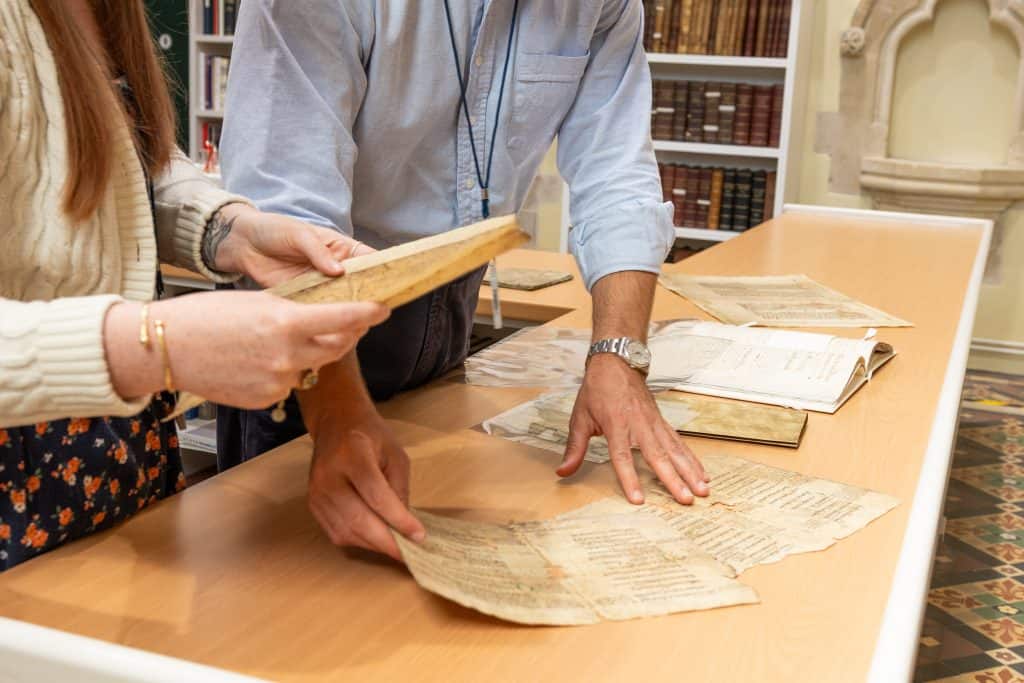
Image: (c) Max Rhydwen-Jones/States of Guernsey; header image is of Prof Atkin and Callum Tostevin-Hall, the Archives Assistant who found the fragments, taken by colleague Dr David Rundle