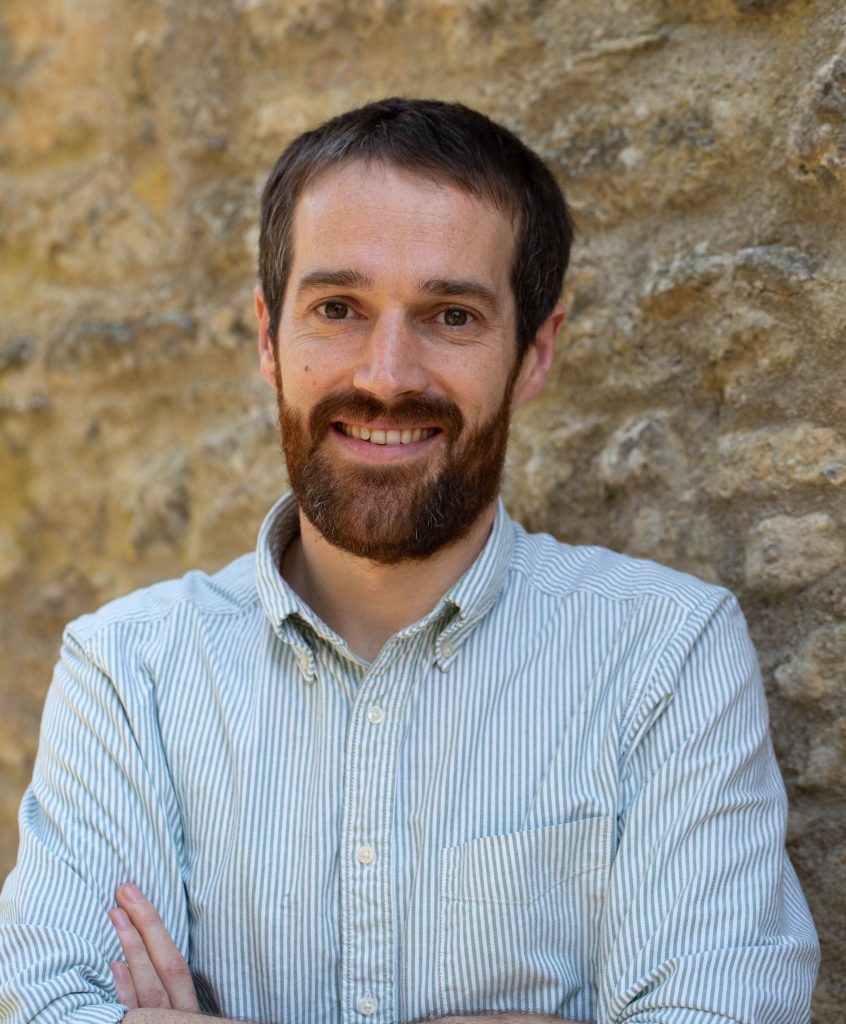
The College warmly congratulates Prof Rob Weatherup who is one of 11 academics from the University of Oxford to lead new research projects supported by European Research Council (ERC) Consolidator Grants. These grants support highly promising mid-career scientists of any nationality and any field with building a research team at an eligible host organisation.
Current chemical and fuel production methods are driving climate change. Prof Weatherup’s project is called OPERATE (Operando Probing of Electrochemical Reactions At Triple-phase-boundaries) and it seeks to make chemicals and fuels more sustainable by decarbonising their production.
This requires efficient electrochemical reactions that turn water and carbon dioxide into useful products. However, these reactions take place at complex ‘triple-phase’ boundaries where solids, liquids and gases meet. Such phases are extremely difficult to study.
OPERATE, led by Robert Weatherup (Professor of Energy Materials at the Department of Materials) will develop new ways to observe these reactions in real time, using advanced X-ray techniques and precisely engineered nanoparticle catalysts.
The project will use and develop operando methodologies; analysing a material inside its working environment while simultaneously measuring its performance. In this case, tracking structural and chemical changes of the nanoparticle catalysts while measuring the voltage and current applied to them. These methods provide a ‘live view’ into the functional world of materials.
By revealing how catalysts change during operation, the project will guide the design of improved systems for producing sustainable fuels and chemicals, helping to drive society’s transition to Net Zero.
Prof Weatherup says:
What excites me most is the opportunity to pioneer new approaches for automating catalyst discovery and to advance operando techniques that reveal how catalysts behave under truly realistic device conditions. The long-term support from this ERC grant will allow us to uncover how catalysts really function and guide the design of next-generation sustainable technologies.
Consolidator Grants award around €2 million for projects typically lasting 5 years. Awardees must have 7-12 years of highly promising postdoctoral experience plus an excellent research proposal. With funding from the EU’s Horizon Europe programme, these grants will support cutting-edge research at universities and research centres in 25 EU Member States and associated countries. The ERC received 3,121 applications for this call, of which 11.2% were successful.
Oxford received more grants than any other institution in the UK; discover all eleven Oxford grantees.