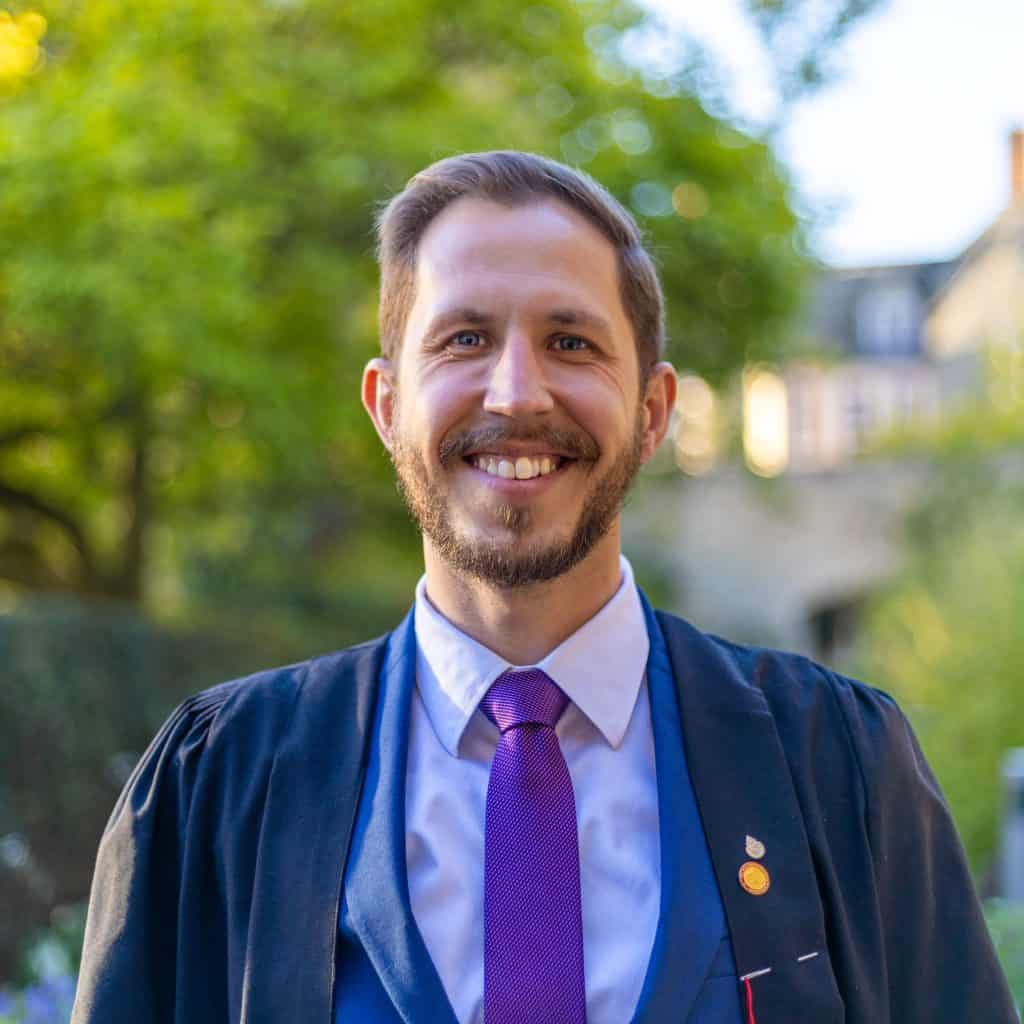
The College warmly congratulates Dr Mats van Es, Extraordinary Research Fellow in Experimental Psychology, who has been awarded a Medical Research Council (MRC) Career Development Award to establish his own research group investigating how the brain coordinates thought, memory, perception and action.
His work could lay the foundations for a new generation of brain-state dependent therapies for neurological and psychiatric disorders. We asked him to tell us more.
Congratulations on your MRC Career Development Award. What does receiving this award mean to you, and how will it shape the next stage of your research career?
This is an enormous personal milestone. Throughout my career I’ve worked on projects led by other researchers, but this fellowship recognises my own scientific vision and gives me the opportunity to build an independent research programme. It also comes with many opportunities, as I now get to set up my own lab, and hire students and junior researchers.
Your research investigates how the brain coordinates thinking, memory, perception and action. What is the central question you’re trying to answer, and why has it remained such a fundamental challenge in neuroscience?
Imagine you’re driving to work. You need to pay attention to traffic, remember where you’re going, plan ahead, and react if something unexpected happens. The brain can’t prioritise all of those things simultaneously, so it has to constantly decide what to prioritise. My research asks what principles the brain uses to coordinate these different cognitive functions efficiently. Traditionally, neuroscience has studied one mental process at a time—for example memory or attention. But in real life, the brain is constantly juggling many different processes. Understanding how it coordinates them has remained surprisingly difficult because we haven’t had the tools to observe these rapid changes.
My research asks what principles the brain uses to coordinate different cognitive functions efficiently.
Your work suggests that what was once thought of as the brain’s background “noise” actually follows structured patterns. Why is that discovery so significant, and how could it change the way scientists think about the brain?
The brain is constantly changing, even when you are trying to do exactly the same thing. For example, if you are fully concentrating on pressing a button whenever a light flashes, your reactions will still vary from one trial to the next. Sometimes you react a fraction of a second faster, sometimes a little slower, even though nothing has changed. Psychologists have often assumed these differences simply reflect random noise in the brain. My research suggests that this “noise” is anything but random. Instead, it follows predictable patterns that may reflect the brain rapidly switching between different cognitive operations in the background.
The brain is constantly changing, even when you are trying to do exactly the same thing.
One of the most exciting aspects of your work is its potential to lead to brain-state dependent therapies. What could that mean in practice, and how might patients benefit in the future?
Imagine if brain therapies could adapt to what your brain is doing at that very moment. Given that the brain rapidly switches between different modes of processing, which we can read out from brain activity recordings, can we use this information to time brain therapies? Adaptive therapies like this are already used in Parkinson’s disease, where a specific part of patients’ brains is electrically stimulated at the right time. This principle could make brain therapies more efficient for patients with various psychiatric and neurological disorders.
How has being an Extraordinary Research Fellow at Queen’s supported your work?
It has been genuinely helpful to test and refine my ideas through conversations with Fellows both inside and outside my area of expertise, and they have encouraged me to think more broadly about the implications of my work. A few Fellows have also kindly helped me prepare for my MRC interview through a mock interview.
What do you enjoy most about being a member of the College?
I get to meet and chat to academics from every discipline imaginable on a daily basis – people I wouldn’t run into at my department. All of us are united in our intellectual curiosity, and so these conversations really broaden my perspective. I also love quirky traditions, and Queen’s has quite a few that fall in that category!
All of us are united in our intellectual curiosity, and these conversations really broaden my perspective.