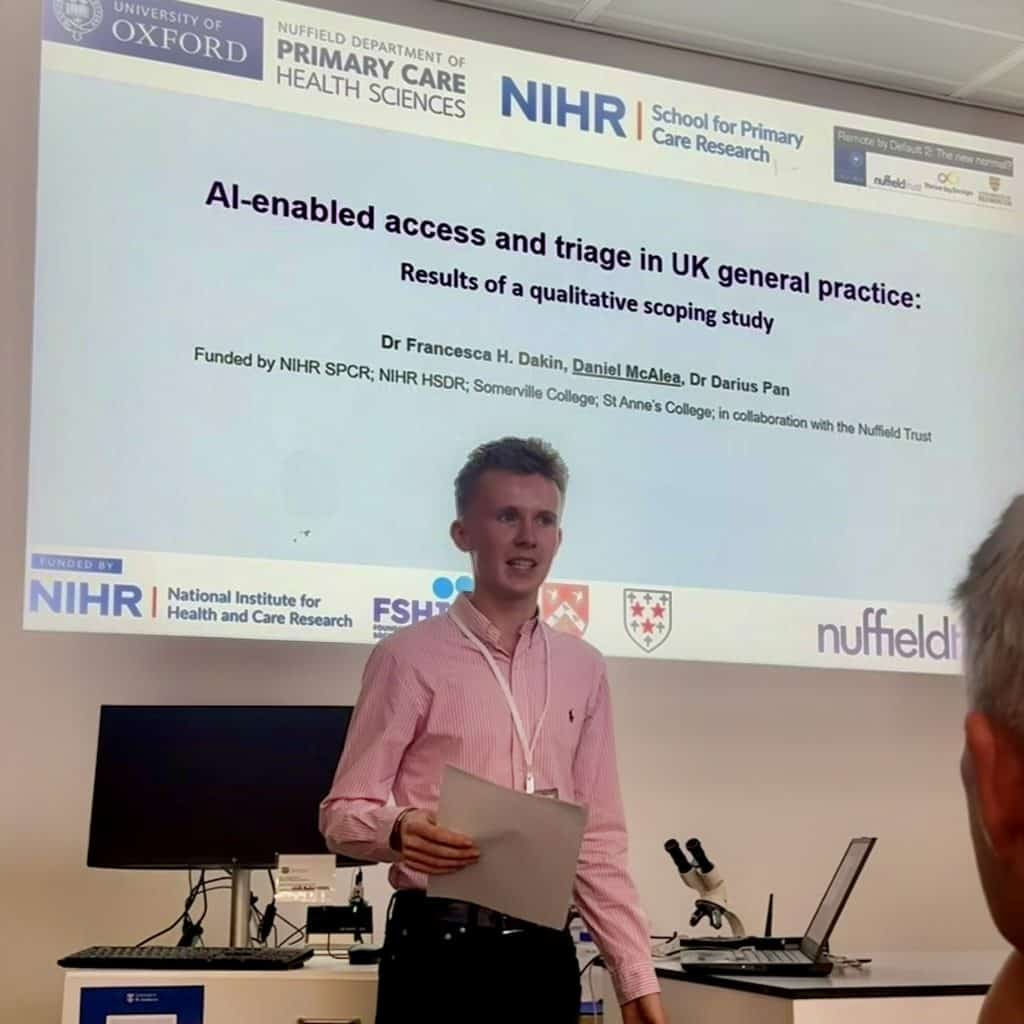
The College warmly congratulates 5th year Medical student Danny McAlea who has been highly commended in the NIHR School for Primary Care Research (SPCR) George Lewith Prize results for his essay ‘AI-enabled access and triage in UK general practice: results of a qualitative scoping study’. Here he tells us what he explored in his essay and why, with the widespread adoption of new AI-powered technologies, he thinks it’s more important than ever that clinicians are involved in policy-making.
What first drew you to the question of AI-enabled access and triage in general practice?
I think that questions over the use of artificial intelligence in modern-day life, be this in education, business or medicine, are currently at the forefront of many people’s minds – with questions over the safety of technologies, their implementation and outcomes being particularly topical. Naturally, this is reflected in the type of research which is taking place at Oxford, and I was fortunate enough to be part of a project led by Dr Francesca Dakin, senior researcher in digital health in the IRIHS research group.
The determinants of health are many-fold and stretch far further than any single patient-doctor interaction. Our health is affected by where we are born, our upbringing, education, ethnicity and importantly, our ability to access healthcare. The ways in which people interact with healthcare have changed drastically over just the past 20 years with the introduction of telephone and video consultations, online triage and the NHS app to name just a few additions. During the COVID-19 pandemic the uptake of these changes accelerated, and we now find ourselves facing yet another revolution in the face of AI-assisted medical care.
Primary care acts as the ‘front door’ by which most patients access the healthcare system, with people’s ability to interact with this service therefore representing an important determinant of healthcare equity and having knock-on consequences for access to most other ‘in-hospital’ secondary and tertiary care centres. Triage is the important task by which people or tasks are sorted to prioritise resources or staff to areas most in need. Artificial intelligence tools are being used in general practice to attempt to streamline this process, reduce administrative workload and ensure that the patients most in need are prioritised.
Triage is the important task by which people or tasks are sorted to prioritise resources or staff to areas most in need. Artificial intelligence tools are being used in general practice to attempt to streamline this process, reduce administrative workload and ensure that the patients most in need are prioritised.
However, despite its rising implementation across healthcare services in the UK, the real-world equivalence of AI-mediated and human-triage remains uncertain, with the relatively early stage of implementation and scarcity of evidence on outcomes meaning that we do not yet know the impact of these tools. Can AI triage pick up on important red flags, does it allow for nuances in the way different people will express their medical need, and will it lead to some individuals being better able to access healthcare than others? Our paper theorises these questions through the lens of digital candidacy and facsimile: a person’s capability to use digital systems to express their eligibility for care, and the way that patients must submit a digital representation of themselves to achieve this.
I have always felt that medical professionals have a responsibility to the bigger picture of how healthcare is run outside of our clinical interactions, be this in governance, teaching or policy. All healthcare professionals are affected by decisions made on a regional or national level, which are sometimes perceived as out of our control and detached from the realities of clinical practice. I think it’s essential for clinicians to be involved in the making of these decisions which is why this project interested me so much. The responsibility of caring for patients should extend outside of the clinic room, to making sure that the policy decisions which will affect patients also act in their best interests and importantly also ‘do no harm’.
The responsibility of caring for patients should extend outside of the clinic room, to making sure that the policy decisions which will affect patients also act in their best interests and importantly also ‘do no harm’.
What was the most striking finding from your study, particularly in how patients or healthcare professionals viewed the use of AI?
I think the most striking finding was the contrast between the relatively immature evidence base and the apparent scale of implementation and uptake. This came in conjunction with an overall theme of ‘techno-optimism’ running through the literature, with ‘assumed’ or’ imagined’ benefits of AI triage implementation extending far beyond what can reasonably be inferred from the current body of evidence. However, this is perhaps to be expected on the present background of policy enthusiasm e.g. the NHS 10-year health plan and a move to promote a “digital-by-default” healthcare model. Interestingly, there was a relative scarcity of research into the views of healthcare workers, and especially patients, but abundant conjecture into how technologies would revolutionise the experience of both.
The most striking finding was the contrast between the relatively immature evidence base and the apparent scale of implementation and uptake.
In healthcare policy implementation, the consequences of rushing into decisions without sufficient backing can be significant, so highlighting the current gaps in the research guiding the rollout of these technologies was an important focus of the project.
Where do you think AI could make the greatest positive difference in clinical practice and what do you think are the main risks that must be addressed?
More often than most people realise, doctors are increasingly spending much of their time performing documentation tasks – writing up consultation notes, discharge summaries and referral letters which is often very time consuming and takes them away from the important task of patient-facing care. To me, the most promising prospect of integrating AI is in reducing this administrative burden and letting healthcare professionals get back to doing what they do best (and what AI remains far from replicating!).
Whilst this is definitely an attractive tagline for AI use, the reality of whether this is the case when AI tools are integrated into clinical workflows is less clear. This relies on tools being equally accurate and safe in the tasks they are performing as healthcare professionals – hard to determine with limited real-world implementation and an evidence base which relies heavily on clinical vignette-based evaluations. Ultimately, responsibility for the outputs of AI tools still falls on doctors who must scrutinise and check for errors, meaning that gains made by machine-generated outputs may be lost in the evaluation of their accuracy. There also needs to be more clarity on what tools are considered ‘medical devices’ and therefore must meet higher standards before employment. Without this, doctors may feel pressured into using tools to move with the times, without the necessary securities and backing that they are supported to start bringing them safely into their practice.
How did your medical studies and tutorial teaching at Queen’s help you develop the ideas and skills behind the essay?
Having written a frightening number of essays during my preclinical years at Queen’s, I think I have been suitably prepared for this sort of task! On one level, yes, Queen’s has prepared me for the practicalities of academic medicine, but more than this, I have gained so much by being constantly challenged and made to question my own reasoning and judgement. I think this is an essential part to learning and prepares you really well for the nuance of medicine and more broadly, that of life!
What’s more, being pushed and critiqued is only productive in an environment where you feel free to share your work and views, and confident that they will be listened to – and Queen’s is definitely this sort of place. There are many places where you can learn a lot, but far fewer, I think, where you really receive an ‘education’.
Being pushed and critiqued is only productive in an environment where you feel free to share your work and views, and confident that they will be listened to – and Queen’s is definitely this sort of place. There are many places where you can learn a lot, but far fewer, I think, where you really receive an ‘education’.
You recently presented the project at the Society for Academic Primary Care Annual Conference in St Andrews. What was it like to share your findings and did any questions or feedback change/develop how you think about the research?
It was an absolute pleasure to present at the conference, and I should also thank Francesca Dakin again, as well as the Nuffield Department of Primary Healthcare Sciences for supporting me in being able to attend the event.
This was my first time delivering an oral presentation – which comes with a certain degree of trepidation, especially when you are almost certainly the least qualified person in the room to do so (and definitely the person with the fewest number of letters after their name!) but the audience was attentive and encouraging which made the whole experience very positive. St Andrews itself was also gorgeous – I had never been before and it was a particularly glorious couple of June days whilst I was there which made exploring some of the town amazing.
I think my most memorable conversation in St Andrews was actually had after having climbed the ladder to reach the very tip of the St Andrews pier, which stretches ~900 feet from the coast into the North Sea. Looking out to the miles of open water, I was joined at the top by a lady also wearing a SAPC lanyard. As our conversation pleasantly progressed, it became clear that, unbeknownst to me, I had been joined by a rather important clinical academic (naming no names!) who had in fact been on the board which had provided the very funding which had made the project I was presenting possible! Our conversation on the pleasure and reward in combining clinical and academic work was encouraging and inspiring – made even more so, by the backdrop St Andrews historic cathedral and town and the harsh and dramatic vista stretching in front of us.

What did it mean to be highly commended for the George Lewith Prize, and has the experience influenced the areas of medicine or research you would like to pursue?
It really is a privilege to be able to work with inspiring people and explore the breadth of research that is happening in Oxford – for the work to be recognised is a bonus! Over the past few years I’ve been used to the quantitative and lab-based work which underpins the medical sciences but understanding and applying qualitiative analysis was a really interesting step in another direction – and I think fitted hand-in-hand with the transition to clinical school. Now in 5th year, our specialties year, there is a great deal of medicine we are still yet to touch, so I’m excited to see what this year brings and looking forward to having my horizons broadened even further! It’s incredible to have opportunities like this to build research skills at this stage, which I would love to keep as an element to my work in years to come.