Today, Queen’s is launching the Anthea Bell Prize for Young Translators 2026-27, sending out teaching packs on translating poetry, fiction, and non-fiction to over 2,600 teachers.
We are proud to launch the Anthea Bell Prize in advance of European Day of Languages (26 September) and International Translation Day (30 September), by providing creative, cultural, and inclusive content for languages classes across the UK. Teachers can register here to receive over 130 free classroom resources for poetry, fiction, and non-fiction translation. Please visit our FAQs for more information.
The Anthea Bell Prize for Young Translators is the Queen’s College Translation Exchange’s flagship project, launched in 2020 to get students aged 11-18 in every part of the United Kingdom translating enriching, authentic texts with creativity and rigour. Last year, the Prize ran in six languages – French, German, Italian, Mandarin, Russian, and Spanish – and offered translation from French into Welsh/Cymraeg. A record-breaking 25,000 students participated, as the ranks of young linguists grow year-on-year.
New to this year’s Prize is a dedicated resources library, which filters resources by topic, grammar, and curricula. All new and existing resources have been tagged by grammar content and examination themes in line with AQA, Edexcel, Scottish National Qualifications, and WJEC syllabi. This means that teachers looking to supplement classwork on the imperfect tense in Spanish, modal verbs in German, the genitive case in Russian, for example; or looking to lead a lesson on Italian society, Chinese festivals, or A Level set texts like Faïza Guène’s Kiffe kiffe demain, can search our resources and find related materials.
New to this year’s Prize is a dedicated resources library, which filters resources by topic, grammar, and curricula.
Over the next few months, we will be adding brand-new resources – which include PowerPoints, student worksheets, and teacher notes – to our growing library. Today, we have released new resource packs on translating poetry, from Guillaume Apollinaire’s shape poems to Antonia Pozzi’s poetic reflections on hiking in the Dolomites. Our new resources for translating fiction and non-fiction will be released in early November and early January respectively, ahead of the competition launch on Monday 25 January 2027.
Highlights for the coming year include two new resources on translating German film, developed in collaboration with the German Screen Studies Network, and a series of newly translated resources on teaching creative translation from German and Spanish into Welsh. We will be running an extended programme of webinars throughout the year, which will provide an overview of our resources (including those for Russian beginners), the competition itself, and how Anthea Bell Prize entries are judged. Teachers can sign up here for our welcome webinar, taking place on Wednesday 23 September at 16:30.
The ambition of the Prize has always been to give teachers and students high-quality resources that bring creativity and culture into the classroom, and to combat the worrying decline in language-learning at GCSE, A Level, and University.
The ambition of the Prize has always been to give teachers and students high-quality resources that bring creativity and culture into the classroom, and to combat the worrying decline in language-learning at GCSE, A Level, and University. The Queen’s College has a rich history in teaching and research in Modern Languages, and continues to be one of the best places to study Modern Languages. The Translation Exchange’s work brings this reputation into classrooms across the country, and the Anthea Bell Prize continues to grow each year.
If you would like to learn more about the Anthea Bell Prize, come along to our introductory webinar on Wednesday 23 September at 16:30.
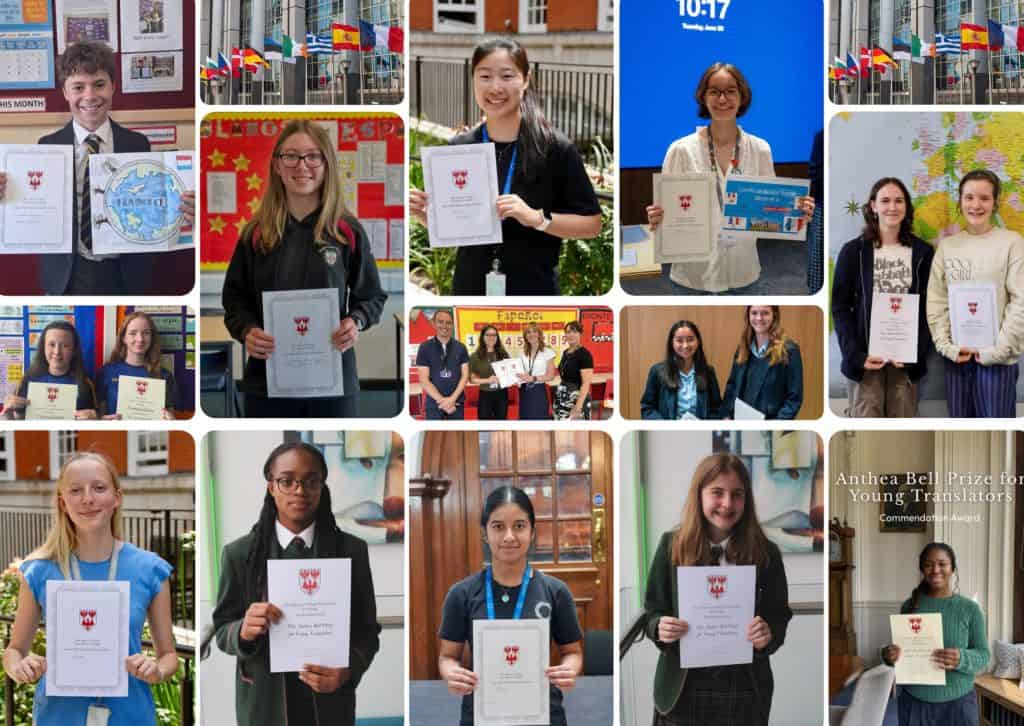
A montage of former Anthea Bell Prize winners and highly commended entrants from the following schools: Lichfield Cathedral School (photo by N. Smith), Wycombe High School, Callywith College (photo by Charli Hanney), Richard Lander School, St John the Baptist’s College (photo by S. Morgan), Headington Rye School, Clayesmore School, St Paul’s Girls School, and Albyn School.