Professor of Plant Development Jane Langdale CBE FRS FAA has been named one of five ‘Oxford Changemakers’ in In Bloom, the Ashmolean’s new exhibition exploring how plants have shaped our world. Bringing together historic collections, art, and contemporary research, the exhibition places modern plant science in dialogue with centuries of botanical discovery. We spoke to her about the future of plant science.
You’re featured in In Bloom as one of the exhibition’s ‘Oxford Changemakers’. How would you define what it means to be a “changemaker” and what does that recognition mean to you personally?
I was surprised to be asked and obviously flattered. My interpretation of changemaker as it applies to me is that although I don’t think I have made any paradigm shifting discoveries, over the years I have changed the way that plant sciences is approached – both in teaching and research, and both in Oxford and externally.
What was it like to sit for the photographic portrait by Fran Monks that forms part of the exhibition?
I thought it was going to be awkward as I really don’t like being photographed – but Fran was very good at getting on with it while we chatted.
The exhibition traces how plants have shaped our world through exploration, trade, and science. How does your own research fit into this longer history of how humans have understood and used plants?
I think my research is very much contributing to the future – trying to push the boundaries of our understanding to ensure that we will have the information needed to breed/engineer plants that can adapt to future climate scenarios.
My research is very much contributing to the future – trying to push the boundaries of our understanding to ensure that we will have the information needed to breed/engineer plants that can adapt to future climate scenarios.
In particular, your work contributes to our understanding of plants in a changing climate. What do you think plants can teach us about resilience, adaptation, and vulnerability in the decades ahead?
One of the reasons I was first interested in plant biology is that I find the mechanisms by which plants develop more complex than those by which animals develop – and thus more interesting. When animals come across an incompatible environment, they move away. Plants can’t do that. Instead they adapt their growth and development to deal with it (think of trees on a clifftop that are bent away from the wind direction). The other amazing thing is how old some plants can get – think oak trees that are hundreds of years old. Cells still dividing after all that time and somehow avoiding deleterious mutations (humans are not very good at that).
I find the mechanisms by which plants develop more complex than those by which animals develop and thus more interesting.
Your work contributes to an international effort to develop higher-yielding ‘C4’ rice. How does this project build on, and depart from, earlier histories of plant cultivation and improvement?
In science we all stand on the shoulders of others and our project is no different. The discovery of the C4 photosynthetic cycle by Hal Hatch and Roger Slack in the 1960s (Australian National University) and the suggestion by John Sheehy in the 1990s (International Rice Research Institute) that introduction of a C4 pathway into a C3 plant such as rice would improve yield were the major enablers of our project’s concept. But throughout the project we have constantly been developing new technologies to speed up the research. This means we do something in a particular way, realise it takes too long and thus develop a method to do it more quickly so we can move to the next step. Repeat with the next step….
The exhibition brings together science, art, and history. How important is it to you that plant science is communicated beyond academic audiences, and what role do museums and exhibitions play in that?
I think everyone should appreciate the importance of plant science but I realise that, with the exception of gardeners, it is sometimes hard to convey how interesting it is. Museums and exhibitions certainly play a part – but often it is only those who are already interested that cross the threshold. The biggest opportunity to engage is mostly lost because very few schools include plant science in their teaching. It is too easy to use animal examples for everything in the GCSE and A level syllabus.
If visitors leave In Bloom thinking differently about a single leaf or plant in their daily lives, what do you hope they notice or reflect on?
How complex plants are.
In Bloom: How Plants Changed Our World runs at the Ashmolean from 19 March–16 August 2026.
Header image of Prof Langdale by John Pheasant
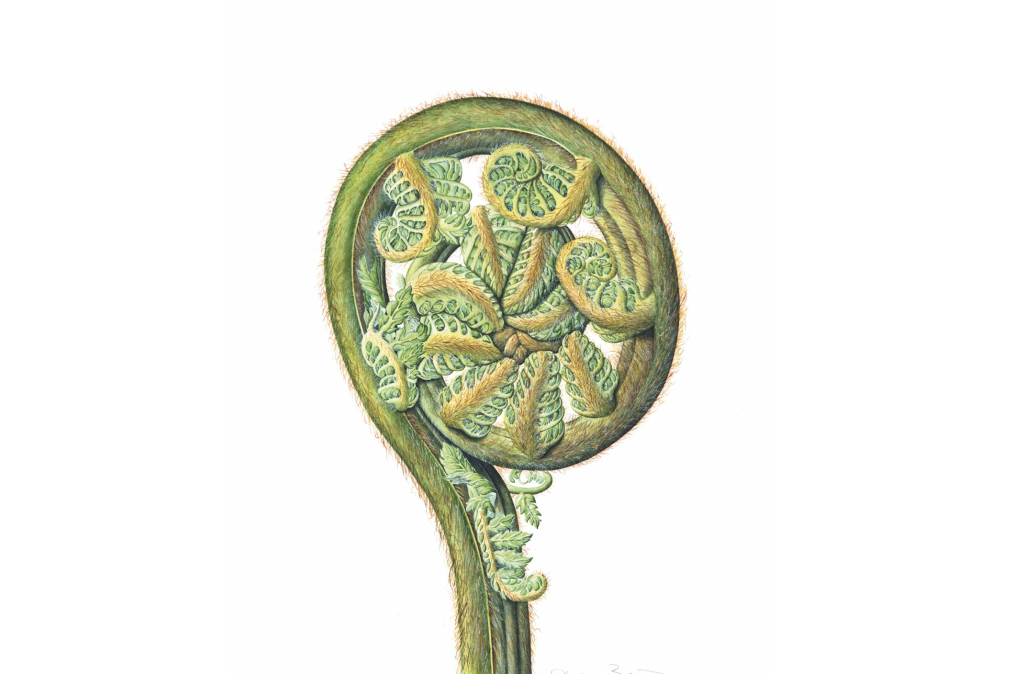
Additional image: Stephanie Berni (b. 1949), Australian Tree Fern (Balantium antarcticum), 2004, Watercolour and pencil on paper, 29 x 20 cm © Stephanie Berni, courtesy of the Shirley Sherwood Collection