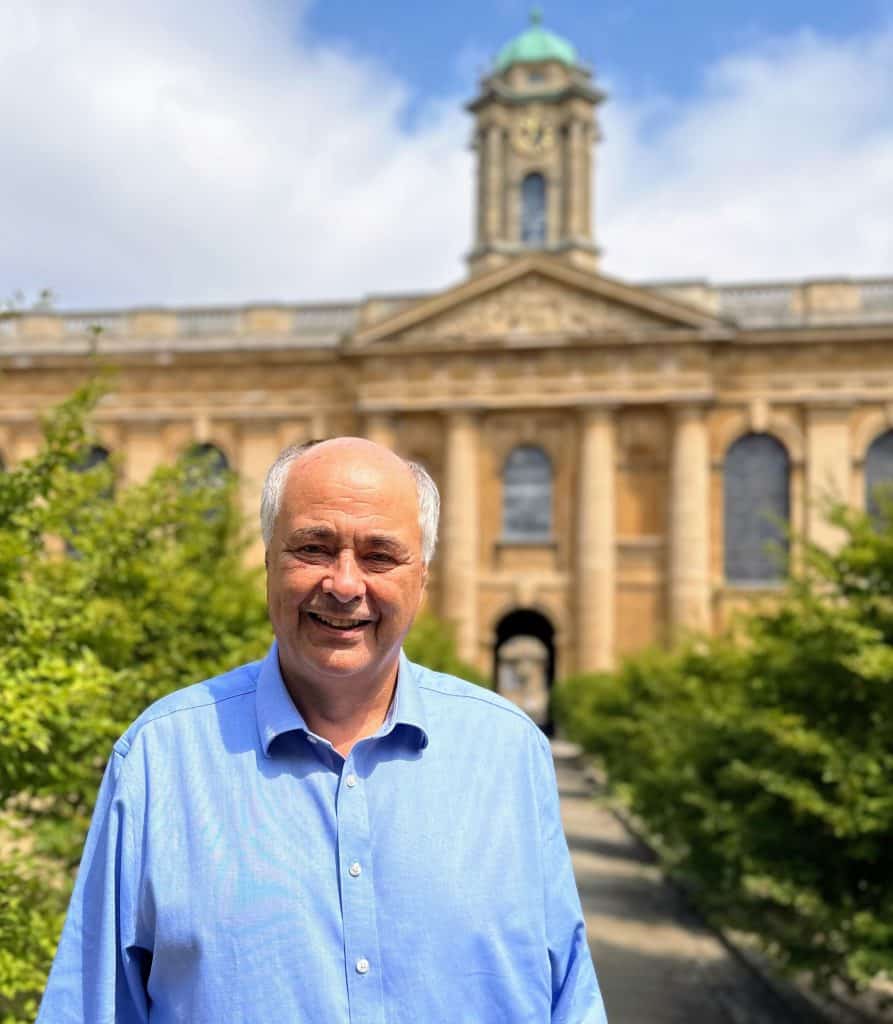
Fellow in Medicine and Professor of Physiology Peter Robbins retires at the end of this academic year after over 40 years at Queen’s. We asked him to reflect on his time here and tell us how both Physiology and the College have changed, and what’s stayed the same.
What first drew you to medicine?
I think it’s because it was a vocation, and I thought it would be a fantastic thing to do. My mother was a midwife and so we discussed medical things at home. I really enjoyed science at school and when I started to look ahead, I thought a career in medicine would fit the bill.
You studied medicine at Oxford and undertook your doctoral studies in Physiology by taking three years out in the middle of the medical course – how did that work and what did you study?
It was much more common to take this approach back then – probably 10% of the year did something like this – and it had its pluses and minuses. The major plus is that you get stuck into science early on and it’s a great time to be a student. The minus, of course, is that if you’ve done your medical training, you know a little more about the things that you might want to focus on for your doctorate. Personally, I decided I’d like to do some more science before I went on to do my clinical training.
I was interested in the way you could use ideas from physics and mathematics to explain physiology.
I was interested in the way you could use ideas from physics and mathematics to explain physiology and I had a wonderful time exploring this during those three years. A friend of mine who had done a Physics degree was doing Physiological Sciences as a second degree alongside starting a small computer company. This was before there were PCs. I was looking at how to control an experiment and he said, ‘I’d do it with one of my computers if I were you’. I thought that sounded fun and so he taught me the electronics necessary to build the digital-to-analogue converters required to control the equipment. At that time, you couldn’t buy these for the computer he had, and so I had to build it myself. I had my tutorials from him on what to order from the Radio Spares catalogue, built it, plugged it into the computer bus and was then able to make some measurements that hadn’t previously been possible without that level of control from a computer. It was tremendous fun.
Your research has focused on how humans respond to low oxygen and other physiological challenges. What has kept that question so compelling over the course of your career?
In a way, oxygen sculpts the body. If you’re a tiny organism, the oxygen that you have is what’s in the environment around you. For large organisms like ourselves, we have to transport it to the tissues, first by breathing it in, then exchanging it across the lungs into the blood, then transporting it through the cardiovascular system, and finally allowing it to diffuse all the way to where we want it. This can have problems in terms of disease, because disease can stop the oxygen getting there. But it also means that you can build and shape the body according to the adequacy of the oxygen levels. The thing that’s really interested me is the degree to which oxygen is used for directing how the body is built. Indeed, the 2019 Nobel Prize in Physiology or Medicine was awarded to Sir Peter Ratcliffe here in Oxford, amongst others, for discovering the molecular basis of this process. Because you’re continually consuming oxygen, its levels provide a very useful signal for the body.
In a way, oxygen sculpts the body.
Looking back, which research project or discovery has given you the greatest sense of satisfaction?
There are a few moments in your career when you suddenly realise you understand something new. For me, the most striking of those was probably the identification of a genetic variant in the Tibetans associated with high-altitude adaptation. It was a collaborative project that I was running, and I still remember the statistical geneticist calling me from London and saying, ‘Does this EPAS1 gene mean anything to you?’ And it certainly did because I was busy getting people with rare mutations in that one particular gene from across Europe to come to Oxford to study their physiology. So, I knew we’d hit gold then. Genetics has actually not been a major research area of mine, and there have been other turning points when I’ve suddenly understood something new, but this is the least technical example.
You’ve balanced research, teaching, clinical medicine, and College life throughout your career. How have those different roles influenced one another?
I found I can enjoy a lot of things. I enjoy my teaching; I enjoyed seeing patients, although I have not practised clinical medicine for a long time; and I enjoy the research. I take a keen interest in organisations and how they work. I sat on the University Council for seven years, and I was the Estates and Finance Bursar at Queen’s during the time when that job fell to an academic. I don’t find these roles as interesting in the long term as science, though – once you’ve worked out how things work, the rest of it tends to be more of the same, whereas science is continually changing and evolving.
What did you enjoy most about teaching Queen’s students?
An hour’s tutorial is always fun – well, perhaps not always – but by and large it is. I found great pleasure in talking about science and that’s really what it comes down to. Similarly, with graduate students, I spend a lot of time talking about science, bouncing ideas around, suggesting new projects, and so on, and I enjoy that. The thing I have enjoyed less is probably marking essays, but it is important because unless you have feedback, you can’t learn. So, although I confess I didn’t so much enjoy marking essays, it’s probably one of the most important things I did.
Medicine and physiology have changed a lot since you joined the Fellowship in 1985. What developments have surprised you most?
Biology has changed out of all recognition over my working life. This has been generated primarily by our increased understanding of molecular and cellular biology. Those are not the areas in which I’ve generally worked, but what I’ve been interested in is how I can use those new understandings to comprehend more integrated human function. For example, that’s why we’re interested in people with rare or genetic diseases, and they wouldn’t have been found without those developments. Others have gone down to the molecular scale, and I like to go back the other way and ask, ‘What does this actually mean for human function? Does it matter? How does it matter, and what changes?’
I like to ask: ‘What does this actually mean for human function? Does it matter? How does it matter, and what changes?’
Speaking of change, how has Queen’s itself changed during your time as a Fellow?
Queen’s has changed a lot in some ways and not at all in others. Over my time, I feel the College has got better and I think it’s better in all sorts of ways. When I joined Queen’s, the Governing Body was all male. I was also the only medical tutor and now it’s grown quite a lot. I think the College is thriving. In terms of what’s stayed the same, I think some of the values have stayed very much the same: we’re here to strive for academic excellence. The desire for people to do really well cuts across our undergraduate and graduate students, but also the Fellowship and supporting them to achieve their research goals, alongside all their other activities. The College continues to take great care in supporting scholarship at the highest level and I think that value has always been there.
Queen’s has changed a lot in some ways and not at all in others. In terms of what’s stayed the same, the College continues to take great care in supporting scholarship at the highest level and I think that value has always been there.
Is there a particular tradition at Queen’s that stands out for you?
I enjoy going into dinner. I just enjoy sitting next to people and talking, and I’ve learned quite a lot from this. A lot of the time, of course, it’s not moving science along or things like that, but now and again you do learn things from another discipline about how something works and you think, ‘Oh, I could use that.’ It’s something that colleges bring that you don’t have in many other universities, this mixing up of disciplines. It’s very important at the undergraduate level, but it’s also important for graduates and Fellows that you’re not just always with your own department.
Alongside your academic career, you also served as Estates Bursar. Looking back, what did you enjoy most about helping to shape the College’s future from that perspective?
I enjoyed being Bursar – it was very interesting. I did it at a time when we had Sir Alan Budd as Provost, which was terrific because when there was something I didn’t understand about economics, I could go and ask him. Of course, sometimes I got what I would describe as an economist’s answer, which was probably correct, but not that helpful in terms of going forward. It was also a time of big change – colleges were changing their legal status and falling under the Charities Commission as their regulator, and this involved, amongst other things, completely changing the College’s accounts. The way we thought about investment also changed over that period, moving from thinking about spending dividends to taking a total return approach.
We spent a lot of time discussing how we should invest in the stock market, as well as working on casework around development opportunities, some of which can run over decades. It was very varied: I spent quite a bit of time going to look at various bits of the estates and talking to people outside of Queen’s in finance and property. At that time, we had a Finance Officer called Alan Parsons who worked for the College. He was terrific and I thoroughly enjoyed working with him on these things.
In fact, you have seen Queen’s from several perspectives—as trustee, tutor, researcher, departmental leader and Bursar. How has that shaped your understanding of what makes the College thrive?
It’s people. It’s as simple as that, actually. It doesn’t matter where you are, really it comes down to the people. If you’re working with an excellent team of top-notch people, things just work, and if you’re not, they don’t. Queen’s works hard to cast its net wide to attract talent at the undergraduate level, but we also do this for graduates and Fellows as it’s so important to get the best people.
If you’re working with an excellent team of top-notch people, things just work.
What advice would you give to today’s students or early-career researchers embarking on careers in medicine or science?
Keep your head up. There’s lots of stuff to specialise in and to read about in depth, but you should also spend time looking around you and see what’s going on in the wider world. That is so, so important. Of course you must drill down in your research, but you also need to keep broad otherwise opportunities will pass you by.
Retirement often opens the door to new projects. What are you looking forward to most?
I have found a poor unfortunate person who’s going to take me on as her student so I can try to get better at playing the piano. There are lots of other things, like sailing, walking, and bridge, that I enjoy to an extent, but it’s not like science – I couldn’t do them all day every day. So, like a lot of academics, I won’t completely retire. I have an active translational research project where we’re developing new technologies to diagnose airway disease at a much earlier stage.
The principal thing we’re looking at is chronic obstructive pulmonary disease. This disease is mostly caused by smoking in the Western world, but about 25% of US citizens who have this disease have never smoked. It’s an insidious disease because you can lose half of all the small airways in the lungs before it gets diagnosed. This means that the opportunity to intervene and stop the disease is lost because there’s already so much destruction. What we want to do is diagnose it earlier. We’ve been taking some ideas from physical science as to how we might do that. The initial clinical data look good, and I’d like to see this work through.