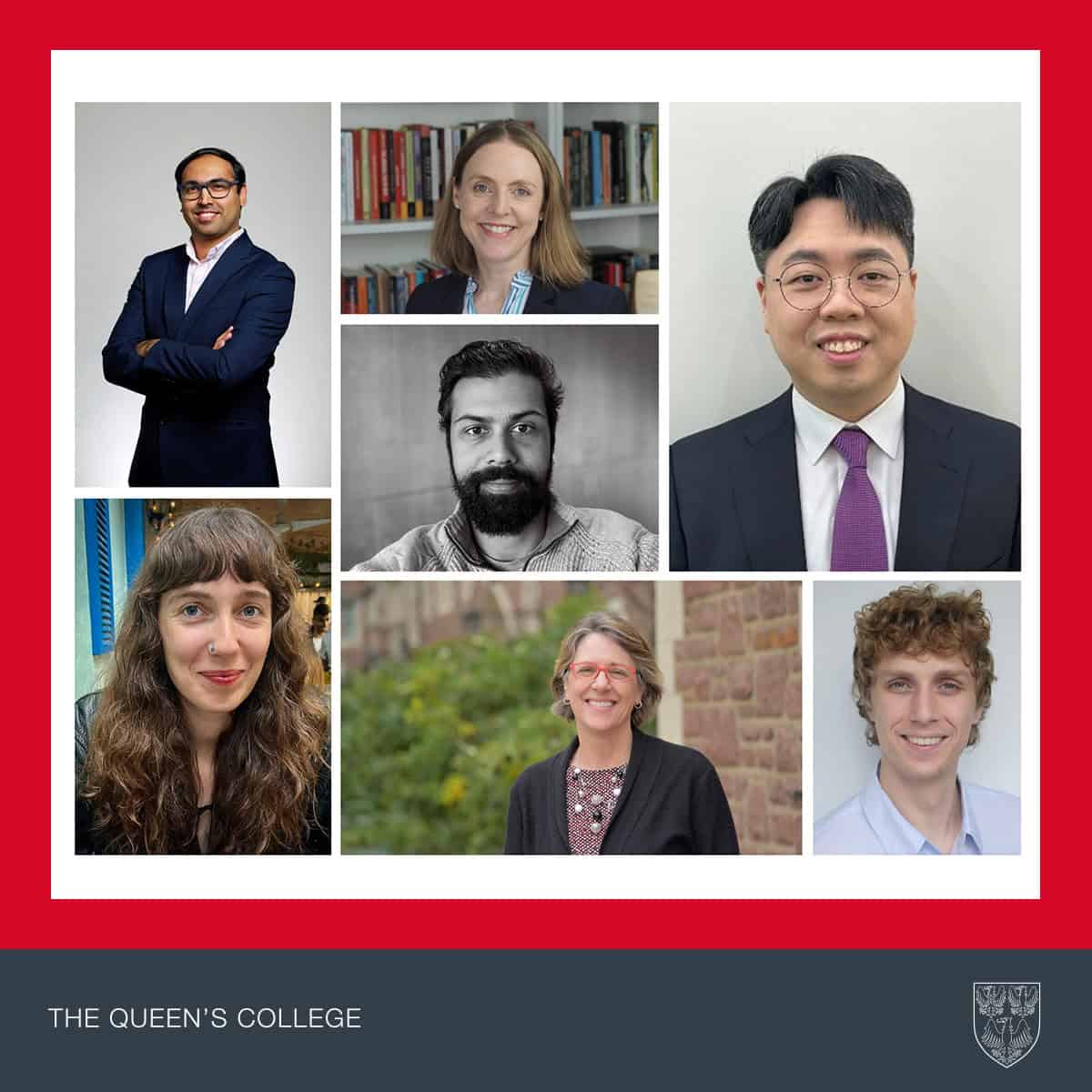
The College warmly congratulates recent DPhil graduate Kieran Agg (Physical and Theoretical Chemistry, 2021) who has been awarded the 2026 Katharine Burr Blodgett Award.
The prize is awarded annually for the best PhD research in colloid and interface science and is named in honour of Katharine Burr Blodgett, who was the first woman to receive a PhD in Physics from the University of Cambridge. As part of the award Kieran, who successfully defended his thesis entitled Surface Forces and Structure in Model Cytosol Solutions in September 2025, will give an invited talk at the 9th Annual Early Career Colloid Meeting next year.
Kieran is currently a Postdoctoral Research Scientist at the Ellison Institute of Technology, working within the Materials and Devices for Life Sciences Institute to research next-generation nanopore sensing technologies. We asked him to tell us more about his work.
Congratulations on receiving the 2026 Katharine Burr Blodgett Award. What does the award recognise, and what did it mean to you to find out that your DPhil research had been selected?
Thank you! The award is conferred by the Joint Colloids Group of the Royal Society of Chemistry and the Society of Chemical Industry for the best doctoral research in colloid and interface science, and it was a wonderful surprise to find out that my DPhil research had been selected. Research is very much a collective endeavour, so while it is great to have my own work recognised in this way, the award also reflects the enormous support I’ve had from colleagues and collaborators along the way, and most of all my supervisor, Professor Susan Perkin.
For a non-specialist audience, what was your DPhil research about, and what problem or question were you trying to solve?
My DPhil research focused on studying some of the fascinating properties of liquids. In particular, I was investigating model solutions that mimic aspects of the cytosol, the fluid found inside all cells. The cytosol contains water, but it also contains a rich mixture of ions and small molecules. I was interested in unpicking how these different components influence interactions and structures at the molecular level, and ultimately how they might help maintain biomolecular stability.
My DPhil research focused on studying some of the fascinating properties of liquids.
To do this, I used a range of experimental techniques to probe these liquids. One of the main techniques involved use of a custom-built instrument in our laboratory called a surface force balance, which allowed me to measure the interactions between charged surfaces with precision smaller than the size of an individual water molecule.
What was the most significant or surprising finding to come out of your research, and why does it matter?
My research showed that molecules called zwitterions – which are electrically neutral overall but contain both positive and negative charges – can play an important role in controlling interactions between charged surfaces. We found that these molecules can help maintain repulsive interactions between these surfaces, even as their concentration changes significantly. Zwitterions are widespread in biology but are often overlooked as background components of the cellular environment, so these findings suggest they may play a more significant role in regulating biomolecular interactions within cells than is commonly appreciated.
What first drew you to this area, and what do you find particularly interesting about it?
Processes that take place at the interfaces between different materials are important in all sorts of areas of everyday life, from understanding geological processes and living organisms to designing new batteries. I’ve always enjoyed how inherently interdisciplinary it is as a field: it brings together ideas from across physics, chemistry, and biology, and allows you to apply the same fundamental principles to problems that can initially seem completely unrelated.
Processes that take place at the interfaces between different materials are important in all sorts of areas of everyday life, from understanding geological processes and living organisms to designing new batteries.
You were a recipient of The Oxford–The Queen’s College Graduate Scholarship during your time at Queen’s. What difference did that support make to your time at Oxford and to your ability to pursue this research?
The College scholarship, in partnership with the Clarendon Fund, covered my course fees and provided a living-cost stipend throughout my DPhil, which made it possible for me to undertake doctoral study at Oxford. Queen’s also provided additional financial support during my time as a graduate student, including funding that enabled me to attend an international conference and give an oral presentation of my research. I’m very grateful to the College donors whose generosity makes opportunities like these possible for graduate students.
Queen’s also provided additional financial support during my time as a graduate student, including funding that enabled me to attend an international conference and give an oral presentation of my research.
Looking back on your time at Queen’s, are there particular aspects of College life that played an important part in your research?
One of the things I particularly valued about Queen’s was being part of a community working across such a range of disciplines. Having conversations about my research with people outside my immediate field encouraged me to think about how to communicate the important ideas without relying on specialist terminology. Even when speaking to other scientists, communicating your work in the right way is an important skill, and explaining my research to people with very different academic backgrounds often helped me to think about it from a different perspective.
One of the things I particularly valued about Queen’s was being part of a community working across such a range of disciplines.
You’re now a Postdoctoral Research Scientist at the Ellison Institute of Technology. What are you working on there, and how has your DPhil research at Oxford shaped this next stage of your career?
I’m working at EIT in the Materials and Devices for Life Sciences Institute as part of a team researching next-generation nanopore sensing technologies. Nanopore sensing uses extremely small pores to detect and characterise individual molecules; our aim is to expand the range of biological molecules that can be studied using this technology, with the potential to enable new and improved approaches to diagnosing a range of diseases.
While this is a new area for me, there are many overlapping themes with my DPhil. Both sit at the interface of physics, chemistry and biology, and involve using physical measurements to understand the behaviour of molecules at very small length scales. My DPhil gave me a strong foundation in this kind of biophysical research, as well as experience using sensitive experimental techniques. I’m also working within a highly interdisciplinary team, which my experience at Oxford prepared me well for. It’s exciting to be able to apply the knowledge and skills I developed during my DPhil to a new set of scientific and technological challenges!