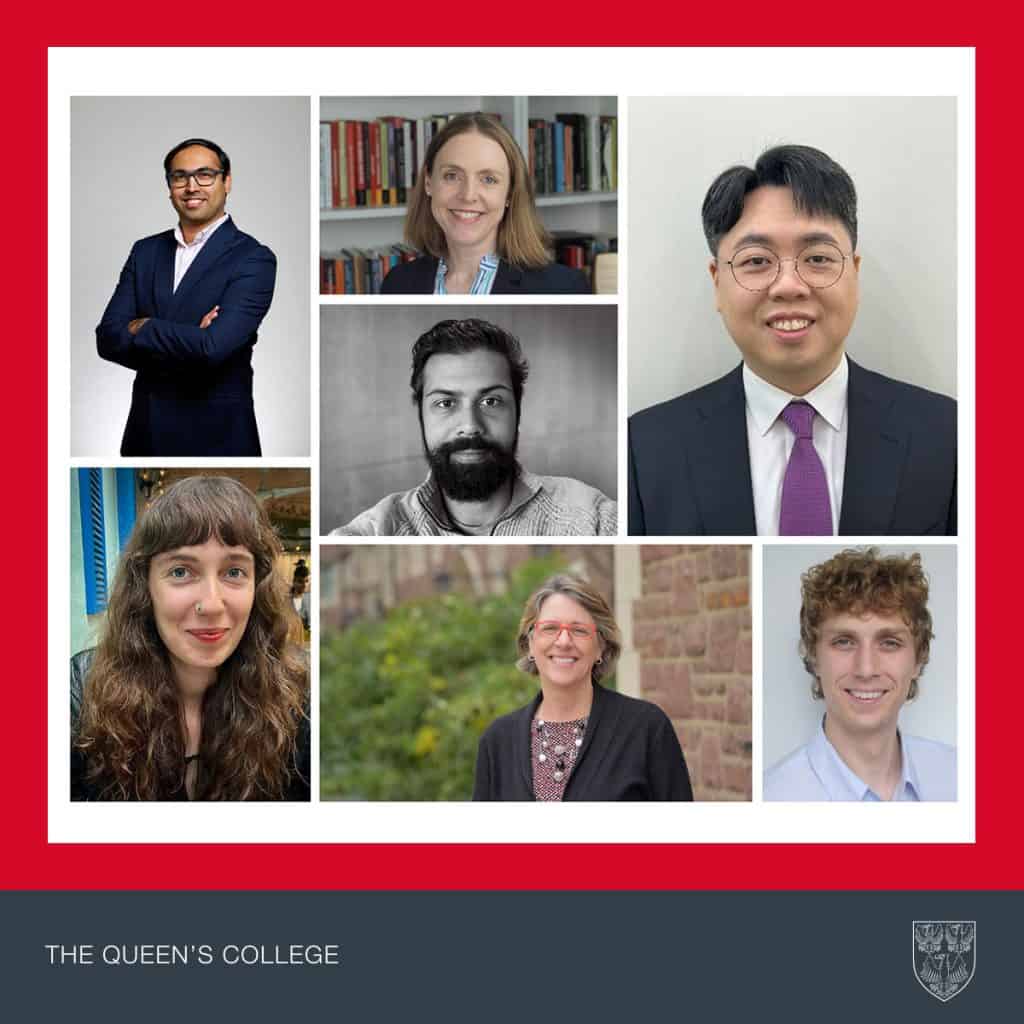
At the start of each academic year, we welcome new academics to Queen’s. Please find biographies for our newest members below.
Jungnam Cho, Fellow in Biology
Jungnam joins Queen’s as a Tutorial Fellow in Biology alongside his role as an Associate Professor in the Department of Biology. He earned his BSc and PhD from Seoul National University, before undertaking a postdoctoral fellowship at the Sainsbury Laboratory at the University of Cambridge. Prior to coming to Oxford, he established his independent research group at the CAS-JIC Centre of Excellence for Plant and Microbial Sciences and served as an Associate Professor at Durham University.
At Queen’s, Jungnam will teach foundational plant sciences, genetics, and molecular biology to undergraduate students. His research group, supported by an ERC Consolidator Grant (MOBICODE) and BBSRC funding, investigates the molecular mechanisms of transposable elements (TEs) in plant genomes. Once dismissed as “genomic dark matter,” TEs are now recognised as driver forces behind genetic variation and rapid environmental adaptation. By combining molecular genetics, biochemistry, and computational biology across model species such as Arabidopsis and crop systems, his lab aims to decode host-transposon co-evolution to help pioneer novel pathways for crop climate resilience and global food security.
Viviane Fairbank, Junior Research Fellow in Philosophy
Viviane recently received her PhD from the St Andrews and Stirling Graduate Programme in Philosophy (Scotland). Her thesis focused on the objectivity of logical norms of reasoning, drawing from contemporary pragmatist and feminist philosophy. Before philosophy, Viviane worked as a magazine journalist in Canada. She is co-founder and co-lead of an initiative that educates professionals in ethical reporting methods and encourages public discussion about accuracy and objectivity in journalism.
During her time at Queen’s, she will be building on previous work in order to develop a new account of the objectivity of epistemic norms—norms of belief, inference, and inquiry. The aim is to complete a manuscript on the topic, tentatively titled Objectivity in Practice.
Ursula Hackett, Supernumerary Fellow in United States Politics
Ursula grew up in Bath, where she attended state schools, before studying PPE and then an MPhil in Comparative Government at Exeter College, Oxford. She took her DPhil in Politics at Harris Manchester College, Oxford, and subsequently became a Junior Research Fellow at the Rothermere American Institute. In 2016, Ursula was appointed to her first academic post at Royal Holloway, University of London, where her research was supported in part by British Academy postdoctoral and mid-career fellowships. In 2026, Ursula returns to Oxford as the inaugural Churchill Associate Professor of U.S. Politics at the Rothermere American Institute in association with The Queen’s College.
Ursula’s research in American Political Development examines how law, institutions, and public policy shape representation and political inequality in the United States. Her award-winning first monograph demonstrated that state policymakers learned to design school voucher programmes to minimise legal vulnerability. Subsequent work examined how policy drift perpetuates and deepens racial inequalities via welfare retrenchment, and how courts adjudicate the constitutionality of drifting policies. Ursula’s most recent monograph and associated papers develop original spatial measures of redistricting continuity and change. This work identifies the strategic uses of minimal-change redistricting: to shield incumbents from electoral risk, preserve the benefits of prior gerrymanders, and obstruct Black and Latino voters from achieving representation.
Felix Heyen, Extraordinary Junior Research Fellow in Physics
Felix recently completed his PhD in Physics at the Vrije Universiteit Brussel, Belgium, with a dissertation exploring experimental analysis methods with which to measure the so-called Yukawa coupling between two of our world’s fundamental particles, the charm quark and the Higgs boson. He previously earned a MSc in Physics at the Karlsruhe Institute of Technology, Germany, which sparked his interest in the Higgs boson.
While at Queen’s, Felix will continue to pursue his research interest in the Higgs boson using data from the most cutting edge, high energy particle collider – the Large Hadron Collider. During this time, he also looks forward to contributing to the overall academic and cultural life of the College.
Hariom Jani, Fellow in Materials Science
Hariom is a materials physicist with the ambition of designing the ‘Silicon of tomorrow’. He leads the Designer Quantum Materials for Devices research group at Oxford, exploring unique materials where quantum mechanical interactions between electrons, spins and atoms give rise to remarkable collective properties. By tailoring such quantum correlations, his group aims to design new materials that could serve as a platform for next-generation information technologies. Hariom’s work has led to the discovery of nanoscale topological magnetic states that could form the building blocks of future computing and memory, with advances published in Nature and Nature Materials. Hariom is also a Royal Society University Research Fellow.
At Queen’s and the Department of Materials, Hariom’s group will bridge fundamental discovery with future applications by developing programmable magnetic quantum materials. His group will harness atomically precise materials fabrication techniques to unlock new functionalities for ultrafast and energy-efficient technologies.
Michael Lynn, Extraordinary Junior Research Fellow in Physiology
Michael received his PhD from the University of Ottawa, where his work uncovered foundational physiological and computational principles of the mammalian serotonin system. He previously earned an MSc from the Massachusetts Institute of Technology. In his spare time he is a saxophonist, specialising in jazz, folk, and contemporary music.
While at Queen’s, as a Wellcome Early-Career Fellow, Michael will investigate the physiology of serotonin release in frontal cortical areas during economic decision-making. He is especially interested in determining how serotonin controls neural activity patterns and mechanistically shapes the decision process. Michael also looks forward to contributing to musical life in College.
Laurie Maffly-Kipp, Harmsworth Professor of American History
Laurie Maffly-Kipp holds the Richard Lyman Bushman Chair of Mormon Studies at the University of Virginia. She received her MA and PhD in U.S. History at Yale University and has held teaching positions at the University of North Carolina, Washington University, and the University of Heidelberg. She has authored and edited nine books and many articles on religion and society in the American West, African American religious history, and Mormonism and globalization. A past president of the American Society of Church History and the Mormon History Association, she is currently working on a book on the transnational dimensions of Mormonism.
Pictured from left to right are: Jani Hariom, Ursula Hackett, Jungnam Cho (top row), Michael Lynn (centre), Viviane Fairbank, Laurie Maffly-Kipp, Felix Heyen (bottom row).