Viewing archives for English and Joint Schools

Introduction

I went to school in East Sussex (Ringmer Community College and then South Downs Sixth Form College) before studying for a BA in English Literature at Royal Holloway, University of London, where I studied medieval English literature for the first time. I then studied for a MPhil in Medieval Literature at Sidney Sussex College at the University of Cambridge, and a DPhil at St John’s College, University of Oxford (funded by an AHRC DTP and Lamb & Flag scholarship). My doctorate examined how medieval people reflected on the materiality of their books in their devotional writings.

Teaching

I teach the first year course Prelims 2, which spans Old and Middle English literature 650-1350, and the second year FHS Paper 2, which spans the later medieval period (1350-1550). I am also the English Subject Lead for the Astrophoria Foundation Year Programme at the University of Oxford.

Research

I am predominantly interested in three areas of research: perceptions of late medieval material texts, medievalism and craft, and medieval folk horror. Along with Dr Laura Varnam and Dr Kristen Haas Curtis, I founded the Guild of Medievalist Makers, which supports and connects creative-critical medievalists. 

Publications

Trade Press Books

  • Tales of Horror from Medieval England (Oxford: Bodleian Publishing, forthcoming)
  • Book Curses (Oxford: Bodleian Library Publishing, 2024)

Select Articles and Book Chapters 

  • ‘Cut, Pasted, and Pocketed: J. L. Carr’s Chaucer Pocketbook’, Inscription: The Journal of Material Text, 6 (2026) 92-103. 
  • ‘Late Medieval Book-Craft Recipes and Perceptions of the Book’, in Recipes and Book Culture in England 1350-1600, ed. by Carrie Griffin and Hannah Ryley (Liverpool: Liverpool University Press, 2024), pp. 135-154. 
  • Marion Turner et al., ‘‘Chaucer’s World’ Study Days in Oxford for Post-16 Students: Enhancing Learning and Encouraging Wonder’, New Chaucer Studies: Pedagogy and Profession, 3 (2023) 70-78
  • ‘Metaphors of Textual Materiality in Late Medieval Middle English Sermons’, Studies in Philology, 118 (2021) 631-665

Introduction

My specialism is literature of the long eighteenth and nineteenth centuries.

I grew up and went to comprehensive school in London.  I read for an Undergraduate Masters in English and Philosophy at the University of St Andrews, and went to Durham University for my graduate Master’s in Romantic and Victorian Literary Studies.  I came to Oxford to write my DPhil on Alexander Pope’s literary legacy in the century after his death.  I have taught at many Oxford colleges, in the English Faculty, and at the Department for Continuing Education. 

Teaching

I teach literature of the long eighteenth and nineteenth centuries, as well as approaches to literature and literary studies.  At Queen’s, I teach FHS Paper 4 (1660-1760) and FHS Paper 5 (1760-1830).  I also supervise undergraduate and Master’s dissertations, and a DPhil project on tragedy in Victorian fiction. 

Research

My research interests include: literary influence, inheritance, and legacy; literary self-consciousness; intertextuality, metatextuality, and paratextuality; canonicity and counter-canonicity; genre; and women’s writing.

My forthcoming first monograph, Alexander Pope and Romantic Poetics, examines the influence of Pope’s poetry on Romanticism.  My second project, Jane Austen and Genre, analyses ways in which Austen destabilises established conventions in novel genres.

Publications

I have published various peer-reviewed chapters, articles, and book reviews.  Please see the English Faculty website for a full list.

My favourite memory of Queen’s

It’s hard to pick a favourite memory but I would probably say my first Oxmas dinner in Hall. Everyone was so in the festive spirit, Hall looked beautiful with the most magnificent Christmas tree, and then the Choir burst in and sang some carols. It was the kind of magical Oxford dinners I had imagined before joining Queen’s and it just felt very special.

What Queen’s means to me

I am indebted to Queen’s, not only for the most incredible education but also for three amazing years in which I met lifelong friends. As a first generation, state school university student my journey to Oxford was tough but as soon as I stepped through the door at Queen’s everything changed. There’s no doubt that if it wasn’t for the rigorous, challenging teaching – coupled with all of the fun and friendships formed at College – I would not be doing what I do today.

My journey since leaving Queen’s

When I left Queen’s in 2023, I immediately took up the post of Assistant Producer at GB News. In the three years since, I’ve worked on a range of programmes, and I’m now an Assistant Editor looking after three shows (including our Sunday morning politics programme as a nice reminder of Union debates, as well as our arts and culture show which fits nicely with my English degree.) I also cover some news reading shifts on the channel which is an enormous privilege and great experience to be ‘on air’ this early in my career.

About me

Hi, I’m Hannah, a first-year English undergraduate student, and I am from a small town near Cologne in Western Germany. I have absolutely no self control when it comes to books and I love all kinds of literature. Since Pride and Prejudice was the first English novel I read, Jane Austen will always hold a special place in my heart, but I enjoy Mary Oliver, the Brontës, Shakespeare, Oscar Wilde, and translated Asian fiction (specifically Japanese and Korean fiction) just as much!!

College experience

I absolutely LOVE Queen’s and whilst the College has a reputation for being nice, the people are my absolute favourite part of the College. Everyone is so friendly, welcoming, and the College truly feels like a family. As a choral scholar I am also part of the choir and our rehearsals and choir dinners are the highlight of my week.

Oxford life

I usually spend my mornings in the English faculty attending lectures and come back to Queen’s around lunchtime to eat lunch in hall with my friends. It’s a great way to catch up and laugh about the extensive workload together. My afternoons are spent in classes or tutorials with my professors (which are really fun) followed by some essay writing in the library. Most evenings I have choir rehearsals, evensongs, and choir dinners followed by a trip to the BC (Beer Cellar) or a nearby pub which is a lovely way to end the day connecting with people.

Advice for applicants

Really try to make the most of your Oxford experience!! Oxford has so much to offer and I know that it can be very confusing in the beginning, but your uni experience is really what you make it, so go out, have fun and enjoy every second of it!!!

Introduction

I grew up and went to school in north London before studying English at Trinity College, Dublin. I first came to Oxford for my Master’s degree at University College, and I stayed on to write my DPhil on medieval and Tudor drama. Before joining Queen’s in 2024, I taught medieval and early modern literature in the School of English and Drama at Queen Mary University of London, where I was also Head of English.

Teaching

I teach English literature from 1350–1660, and have particular interests in premodern drama, book history, and material culture. I have supervised graduate students working on a broad range of fifteenth- and sixteenth-century topics including fifteenth-century aureate verse, Henrician court poetics, and the performance of skin on the early modern stage. I welcome enquiries from potential doctoral students interested in any of the areas of my research.

Research

All my work is concerned with the material conditions that shape literary production and reception. My first two books—The Drama of Reform (Brepols, 2013) and Reading Drama in Tudor England (2018)—were about the drama written and performed in England before a culture of commercial playgoing was established at the end of the sixteenth century. I continue to work on premodern drama and have co-edited a collection of essays on dramatic manuscripts—Early English Drama in Manuscript (Brepols, 2019).

Alongside my writing about drama, I have published widely on the interactions between manuscript and print, the marketing of early printed books, and various other aspects of the early English book trade. My current book project grows from a Leverhulme-funded Major Research Fellowship and explores the reuse and recycling of old books in early modern England. Assessing the relationship between bibliographic and literary ideas about waste and reuse, it considers the role of old books (both as wasted remnants and second-hand commodities) in early modern culture. Out of this work, I am also developing a new project about the second-hand movement of books in early modern Europe.

Introduction

Dr Hankinson studied English at Balliol College, completing his DPhil in 2020 under the supervision of Professor Matthew Reynolds. He has since taught at St Hilda’s College, St Anne’s College, and Jesus College, and worked as the Co-ordinator of the Oxford Comparative Criticism and Translation Research Centre (OCCT), based at St Anne’s, where he currently leads a research strand on Comparative African Literatures.

Teaching

To Queen’s English undergraduates I teach both Prelims Paper 3, on nineteenth-century texts and contexts, and Prelims Paper 1b, an introductory paper on literary theory.

Research

Dr Hankinson’s research explores the relations between nationalism, belonging, foreignness, and style, with a particular focus on the period 1860-present. His work routinely involves the tracing of relations which proliferate beyond temporal and geographical boundaries, and the development of innovative comparative methodologies—two activities united in a forthcoming monograph which stages an encounter between the Victorian poet Robert Browning and the contemporary Ghanaian poet and novelist Kojo Laing. 

Publications

Please visit: https://www.josephhankinson.com/articles.

Courses

  • BA English Language and Literature
  • BA English and Modern Languages
  • BA Classics and English
  • BA History and English

Average Intake at Queen’s: 7

The Course

The BA in English Language and Literature at Oxford is a three-year degree. Its distinctive feature is its historical breadth: you will finish your degree having studied the full range of English literature, with compulsory papers on literature from 650 to the present day and the opportunity to specialise in the areas that interest you most in your final year. There’s more detail about the course on the Faculty website.  If you are taking English with another subject, you’ll study roughly half the English degree, and there is the opportunity to combine your two subjects in some of the papers.

English is a very rewarding subject to study at university level. You will develop a deep knowledge of individual authors, literary movements, historical periods, and theoretical approaches that you will draw on for the rest of your life. You will gain skills that will equip you for a wide variety of careers: skills of written and spoken communication, analysis, and interpretation at the highest level. In recent years, students who have studied English at Queen’s have gone into teaching, journalism, publishing, arts administration, marketing, law, acting, public relations, international relations, social policy, and the Civil Service. A significant proportion have loved their course so much that they’ve gone on to Master’s and PhD study. The Faculty website has more information about careers for English students.

Teaching

Studying English at Queen’s means joining a friendly and lively community of students and tutors who will encourage and support you as you encounter new texts and ideas.  Most English papers are taught through a combination of Faculty lectures (with students from across the University), and Queen’s classes (with the rest of your Queen’s year group) and tutorials (with one or two other Queen’s students).  For example, a typical first-year paper will be taught over one term, and is made up of six tutorials, for which you will write a weekly essay, four classes on historical and critical context, for which you will be asked to prepare reading and perhaps a presentation, and lectures in the Faculty, which you choose yourself, with guidance from your tutor. If you are taking English with another subject, you may take a paper over two terms, alternating between your subjects weekly. You will meet with a tutor every week in the term, and this close attention means that we can provide exactly the support you need to get the most out of the course.

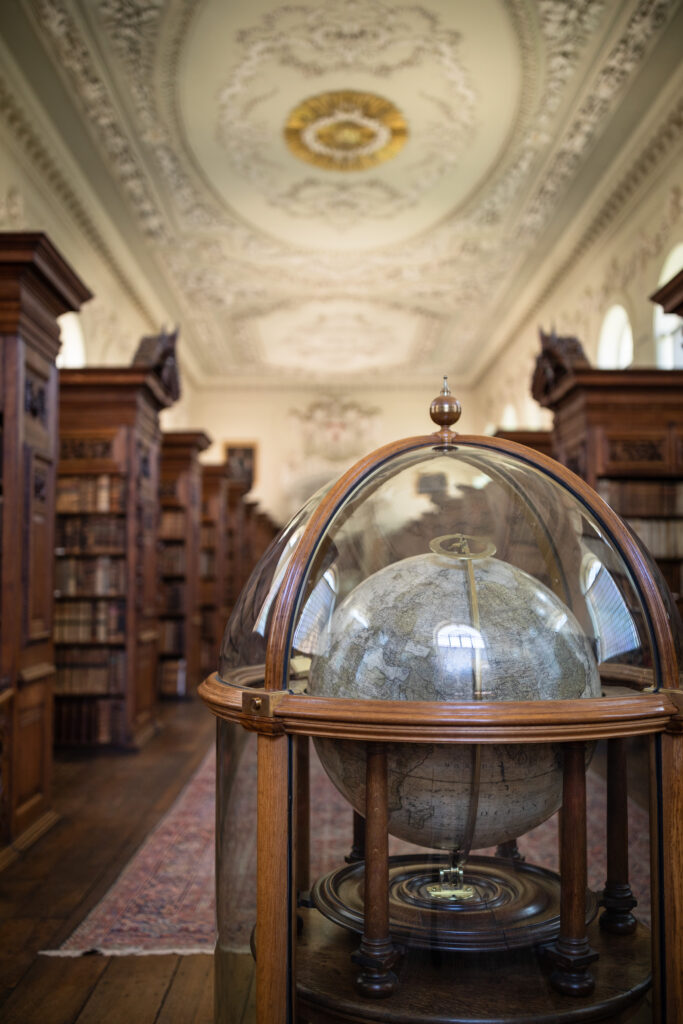
At Queen’s we are very lucky to have one of the most beautiful libraries in the world—no exaggeration!—in which to study. The Library has an exceptionally rich collection of rare books, and we regularly use these books for teaching (some of our English students recently curated an exhibition in the Library). You will be able to spend time with first editions of works by some of the greatest writers in English, including Ben Jonson and William Shakespeare, and the Library also holds the manuscript of Thomas Hardy’s last volume of poetry, Winter Words. Queen’s is situated close to the Bodleian, the University’s main library, and is a short walk away from the Schwarzman Centre which contains the Faculty of English and is where you will have your lectures.

There are plenty of opportunities for students to explore their literary interests beyond their tutorials. Many of our students have contributed to the Queen’s creative writing journal, The Rambler, and played a central role in our literary and film societies, and our drama society, The Eglesfield Players. Queen’s students are often involved in creative writing, student journalism, and drama at the University level too. At Queen’s we pride ourselves on creating a friendly, supportive, and inspiring community for students studying English. Students and tutors in English come together throughout the year for a range of events, such as play readings, our medieval Yule Feast with music, games, food, and drink inspired by the Middle Ages, and creative writing workshops. We are passionate about literature, and we are sure you will enjoy the course here if you feel the same way.

Admissions

The College normally admits seven students per year for the courses involving English: English Language and Literature, English and Modern Languages, History and English, and Classics and English. Please note that though deferred applications (i.e. for two years ahead of when you apply) are not accepted for the English Language and Literature course, they are for all the joint courses.

The entry requirements for English are the same across the University. We are looking for students who are enthusiastic and thoughtful readers, and we look for future potential as well as current achievement. Queen’s students are curious and committed learners and Queen’s has an excellent track record of academic attainment in English.

In the admissions interviews we want to get a sense of how you think about the literature you’ve read, and about literature that you are seeing for the first time. We encourage you to think of this as a conversation rather than a test: there are no trick questions in our interviews. We simply want to get the best out of you and we aim to make the interview as rewarding and enjoyable as possible.



Introduction

I grew up in Kent, and after attending the local state grammar school I read English at Oxford, where I took my undergraduate and graduate degrees. I have taught at Oxford since 1999, and have also worked at the universities of Reading and Southampton. I have held a lectureship in English language at Queen’s since 2018.

Teaching

I teach English literature from the early medieval period up to the sixteenth century as well as regularly teaching the history, theory and use of the English language.

Research

My principal research interests are in Chaucer, the medieval and sixteenth-century love lyric, and poetics, with an emphasis on how form precedes and generates meaning. I am interested in interrogating the agendas which drive the taxonomy of poetic form, and in challenging the division still made between medieval and early modern literature.

My book Rhyme and the Construction of Love in English Lyric 1300-1579 was published by Oxford University Press in 2026. It shows that decorum in the choice of vocabulary, combined with the limited rhyme resources of English, render certain clusters of words and ideas almost inevitable, particularly in complex poetic forms demanding large rhyme-groups. As a result, the essentially arbitrary element of rhyme comes to generate features of the experience of love in poetry, and the impression of subjectivity in love lyric is a side-effect of the necessities of rhyme.

The book is accompanied by a database, ‘Rhyme Words in English Love Lyric 1300-1579‘.

I am currently working on a new book about anthologies of ‘English verse’ and the fantasies of England they project. This picks up my longstanding interests in poetry anthologies and the agendas which drive the critical framing of texts.

Publications

  • Rhyme and the Construction of Love in English Lyric 1300-1579 (Oxford University Press, 2026).
  • ‘Chaucer’s presence in Songes and Sonettes’ in Stephen Hamrick (ed.), Tottel’s Songes and Sonettes in Context (Ashgate, 2013), pp. 87-110.
  • ‘An obscured tradition: the sonnet’s relationship to its fourteen-line predecessors’, Review of English Studies 62 (2011), 373-92.
  • Edition of Tottel’s Miscellany (Penguin Classics, 2011). Co-edited with Tom MacFaul.
  • The Sources of Chaucer’s Poetics (Ashgate, 2008).
  • ‘Resistance, Regard and Rewriting: Virginia Woolf and Anne Thackeray Ritchie’, English 57 (2008), 42-64.

Introduction

I grew up on the Isle of Wight, and in Yorkshire and Hampshire. After attending my local comprehensive and sixth form college, I studied English at Cambridge. For my Master’s degree, I went to the University of California, Berkeley, and then returned to Cambridge to write my PhD on the twentieth-century American poet, Ezra Pound. Since 1998, I have taught in the English departments of the University of Liverpool, Queen Mary, and Birkbeck (both University of London), before coming to Queen’s in 2009.

Teaching

I teach literature from the Victorian period to the present day, and have particular interests in early twentieth-century literature, literature and visual culture, and the relationship between different national literatures. I have supervised graduate students on a broad range of twentieth-century topics, particularly in the field of modernist literature.

Research

My first two books — Ezra Pound and the Visual Culture of Modernism (Cambridge University Press, 2007) and Theorists of Modernist Poetry (Routledge, 2007) — were on modernist poetry and its contexts, and I continue to research and publish in that area, particularly on topics relating to Ezra Pound, art criticism, and periodical culture.

More recently my research focused on the impact of Russian culture on early twentieth-century British literature, resulting in two co-edited collections — a special issue of Translation and Literature, Translating Russia, 1890-1935 (2011), and Russia in Britain, 1880-1940 (Oxford University Press, 2013) — and a monograph, Russomania (Oxford University Press, 2020). I am now beginning a book on the popularisation and institutionalization of modernist culture in Britain.

Publications

Please see my faculty profile page for research updates and a full list of publications.