Old Member Dr Lennard Lee (Medicine, 2005) has built a career at the intersection of medicine, technology, and public service, and is now helping to lead a pioneering project using AI and supercomputing to accelerate the development of personalised cancer vaccines. In this interview, he reflects on the promise of faster, more precise cancer therapies, the role of sovereign AI infrastructure in UK science, and his experiences at Queen’s that shaped his belief in teamwork and ambitious collaboration.
You are leading the UK Cancer Vaccine AI Scientist and Supercomputing Project, which combines cancer research with AI and supercomputing. Can you explain the challenges in cancer treatment that this programme is trying to address?
The opportunity we are trying to realise comes from the remarkable achievements of the Oxford-AstraZeneca vaccine and vaccine investment programmes around the world. Vaccines can now be produced relatively cheaply and efficiently. There is the potential to use this technology to create cancer therapies that are affordable, straightforward to manufacture, and able to direct a patient’s own immune system to control or even eradicate cancer.
When speaking about cancer treatment, people are perhaps less familiar with the term ‘cancer vaccine’ than they are with other treatments. Can you explain how immunotherapy treats cancer?
Immunotherapy works because it enables a patient’s own immune system to control or eradicate their cancer. Around half of people will never develop cancer during their lifetime. For those who do, factors that affect immunity, including smoking, obesity and aspects of lifestyle, can contribute to risk.
Immunotherapy has transformed outcomes for some cancers, such as melanoma, where complete eradication can occur. For many patients, however, it leads to a period of disease control before the cancer evolves mechanisms to escape immune recognition.
Cancer vaccines build on the same principles as vaccine technologies used during the pandemic.
Cancer vaccines build on the same principles as vaccine technologies used during the pandemic, including adenoviral and mRNA platforms. They aim to direct the immune system towards abnormalities that are unique to an individual’s cancer, creating a more precise and targeted immune response.
What has changed technically or scientifically that makes it possible to move much faster from AI prediction to real-world personalised drug development?
AI. Quite simply, this technology has removed much of the friction from medical research.
We started with the premise that AI could analyse genetic data faster than any human. Initially, this was challenging because we needed to build our own specialised GPT models. That required access to the UK’s sovereign AI supercomputer, DAWN, as well as learning how to develop entirely new AI systems.
It worked. The models generated high-quality predictions at remarkable speed. In much the same way that ChatGPT or Gemini transformed language tasks, our model allows us to ask questions such as: ‘What should be included in a cancer vaccine for this patient?’ or ‘Which features of this person’s cancer should we direct the immune system towards?’
It was a genuine step change. Analyses that once took six months can now be completed in around 72 hours. We’ve learned that these systems depend upon large, high-quality datasets, which is why we have trained our cancer vaccine designer using more than two billion data points, securely stored within the UK.
Analyses that once took six months can now be completed in around 72 hours.
The AI scientist platform CIARA sits at the centre of the work. Can you describe what CIARA does, and how this supports human researchers?
CIARA is an AI agent and the United Kingdom’s first prototype AI Scientist. She is an autonomous system capable of reasoning, planning and helping to execute experiments designed to improve cancer vaccine development.
Most current AI systems, such as ChatGPT, Gemini and Grok, exist solely in the virtual world. They can generate ideas, although they cannot directly influence the physical world. Across the globe, researchers are now exploring how AI systems can bridge that gap.
In Oxford, we are taking a distinctive approach. Rather than focusing on defence or entertainment applications, we are applying these technologies to scientific discovery.
In Oxford, we are taking a distinctive approach. Rather than focusing on defence or entertainment applications, we are applying these technologies to scientific discovery.
CIARA, which stands for Centre for Immuno-Oncology Research Assistant, has been given supervised access to robotic laboratory equipment. We are piloting her use in performing ELISpot experiments to determine whether predicted cancer vaccines generate measurable immune responses.
For the first time, an AI Scientist is helping to deliver real laboratory experiments. We are doing this thoughtfully, with full human oversight, while studying how researchers and AI systems work together. CIARA has never been designed to replace scientists. She has been designed as an assistant, helping researchers become more productive and accelerating the rate of discovery.
Why is access to UK sovereign AI systems such as the DAWN and ISAMBARD-AI supercomputers important for this research?
AI supercomputers are very different from conventional computing systems. They contain vast numbers of graphical processing units, or GPUs, which are essential for training and operating modern AI models.
We have moved well beyond simpler approaches that could run on traditional university clusters. Sovereign AI infrastructure, such as DAWN and ISAMBARD-AI, provides the computational power needed to compete internationally.
These facilities are today’s equivalent of the coal networks that powered the industrial revolution. They are precious national assets.
In many ways, these facilities are today’s equivalent of the coal networks that powered the industrial revolution. They are precious national assets. Only a limited number of countries possess them, and they are now supporting programmes such as the UK Cancer Vaccine AI Scientist and Supercomputing Project. Without access to this infrastructure, UK science would struggle to compete on the world stage.
Funding from the Medical Research Council is being used for the next stage, including manufacturing experimental cancer vaccines and testing predictions in patient samples. What do you expect to happen over the next year?
We hope that, for the first time, an AI system will have designed and enabled the manufacture of a cancer vaccine in the UK, demonstrating a working prototype of this new approach.
At present, manufacturing often depends upon overseas organisations. One of the important questions we should ask is why the UK no longer makes more of these advanced therapies itself. If cancer vaccines can be developed and manufactured here, why should we stop at discussing the opportunity rather than delivering it?
I am enormously grateful to the Medical Research Council for investing in this work and giving us the chance to explore what is possible over the next year.
Patients often ask whether AI will genuinely make a difference for people with cancer. What is your answer to them at the moment?
I believe AI has the potential to transform healthcare. Anyone who has recently used the NHS may have wondered why information is repeated so often, why there is so much paperwork, or why doctors and nurses have so little time available for direct patient care.
I believe AI has the potential to transform healthcare.
Used thoughtfully, sovereign AI technologies could help address many of these longstanding challenges.
Through the UK Cancer Vaccine AI Scientist and Supercomputing Project, we are starting by focusing on people living with cancer, aiming to develop safer, more precise and more effective therapies. The opportunity extends much further than that.
You founded the award-winning UK Coronavirus Cancer Monitoring Project, linking data from 90 hospitals to understand outcomes for cancer patients during the Covid-19 pandemic. What did that period teach you about urgency in medical research?
It taught me that one of the most important ways doctors can serve their patients is through research.
One of the most important ways doctors can serve their patients is through research.
During 2020, there were serious concerns that cancer patients should avoid hospitals altogether. We rapidly established the UK Coronavirus Cancer Monitoring Project, linking data across almost 90 cancer centres.
Within 100 days, we had generated evidence showing that greater harms would result from stopping cancer treatments. By the second wave, research led by Oxford helped ensure that cancer services remained open and patients around the world continued receiving treatment.
We learned that, even during a global pandemic, cancer care must continue. More harm occurs when people are denied effective treatment. I remain enormously proud of what that collaboration achieved.
Looking back on your time at Queen’s, how did your experience there help to shape the way you work now?
Queen’s was an enriching environment. It encouraged us to develop skills that extended beyond academic knowledge.
I captained the University swimming team. We rowed from Oxford to Tower Bridge. We swam the Strait of Gibraltar and achieved a UK world record.
Those experiences taught me that success is fundamentally about teams. Can you inspire people to aim for something bigger than their everyday responsibilities? Can you bring together groups of talented individuals to achieve something ambitious, bold and genuinely transformative?
Success is fundamentally about teams.
Queen’s taught me that.
What other experiences outside formal study proved unexpectedly important to your career?
Swimming the English Channel.
If you persist long enough, and if you have the right people supporting you, extraordinary things become possible. Even as a young adult, you can swim to France, navigating jellyfish, shipping lanes, cold water, and challenging conditions.
That experience taught me resilience and the importance of community.

What qualities do you think student researchers need to develop now?
Overcoming cynicism.
It is easy to assume that problems belong to someone else or that solutions do not exist. Yet, if you try, you often achieve far more than you imagined possible.
Bring people together. Identify their strengths. Accept offers of help. Work towards changing the world.
Today, it can feel tempting to disengage from institutions such as the NHS or from public service more broadly. Yet, throughout history, progress has depended upon talented people choosing to contribute. Great things happen when bright minds decide to serve.
Throughout history, progress has depended upon talented people choosing to contribute. Great things happen when bright minds decide to serve.
Your work spans medicine, technology, policy and public communication. What personal qualities have helped you move between those worlds?
Positivity.
The ability to bring people together and help them recognise their own importance. To remind them that they are capable of much more than they realise.
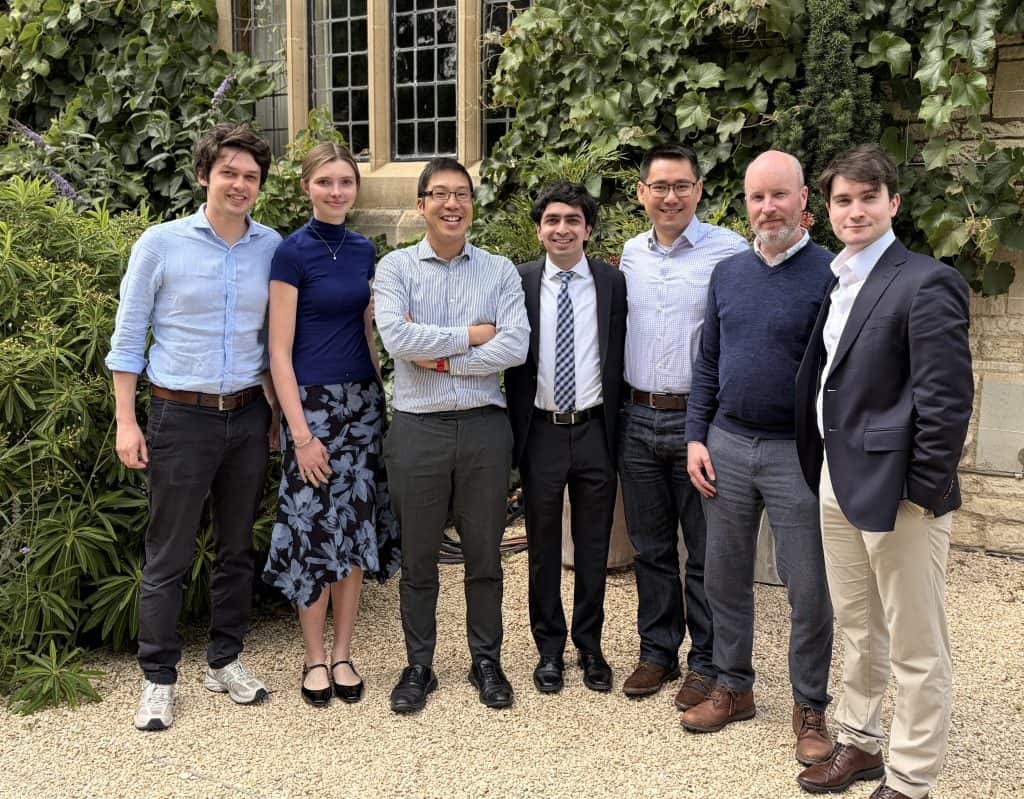
I often say that it only takes six people to change the world. From there, you build teams capable of extraordinary things.
That philosophy helped us keep cancer treatment available during the pandemic, expand access to testing, deliver some of the largest studies undertaken within the NHS, and now explore how AI could help create the next generation of cancer therapies.
Small teams of talented people can achieve outsized impact.
Small teams of talented people can achieve outsized impact.