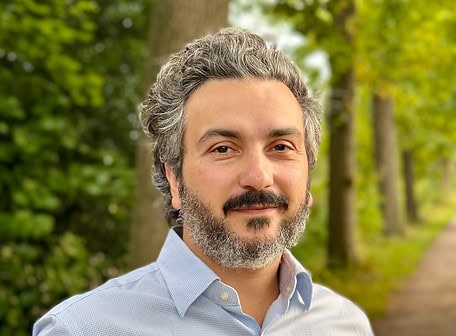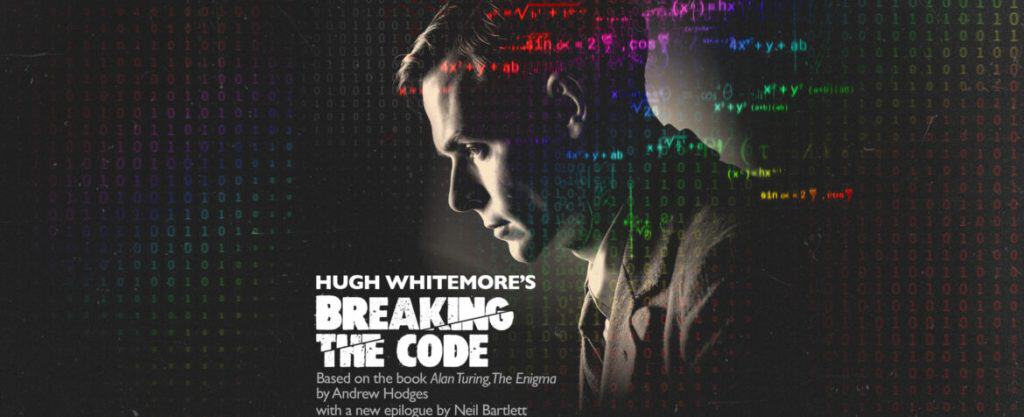
When Royal & Derngate Theatre staged Breaking the Code, the acclaimed play about Alan Turing’s life and legacy, they turned to Senior Research Fellow Dr Christopher Hollings for expert guidance.
As historical adviser on the production, he helped the cast navigate the mathematical ideas at the heart of Turing’s groundbreaking work, helping to ensure that one of the twentieth century’s greatest minds was portrayed with both intellectual rigour and human authenticity. We asked him to tell us more about the experience.
How did you become involved with Breaking the Code at the Royal & Derngate Theatre?
I received an email out of the blue from a producer at the theatre, asking whether I’d be interested in coming to talk to the cast about Turing. I think they must have found me online, not as someone who has ever worked on Turing (I haven’t), but as someone who has worked on the history of twentieth-century mathematics and could provide some context for Turing’s work.
What did your role as mathematical adviser to the theatre production involve?
I went to Northampton and spent a couple of hours answering questions and discussing the historical and mathematical background with the cast, starting with the things going on immediately around Turing, and gradually expanding outwards into other developments in early twentieth century mathematics.
What aspects of Alan Turing’s mathematics or working methods did you help the production portray accurately?
Parts of the play, including one long speech, deal with the Entscheidungsproblem (decision problem), which was a question posed by the German mathematician David Hilbert in the early twentieth century. It asks whether there is a mechanical process whereby we can prove that any given mathematical statement is true. Hilbert thought yes, but in 1936 Turing showed that the answer is in fact no (this was also proved, independently, by the American mathematician Alonzo Church around the same time).
Turing did this using what we now call a Turing machine – a hypothetical device that models processes of computing. I explained some of these ideas to the cast in general terms, and also answered other questions – for example, some members of the cast wanted to know how familiar their character would have been with the ideas or people involved in the mathematics.
Were there any moments where theatrical storytelling and mathematical or historical accuracy were in tension? If so, how were those resolved?
Not as such, as far as I can think. The play takes some of the ideas surrounding the Entscheidungsproblem and reframes them beyond mathematics as relating to questions of telling right from wrong in more of a moral setting. Arguably, that stretches the mathematics a bit, but it fits well with the overall themes of the play!
Did working closely on a production about Alan Turing change your own perspective on him or his legacy?
I think that rather than changing anything in my perspective on Turing, it emphasised his particular approach to mathematics, as this is something that the cast were keen to understand and convey. In contrast to Hilbert, who famously viewed mathematics as a pursuit conducted according to strict rules, regarding mathematics as a part of formal logic, Turing advocated for a more flexible approach to mathematics, where intuition has a much greater role to play. I was also pleasantly surprised by Turing’s 1936 paper, which I read properly for the first time by way of preparation – I was struck by how readable it was, and how Turing didn’t just fill the page with mathematical formalism but often tried to present the reader with a heuristic approach to the material.
Turing advocated for a more flexible approach to mathematics, where intuition has a much greater role to play.
What was it like seeing your advice brought to life on stage? Was there a particular scene or detail that stood out?
I can’t take much credit, as the cast – and, in particular, the actor playing Turing – was already very engaged with and knowledgeable about Turing’s story. I hope that I managed to add a little to their understanding of some of the historical background and the mathematical ideas. The over-simplified way in which mathematics is sometimes conveyed in fiction can make mathematicians cringe, but I thought that the mathematical discussions in the play sounded completely plausible – in particular, in the speech about the Entscheidungsproblem mentioned above.
As an historian of mathematics, what do you think theatre can offer that books or lectures cannot when it comes to communicating the lives of mathematicians?
If it’s done well (as it was in this case), I think theatre can tell the story with much more immediacy and really bring out the human element.
The production doesn’t just celebrate Turing’s genius; it also explores the injustice he faced after the war. As a historian of mathematics, do you think understanding the people behind the mathematics is as important as understanding their discoveries?
Definitely, because who people were, what they experienced, who else they interacted with, etc. shaped the mathematical work they did. This link is sometimes denied by people who want mathematics to be something pure and high-level, separated from everyday life, but I think this stems from the misconception that understanding the person behind the mathematics must necessarily entail strictly logical deductions such as ‘person X proved theorem Y because of event Z’.
The path to a mathematical development is rarely so clear – the influence of a mathematician’s individual circumstances on their work will usually be much more subtle, but it is still there.