Honorary Fellow Prof Elizabeth Frood on identity and legacy in Ancient Egypt
In April 2026, Prof Frood spent a month as a Visiting Fellow at the École des Hautes Études en Sciences Sociales (EHESS) in Paris, returning to an extraordinary statue she first encountered during her doctoral research. Here she explains what objects like this can reveal about ancient lives and why her time in Paris was an important milestone for her.
What made your time as Visiting Fellow in Paris especially significant?
Since my illness and the resulting injuries, travel has become logistically complex, and the idea of living independently away from home had seemed almost impossible. So, when my close colleague and friend, Professor Chloé Ragazzoli at the EHESS, suggested in the summer of 2025 that I apply for the Fellowship, I’m fairly sure I laughed and dismissed the idea outright.
But her gentle encouragement made me slowly begin to wonder if it might actually be possible. With her help, and the support of my family and friends, I managed it. Achieving that day-to-day autonomy was enormous for me and really transformed my trust in my own abilities and adaptability. So, the Fellowship was both a professional and a deeply personal achievement.
Your work explores how ancient Egyptians represented, or ‘staged’, themselves through funerary autobiographies, images, and statues. What can those forms of self-presentation reveal that a more traditional historical record might not?
I’m interested in the choices people made — or that are made for them — in presenting something of themselves to the world and to the future. That can range from a name scribbled on a temple wall to artful, poetic autobiographies inscribed in tombs or around the bodies of statues. The material presence of these things is part of that choice, too.
I’m interested in the choices people made — or that are made for them — in presenting something of themselves to the world and to the future.
By the period I work on, the late second millennium BCE, autobiography was already an ancient genre, and one that seems to have fallen somewhat out of fashion. So including an autobiography on a monument wasn’t an automatic or conventional choice; it was something distinctive. And although these texts drew on ancient models, people could also use them to do things that seem strikingly new. I love that sense of experimentation — of people working within tradition while also finding ways to push its boundaries.
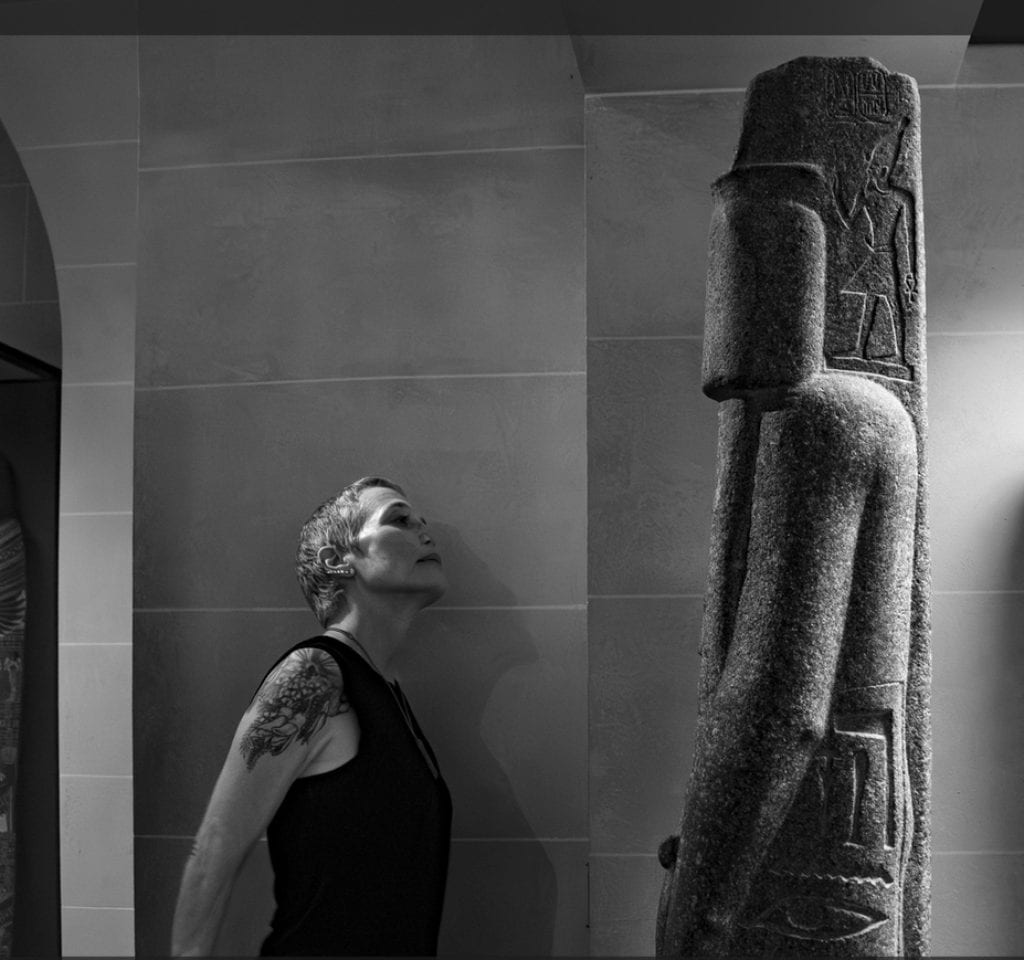
During your time in Paris, you interpreted a statue of Wenennefer (pictured above), a high dignitary under Ramesses II and great priest of Osiris, at the Louvre. What drew you to this particular statue, and what can one object like this reveal about life in Ancient Egypt?
It’s a remarkable object. The statue takes the form of an architectural pillar from which Wenennefer’s body emerges, while the text on its rear surface is arranged as a series of rhythmically aligned speeches. He addresses his god, Osiris, and describes his own crucial role in the annual festival celebrating the god’s revivification.
What fascinates me is how much is happening in this one object. Its words, imagery, material form and monumental setting all work together to tell us something about what mattered to Wenennefer — his relationship with his god, his status, his ritual knowledge, and how he wanted himself and his actions to endure. So one statue can open onto something much larger: not simply the life of an individual, but the religious, social and creative world in which that life was lived.
What fascinates me is how much is happening in this one object.
Ancient Egyptian self-presentation feels surprisingly modern in its focus on status, identity, and legacy. Are there parallels you find useful, or are you cautious about making them?
I’m cautious about drawing direct parallels. There’s no comfortable modern equivalent for these ancient forms of self-presentation, and that’s part of what makes them so compelling as sources. But for my own analytical framing, I’ve found scholarship on modern autobiography quite productive, especially for thinking about the forms of subjectivity articulated in Egyptian autobiographical texts.
In the short film I was involved with in Paris, I instead drew a loose parallel with obituaries — that telling of a life in celebration of an individual. I hoped this would give viewers an immediate point of connection. But what Wenennefer is doing is ultimately very different, and much more complex in its monumentality and poetry. He speaks in his own voice, describing his performance of vital rituals that bring about his own transfiguration — a transformation that the statue itself, through its extraordinary physical form, also seems to enact.
What are the advantages of using object-led storytelling to introduce non-experts to ancient cultures?
I think there’s sometimes an assumed distinction between textual stories and objects, whereas for me, all my texts are objects, and their stories are multiple and diverse. So I try to begin with what someone could actually have seen and experienced. Sometimes it can be a small visual detail, like Wenennefer’s adornments or his name and titles carved across his body in unusually large hieroglyphs, almost like those on a temple wall.
This reminds me of a stela from Abydos, where Wenennefer’s statue was also set up. A group of women are shown making music during a festival procession, and the woman at the front actually steps outside the frame, almost as though she were walking off the monument and joining the procession itself. Details like that can suddenly make an apparently remote object feel dynamic. They encourage us to think about movement, sound, audiences, and the lived settings in which these monuments were active.
Bringing in that kind of archaeological and material context — how something was made, designed, composed and encountered — can, I hope, bring stories to life for people who may be looking at ancient Egyptian monuments like these for the first time.
Your Paris Fellowship included seminars, a public workshop, an informal student roundtable, and a short film project. How did those different settings shape the way you shared and developed your research?
Each setting offered something different. The seminars and workshop gave me the chance to test ideas and discuss my work with brilliant and generous colleagues whom I rarely get to see otherwise, while the roundtable opened up a much more informal kind of exchange, exposing me to new research and unexpected questions. Hearing about this inspiring and diverse work being done by students at EHESS and the Sorbonne was a particular pleasure — and I’m hoping to lure some of them to Oxford in the future!
The film was different again: it made me think very carefully about how to distil quite complex ideas and communicate them to a much wider audience. Taken together, those different conversations were enormously stimulating and have given me new ways of thinking about both the research itself and how I share it.
How has your association with Queen’s shaped your academic life?
Queen’s was my first home when I moved here from Aotearoa New Zealand to study Egyptology with John Baines. I made lifelong friends during that time, particularly through rowing and the wonderfully supportive MCR community, and later hid myself away in the cosy Peet Library during the final stages of writing up.
My Honorary Fellowship, made possible through nomination by a lovely former undergraduate student and advocated for by my close colleague and friend Richard Parkinson, has now given me a second academic home in Oxford. Queen’s has been a centre for Egyptology since the very beginnings of the subject at Oxford, so to find myself part of that long legacy is an immense privilege.
Film link: https://llx.fr/site/index.php/2026/05/11/i-wenennefer-moi-ounennefer/
Part of Histoire Courts, a project of Jean-François Dars and Anne Papillault.
Header image from screengrab credit: Jean-François Dars and Anne Papillault.