What do island ecosystems, gut microbes, social networks, and the evolution of death have in common? For Browne Junior Research Fellow in Biology Dr Aura Raulo, they are all ways of exploring one of ecology’s biggest questions: how does life find balance between isolation and connection?
We spoke to Aura about the hidden networks that shape the living world and how collaborations spanning animation, choral music, and philosophy are opening up new ways of thinking about science – as well as the surprising gravity-defying abilities of wood mice.
Your research explores ecology and network theory. What are the big questions you’re trying to answer?
Funnily enough, ever since I was an undergraduate the question I have been most fascinated by is why biodiversity seems to be so high on islands and archipelagos. Is the island nature enriched by its isolation and the unique local evolution that creates new life forms? Or is the diversity born out of the spread of species between islands? I think this fascinates me because I want to know whether we should protect the richness of life by fostering connections between ecosystems or by guarding their isolation.
I want to know whether we should protect the richness of life by fostering connections between ecosystems or by guarding their isolation.
Ecology has a long history of thinking about how life distributes itself across landscapes – which species end up living where and why. A lot of this theorising is based on an idea of a world that is a continuous landscape, like a forest. However, in reality even forest ecosystems are often fragmented in little separate patches, especially today when humans have transformed our landscapes into a mosaic of sorts – think about English woodlands separated by fields and connected by hedge rows. Ecologically they resemble an archipelago! And similarly, the microbial ecosystems living inside our bodies experience a world as an archipelago – each individual host is like an island and our social relationships form bridges through which microbiomes can spread.
So, the question about how biodiversity is born out of isolation or contact is relevant to more than just islands. By combining theories of island ecology and analysis of human social networks, we can perhaps find out what kind of social life styles (how much isolation and how much contact) are best at fostering diverse and healthy gut microbiomes.
Your talk How to Die Less grew out of your research into the evolution of death and dying across different scales of life. What does it mean to look at death in this way, and what might surprise people about what you’ve found?
I think what people don’t often think about is that, despite all the mythology about inevitability of death, the ability to die is actually not a necessary part of living but in fact a trait that has evolved in the history of species because it is adaptive. Death, sex and individuality all evolved hand in hand to allow regeneration of life, recombination of genes, and new ways of living to emerge. That way dying makes lineages of animals and plants able to change and adapt in changing environments.
As an ecologist, I look at death as a process that creates life, not as a process that destroys it. Dying is also tied to our individuality in ways that make sharing yourself an act of immortality: all the things that make me the person I am – my genes, my memories, my values, my ideas, the cells of my body – they are all things that come to us from someone else and are given away to someone else again. We don’t really own anything, it’s all borrowed, except perhaps our unique position in the social and ecological networks we are part of. Even if all my matter and spirit is borrowed, I am a unique crossroads in the roadmap of spreading life. No one else has this particular combination of genes, political views, memories, gut microbes or values as I do.
As an ecologist, I look at death as a process that creates life, not as a process that destroys it.
There, as part of a network, we have a real choice of how much we die. It is a choice of how much of the unique combination of matter and spirit that is us we pass on to others and how much we keep to ourselves. If we protect our integrity by not sharing from ourselves, when we die we die a lot. All that is us will go to the grave with us. But if we share a lot – give away our ideas, spread our gut microbes, tell away our stories – then when we die, we die just a little. Most of what made us us will live on, circulating in the network, feeding new forms of life.
Your public talks have been very popular online, receiving over 5,000 views in less than a year. What do you think has connected with audiences, and has communicating your research to a wider public changed the way you think about the research itself?
I have been surprised by how much people in the general public, and artists in particular, have been interested in ecological networks and our position as part of them. Perhaps this is part of a bigger shift in our culture, where people are increasingly critical towards the old narrative of humans as somehow independent beings outside of nature. As our ecosystems crumble, our health and societal order is also crumbling. And people are more and more aware of the intimate interconnectedness of our being with the other, non-human life on this planet.
People are more and more aware of the intimate interconnectedness of our being with the other, non-human life on this planet.
Related to this, I think many people are also tired of the aspects of our culture that emphasise the power and responsibility of individuals. People feel powerless as individuals and seeing themselves as nodes in a larger network gives them empowerment and hope that their actions have a meaning. Which is very true! As part of social and ecological networks we can carry huge responsibility, more than any individual can, and we have a huge collective power to change things as well. It just takes a bit of practise to start seeing yourself as part of a network. First they can be invisible, but if you bend your mind a bit, you will start seeing them everywhere.
The discussions I have had with people around these talks have been hugely inspiring to me. They have convinced me that scientific research has philosophical consequences, and that it is an important part of the job of a scientist to participate in the discussions over the meaning of their research. And it’s important to have these discussions ambitiously, beyond the obvious rationales we all write in grant applications, like we would like to cure cancer or save the rainforests. To truly stand behind one’s research and be one voice of science in the world, I think we should ask ourselves ambitious and provocative questions like why should we cure cancer, why save rainforests, why do we want to protect and value life in the first place? And when we protect life, whose life do we protect?
Your work has also moved into the world of art through I Wish We Had More Time, an animation about the heartbreak caused by species extinction. How did that collaboration begin, and what can animation express about extinction that an academic article perhaps cannot?
This project stemmed from my friendship with Nicolas Baird, a palaeontologist, an artist and one of the curators of this exhibition. They had this brilliant idea of comissioning art pieces that relate ecological crises with personal crises. Like can we use the emotional tool kit we have developed to survive romantic break ups to deal with ecological disasters in our environment. Or that sadness one feels when they meet someone special but it’s a bad time for both and no relationship can stem from the connection that time. Can we relate that with the awkward love relationships we hold with other species that we adore but also drive to extinction. The exhibition is aptly titled “I wish we had more time”, it’s like a text message from one species to another in a world of ongoing ecological destruction. Like a little wish that in another time, in another world, we could have been something great together.
This feeling is what me and my artist collaborators were chasing when we made the animation. We chose a species whose ongoing extinction is particularly painful for us personally, the Blue Canary, an endangered passerine endemic to Gran Canaria. Our piece, The Song of the Rib Cage Bird is an animation about heartbreaks in ecological relationships, a story of human and the blue canary. Much loved by local people, this species is on the brink of extinction due to fires that threaten the small, fragmented pine forests it lives in. There may soon exist more stories about blue canaries than there are blue canaries flying about. We were fascinated by how as they slowly vanish from this planet; they simultaneously live on in our tales. And as stories, they get trapped inside of us, making us the cages of what we have lost.
Your work on humans as part of ecological networks have now inspired a new choral work by musician Aili Järvelä. What is it like to hear your ideas translated into music?
To be honest this was quite surprising to me. I have only seen the lyrics so far and look very much forwards to hearing the piece when it premiers in a couple of weeks!
Taken together, these projects have carried your ideas from academic research into YouTube, animation, and choral music. Is working across those different forms part of how you see your role as a researcher and where are you planning to take that next?
I think working with artists and discussing the broader implications of all I do as a scientist is becoming a very important part of my career. I wish to continue this work as part of my job and would be very sad if I had to reduce the philosophical and artistic part of my research into mere science communication – by now it has become so much more than that. I don’t feel that I am just communicating science through means of art or philosophy, but that artistic and philosophical processing of my research themes is greatly influencing the way I do science as well. I specifically hope I can keep talking to artists to find new ways of talking about complex system dynamics.
Artistic and philosophical processing of my research themes is greatly influencing the way I do science.
Powerful metaphors are what drives science forward and artists are super good at coming up with new good metaphors. Think about how we talk about social systems as networks, temporal processes as waves (“wavelength of light”, “epidemic waves”, “rise and fall of civilisations or species”) or Darwin’s idea of tree as the symbol of evolutionary history of species. These metaphors are inherently artistic choices, and they have huge influence over how we think about, or mathematically model, natural processes. Working with artists can help us find new insightful metaphors that can make previously invisible patterns of life suddenly visible. I think it’s magical.
You also study mice at Wytham Woods; can you tell us a fun fact about them?
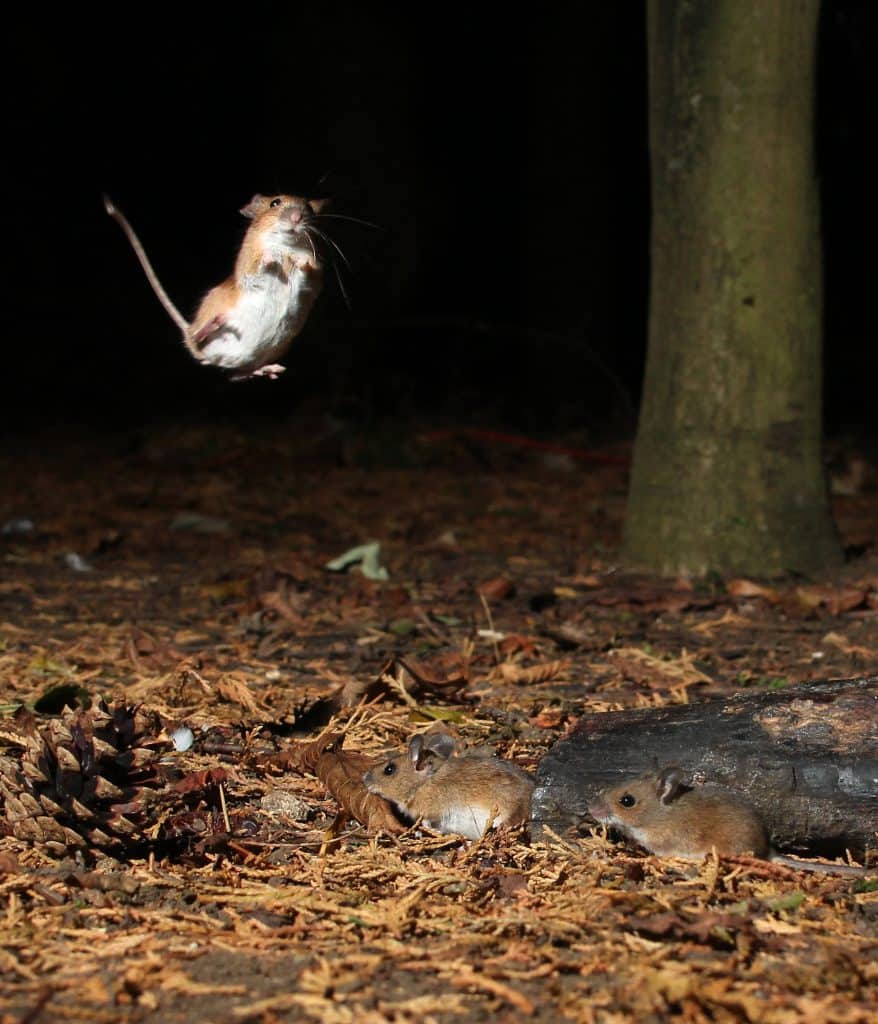
Wood mice seem to be able to defy gravity! See the camera trap photo in the header taken by our great photographers Roy and Marie Battell.
What do you enjoy about being a member of the Queen’s community?
I love being part of such a diverse academic community. And one where everyone seems to have that gleam in their eyes that says they are just interested in the world. Despite the hectic Oxford life, people have the time and curiosity to often end up having longwinded discussions about anything and everything on Earth and beyond. These discussions I have had over lunch, tea and dinner have been like fuel to my thinking and have also led to some actual collaborations. My dinner discussions with Dirk Meyer (philosopher) and Mats Van Es (psychologist) about what knowledge even is have led to us starting a research project together exploring how changing patterns of connectedness between people across centuries have affected how humankind creates knowledge.
Everyone seems to have that gleam in their eyes that says they are just interested in the world.
Can you recommend a book?
Can I recommend two?
I must recommed Benjamin Labatut’s book When we cease to understand the world, which is an outrageous yet amazingly written recollection of the history of western mathematics in twentieth century. I assure you it is not dry – in fact the author takes so many liberties in describing the life of some scientists that the book that starts as an honest essay, becomes pure fiction in the end. I am in awe of how beautifully and poetically Labatut talks about science and at the same time I disagree fiercely with him about the basic philosophical standpoints of the story. I’m not telling you what those are, read it yourself, be amazed, provocated or inspired. It won’t leave you cold!
I also want to recommend my all-time favorite, J.D. Salinger’s Franny and Zooey. I love the book because it is like watching theatre on page and because it is a perfect little story about how to find a way to be genuine when everything around you supports acts of being cool, ironic, defensive, or otherwise not sharing one’s true self in fear of the vulnerability it brings. I think scientists could learn from that.