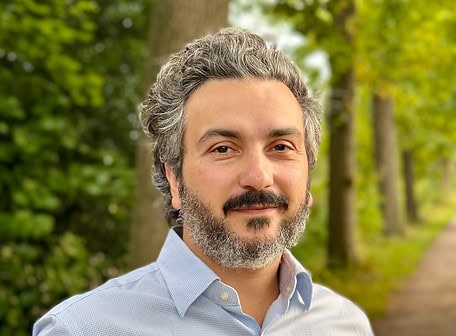
How can we change the chemistry of a precise area of the brain without invasive surgery? Queen’s Extraordinary Junior Research Fellow in Psychology Dr Nima Khalighinejad is developing a pioneering approach using focused ultrasound to allow drugs to reach specific brain regions.
Following a year that has brought a Wellcome Career Development Award, an appointment as Associate Professor, and the growth of his new research group, we spoke to Nima about targeting brain chemistry with greater precision and the power of interdisciplinary research.
This has been a significant year for you; looking back, which moments stand out most?
The transition from being a postdoc to becoming an independent group leader is probably one of the hardest steps in an academic career, so the moment I found out that I had received the Wellcome Career Development Award really stands out. It meant that I could establish my own research group and, importantly, have stable funding for several years to focus on the questions I am most interested in. That sense of independence and security was very special.
Your research develops ways to deliver drugs to the brain using ultrasound. For those without a neuroscience background, can you explain how that works and why it’s an exciting area?
One of the big challenges in neuroscience is that we often have to choose between two imperfect options. We can give a drug systemically, for example as a tablet or injection, but then it reaches many parts of the brain and body at once. Or we can use very precise methods that target one small brain region, but those methods are often invasive.
What we are trying to do is something in between. We use focused ultrasound to temporarily, and very locally, open the blood–brain barrier, which normally acts like a protective filter around the brain. While that small area is open, a drug circulating in the bloodstream can enter that specific part of the brain.
This means that, in principle, we can change the chemistry of one brain region without having to perform invasive surgery. For example, we can target neuromodulators such as serotonin or dopamine to a particular area and then study how behaviour changes. That gives us a much more precise way of asking what different chemicals are actually doing in different parts of the brain.
What kinds of conditions or scientific questions could non-invasive control of brain chemistry help us tackle?
Serotonin is a good example because it is strongly linked to depression and is also the target of many antidepressant drugs. But serotonin does much more than regulate mood. It is involved in motivation, learning, patience, decision-making and many other aspects of behaviour.
At the moment, when we give a serotonergic drug, it affects serotonin throughout the brain, so it is difficult to know which brain regions are responsible for which effects. A more targeted approach could help us separate these different functions.
The same is true for other neuromodulators such as dopamine, noradrenaline, and acetylcholine. These chemicals influence many different cognitive processes, but we still do not fully understand how their effects depend on where in the brain they are acting. Being able to manipulate them locally gives us a much better tool for answering those questions.
In the longer term, understanding these mechanisms could also help us think more precisely about psychiatric and neurological conditions in which these systems are disrupted.
Your lab has grown considerably this year. How has the transition from leading a small research group to building a larger team changed the way you work?
When your group is small you are still mostly a scientist working directly on experiments, analysis, and papers. As the group grows, you also become a manager and a leader. You spend more time thinking about how different projects fit together, how to support people at different stages of their careers, and how to make sure everyone has what they need to do their best work. I still very much enjoy being involved in the science itself, but I have had to learn that running a lab is not just about having good research ideas. It is also about helping other people develop their own ideas and careers.
You were involved in several papers published in journals, including as senior author for papers in Nature Human Behaviour and Nature Communications. How important is collaboration in modern neuroscience, and what does it make possible?
Collaboration is absolutely essential in modern neuroscience. The field has become so broad and technically sophisticated that no one person can be an expert in everything. For example, our recent work on targeted neuropharmacology brought together expertise in neuroscience, engineering, pharmacology, ultrasound physics, and neuroimaging. Each part of the project required a different type of knowledge. That is one of the things I enjoy most about neuroscience. You can have a question about behaviour, but answering it may require working with an engineer, a physicist, a pharmacologist, and a computational neuroscientist. The final science is often much stronger because different people bring completely different ways of thinking about the same problem.
Collaboration is absolutely essential in modern neuroscience.
Alongside your research, you’ve represented early career researchers on the College’s Academic Committee. Can you tell us a bit about this experience?
Being part of the Academic Committee gave me a much better understanding of how the College works behind the scenes. As researchers, we often focus very narrowly on our own projects, but there are many decisions being made about teaching, research, recruitment, and the wider academic life of the College.
It was also a useful opportunity for me to represent the perspective of early career researchers and to contribute to discussions beyond my own discipline. I think experiences like this are important because, as you become more senior, your role is not only to lead your own research but also to contribute to the wider academic community. For me, it was an important step towards taking on more leadership responsibilities in the future.
What do you enjoy about being part of the Queen’s community?
One of the things I enjoy most is talking about my research with Fellows from completely different disciplines and, equally, hearing about their work. Within a department, you can easily end up living in quite a narrow academic bubble, surrounded by people who use the same terminology and think about similar problems. Queen’s gives me the opportunity to step outside that bubble. You might have lunch with someone working on history, economics, literature or mathematics, and suddenly you are thinking about your own research in a completely different way. I really value that broader intellectual environment.
What advice would you give to a student who is fascinated by the brain and is thinking about a career in neuroscience research?
I think the brain is not only the most fascinating organ in the body, but one of the most fascinating things we can study. Everything we do – our decisions, emotions, memories, movements, and sense of who we are – emerges from activity in the brain. So in trying to understand the brain, we are also trying to understand what makes us human. Neuroscience is also incredibly interdisciplinary. You do not have to start with a neuroscience degree. People come into the field from psychology, medicine, biology, engineering, physics, mathematics, computer science, and many other backgrounds. That diversity is becoming even more important with the growth of artificial intelligence. Many ideas in AI, including neural networks, were originally inspired by the brain, and now AI is also giving us new tools to understand the brain. So my advice would be to build strong skills in whatever discipline you are currently in, and do not worry too much about following one fixed route. There are many ways into neuroscience.
In trying to understand the brain, we are also trying to understand what makes us human.