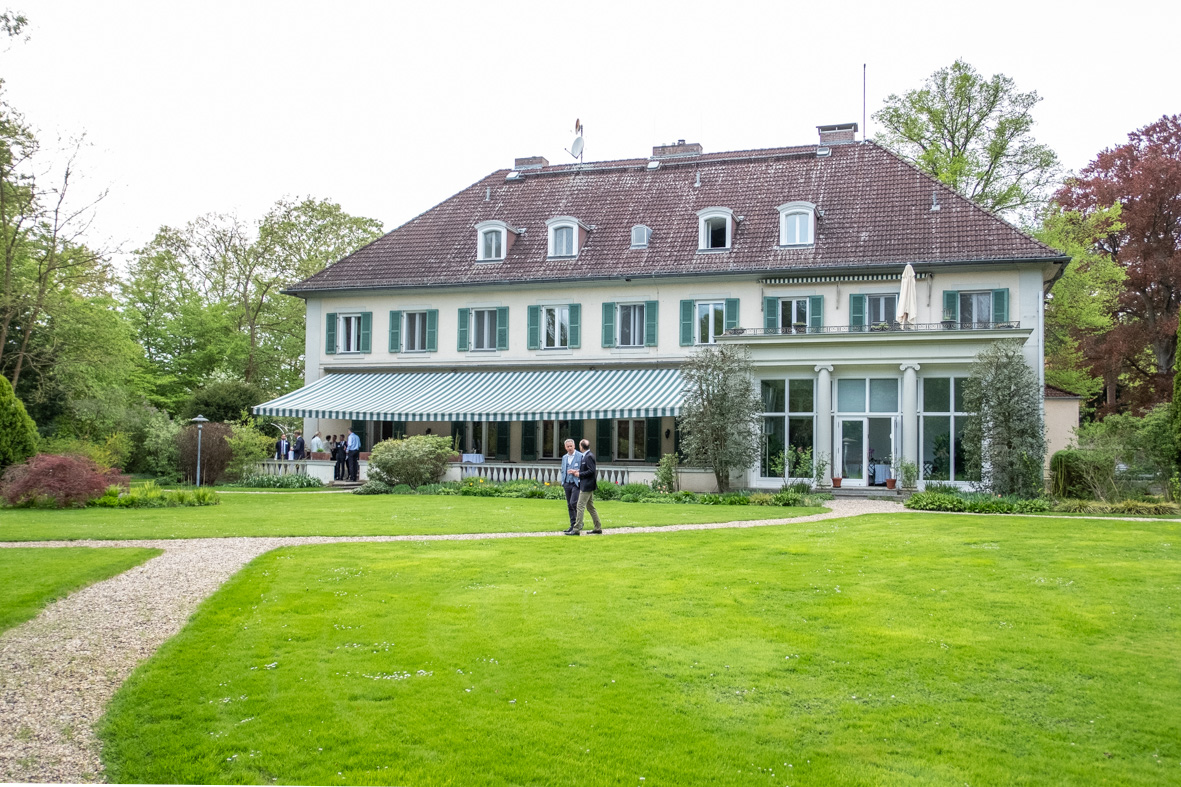
Returning to Queen’s as an Honorary Fellow, Old Member Sir Michael Barber (Modern History, 1974), Lord Barber of Chittlehampton, reflects on the ideas, tutors, and debates that shaped his time as an undergraduate, and continue to inform his thinking today, from the role of the humanities to the future of university education in an age of AI.
What did you enjoy about your time at Queen’s?
I enjoyed the whole thing. I loved studying history, but didn’t do as much work as I could have done, because I did lots of other things too: I had lead roles in plays, I was President of the JCR, I was in charge of table tennis, and I made a lot of good friends.
I was left with two things that have been important throughout my life. One is a love of history. I still endlessly read history books, and that passion has remained a friend, and then the friends I made have stayed best friends. These are huge things that trace back to Queen’s, so it’s always a pleasure to come back to College, and I associate it with great memories.
You have contrasted universities that are ‘uncomfortable and empowering’ with those that are ‘comfortable but enfeebling’. How does the tutorial model help to make the difference?
You want university to be challenging. You might not think that when you’re an undergraduate, but it is good for it to be challenging and good to get into genuine academic debate. One of my tutors at Queen’s was the legendary J O Prestwich who taught Mediaeval History brilliantly. You’d write an essay for him and read it aloud, and he would say: ‘But where’s the evidence? Where’s the evidence?’ His constant emphasis on being able to demonstrate that what you had said had an evidence base was very influential on me.
You want university to be challenging. You might not think that when you’re an undergraduate, but it is good for it to be challenging and good to get into genuine academic debate.
Another of my tutors was Kenneth Morgan, the biographer of many key figures in the Labour movement, and he just made me think, not only about history, but about politics and why politicians do certain things and whether the pressures people are under in different circumstances affect their actions. He taught me American History, which I specialised in, and was always challenging me. He said to me in my second year, when I was President of the JCR, ‘you really need to be doing some more work’ and I then spent the summer catching up. So, he had a direct influence in that respect, because I was so busy with extracurricular activities and he knew, in a way that I didn’t aged 21, that if I didn’t get a good degree, I’d have always regretted it.
You told an anecdote to Fellow in Biochemistry Prof Jane Mellor about a lecture series where the tables turned, and you challenged the lecturer. Can you tell us about this?
It was a series of lectures on the Industrial Revolution and one of the big debates was whether, in the first 50 years of the 19th century, the standard of living of the working classes got better or worse. There’s lots of conflicting evidence on that and I was taking the point of view that it must have got worse. The Lecturer took the free-market view that this period was very positive with lots of opportunities. My friend and I had done a lot of reading, and we interrupted his lecture, not rudely, but to challenge him on these views. He then argued with us point by point before saying: ‘Hang on, other people have come to listen to my lecture but it’s a great debate so let’s continue afterwards.’ So, we did in a tutorial with him, and it was a genuinely worthwhile debate. My favourite line was at the end when I recommended a book to him and he looked at it, gave it back to me, and said: ‘I’ve worked out I’ll be able to read 1,000 more books in my life and I’m not reading any crap.’
Where had you leaned to debate or was this a case of you trying it out for the first time?
Well, I don’t think I had interrupted a lecture before, but I had a Quaker upbringing. I went to a Quaker school where we were expected to treat people equally whatever their background and our classes were quite open, though always very polite and genuine. Then, I was President of the JCR, so we were constantly debating and arguing there.
In what way does the tutorial also continue to aid the general powers of the mind during the rise of AI usage?
Who knows what the impact of AI in education is going to be. There are questions around assessment, exams, and how you do research. I think we’re only just at the beginning of it and it will be transformative. As you’ve implied in the question, the tutorial will be fundamental, because you have to talk things through with people without a machine in front of you. You must show knowledge of the facts but also understanding and the ability to debate in the way we were talking about previously. I think in mediaeval universities, including here, and Bologna was famous for it, everything was assessed orally so we may see a return to this.
However, there will have to be changes because we can’t do the volume of examining that we do now in the modern university orally at the speed of 1,000 a day. The AI will also get good at checking when students are abusing it but then we get into a horrible cycle of essays getting more and more AI-based and then the checking system and the marking system also doing the same.
Ultimately, who’s talking to each other? It’s like a kind of arms race and that feels like a big distraction from the real purpose of a university education, which is to teach people to think, to learn, to structure an argument, but also to understand an opposing argument. That’s what the Lecturer in that anecdote was very good at. He obviously saw two students who didn’t agree with him, didn’t know anything like as much as he did, but he wanted to encourage us to argue properly and that is a huge thing. I think we want this to be absolutely central to what happens at university and at Queen’s.
Ultimately, who’s talking to each other? It’s like a kind of arms race and that feels like a big distraction from the real purpose of a university education, which is to teach people to think, to learn, to structure an argument, but also to understand an opposing argument.
Bodley’s Librarian Richard Ovenden call librarians and archivists ‘the advance guard of the future’. What investments should universities prioritise in a digital and AI age to protect students’ freedom to find ideas across time?
Well, I think librarians. I love libraries and I love the Queen’s library. It’s a beautiful building but also a fantastic institution. Libraries are important but not just as a record, also as a living thing that’s developing. Every library has to make selections about what it can and can’t include and the people making those judgements are very important. The big risk when it all goes digital is that the archives of the world end up being owned by very large tech companies, which is not a good idea. The Bodleian Library or the British Library are making selections on what they keep and what they delete for research reasons, for historical reasons, and for stewardship reasons. What do we need to pass on to the future? You can’t rely on the AI companies to do that. I’m not saying they’re bad people but they’re not doing the same job.
I go to the National Archives as part of a Master’s degree I’m doing in Mediaeval History, and there are actual documents that Edward III sent back from Calais, where he was fighting, to Kent. Those things are priceless. You’re looking at a 14th century document. But now the records are so voluminous that you have to choose all the time. When George Washington finished as the first President of the US, they were still building the White House and the archives he handed over to John Adams consisted of seven cases that fit on a cart. Now we’re putting all the cabinet papers in a digital repository, but what happens if there’s some digital disaster? I worry that we won’t make the right decisions for the right reasons because we haven’t thought it through.
Can you tell us about a moment when a tutorial changed your mind or helped you to distil your own thoughts?
As I mentioned, I specialised in American History, and I did a course as part of that called Slavery and Secession. Going into that paper I thought that the American Civil War was all about slavery, but what Lincoln had said to the Southern States was that if they stayed in the union, they could keep slavery. This was all a complete revelation to me, and it was a revelation in how I thought about it. He wanted to abolish slavery, but he knew that if he got it wrong at the beginning, he wouldn’t be able to. Following Lincoln through his career was an education in tactical and strategic mastery. I remember all that very vividly.
You praise ‘robust civility’ (Timothy Garton-Ash). What does good disagreement sound like and how do we teach it?
I don’t claim to be an expert, but I have thought about this a lot. There are two main threats to having a good argument. One is that everybody just gets angry and they don’t listen to each other. The other is that because it might be challenging for one or other of the participants, each side is suppressed and you run away from it. Neither of those is what you want in a university academic debate.
You want both sides of the argument to be set out well and you want excellent listening. In my work to help governments improve their performance, I teach people to ask questions once an argument has been explained where they set out the argument in their question, for example: ‘If I’ve understood you correctly, you’re saying X, Y, and Z?’ This either positively, shows you have understood them or, if you haven’t understood them, they can correct it. But you’re also demonstrating that you’ve been listening and you’re trying to understand. Part of robust civility is simply listening. You can do exercises where people make their case and then you reverse it so they have to restate the case made by their counterpart. At the very least, that requires a depth of understanding, and then you can have an argument about it because now you’ve got a shared understanding, if not a shared view.
Part of robust civility is simply listening.
What mindset do you think every student should bring to get the best out of an Oxford education?
The conversation you mentioned earlier with Jane Mellor came about because I interviewed her for my book Accomplishment. I interviewed a lot of different people for that book, and I always asked them the question, ‘what do you do all day?’ It is a fascinating question and when I asked Jane, she said, ‘I go into the lab with an open mind’. I think that’s a very nice summary of what you want a student to do because having an open mind is a very important step in learning. I think it does also pay to work quite hard!
What do you mean when you use the word ‘accomplishment’ and what do you like about this term?
I love the word. It sounds beautiful, and to me, an accomplishment is something you’ve completed that was worthwhile. When writing Accomplishment, I was building on a previous book called How to run a government, and that was about the way governments need to set themselves up to deliver their promises. Accomplishment then basically says that the same method of getting things done applies across science, art, music, sport, business etc.. I wanted a word that gathered together achievement in all those very diverse sectors, and this was it.
Do you think the same method could apply to an undergraduate reading for their degree?
Yes. A degree is a challenging goal and so you need to consider how you will go about it. The approach will have certain elements, such having the open mind we talked about, and a willingness to read books and do the research. Spending time with peers and learning from others by having conversations is also key. For example, I learnt a lot from the PPE crowd at Queen’s, who are still my friends, and the debates I had with them were a powerful part of my learning.
What motivated you to establish the Accomplishment Scholarship?
The Accomplishment Trust, which I founded, has two themes: one is biodiversity and the natural world in the southwest of England where I live, and the other is about encouraging, in the broadest sense, education and sporting opportunities for people who might otherwise not be able to afford it.
I wanted to support Queen’s because it was a great time in my life and has remained a significant part of who I am. I knew from my time as the first Chair for the Office for Students that the number of Master’s students in the humanities is dropping, and it’s expensive to do a Master’s course. So, even if you if you’ve got into Queen’s, or any other Oxford college, from a low-income background as an undergraduate, it can be very hard for you to stay on for a Master’s course, even though it’s the route into academia, as well as lots of other things. So here was a gap where we could do something meaningful. The Trust does lots of great things, but I’m particularly excited about this scholarship because it combines my love of both history and Queen’s. There’s already a student benefitting from the funding, so I’m very happy with the speed with which this has got off the ground.
I’m particularly excited about this scholarship because it combines my love of both history and Queen’s.
What’s your best case for studying the humanities in the face of their steady decline?
At their best, the humanities teach you how to think. They train you to analyse, question, and make arguments and this approach doesn’t end with a degree; it shapes how you interpret the world long afterwards.
But these abilities rest on something deeper: a strong and growing body of knowledge that’s challenged and reworked as each generation adds to it. This deepens our understanding of the past, present, and possible futures and it’s why pure scholarship matters and needs protecting. Universities like Oxford are among the best places to do this because they provide space not only to think, but also for synthesis and the bringing together of ideas and disciplines. Studying the humanities is not just about skills, it’s also about preserving and expanding knowledge itself.
I like to quote Václav Havel who was the last President of Czechoslovakia and the first President of the Czech Republic. When Slovakia wanted to separate, he did not go to war; he said let’s do this properly and with decency and form two countries where there had been one. He said:
For we never know when some inconspicuous spark of knowledge may suddenly light up the road for the whole of society, without society ever realising perhaps how it came to see the road. But that is far from being the whole story. Even those other flashes of knowledge which never illuminate the path ahead…have their deep social importance, if only through the mere fact that they happened: that they might have cast light; that in their very occurrence they fulfil a certain range of society’s potentialities – either its creative powers or simply its liberties; they too help to make and maintain the climate of civilisation without which none of the more effective flashes could ever occur.
To me, this is a beautiful argument for scholarship.
Did you have a favourite place to study when you were in College?
My room as JCR President was in the Back Quad, one floor up, looking out onto the Library and I loved to study there. I liked working in the Lower Library too. I also love good coffee, so sometimes I sat and read in the Queen’s Lane Coffee House.
Can you recommend a book?
Some excellent examples of the pure scholarship I mention above are as follows: The Enlightenment: The Pursuit of Happiness, 1680-1790 by Queen’s Emeritus Fellow Prof Ritchie Robertson; Peacemakers Six Months that Changed The World by Margaret Macmillan; The Sleepwalkers: How Europe Went to War in 1914 by Christopher Clark; The Dissolution of the Monasteries: A New History by my tutor at Exeter, James Clark. These are mind-bogglingly brilliant works.
My favourite history book is the three-volume biography of Garibaldi by G M Trevelyan, an early 20th century British Historian. It’s a wonderful story, wonderfully written.
In fiction, I love the great Russian novels and my favourite of these is The Brothers Karamazov by Fyodor Dostoevsky. I like the interaction between the story, the context, and human psychology. A shorter, and hardly ever read now, choice is My Name Is Asher Lev by Chaim Potok. The story is about a Jewish boy from a strict, Orthodox background who is utterly brilliant at art, but his parents don’t want him to pursue this. It’s about genius and how to manage it. I can hardly recall it without a tear coming to my eye, so I really recommend that: it’s brilliant.