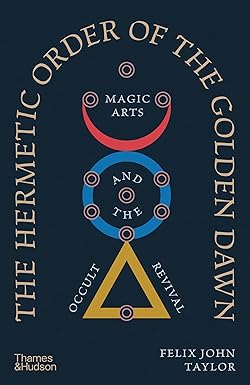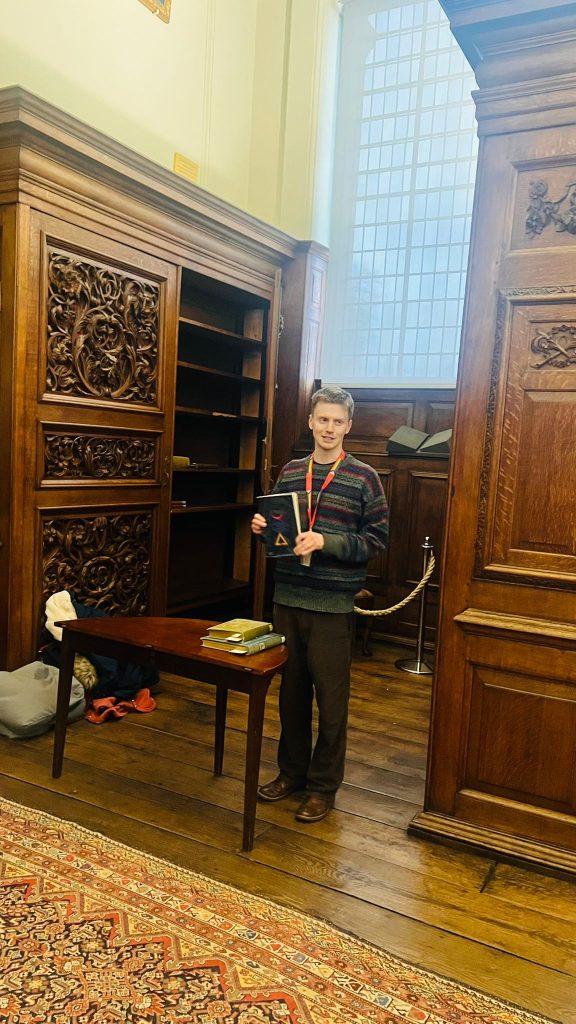
At Queen’s, our Library staff don’t just look after books, they write them too. Library Assistant Felix has written a new book exploring one of Victorian Britain’s most intriguing secret societies. In his study of the Hermetic Order of the Golden Dawn, Felix brings fresh attention to a network of writers, artists, and thinkers, including W. B. Yeats, recasting the group as a creative community whose influence still resonates today.
What first drew you to researching the magical order known as the Hermetic Order of the Golden Dawn and why do you think its story is interesting to share now?
The idea for the book came to me after finishing my DPhil, on Welsh myth and folklore in modern British literature, though it was not a direct product of that research. I noticed that some of the figures I had been writing about – the Welsh supernatural horror writer Arthur Machen and the Irish poet W. B. Yeats, for example – had connections to this mysterious London society. As I read into the history of the Golden Dawn, the more I began to view it as an unusual artistic subculture of Victorian Britain. Why wasn’t there a book that approached this occult group as an arts society or literary movement in its own right? We’re experiencing a new period of interest in the occult, and I thought a book like this would provide an accessible history of the Golden Dawn and ceremonial magic, while also considering the society from a new angle.
How would you describe the Order in simple terms and why did it capture so much attention in its time?
The Order of the Golden Dawn was a secret society founded in London in 1887 devoted to the study of the Western magical tradition. This was during a period in the late nineteenth century known as the occult revival, a new flowering of interest in all kinds of esoteric and speculative philosophies. By the Western magical tradition, I mean areas we would now consider as having been ‘replaced’ or suppressed by Enlightenment science: alchemy, astrology, Kabbalah (a branch of Jewish mysticism), divination. The Order’s founders, all Freemasons, synthesised these subjects into a detailed curriculum of study.
The Order of the Golden Dawn was a secret society founded in London in 1887 devoted to the study of the Western magical tradition.
Members passed through a series of hierarchical ‘grades’ by taking examinations and participating in initiatory rituals. They wore robes, adopted Latin mottos (Yeats, for example, went by Demon Est Deus Inversus) and wielded ceremonial tools such as wands or talismans. For the most part this was purely theatrical and academic, but in 1892 a second, or ‘Inner’ Order was established for the learning of practical magic: astral travel, invocation of spirits and scrying. All of this went on in Temples first in London, then Edinburgh, Bradford, Weston-Super-Mare, and later Paris and the US. People joined because there was nothing else like it at the time.
The Order brought together writers, artists, and performers; why do you think the occult held such appeal for creative communities?
A high proportion of members were creative people, mainly writers and painters, but also illustrators, translators and actors. Oscar Wilde’s wife, the writer Constance Wilde, was one of the earliest initiates. The allure of magic would have been hard to resist. A certain romance had built up around the figure of the magician in British literature – Merlin, Prospero, and Edward Bulwer-Lytton’s Zanoni – and many leaders of the occult revival consciously modelled themselves on these characters. To engage with the occult is also to take part in a process of reinterpretation and reimagining: essentially a creative act. The curriculum itself contained a vast trove of occult symbols and correspondences, which would have been perfect material for artistic projects.
The allure of magic would have been hard to resist.
Your book highlights progressive elements within the Order, particularly around class and gender; how unusual was that in the Victorian context?
That women were permitted to become members and also rise to assume leadership roles was quite unusual for the time. Particularly if you consider that Freemasonry, the dominant organisation of its kind during this period, did not usually allow women to join. The Church also prevented women from holding any kind of spiritual authority. The actor Florence Far was able to move up the ranks of the Golden Dawn to become Chief Adept in Anglia (‘in England’) and played a crucial role in the eventual breakup of the Order. There were no class barriers to membership either (in theory), though students were generally recruited from middle class social circles.
There are also hints of scandal and internal conflict; how did those shape the rise and fall of the Golden Dawn?
The whole project fell apart due to infighting. The increasingly paranoid leader S. L. MacGregor Mathers made aspersions about the magical credentials of other high-ranking members and questioned the circumstances of the Order’s founding. Other factors were also at play, including the discovered existence of an illegal ‘sub-group’ (yes, a secret society within a secret society). The original Order then split into three or four separate offshoots, each with a different vision of how the Golden Dawn should operate. Even the Golden Dawn name was brought into disrepute when a pair of American fraudsters managed to persuade Mathers to lend them a set of rituals which they used to conduct their own ceremonies; an underage girl was sexually assaulted during one of these faked initiations and the Golden Dawn name appeared in newspapers. Many members resigned due to this association, though the various splinter groups survived throughout the 1910s and 20s.
There’s renewed interest in the occult today; what connections do you see between the Golden Dawn and contemporary culture?
The Order’s rituals and organisational structure ended up influencing quite a range of new spiritual movements, including Wicca. Dion Fortune, who joined the Golden Dawn offshoot ‘Alpha et Omega’ in 1919, is still considered an important figure in modern paganism, and her own group, the Society of the Inner Light still operates today. Many societies bearing the Golden Dawn name have since been formed, using the same rituals and teachings as the original Order; you can even watch some of them on YouTube.
Perhaps it sounds too simple, but we live in uncertain times and looking back to alternative forms of tradition can provide a reassurance that conventional religion might not. In a sense, this is what the Golden Dawn were doing as the end of the Victorian era approached: excavating wisdom (as they considered it) from the rejected past.
Are there any interesting occult books in the Library, and can you tell us a bit about them?
The Library holds a surprising array of books relating to magic and the occult in its special collections, many on alchemy. There is, for example, a copy of Heinrich Cornelius Agrippa’s Three Books of Occult Philosophy from the 1530s, a foundational text for the Victorian occult revival (Mary Shelley’s Victor Frankenstein consults it in preparation for creating his monster). But my favourite is a three-volume set of The Works of William Blake from 1893, edited by W. B. Yeats and Edwin Ellis. Yeats was initiated into the Golden Dawn while working on it, and his occult studies clearly influenced how he came to interpret Blake’s system of poetic myth. The three books are beautiful objects in themselves, green cloth covers decorated in gold, printed in an edition of 500 copies.
The Library holds a surprising array of books relating to magic and the occult in its special collections.
It’s quite an undertaking researching and writing a book alongside your day job and family life. What approach did you take to make it work and do you have plans to do it again?
Just being very deliberate about how I use my (now quite limited) free time. I’m fortunate that I get real enjoyment out of sustained research and writing, so I will happily forgo something like watching Netflix in the evening. It also doesn’t hurt to be a librarian in Oxford and have access to the Bodleian collections! If I lived anywhere else, I’d be having to make far more research trips. My next book is coming out in January, a biography of Arthur Machen from Yale University Press. I wrote about Machen for my DPhil thesis and for the Golden Dawn book, so I had a lot of material on him already. He was a pleasure to write about.