Looking for your next summer read? The Library team have got you covered as they once again share the books they think deserve a place in your holiday bag. From eerie houses and winds that become characters, to American history, post-apocalyptic coastlines, and novels that span centuries, this year’s recommendations promise to transport you somewhere unexpected.
Sarah Arkle, Deputy Librarian
I have a few recommendations, all of which we have in the library as part of our General Collection, shelved in the Lower Library (Ground Floor). At the time of writing, all were still available to borrow!
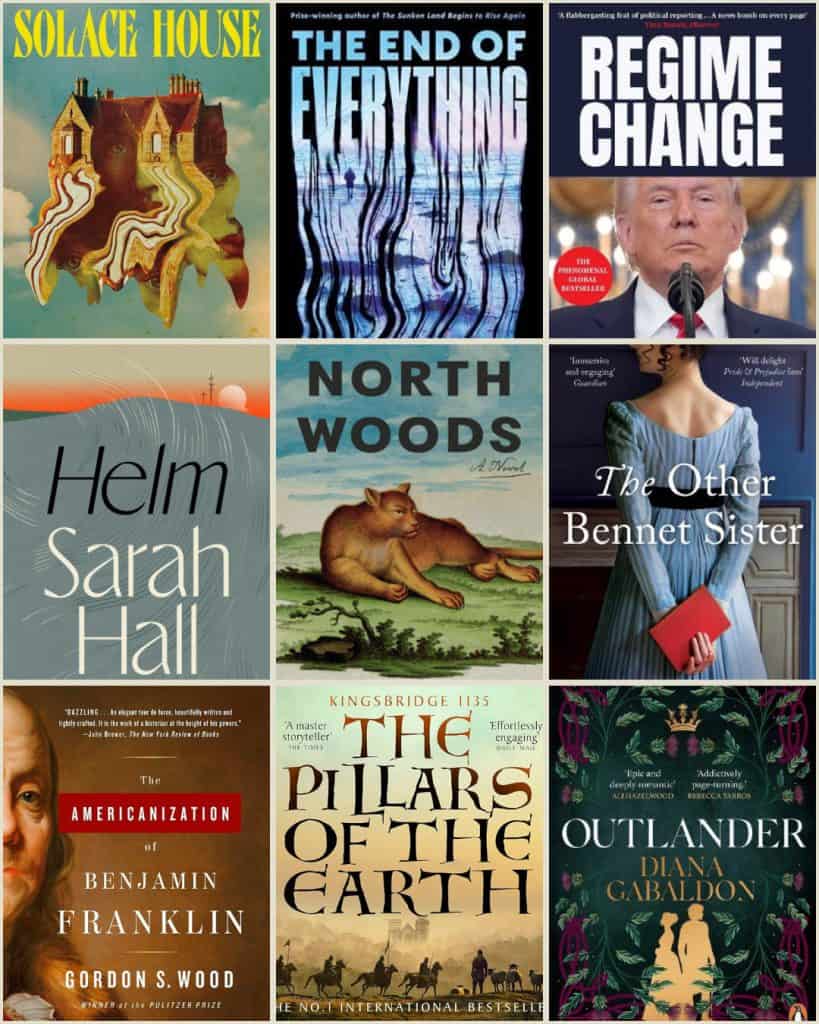
Transport yourself back to summer, 1993: a group of students are clearing out a weird house stuffed to the brim with clutter left behind by the reclusive and eccentric, now deceased, owner. Things get weird. Then they get weirder. Parallel dimensions might exist. Maybe ghosts? Alternate realities? Who knows! All this and more awaits in my first recommendation: Will Maclean’s novel Solace House.
It has drawn comparisons to The Secret History and The Haunting of Hill House; comparisons that set a remarkably high bar. I prepared for disappointment, but was pleasantly surprised; I found Solace House very entertaining and incredibly strange. I liked that it refused easy interpretation – there’s a whole host of possibilities when it comes to what is ‘really’ going on and you do have to decide for yourself what you make of it all. I also read it in almost one sitting despite it being over 500 pages long!
I liked that it refused easy interpretation – there’s a whole host of possibilities when it comes to what is ‘really’ going on and you do have to decide for yourself what you make of it all.
Maclean also does a good job of synthesising a wide range of influences across art, literature, music and history into the novel. There is a risk when writing something with so many inspirations that you may produce something significantly less than the sum of its parts, but I didn’t find this the case with Solace House at all.
If I had to criticise anything it was that one or two elements – like the framing of a traumatic event in the narrator’s past – felt a bit underbaked, but at 500+ pages, more might have felt too much. If you want an entertaining and very weird time, this book will absolutely deliver on that. Find it at Gen Mac in the Library.
My next recommendation is Sarah Hall’s most recent work Helm. Brought to my attention because it is set in the northwest of England, and I try to collect works for the library by authors who write about or come from the area due to our long-standing connection to the region.
Helm is a real wind in Cumbria (it is the only named wind in the British Isles). Helm is the main character of this novel, overseeing generations of characters and millennia of change. Helm is playful, Helm is needy, Helm is powerful, Helm is curious. The premise is great, very original, and Hall manages to pull off something remarkable in scope, thinking about connection, environment, place, climate, humanity, the past, the present, the future. The chapters detailing Helm’s interactions with a troubled young girl in the mid-20th century are particularly moving. It is one of my favourite reads of this year so far and is available shelved at Gen Hal!
Helm is a real wind in Cumbria (it is the only named wind in the British Isles)
Helm reminded me of my final recommendation; Daniel Mason’s wonderful novel North Woods, which is shelved at Gen Mas. Similarly set in a very specific location over a vast amount of time. Do you ever think about all of the people who lived in your house before you did? This novel might well make you do that, following 400 years of various inhabitants of a house in the woods in New England, ranging from runaway lovers, spinster sisters and, at one point, a ‘lusty beetle’ as the blurb describes it. Perfect for readers who enjoy rich descriptions and historical fiction, who don’t mind the occasional sojourn into the unusual.
Perfect for readers who enjoy rich descriptions and historical fiction, who don’t mind the occasional sojourn into the unusual.
Amanda Lima, Assistant Librarian
Over the past several years I have fallen into the habit of reading just to read rather than reading for the joy of it. I’ve avoided large books entirely for fear of failing to meet arbitrary book goals and have instead forced myself to finish smaller novels that I just hated. In honour of wanting to break this cycle, I have called this year ‘The Year of the Big Books.’ Rather than sticking to a set number, I wanted to challenge myself to really sit with an author’s work for a while. For my summer reading recommendations, I hope to motivate others to revisit the large tomes they may have also shunned to the backs of their bookshelves.
For my summer reading recommendations, I hope to motivate others to revisit the large tomes they may have also shunned to the backs of their bookshelves.
Book recommendation 1: For readers who love a mass market paperback
I do classify myself as a romance lover but lately I’ve been frustrated with how romance novels seem to be published with such a ferocity that the plot is lost entirely. Because of this, I have been looking back to books written in the ‘80s and ‘90s. These books have their flaws, of course, but you can really sense the authors’ enthusiasm in the writing and there’s something about their unpolished nature that’s incredibly charming.
You might know of Outlander from the recently wrapped up tv show but have you ever read the book? Outlander by Diana Gabaldon follows an ex-army combat nurse from WWII who stumbles back in time to 18th century Scotland in the middle of the Jacobite rising. There she is forced to use what survival skills she learned from the war to convince those around her she isn’t a spy for the enemy. Outlander feels like that classic late 80s romance with its witty lines, grand gestures, and high stakes. This story blends rich historical detail with a sweeping romance that provides a nice balance for readers who may want a bit of something more in their romance.
Book recommendation 2: For folks who want it all
There are certain books that you tend to always see in a charity shop. They once hit it big and everyone bought a copy but over time they have slowly made their way to donation piles. The Pillars of the Earth by Ken Follett very much fits the bill. There’s a reason it became a modern classic though and I want to remind folks of why it was just that good. On the surface, it is a novel about the building of a medieval cathedral but in actuality it is so much more. It’s a story that blends court politics and religious drama with romance, superstition, and mystery. There’s everything a reader could want from a covered up murder, to a passionate romance, all within a deeply fleshed out historical backdrop. Readers will follow a monk with a mission to save his community, a mason who has sacrificed everything for a fantastical dream, and an unstable court plunged into a bitter battle for the throne. Pillars of the Earth showcases 12th century England with a level of depth that can only be compared to works such as Wolf Hall.
On the surface, it is a novel about the building of a medieval cathedral but in actuality it is so much more.
Book recommendation 3: For the slice of life reader
Sometimes you just want to read something that feels predictable. The world can be bleak and there are times when you want a sense of nostalgia. For cases like these, The Other Bennet Sister by Janice Hadlow is recommended. The story follows the ugly duckling sister Mary Bennet as she tries to carve a place for herself in the world after all of her sisters are wed. ‘Old’ and without any prospects, Mary’s outlook on life seems incredibly bleak. But not all is lost. Readers will quickly fall in love with this sweet Austen character as she grows into her own, discovers her passions, and builds a loving community that honours her sense of being. The Other Bennet Sister stays true to the classic story while bringing voice to a character who lived a bit in the shadows. Readers will see themselves in Mary who is timid and awkward at times, and it’s her persistence and rosy outlook that has you consistently rooting for her success. Mary’s story is satisfying from start to finish and is a great palette cleanser for cozy book lovers.
Matthew Shaw, Librarian
The unavoidable summer read this year has to be Maggie Haberman and Jonathan Swan’s Regime Change: Inside the Imperial Presidency of Donald Trump (2026), the current de facto account of a ‘feral instinct for power’. Wherever you are holidaying, you can at least, I think, be grateful that you are not at Mar-a-Lago.
The unavoidable summer read this year has to be Maggie Haberman and Jonathan Swan’s ‘Regime Change: Inside the Imperial Presidency of Donald Trump’, the current de facto account of a ‘feral instinct for power’.
For a second selection, and in recognition both of the semiquincentennial of the Declaration of Independence and of the recent death of Gordon S. Wood, I would recommend Wood’s The Americanization of Benjamin Franklin (2004). It remains perhaps the finest biography of Franklin, air bathing and all, and serves as a fitting memorial to a historian whose interpretation of the ideological and republican origins of the American Revolution achieved an unexpected form of popular immortality through Matt Damon’s citation of his work in the film Good Will Hunting. Franklin, of course, hoped that the American republic was a ‘rising, not a setting, sun’.
Felix Taylor, Library Assistant
This summer I can recommend something with a beach setting, The End of Everything, an unsettling post-apocalyptic novel from British writer M. John Harrison. For perhaps a decade the Earth has been host to a group of alien creatures hundreds of feet high known as the iGhetti; they appear disinterested in humankind and can be observed far out to sea moving about. Are they building something? Experimenting? No one knows where they came from; one theory has them emerging ‘out of the internet’. The majority of the population has fled Britain, and those remaining attempt to get on with their lives, desensitised to the invasion (if invasion is even the right word). Zones of economic activity resemble the old life, but the social fabric has been ripped apart. Occasionally ‘items’ or ‘artefacts’ wash up on the shore, detritus from alien activity, which can be sold on the black market by scavengers. Phillip Tennant is one such scavenger. Finding a small humanoid in the waves, he drives it around in the backseat of his car, observing as it regrows a hand and mimics human speech. An aunt-like figure, Marnie, protects her house from trespassers and gives Phillip shelter and emotional support.
There are no answers in The End of Everything, and its short length (less than 200 pages) can often make it feel like an unformed idea, a contained coastal setting where characters deal with the philosophical repercussions of alien life and try to survive in a disintegrating society. Readers of John Wyndham, J. G. Ballard or early H. G. Wells will find this familiar territory, as will anyone who has read Arkady and Boris Strugatsky’s Roadside Picnic, also about the aftermath of an alien visitation. But Harrison’s book is more oblique than its classic sci-fi predecessors, lacking plot or explanation. Essential beach read!
There are no answers in ‘The End of Everything’, and its short length can often make it feel like an unformed idea, a contained coastal setting where characters deal with the philosophical repercussions of alien life and try to survive in a disintegrating society.