Edmond Halley’s ‘A Description of the Passage of the Shadow of the Moon’ (1715)
Dr Matthew Shaw, Librarian
Many of the Library’s greatest treasures have been in the collections for centuries. This year, however, thanks to the generosity of an Old Member, the Library has been able to acquire one of the most important scientific charts printed in the early eighteenth century.
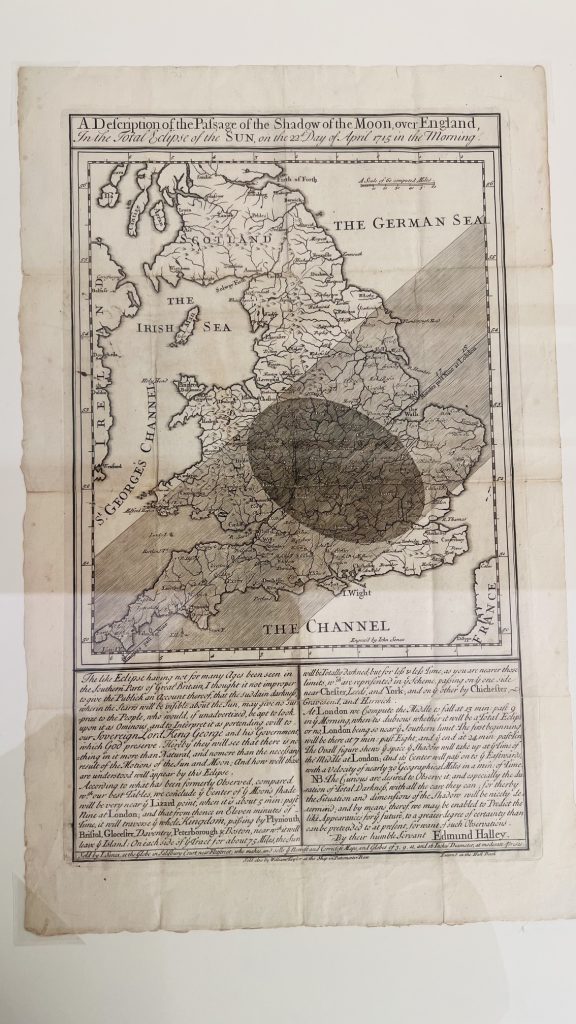
Purchased at auction from Christie’s, New York, Edmond Halley’s A Description of the Passage of the Shadow of the Moon (1715) is a remarkable survival from the decades following the publication of Newton’s Philosophiæ Naturalis Principia Mathematica. Halley, who studied at the College for two years from 1673, drew on his astronomical and mathematical knowledge to predict with remarkable accuracy the total solar eclipse that crossed southern England on 22 April 1715.
As Halley explained in the accompanying text, the chart had a practical as well as a scientific purpose. Britain had recently acquired a new monarch, George I, and eclipses were still widely regarded as ominous portents. Halley hoped that an accurate prediction would forestall superstition and public alarm:
The like Eclipse having not for many ages been seen in the Southern Parts of Great Britain, I thought it not improper to give the Publick an Account thereof, that the sudden darkness, wherein the Starrs will be visible about the Sun, may give no surprize to the People, who would, if unadvertized, be apt to look upon it as Ominous, and to interpret it as portending evill to our Sovereign Lord King George and his Government.
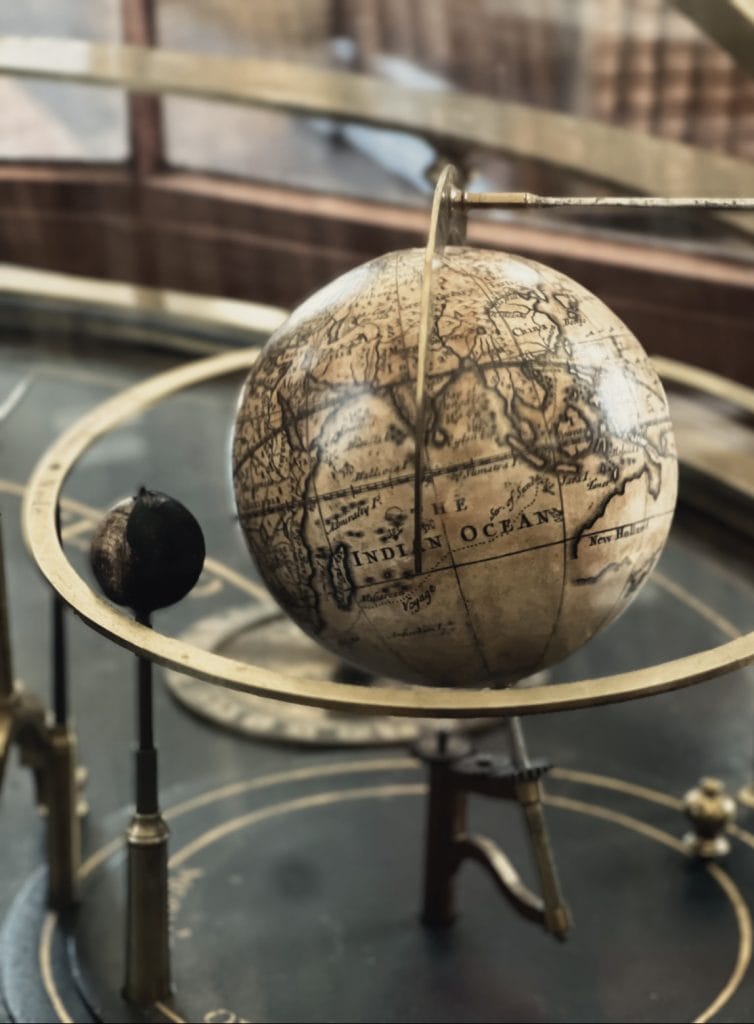
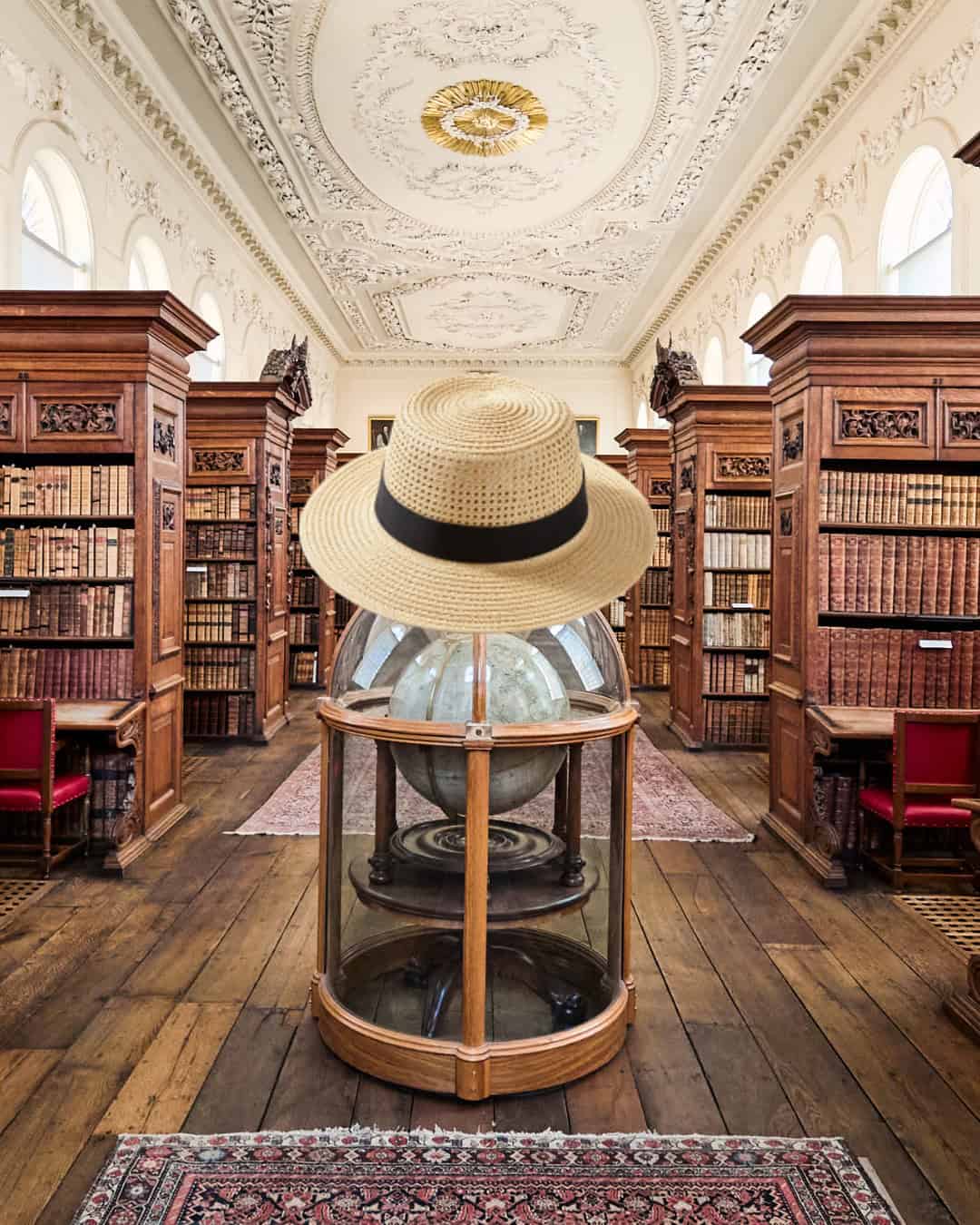
The chart was engraved by the London mapmaker, globe maker and publisher John Senex, one of Halley’s regular collaborators. Senex produced numerous illustrations for the Royal Society and other publishers. After his death, his widow Mary Senex continued the business and was responsible for producing the pair of monumental globes that still stand in the Upper Library.
Formerly owned by two distinguished collectors of the history of science, A Description of the Passage of the Shadow of the Moon now joins Camden’s Britannia, annotated by Halley following his ascent of Yr Wyddfa (Snowdon) to investigate altitude by barometric pressure; Isaac Newton’s Philosophiæ Naturalis Principia Mathematica, probably presented by Halley to Provost Timothy Halton; Halley’s rare chart of the southern stars, compiled on St Helena after he left the University at the end of his second year; and the portrait of Halley overlooking the southern end of the Upper Library.