Treasures of the Library: the passage of the shadow of the moon
Edmond Halley’s ‘A Description of the Passage of the Shadow of the Moon’ (1715) Dr Matthew Shaw, Librarian
Many of the Library’s greatest treasures have been in the collections for centuries. This year, however, thanks to the generosity of an Old Member, the Library has been able to acquire one of the most important scientific charts printed in the early eighteenth century.
Purchased at auction from Christie’s, New York, Edmond Halley’s A Description of the Passage of the Shadow of the Moon (1715) is a remarkable survival from the decades following the publication of Newton’s Philosophiæ Naturalis Principia Mathematica. Halley, who studied at the College for two years from 1673, drew on his astronomical and mathematical knowledge to predict with remarkable accuracy the total solar eclipse that crossed southern England on 22 April 1715.
As Halley explained in the accompanying text, the chart had a practical as well as a scientific purpose. Britain had recently acquired a new monarch, George I, and eclipses were still widely regarded as ominous portents. Halley hoped that an accurate prediction would forestall superstition and public alarm:
The like Eclipse having not for many ages been seen in the Southern Parts of Great Britain, I thought it not improper to give the Publick an Account thereof, that the sudden darkness, wherein the Starrs will be visible about the Sun, may give no surprize to the People, who would, if unadvertized, be apt to look upon it as Ominous, and to interpret it as portending evill to our Sovereign Lord King George and his Government.
The chart was engraved by the London mapmaker, globe maker and publisher John Senex, one of Halley’s regular collaborators. Senex produced numerous illustrations for the Royal Society and other publishers. After his death, his widow Mary Senex continued the business and was responsible for producing the pair of monumental globes that still stand in the Upper Library.
Formerly owned by two distinguished collectors of the history of science, A Description of the Passage of the Shadow of the Moon now joins Camden’s Britannia, annotated by Halley following his ascent of Yr Wyddfa (Snowdon) to investigate altitude by barometric pressure; Isaac Newton’s Philosophiæ Naturalis Principia Mathematica, probably presented by Halley to Provost Timothy Halton; Halley’s rare chart of the southern stars, compiled on St Helena after he left the University at the end of his second year; and the portrait of Halley overlooking the southern end of the Upper Library.
Looking for your next summer read? The Library team have got you covered as they once again share the books they think deserve a place in your holiday bag. From eerie houses and winds that become characters, to American history, post-apocalyptic coastlines, and novels that span centuries, this year’s recommendations promise to transport you somewhere unexpected.
Sarah Arkle, Deputy Librarian
I have a few recommendations, all of which we have in the library as part of our General Collection, shelved in the Lower Library (Ground Floor). At the time of writing, all were still available to borrow!
Transport yourself back to summer, 1993: a group of students are clearing out a weird house stuffed to the brim with clutter left behind by the reclusive and eccentric, now deceased, owner. Things get weird. Then they get weirder. Parallel dimensions might exist. Maybe ghosts? Alternate realities? Who knows! All this and more awaits in my first recommendation: Will Maclean’s novel Solace House.
It has drawn comparisons to The Secret History and The Haunting of Hill House; comparisons that set a remarkably high bar. I prepared for disappointment, but was pleasantly surprised; I found Solace House very entertaining and incredibly strange. I liked that it refused easy interpretation – there’s a whole host of possibilities when it comes to what is ‘really’ going on and you do have to decide for yourself what you make of it all. I also read it in almost one sitting despite it being over 500 pages long!
I liked that it refused easy interpretation – there’s a whole host of possibilities when it comes to what is ‘really’ going on and you do have to decide for yourself what you make of it all.
Maclean also does a good job of synthesising a wide range of influences across art, literature, music and history into the novel. There is a risk when writing something with so many inspirations that you may produce something significantly less than the sum of its parts, but I didn’t find this the case with Solace House at all.
If I had to criticise anything it was that one or two elements – like the framing of a traumatic event in the narrator’s past – felt a bit underbaked, but at 500+ pages, more might have felt too much. If you want an entertaining and very weird time, this book will absolutely deliver on that. Find it at Gen Mac in the Library.
My next recommendation is Sarah Hall’s most recent work Helm. Brought to my attention because it is set in the northwest of England, and I try to collect works for the library by authors who write about or come from the area due to our long-standing connection to the region.
Helm is a real wind in Cumbria (it is the only named wind in the British Isles). Helm is the main character of this novel, overseeing generations of characters and millennia of change. Helm is playful, Helm is needy, Helm is powerful, Helm is curious. The premise is great, very original, and Hall manages to pull off something remarkable in scope, thinking about connection, environment, place, climate, humanity, the past, the present, the future. The chapters detailing Helm’s interactions with a troubled young girl in the mid-20th century are particularly moving. It is one of my favourite reads of this year so far and is available shelved at Gen Hal!
Helm is a real wind in Cumbria (it is the only named wind in the British Isles)
Helm reminded me of my final recommendation; Daniel Mason’s wonderful novel North Woods, which is shelved at Gen Mas. Similarly set in a very specific location over a vast amount of time. Do you ever think about all of the people who lived in your house before you did? This novel might well make you do that, following 400 years of various inhabitants of a house in the woods in New England, ranging from runaway lovers, spinster sisters and, at one point, a ‘lusty beetle’ as the blurb describes it. Perfect for readers who enjoy rich descriptions and historical fiction, who don’t mind the occasional sojourn into the unusual.
Perfect for readers who enjoy rich descriptions and historical fiction, who don’t mind the occasional sojourn into the unusual.
Amanda Lima, Assistant Librarian
Over the past several years I have fallen into the habit of reading just to read rather than reading for the joy of it. I’ve avoided large books entirely for fear of failing to meet arbitrary book goals and have instead forced myself to finish smaller novels that I just hated. In honour of wanting to break this cycle, I have called this year ‘The Year of the Big Books.’ Rather than sticking to a set number, I wanted to challenge myself to really sit with an author’s work for a while. For my summer reading recommendations, I hope to motivate others to revisit the large tomes they may have also shunned to the backs of their bookshelves.
For my summer reading recommendations, I hope to motivate others to revisit the large tomes they may have also shunned to the backs of their bookshelves.
Book recommendation 1: For readers who love a mass market paperback
I do classify myself as a romance lover but lately I’ve been frustrated with how romance novels seem to be published with such a ferocity that the plot is lost entirely. Because of this, I have been looking back to books written in the ‘80s and ‘90s. These books have their flaws, of course, but you can really sense the authors’ enthusiasm in the writing and there’s something about their unpolished nature that’s incredibly charming.
You might know of Outlander from the recently wrapped up tv show but have you ever read the book? Outlander by Diana Gabaldon follows an ex-army combat nurse from WWII who stumbles back in time to 18th century Scotland in the middle of the Jacobite rising. There she is forced to use what survival skills she learned from the war to convince those around her she isn’t a spy for the enemy. Outlander feels like that classic late 80s romance with its witty lines, grand gestures, and high stakes. This story blends rich historical detail with a sweeping romance that provides a nice balance for readers who may want a bit of something more in their romance.
Book recommendation 2: For folks who want it all
There are certain books that you tend to always see in a charity shop. They once hit it big and everyone bought a copy but over time they have slowly made their way to donation piles. The Pillars of the Earth by Ken Follett very much fits the bill. There’s a reason it became a modern classic though and I want to remind folks of why it was just that good. On the surface, it is a novel about the building of a medieval cathedral but in actuality it is so much more. It’s a story that blends court politics and religious drama with romance, superstition, and mystery. There’s everything a reader could want from a covered up murder, to a passionate romance, all within a deeply fleshed out historical backdrop. Readers will follow a monk with a mission to save his community, a mason who has sacrificed everything for a fantastical dream, and an unstable court plunged into a bitter battle for the throne. Pillars of the Earth showcases 12th century England with a level of depth that can only be compared to works such as Wolf Hall.
On the surface, it is a novel about the building of a medieval cathedral but in actuality it is so much more.
Book recommendation 3: For the slice of life reader
Sometimes you just want to read something that feels predictable. The world can be bleak and there are times when you want a sense of nostalgia. For cases like these, The Other Bennet Sister by Janice Hadlow is recommended. The story follows the ugly duckling sister Mary Bennet as she tries to carve a place for herself in the world after all of her sisters are wed. ‘Old’ and without any prospects, Mary’s outlook on life seems incredibly bleak. But not all is lost. Readers will quickly fall in love with this sweet Austen character as she grows into her own, discovers her passions, and builds a loving community that honours her sense of being. The Other Bennet Sister stays true to the classic story while bringing voice to a character who lived a bit in the shadows. Readers will see themselves in Mary who is timid and awkward at times, and it’s her persistence and rosy outlook that has you consistently rooting for her success. Mary’s story is satisfying from start to finish and is a great palette cleanser for cozy book lovers.
Matthew Shaw, Librarian
The unavoidable summer read this year has to be Maggie Haberman and Jonathan Swan’s Regime Change: Inside the Imperial Presidency of Donald Trump (2026), the current de facto account of a ‘feral instinct for power’. Wherever you are holidaying, you can at least, I think, be grateful that you are not at Mar-a-Lago.
The unavoidable summer read this year has to be Maggie Haberman and Jonathan Swan’s ‘Regime Change: Inside the Imperial Presidency of Donald Trump’, the current de facto account of a ‘feral instinct for power’.
For a second selection, and in recognition both of the semiquincentennial of the Declaration of Independence and of the recent death of Gordon S. Wood, I would recommend Wood’s The Americanization of Benjamin Franklin (2004). It remains perhaps the finest biography of Franklin, air bathing and all, and serves as a fitting memorial to a historian whose interpretation of the ideological and republican origins of the American Revolution achieved an unexpected form of popular immortality through Matt Damon’s citation of his work in the film Good Will Hunting. Franklin, of course, hoped that the American republic was a ‘rising, not a setting, sun’.
Felix Taylor, Library Assistant
This summer I can recommend something with a beach setting, The End of Everything, an unsettling post-apocalyptic novel from British writer M. John Harrison. For perhaps a decade the Earth has been host to a group of alien creatures hundreds of feet high known as the iGhetti; they appear disinterested in humankind and can be observed far out to sea moving about. Are they building something? Experimenting? No one knows where they came from; one theory has them emerging ‘out of the internet’. The majority of the population has fled Britain, and those remaining attempt to get on with their lives, desensitised to the invasion (if invasion is even the right word). Zones of economic activity resemble the old life, but the social fabric has been ripped apart. Occasionally ‘items’ or ‘artefacts’ wash up on the shore, detritus from alien activity, which can be sold on the black market by scavengers. Phillip Tennant is one such scavenger. Finding a small humanoid in the waves, he drives it around in the backseat of his car, observing as it regrows a hand and mimics human speech. An aunt-like figure, Marnie, protects her house from trespassers and gives Phillip shelter and emotional support.
There are no answers in The End of Everything, and its short length (less than 200 pages) can often make it feel like an unformed idea, a contained coastal setting where characters deal with the philosophical repercussions of alien life and try to survive in a disintegrating society. Readers of John Wyndham, J. G. Ballard or early H. G. Wells will find this familiar territory, as will anyone who has read Arkady and Boris Strugatsky’s Roadside Picnic, also about the aftermath of an alien visitation. But Harrison’s book is more oblique than its classic sci-fi predecessors, lacking plot or explanation. Essential beach read!
There are no answers in ‘The End of Everything’, and its short length can often make it feel like an unformed idea, a contained coastal setting where characters deal with the philosophical repercussions of alien life and try to survive in a disintegrating society.
At Queen’s, our Library staff don’t just look after books, they write them too. Library Assistant Felix has written a new book exploring one of Victorian Britain’s most intriguing secret societies. In his study of the Hermetic Order of the Golden Dawn, Felix brings fresh attention to a network of writers, artists, and thinkers, including W. B. Yeats, recasting the group as a creative community whose influence still resonates today.
What first drew you to researching the magical order known as the Hermetic Order of the Golden Dawn and why do you think its story is interesting to share now?
The idea for the book came to me after finishing my DPhil, on Welsh myth and folklore in modern British literature, though it was not a direct product of that research. I noticed that some of the figures I had been writing about – the Welsh supernatural horror writer Arthur Machen and the Irish poet W. B. Yeats, for example – had connections to this mysterious London society. As I read into the history of the Golden Dawn, the more I began to view it as an unusual artistic subculture of Victorian Britain. Why wasn’t there a book that approached this occult group as an arts society or literary movement in its own right? We’re experiencing a new period of interest in the occult, and I thought a book like this would provide an accessible history of the Golden Dawn and ceremonial magic, while also considering the society from a new angle.
How would you describe the Order in simple terms and why did it capture so much attention in its time?
The Order of the Golden Dawn was a secret society founded in London in 1887 devoted to the study of the Western magical tradition. This was during a period in the late nineteenth century known as the occult revival, a new flowering of interest in all kinds of esoteric and speculative philosophies. By the Western magical tradition, I mean areas we would now consider as having been ‘replaced’ or suppressed by Enlightenment science: alchemy, astrology, Kabbalah (a branch of Jewish mysticism), divination. The Order’s founders, all Freemasons, synthesised these subjects into a detailed curriculum of study.
The Order of the Golden Dawn was a secret society founded in London in 1887 devoted to the study of the Western magical tradition.
Members passed through a series of hierarchical ‘grades’ by taking examinations and participating in initiatory rituals. They wore robes, adopted Latin mottos (Yeats, for example, went by Demon Est Deus Inversus) and wielded ceremonial tools such as wands or talismans. For the most part this was purely theatrical and academic, but in 1892 a second, or ‘Inner’ Order was established for the learning of practical magic: astral travel, invocation of spirits and scrying. All of this went on in Temples first in London, then Edinburgh, Bradford, Weston-Super-Mare, and later Paris and the US. People joined because there was nothing else like it at the time.
The Order brought together writers, artists, and performers; why do you think the occult held such appeal for creative communities?
A high proportion of members were creative people, mainly writers and painters, but also illustrators, translators and actors. Oscar Wilde’s wife, the writer Constance Wilde, was one of the earliest initiates. The allure of magic would have been hard to resist. A certain romance had built up around the figure of the magician in British literature – Merlin, Prospero, and Edward Bulwer-Lytton’s Zanoni – and many leaders of the occult revival consciously modelled themselves on these characters. To engage with the occult is also to take part in a process of reinterpretation and reimagining: essentially a creative act. The curriculum itself contained a vast trove of occult symbols and correspondences, which would have been perfect material for artistic projects.
The allure of magic would have been hard to resist.
Your book highlights progressive elements within the Order, particularly around class and gender; how unusual was that in the Victorian context?
That women were permitted to become members and also rise to assume leadership roles was quite unusual for the time. Particularly if you consider that Freemasonry, the dominant organisation of its kind during this period, did not usually allow women to join. The Church also prevented women from holding any kind of spiritual authority. The actor Florence Far was able to move up the ranks of the Golden Dawn to become Chief Adept in Anglia (‘in England’) and played a crucial role in the eventual breakup of the Order. There were no class barriers to membership either (in theory), though students were generally recruited from middle class social circles.
There are also hints of scandal and internal conflict; how did those shape the rise and fall of the Golden Dawn?
The whole project fell apart due to infighting. The increasingly paranoid leader S. L. MacGregor Mathers made aspersions about the magical credentials of other high-ranking members and questioned the circumstances of the Order’s founding. Other factors were also at play, including the discovered existence of an illegal ‘sub-group’ (yes, a secret society within a secret society). The original Order then split into three or four separate offshoots, each with a different vision of how the Golden Dawn should operate. Even the Golden Dawn name was brought into disrepute when a pair of American fraudsters managed to persuade Mathers to lend them a set of rituals which they used to conduct their own ceremonies; an underage girl was sexually assaulted during one of these faked initiations and the Golden Dawn name appeared in newspapers. Many members resigned due to this association, though the various splinter groups survived throughout the 1910s and 20s.
There’s renewed interest in the occult today; what connections do you see between the Golden Dawn and contemporary culture?
The Order’s rituals and organisational structure ended up influencing quite a range of new spiritual movements, including Wicca. Dion Fortune, who joined the Golden Dawn offshoot ‘Alpha et Omega’ in 1919, is still considered an important figure in modern paganism, and her own group, the Society of the Inner Light still operates today. Many societies bearing the Golden Dawn name have since been formed, using the same rituals and teachings as the original Order; you can even watch some of them on YouTube.
Perhaps it sounds too simple, but we live in uncertain times and looking back to alternative forms of tradition can provide a reassurance that conventional religion might not. In a sense, this is what the Golden Dawn were doing as the end of the Victorian era approached: excavating wisdom (as they considered it) from the rejected past.
Are there any interesting occult books in the Library, and can you tell us a bit about them?
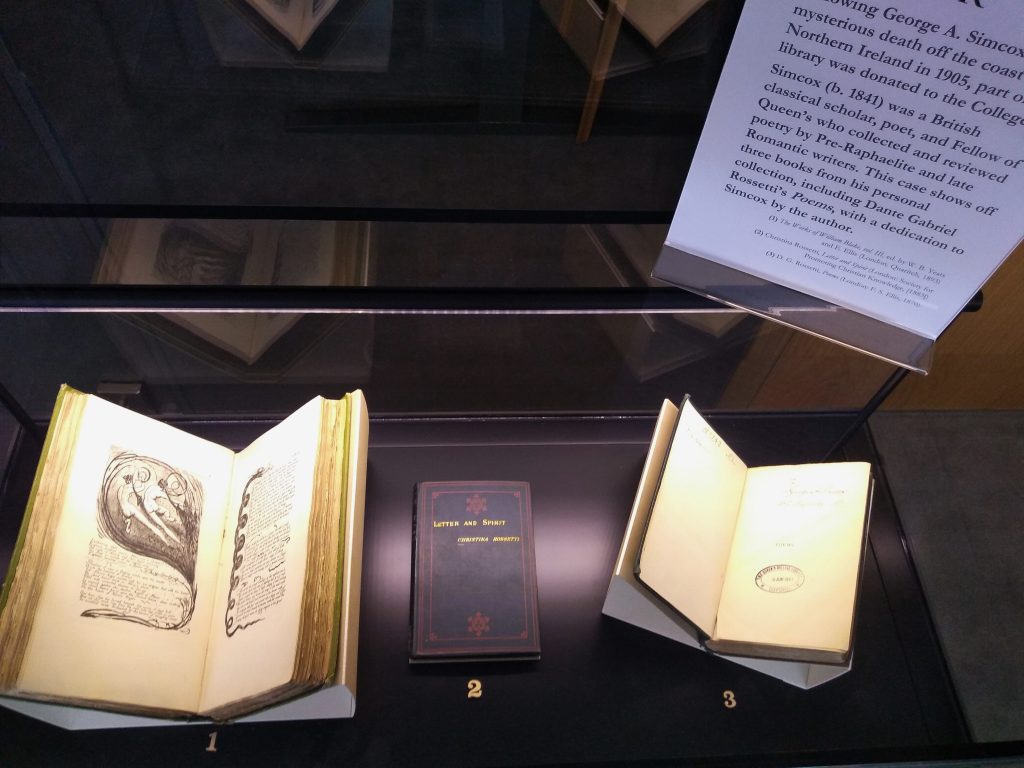
The Library holds a surprising array of books relating to magic and the occult in its special collections, many on alchemy. There is, for example, a copy of Heinrich Cornelius Agrippa’s Three Books of Occult Philosophy from the 1530s, a foundational text for the Victorian occult revival (Mary Shelley’s Victor Frankenstein consults it in preparation for creating his monster). But my favourite is a three-volume set of The Works of William Blake from 1893, edited by W. B. Yeats and Edwin Ellis. Yeats was initiated into the Golden Dawn while working on it, and his occult studies clearly influenced how he came to interpret Blake’s system of poetic myth. The three books are beautiful objects in themselves, green cloth covers decorated in gold, printed in an edition of 500 copies.
The Library holds a surprising array of books relating to magic and the occult in its special collections.
It’s quite an undertaking researching and writing a book alongside your day job and family life. What approach did you take to make it work and do you have plans to do it again?
Just being very deliberate about how I use my (now quite limited) free time. I’m fortunate that I get real enjoyment out of sustained research and writing, so I will happily forgo something like watching Netflix in the evening. It also doesn’t hurt to be a librarian in Oxford and have access to the Bodleian collections! If I lived anywhere else, I’d be having to make far more research trips. My next book is coming out in January, a biography of Arthur Machen from Yale University Press. I wrote about Machen for my DPhil thesis and for the Golden Dawn book, so I had a lot of material on him already. He was a pleasure to write about.
To celebrate World Book Day 2026, we asked the Library team to recommend their favourite books in translation. The selection resonates particularly strongly at Queen’s, home to the Queen’s Translation Exchange (QTE), which champions the study and practice of translation as a vital form of cross-cultural exchange.
Puppet theatre silhouette of Moomin troll
Sarah Arkle, Deputy Librarian
Come with me this World Book Day to the Nordic countries. I am a big fan of this region of northern Europe, partly because I often don’t fare so well in hotter climes, but mainly because – whilst by no means perfect – there is a lot to admire about the countries in the area: Finland has given us Moomins and sauna culture, and Sweden has blessed the world with affordable flat-pack furniture and the music of ABBA. We can thank Norway for brown cheese and the Nobel peace prize, whilst Denmark could certainly teach Oxford a thing or two about bicycle infrastructure, and Iceland we thank you for Björk. (I have yet to visit Greenland or the Faroe Islands.)
There is also a wealth of Nordic literature to consider. Here I have outlined some recommendations for works in translation that we have copies of in the library.
We’re starting in Finland. Tove Jansson was born to a Swedish-speaking Finnish family in Helsinki in the early 20th century, and remains most famous for creating Moominvalley and its many charming inhabitants. She was, however, also an author of fiction for adults, and my first recommendation is her lovely short novel The Summer Book (translator: Thomas Teal). With characters inspired by her real-life family, it tells the story of a six-year-old girl and her grandmother, spending summer exploring a small island in the Gulf of Finland. Rarely mentioned, but underpinning the narrative, is the recent death of the young girl’s mother. Over the course of the summer, the girl and her grandmother bond and ponder life’s many mysteries. The book is tender, but never saccharine, and you can find it shelved at Gen Jan in our ‘General’ collection on the ground floor.
Onto Denmark, to meet another Tove born in the early 20th century. This time, Tove Ditlevsen, the Danish author and poet, whose Copenhagen Trilogy (translators: Tiina Nunnally and Michael Favala Goldman) is my next recommendation. The three books which make up the trilogy (Childhood, Youth, and Dependency) are memoirs pertaining to periods of the author’s life. Ditlevsen writes with clarity and honesty about her experiences of marginalisation, class, relationships, and addiction. Although well known in her native Denmark during her lifetime, her work has only more recently begun to gain popularity in English speaking countries, with the Copenhagen Trilogy being named one of the best books of the 21st century in 2024, leaving me feeling quite smug about having read them back in 2019 when they were newly published! We have all three collected as one volume, available at Gen Dit.
Lastly to Norway to discover a contemporary Norwegian author, Vigdis Hjorth, tinged with scandal. Hjorth’s novel Will and Testament, (published in English in 2019, translated by Charlotte Barslund), is a work – Hjorth maintains – of fiction, where siblings fall out over inheritance, complicated by one sibling’s (the novel’s narrator) allegations of abuse at the hands of their deceased father. The novel was a best-seller in Norway, but not everybody liked it. Hjorth’s sister published a novel of her own in response, refuting the events of Will and Testament, whilst her mother took legal action against a proposed stage adaptation. Hjorth herself maintains that the novel is a work of fiction, and that any real experiences drawn upon the novel were done with consent. Hjorth then followed up with another novel titled Is Mother Dead (also translated by Charlotte Barslund), which looks at the permanence of our relationships with our mothers, as the protagonist Johanna – long estranged from her family – returns to her native Oslo and begins both a real and imagined stalking of her mother, trying to make sense of her childhood. Scandal aside, both novels are a bleak but effective portrayal of fractured family dynamics, both of which can be found shelved at Gen Hjo.
The Charles bridge in Prague
Matt Shaw, Librarian
I was tempted to suggest the Old and New Testament for this task, but presume, like Desert Island Discs, that those most translated of all volumes are a given. Instead, I have three suggestions from either side of the European continent. The earliest is The Good Soldier Švejk by Jaroslav Hašek, first published between 1921 and 1923, and answers the insanity of the First World War, the collapse of the Austro-Hungarian Empire, and a world run by an inexhaustible bureaucracy with the appropriate mode of comic humanism. It is also the most translated work in the Czech language. Cecil Parrott – a former ambassador to Czechoslovakia – is the translator of the edition I’ve read. The Radetzky March (1932) by Joseph Roth takes a slightly longer view of the collapse of the Empire, and the tone is more elegiac than comic. Joachim Neugroschel was the (prolific) translator. Finally, something from Spain by the author and translator Javier Marías: The Infatuations (2011), a murder mystery drawing on the always puzzling nature of life and literature. Margaret Jull Costa is the translator.
Facade of the Conservatoire national des arts et métiers (English: French National Conservatory of Arts and Crafts), Paris
Felix Taylor, Library Assistant
My assumption has always been that Umberto Eco was such a genius that he wrote his novels (including his first, and best-known work, The Name of the Rose) in English. But this is not the case: he wrote them all in his native Italian, translated admirably into English by American academic William Weaver [who dubbed the extension to his house paid for by that book’s success the ‘Eco Chamber’ – ed.]. Foucault’s Pendulum (1988) is often described as the thinking man’s Da Vinci Code: it may well be that, but if anything it presaged the rise in popular conspiracy thrillers like Dan Brown’s. Its characters are the very types of people who would consider writing a mystery linking the Holy Grail with the child of Mary Magdalen.
The novel has nothing to do with Michel Foucault; the pendulum in question is a device invented by French physicist Léon Foucault to demonstrate the rotation of the earth. In Eco’s book the real-life pendulum at the Musée des Arts et Métiers in Paris becomes the focal point of a conspiracy theory, the meeting place of various occult parties who have supposedly lain in wait for hundreds of years to get a glimpse of a certain beam of sunlight that will reveal to them the powers of the Earth’s telluric currents (if I’ve understood the book correctly). The narrator, a man named Casaubon, believes his friend Jacopo Belbo has been kidnapped by the conspiracists and hides in the museum after hours, reflecting on the years leading up to this moment. Casaubon had been a graduate student in the 1970s in Milan; his thesis was on the history of the Knights Templar, a Catholic military order operating in the twelfth and thirteenth centuries. He becomes associated with a small publishing house run by the mysterious Mr Garamond, who desires to attract gullible and wealthy authors willing to pay for their monographs to be published. To sweeten the pot, Garamond enlists Jacopo and Casaubon to invent ‘The Plan’, an all-encompassing scheme of occult influence running through world history. The men begin to believe their own fiction.
Eco clearly has a broad knowledge of the world of secret societies, and many pages are devoted to characters explaining the history of a particular group – the Illuminati, the Rosicrucians, the Cathars – which can often be interesting, overwhelming, or simply boring. All of it contributes to the heady labyrinth of fact, imagination and intrigue set against the backdrop of a politically charged Italy. Not quite as magisterial or as well-received as something like The Name of the Rose, but still an enthralling and intellectual thriller, and the perfect bookish book for World Book Day.
Aran Valley in the Catalan Pyrenees
Lauren Ward, Assistant Librarian
During the course of my long-term project to read a book from every nation on earth (I’m 66 states down, for anyone curious) I’ve encountered a great deal of translated writing and developed a fondness for Spanish and Latin American fiction in particular. Some of the most interesting and arresting new writing is coming from these parts of the world, so that’s where I’ll be focussing my recommendations!
My first recommendation is When I Sing, Mountains Dance by Irene Solà, translated from the original Catalan by Mara Lethem. Beginning with Domènec, a farmer with the soul of a poet who is struck down by lightning as he surveys his land, a polyphonic chorus of voices — from civil war ghosts who wander the Pyrenees, a clutch of chanterelle mushrooms, the very land itself — tell the story of Domènec’s descendants and the landscape they call home. It’s an enchanting narrative that weaves each small, solitary voice into the wider web of life thrumming around them, while communicating the history and folklore of the Spanish-French borderlands in an idiosyncratic but immersive way. A little disorientating to begin with as you try to figure out whose perspective each new chapter is from (a deer? A storm cloud? A trio of witches?), Solà’s novel is a whirling, hopeful portrait of a land and its people that will appeal to Max Porter fans.
Next, from Argentine art critic and writer María Gainza, I recommend Optic Nerve (trans. Thomas Bunstead). In this quiet, contemplative series of auto-fictional vignettes, an unnamed female narrator tours the art galleries of Buenos Aires and reflects on what she finds there. Like the best fiction about art, Gainza manages to capture the particular magic of standing before a piece that resonates with you and all the connections and digressions that sparks off, invisible to an outside observer. The narrator’s anecdotes are generous and digressive but always come back to her native Buenos Aires, gradually building to a realisation at the end of the book, via some excellent and engaging art history. Certainly one for the ‘no plot, just vibes’ fans, but worth a try for anyone!
Little Eyes by Samanta Schweblin (trans. Megan McDowell), another Argentine author perhaps better known for her strange short story collections, is my final recommendation. It’s set in a near future where new interactive technology in the form of toys, called kentukis, quickly becomes a vehicle for voyeurism, narcissism, and clandestine control. So, not familiar to us at all, right? The story is an unsettling and compelling examination of our ever-more connected world and all the pitfalls and benefits that come with it. Looking back to when I first read it in 2021, I also now see it as a prescient commentary on our willingness to participate in our own surveillance if it’s sold to us as even mild novelty or convenience. Perhaps it’s time for a reread?
Among the many treasures held by the College Library, the 16 large volumes of prints made by Giovanni Battista Piranesi (1720–1778) must rank as one the most compelling. Much sought after by collectors in the eighteenth century keen to acquire his etchings of classical Roman antiquities, Piranesi’s fame also rests on 16 etched and engraved plates known as the Carceri d’invenzione, which dramatically depict a series of giant imagined prisons, complete with tortured prisoners, haunting staircases, and inky shadows.
These scenes, which Piranesi began in his youth and then reworked over time, have inspired generations of writers, artists, and musicians, providing materials for the gothic and romantic artistic movements, giving visual form to a series of psychological nightmares or dreams.
Piranesi, who came from a family of Venetian stonemasons, had broad ambitions. He aspired to be an architect, and his works are a testament to this desire, along with his antiquarian obsessions and fantastical visions of ancient restorations. As a pamphleteer, he weighed heavily into the heated debate on the supremacy or origins of Roman architecture, arguing for its native, Etruscan origins, rather than Greek antecedents.
Complete sets of his works are relatively rare, especially ones in as good condition as the College’s, which are also finely bound by Jean-Claude Bozérian, the noted French neo-classical bookbinder (who bound books for Napoleon). The College acquired it the 1840s, thanks to the bequest by Old Member Revd Robert Mason, and the set is augmented by a particularly rare pamphlet, Piranesi’s Lettere di giustificazione scrittea milord Charlemont e à di LVI. agenti di Roma (1757). This attacked Piranesi’s former artistic patron, James Caulfield, 1st Earl of Charlemont, a noted Irish patron of the arts, who spent eight years on his Grand Tour, and who failed to finance the publication of Piranesi’s Le Antichità romane (1756) despite a promise of a subvention after the work had begun. The etchings in the Lettere demonstrate the initial patronage of Charlemont, and how his lack of support caused his name to be removed from the dedication page. As well as a bibliographic treasure, suppressed soon after publication, it is a powerful record of the changing relationship between artist and patron in the eighteenth century. For Piranesi, the nobility of creation is what stands the test of time, not the largesse of the patron.
As well as a bibliographic treasure, suppressed soon after publication, it is a powerful record of the changing relationship between artist and patron in the eighteenth century.
Piranesi presented copies of his polemic to his supporters. As such, the College’s copy originally belonged to Thomas Hollis (1720–1774), an English political philosopher and republican, who donated a vast number of books to English and American libraries (notably Harvard) and nominated Piranesi to be a Fellow of the London Society of Antiquaries. This book is not bound by Bozérian, but by one of the London binders who worked for Hollis and attempted to keep up with his bookbinding – most likely Richard Montagu, who used similar tools for his commissions for David Garrick. Soon after this volume was bound, Hollis commissioned a range of bespoke bookbinder’s tools using classical Roman symbols. While the College’s copy of the Lettre lacks these decorations, it does contain an illustrated inscription by Piranesi to Hollis, depicting the burin he used for his enduring creations, and the exceptionally rare four-page letter of retraction by Piranesi to Charlemont, dated Rome, 15 March 1758.
Treasures of the Library: Gutenberg’s ‘Catholicon’
Dr Matthew Shaw, Librarian
Among the treasures of the College Library is a book closely related to an invention that transformed human history. Acquired in the 1840s, the Catholicon is the only book held by an Oxford college attributed to Johannes Gutenberg (d. 1468), the former goldsmith famed for the invention of the moveable-type printing press at Mainz. This large printed book of nearly 400 folios is also at the heart of a lively academic debate about the origins of printing.
The genius of Gutenberg’s process was in part its coordination of several technologies and systems. He drew on goldsmithing techniques to create moulds for the casting of reusable type and devised a recipe for printing ink created from lamp soot, varnish, urine, and egg whites. Benefiting from pre-existing markets for manuscript books, an understanding of papermaking derived from the Arab world, and an appetite for religious, legal, and mercantile texts, his press helped to usher in a world increasingly shaped by the written word. By 1500, print historians estimate that at least nine million books had been printed.
Gutenberg’s best-known product was the 42-line Bible, also known as the ‘Gutenberg Bible’, designed in almost every detail to resemble a manuscript, including some that were printed on vellum. Just under 50 copies are known to survive; only 25 are complete. The Bodleian acquired its ‘Gutenberg’ (shelfmark Arch B b.10,11) in 1793 for £100 after it was auctioned by the cash-strapped Cardinal Loménie de Brienne (who owned two copies).
The College does not yet possess a Gutenberg Bible, but since the 1840s, it has held a copy of the Mainz Catholicon: the first printed version of a dictionary of medieval Latin, originally composed by the Dominican friar Giovanni Balbi (d. 1298). It contains four treatises on grammar and an alphabetical vocabulary of some 15,000 Latin words and their definitions. Always in demand by scholars, Balbi’s text was a good bet for the new technologies of print. While the Latin-verse colophon (the statement about its production at the end of the text, from the Greek for ‘finishing touch’), notes the ingenuity and skill of the printer who fashioned the book ‘without the use of a reed, stylus, or pen’ and includes for the first time in a printed text the place of publication (Mainz), it does not name him. But since at least 1471, when Guillaume Fichet, a Sorbonne professor, wrote about the spread of printing, the anonymous work has been identified as a Gutenberg. Certainly, when the College acquired it in the 1840s, it was sold as ‘Gutenberg’s Catholicon’, and was recorded in the catalogue as such.
…this noble book, the Catholicon, has been printed and completed as the years of the Lord’s incarnation number MCCLX [1460], in the city of Mainz within the great German nation… without the use of a reed, a stylus, or a pen, but rather by the wonderful concord, proportion and measure of punches and forms.
[Catholicon, colophon]
Closer examination of the surviving copies of the book raises a host of questions that have been exercising scholars. The colophon records 1460 as its year of completion, but it was issued in four variants: three on paper and one on vellum. The date of the paper used in the various issues is puzzling. Watermarks and comparisons with other texts date the papers to after 1460, 1469, and 1473, with the latter two dating from after Gutenberg’s death. Most curiously, the setting of the type in the various editions is identical, meaning that the ‘moveable type’ must have remained in place for several years; a puzzle for a time of tumult in the new print shops when type was limited and expensive.
Various ingenious explanations have been put forward, based on observations such as the apparent pairing of lines of type, the use of nail heads on the paper, and the hint of wires wrapped around slugs of text. Perhaps, Paul Needham has suggested, the type was tied together and placed into clay, allowing metal casts of two-line slugs to be made for future impressions. In contrast, Lotte Hellinga argues that the mix of editions and papers suggest a collaborative project between the various printers in Mainz, who each used their own presses and stock of papers to make up the books. The debate continues today, both in scholarly publications and in lively online discussion.
Even in this digital age, physical copies, such as the one held by the College, preserve evidence that may one day resolve this conundrum from the birth of print, or at least give us a richer understanding of what was involved in the making of a book. Mindful of this, the Library has recently digitised the College’s copy, making it available online for future study, continuing the expansion of knowledge begun by Gutenberg, and underscoring the College’s ongoing support for global scholarship.
Book history has been one of the most exciting subfields in the humanities over the last couple of decades, something confirmed by a recent symposium, Built with Books: Shaping the Shelves of the Early Modern Library held at UCL in September 2025. Part of the Arts and Humanities Research Council-funded project Shaping Scholarship: Early Donations to the Bodleian Library, the two-day symposium brought together a broad range of graduate students, academics, librarians, and curators to explore the current state of research into the creation, use, and impact of early modern libraries.
The College was represented by Prof Tamara Atkin, Fellow in English, who gave the keynote lecture on the first day, and by the College Librarian, Matt Shaw, who presented as part of a panel.
Double Books
The symposium revealed how much remains to be discovered in the archives, particularly when sources are re-read with fresh eyes and new methodologies. Prof Atkin’s keynote revisited the infamous disposal of the Bodleian Library’s original 1623 First Folio of Shakspeare’s Comedies, Tragedies & Histories. As the story is usually told, a copy of this now hugely valuable and famous volume arrived in Oxford in 1623 and, in early 1624 was bound by William Wildgoose in a typical Oxford style. Chained at the Arts End of the Library for consultation, it remained the only Shakespearean holding listed in the 1635 appendix to the Bodleian’s 1620 printed catalogue. Around 1640, however, it was reshelved and later it vanished altogether. The 1674 printed catalogue records instead the Third Folio of 1664, suggesting that when this expanded Restoration edition arrived the earlier volume was deaccessioned – likely sold off with other superfluous books to the Oxford bookseller Richard Davis. This has long been interpreted as evidence of a policy to discard earlier editions when newer ones became available. But is that really what happened?
But is that really what happened?
Drawing on the Bodleian’s Daybook (Library Records e.9) – a record kept by the Library’s First Keeper, Thomas James – Prof Atkin challenged the idea of a systematic policy of deaccessioning older editions. The Daybook lists “double books”, or duplicates, in remarkable detail, showing that early Bodleian librarians were cautious and conservative custodians, who carefully assessed a range of bibliographical data when deciding which books to retain or discard. The age of an edition was rarely a consideration, but format, size, binding, and volume composition were all taken into account. Even so, many titles marked for removal remained on the shelves for decades, suggesting that as long as space allowed, duplicates were tolerated.
The same may have been true of the First Folio. Its disappearance likely stemmed not from policy but from practical pressures, crowded shelves, and the arrival of the Third Folio, whose seven extra plays made it the more comprehensive edition. By returning to the evidence of day-to-day record keeping, Prof Atkin revealed a library more pragmatic and flexible than policy-driven, its decisions shaped as much by circumstance and opportunity as by principle. Her lecture demonstrated how earlier collecting practices and understandings can be illuminated by close readings of archival evidence.
The Upper Library
Earlier in the day, I contributed to a session exploring methodological framings. As College Librarian, I am interested in the early history of the Upper Library, and how its physical construction was linked to the donations or bequests of major collections by Provost Thomas Barlow, Sir Joseph Williamson (Fellow), and Provost Timothy Halton. Methodologically, I highlighted how anecdote and rumour can become accepted as fact in institutions such as the College, particularly given the paucity of the historical record. At the same time, there are clues not just in the Archive but in the books (and their subjects), the shelves, and the building itself, all pointing to what was intended by the construction of the new Library at that point in the College’s history.
It was clearly a statement of confidence, at a time when the College could boast some of the largest student numbers in the University and had close connections to the restored royal court. Its architectural borrowings (from Cambridge and France) also spoke of a desire to project a modern, international image. Clues such as a note in the Bodleian’s manuscripts collection recording a visit to Cambridge by John Townsend, the Library’s builder (and likely “architect,” to use a modern term), shortly before construction began, suggest that the Wren Library at Trinity College may have been a direct inspiration. Even more intriguingly, although Halton is credited with bequeathing his library to the College, only a handful of books now bear his name. He was certainly keen for the Library—and the neo-Classical College—to be built, but a sale of his books at the University Church, recorded in a newspaper classified advert, suggests that his library was a source of funds rather than reading matter. The Library’s archives contain a series of notes by a relative of Provost Joseph Smith, pointing to where the story of Halton’s library goes awry through the misrecording of an earlier letter.
There was much more, of course, during the rest of the symposium. Interest in what the creation (and destruction) of institutional and personal libraries reveals about the lives, assumptions, and passions of the past touches on a host of disciplines, from Materials Science and Sociology to the more expected History and Literature. Many papers also demonstrated the increasing use of digital technology, including artificial intelligence to assess entire collections, and sophisticated databases that make available details of the contents, owners, and provenance of these treasure houses of the past. Together, these approaches are transforming how we understand the history of books – not just as texts, but as objects that record networks of use, exchange, and meaning. The symposium showed how the study of libraries continues to illuminate the evolving understanding of and relationship between knowledge, culture, and community.
The study of libraries continues to illuminate the evolving understanding of and relationship between knowledge, culture, and community.
Pressing matters: what we learned at London Rare book School
Lauren Ward, Assistant Librarian
When you work in a place with a collection of around 120,000 rare books, it’s impossible not to pick up a thing or two about them. However, books created in the hand-press period are complex objects. There are ever-growing avenues of scholarship emerging on their creation and use, making piecemeal knowledge unhelpful when answering enquiries or cataloguing new acquisitions. So, encouraged by the College’s interest in facilitating staff training and CPD, I (Lauren, Assistant Librarian) and Sarah (Deputy Librarian) attended London Rare Book School earlier in the long vacation. The week-long summer school allowed us to spend focussed time learning with experts, from the ground up, how the objects filling the shelves of the Upper Library and the underground vault were created.
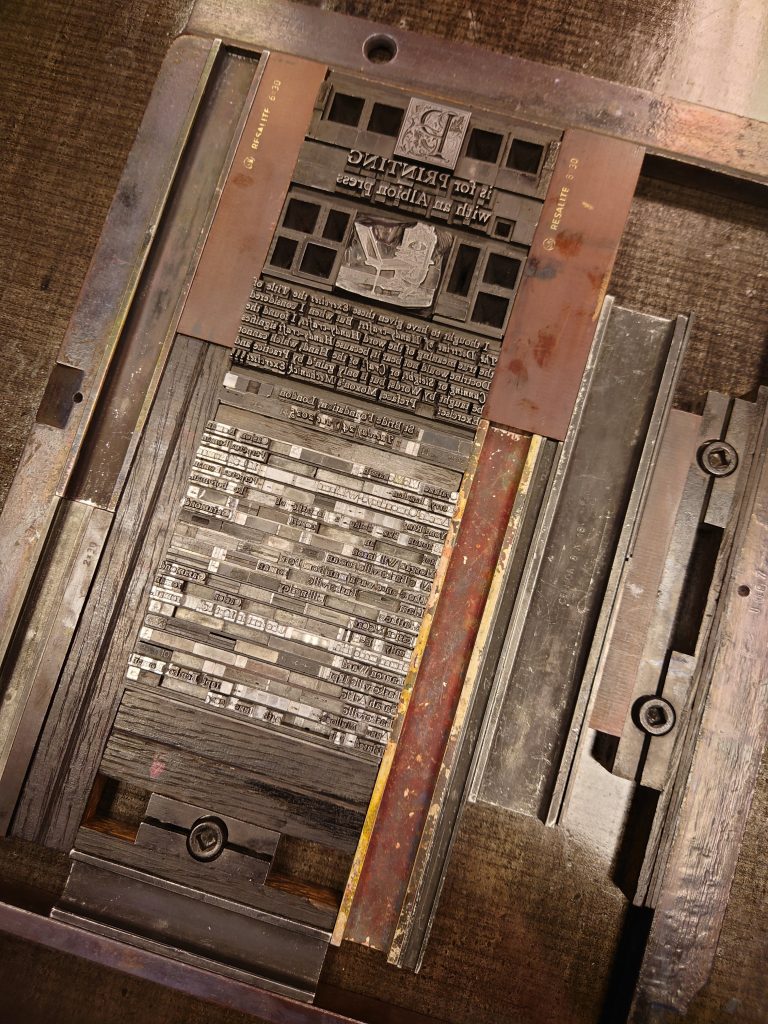
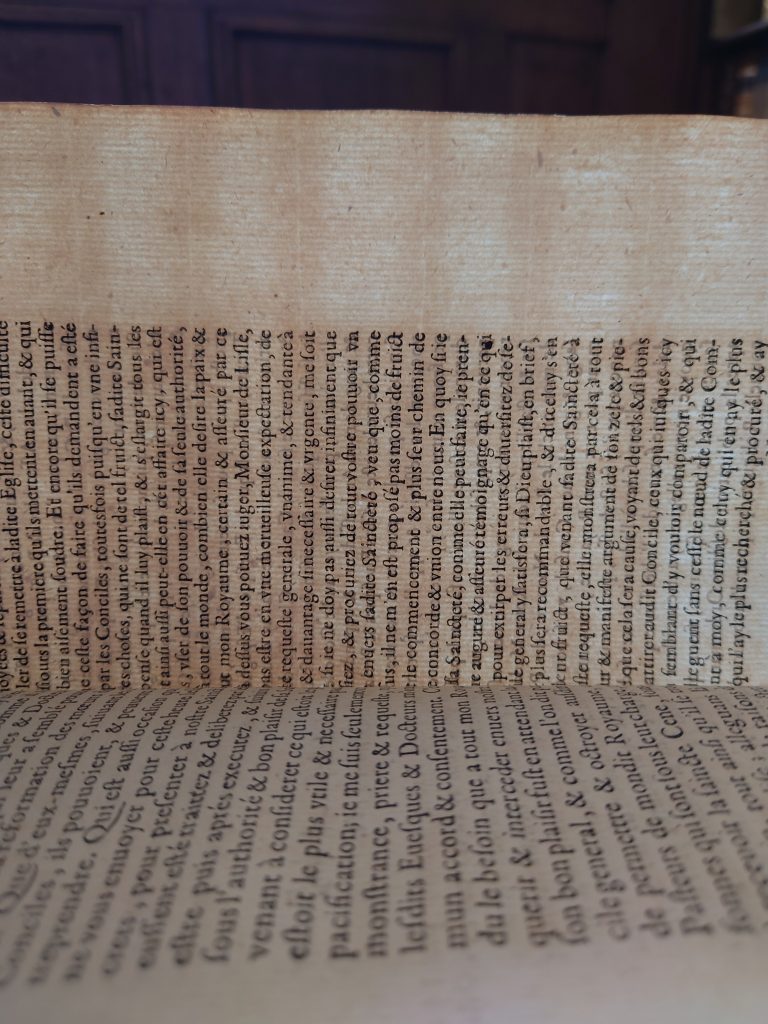
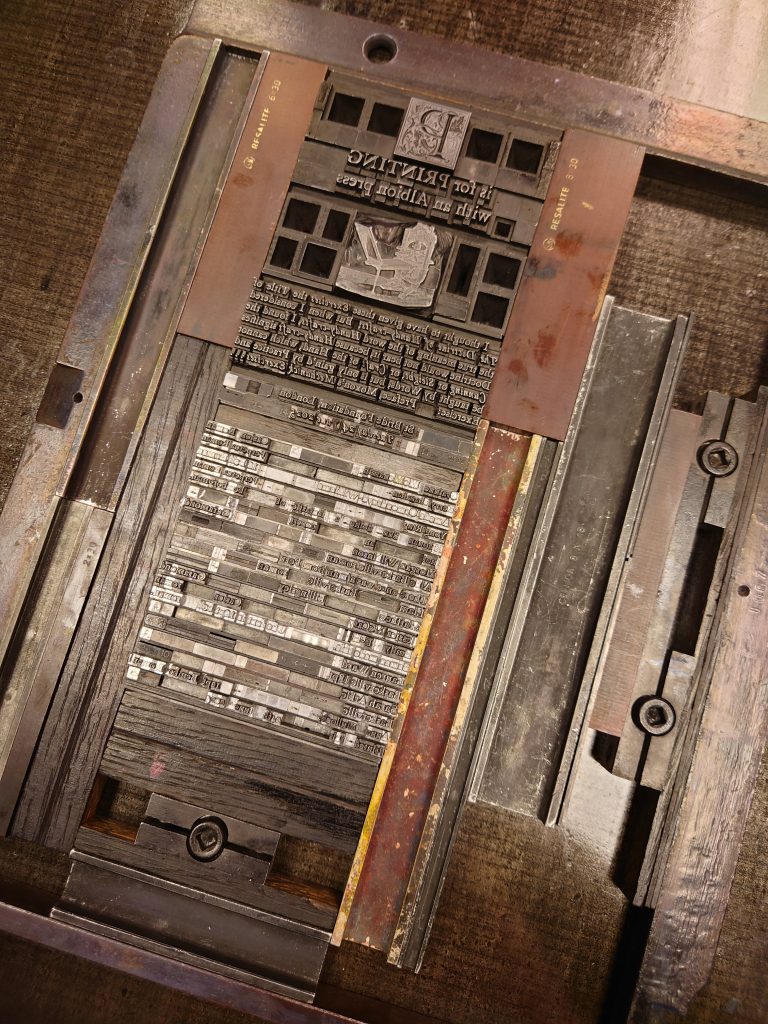
Over thirteen seminars we learned ‘close looking’ techniques – quite literally looking at books carefully for material clues – as well as terminology for what we found, and got practical experience of typesetting and printing.
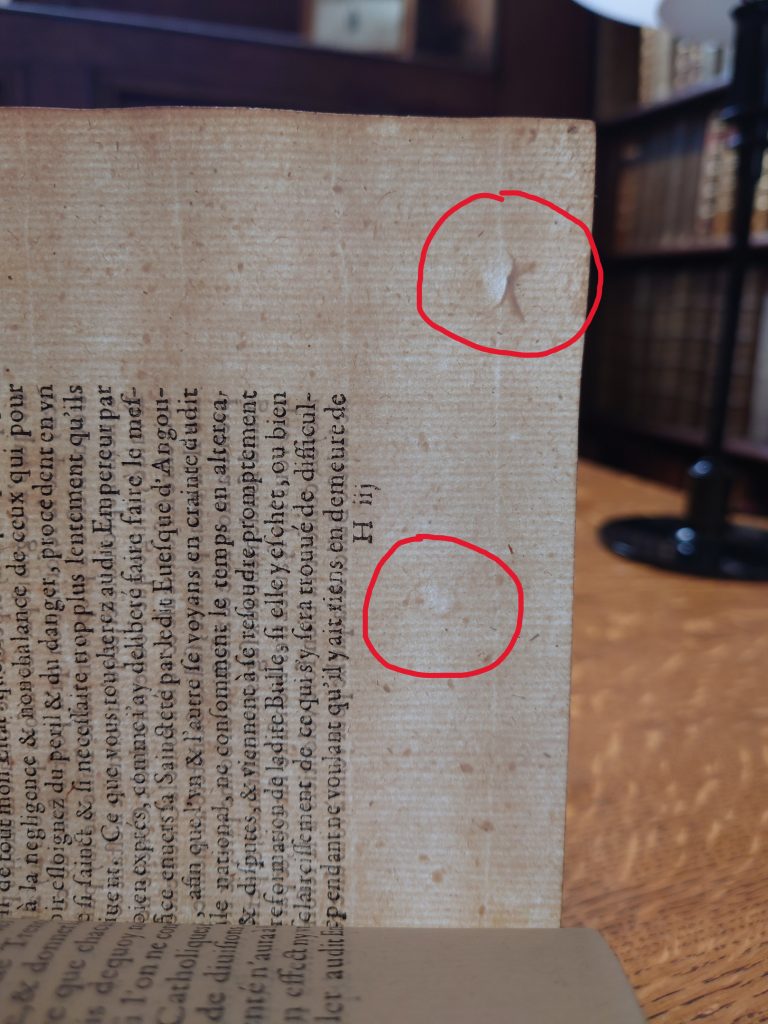
We started with paper – not something I had given a great deal of thought to before, but something without which printed books wouldn’t exist, as parchment (the animal skin used to create manuscripts) doesn’t pair well with the printing press. Our seminar emphasised the physicality of papermaking and the traces of this effort that are left behind. From the slight thickening of the paper around the chain lines, made by the suction created when a paper mould was heaved out of the vat, to vatman’s tears, there are signs of the (literal) sweat that went into creating paper if you know where to look. Even the very beginning of the process, gathering the rags required to break down into the mush that became paper, was extremely labour intensive. Interestingly, part of the reason paper-making didn’t really get going in England until the 1800s was partially due to the lack of available rags in the right quality and fabrics – English people often wore wool, which can’t be used for paper, rather than linen.
Vatman’s tears are signs of the (literal) sweat that went into creating paper.
Please click on the images for the captions.
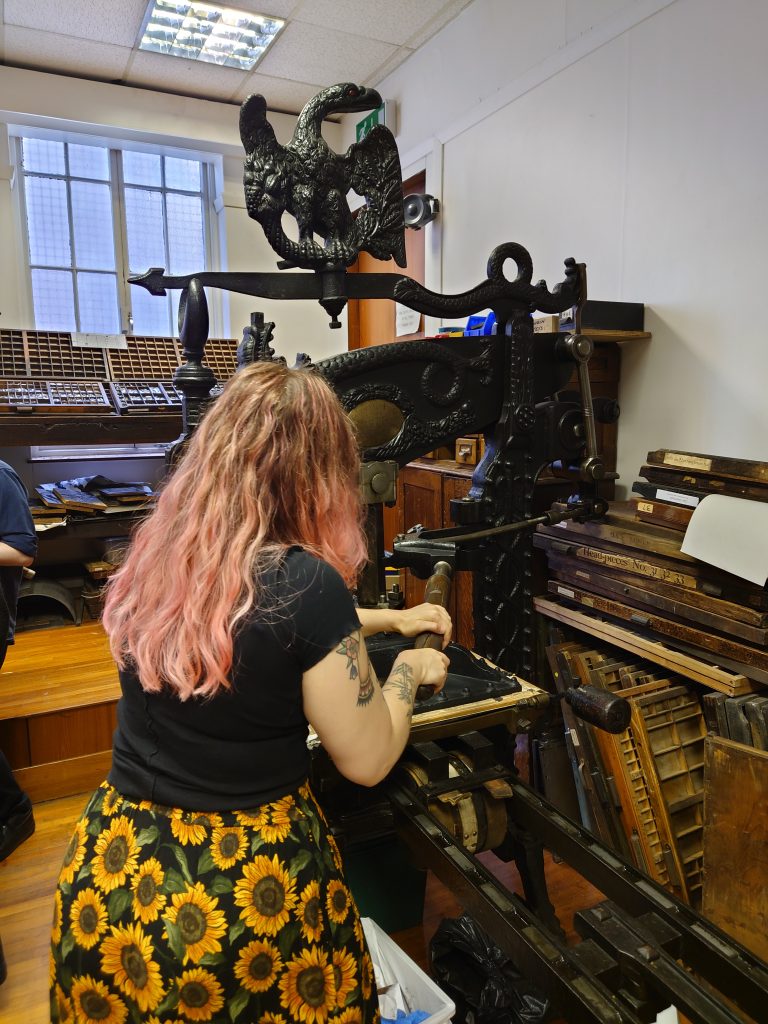
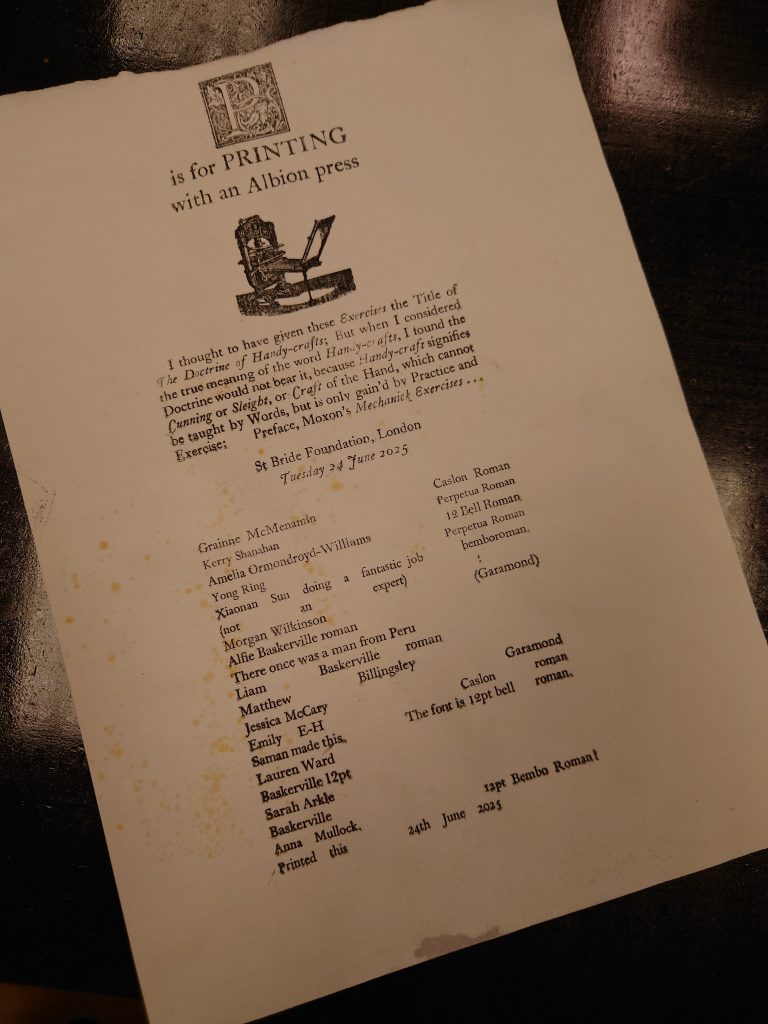
On day two we visited the St Bride Foundation for a workshop on typesetting and printing. Our tutor Richard Lawrence (who can be found very nearby operating the Bodleian’s bibliographical press) was incredibly knowledgeable and did a great job of breaking down some of the reverence we can feel when approaching old books. They are amazing objects to us now, but the people who produced them were businesspeople trying to turn a profit, or maybe just make enough to go to the pub.
In the hand-press period, typed and blank spaces were created by physical means. Each piece of type or ‘sort’ had to be picked from the case by a compositor and placed upside-down into a composing stick. Incidentally, the phrase ‘upper case’ referring to capital letters comes from the position of these sorts in the compositor’s type case, as they were often above the ‘lower case’ letters. Composed lines of type were then transferred into a chase (metal frame) which was locked into place using pieces of wood and expandable ‘quoins’ to create tension, inked, and put on the press bed. The final page layout is called a ‘forme’. We tried our hands at setting lines of type and operating the printing press – see below – to variable results. The experience gave us a small taste of the demanding work of the printing shop; I’ll never chuckle at an early modern typo again.
I’ll never chuckle at an early modern typo again.
Please click on the images for the captions.
In the following days we had seminars on the crossover between manuscript and print culture, allowing us to see how the two influenced each other before diverging, learned how to write a bibliographic collation formula, and how to identify different parts of a book’s binding structure, including the types of animal leather that might be used.
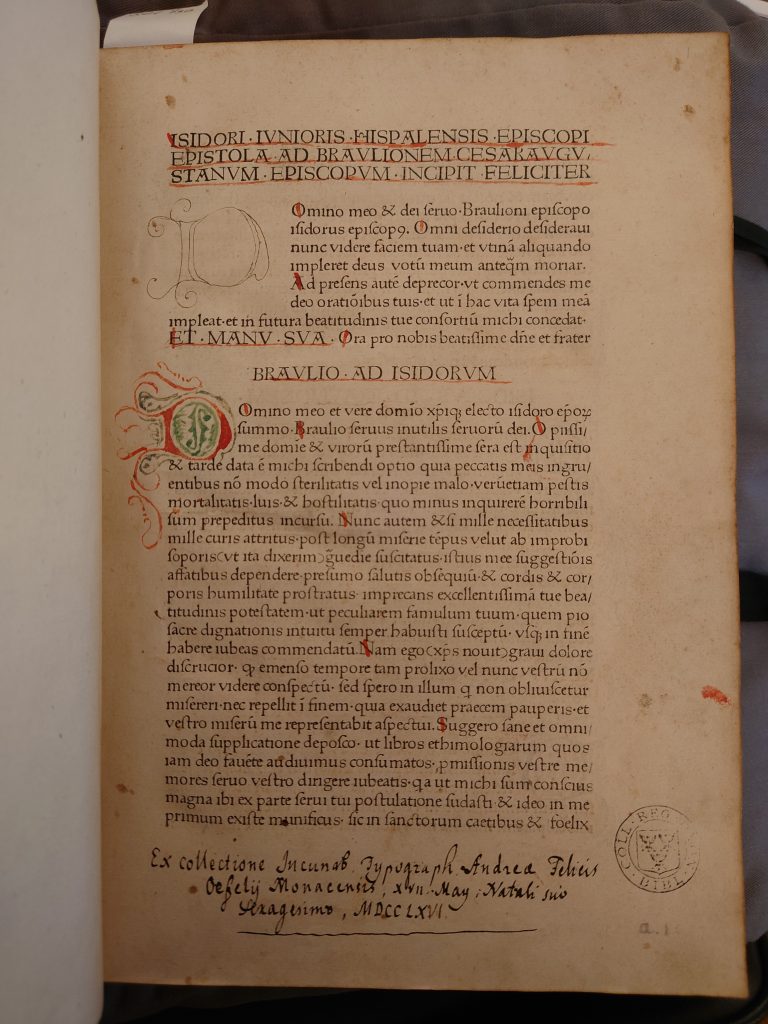
This copy of Isidore of Seville’s Etymologiae (Queen’s Sel.a.130) features rubrication and decorated initials painted by hand alongside the text, which was printed on a press with moveable type.
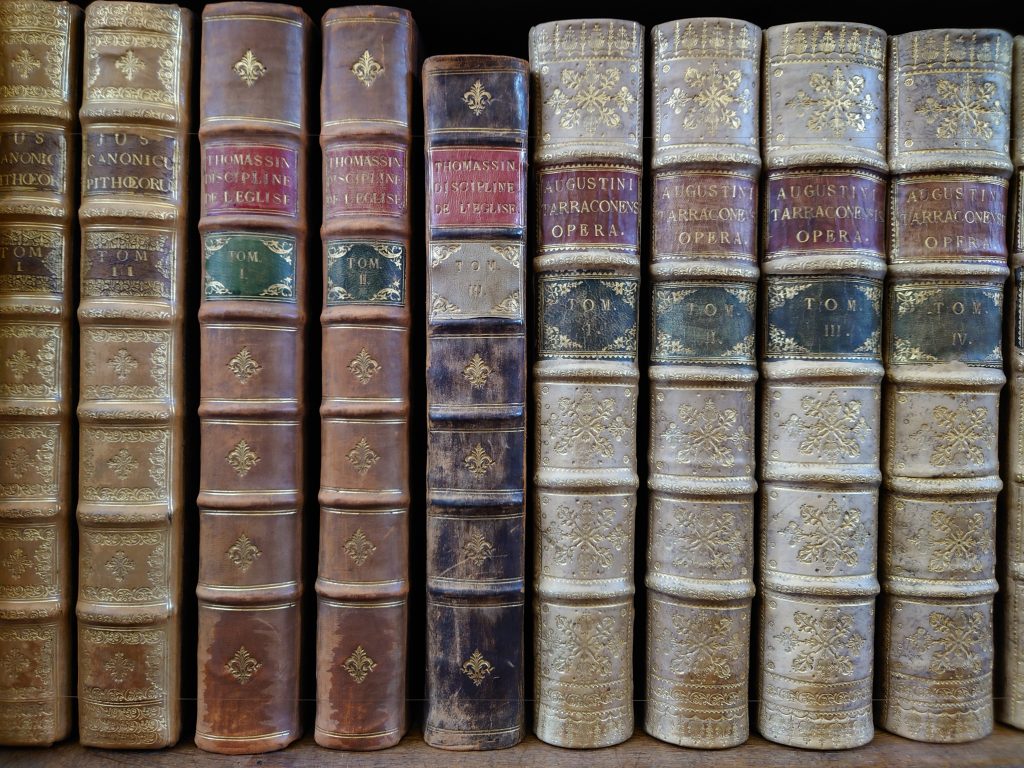
This seminar, led by renowned provenance and binding expert David Pearson, proved particularly fascinating as our group’s perceptions of bookbinding as a fine art were challenged. Bookbinders were thought to be very lowly in the early modern period, to the extent that many binders’ names go unrecorded as they weren’t considered important. Apparently, they were also ‘notorious drunks’ (this theme cropped up again and again – it seems the entirety of the book trade just really wanted to be in the pub), so perhaps that had something to do with it. Still, we were able to admire examples of bindings from the very fine to the commonplace and, with our newly sharpened eyes, could spot the small mistakes or ‘good enough’ pieces of decoration. Binderies were businesses after all and leather was expensive; anything but the most catastrophic mistake would have to stay as it was.
Please click on the images for the captions.
The entire week really drove home the amount of physical labour involved in the making of books. From the picking of the rags for paper-making to the force required to get type and illustrations to print evenly, every book from the hand-press period represents a huge quantity of human effort. It also demystified lots of quirks of old books (those alphanumeric codes at the bottom of the pages aren’t unusual numbering, they’re page signatures), and made us realise that most oddities found in them are probably the result of an effort to save time, or money, or both. Most importantly, we both now feel more confident interpreting and researching books from the hand-press period, and have been able to put our new skills to use on some recent acquisitions for the collection.
Queen’s and the Decadents: Exhibition in the New Library
Felix Taylor, Library Assistant
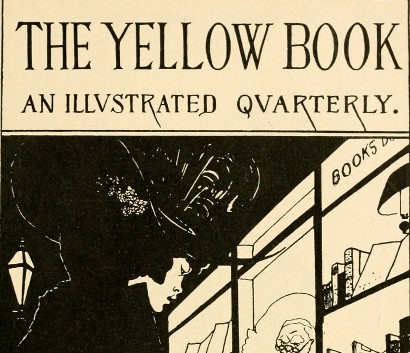
The word ‘decadence’ is used these days to mean anything self-indulgent or hedonistic (rich foods, luxurious clothing, or sex) but when applied to the final decades of the nineteenth century it refers to a set of themes in art and literature that were viewed by conservative critics as a sign of cultural degeneration and moral decline. Emerging in France in the work of poets of the Symbolist and Aesthetic movements, Decadence soon spread to Britain where it became synonymous with familiar figures like Oscar Wilde and the illustrator Aubrey Beardsley. Periodicals such as The Yellow Book and The Savoy sprang up to cater to this evolving avant-garde. Only when Wilde was sentenced to two years’ hard labour for ‘gross indecency’ in 1895 did the bubble finally burst and decadent art and literature begin to be shunned by the wider public.
Only when Wilde was sentenced to two years’ hard labour for ‘gross indecency’ in 1895 did the bubble finally burst and decadent art and literature began to be shunned by the wider public.
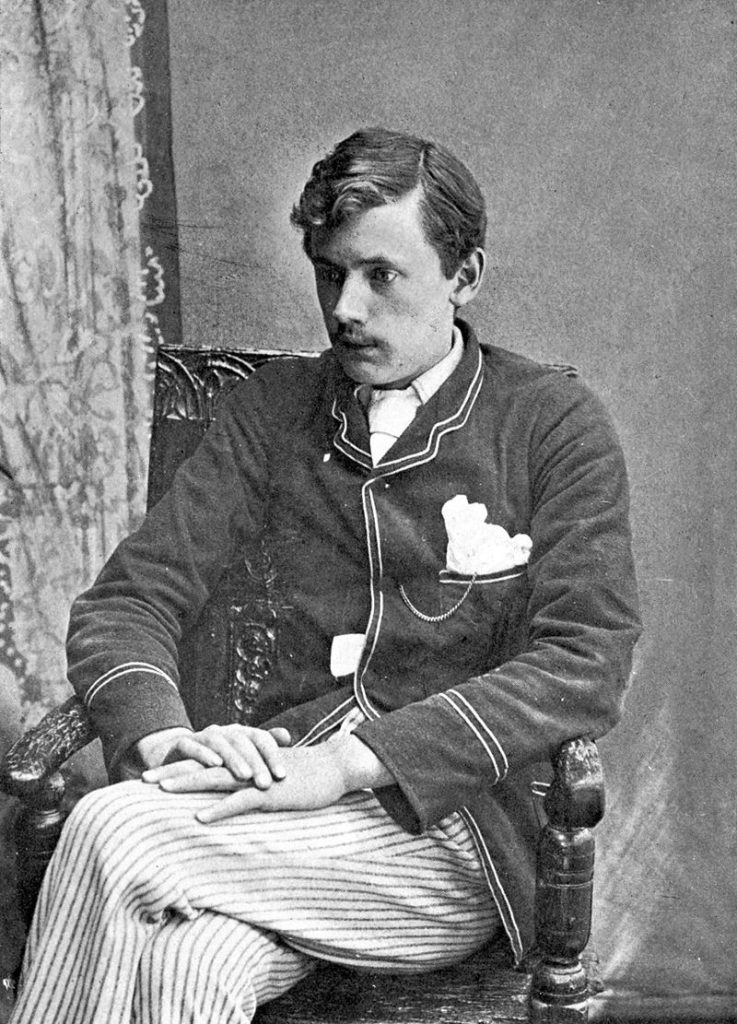
While close neighbour Magdalen College can boast the likes of Wilde and Lord Alfred Douglas as alumni, The Queen’s College has its own links to the Decadent movement. Currently in the New Library there is on display a small exhibition of books relating to two of the College’s Old Members, Walter Pater (1839-1894) and Ernest Dowson (1867-1900). They matriculated 30 years apart but left their mark on the period known as the Yellow Nineties in important ways. Pater is now considered one of the founding theorists of aestheticism whose essays set the imaginations of Wilde and others alight, while Dowson was perhaps the Decadent Poet par excellence. After his death from tuberculosis at the turn of the century, he became enshrined as part of W. B. Yeats’s ‘Tragic Generation’ – the pantheon of writers and artists who lived ‘lives of such disorder’ and consequently did not survive into the 1900s. His reputation as a poet is often overshadowed by his infatuation for the young Adelaide Foltinowicz, the young daughter of a Polish restauranteur whom he met in 1889 when she was just 11.
The Queen’s College has its own links to the Decadent movement.
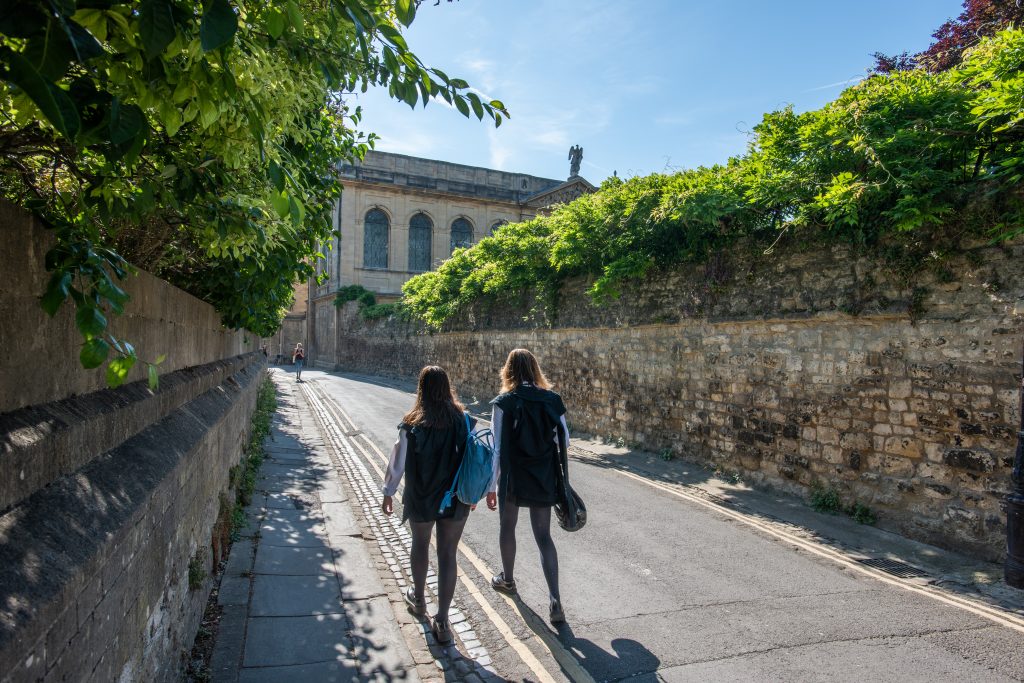
As a commoner at Queen’s, Walter Pater held an ‘exhibition’ (scholarship) for three years, provided by the King’s School, Canterbury. He took his B.A. in December 1862, after which he tried, and failed, to take Holy Orders. He never strayed far from the College during this period, and may have taken rooms in Grove Street (now Magpie Lane) where he worked as a private tutor. He would certainly have known George Augustus Simcox, a newly-appointed classics Fellow at Queen’s and a writer who was deeply influenced by current Romantic literature (see previous blog post on Simcox). Soon Pater was elected Fellow of Brasenose College in 1864. Here he began to write essays, particularly on poetry (his first was on Coleridge), and his literary voice took shape. From 1867 he penned a series of articles for The Westminster Review which would be collected as Studies of the History of the Renaissance in 1873. Pater saw the Renaissance as a period of broad enlightenment beyond merely the fifteenth-century revival of classical antiquity. It was an ‘outbreak of the human spirit’ which overcame the constrictions of medieval religion.[1]
Walter Pater
In 1877 the 22-year-old Oscar Wilde, then in his third year at Magdalen, sent Pater an article he had just had published in the Dublin University Magazine. Pater was impressed – ‘It shows that you possess some beautiful, and for your age quite exceptionally cultivated, tastes, and a considerable knowledge also of many beautiful things’ – and the two began to meet regularly. Wilde was already cultivating his pose of arch-aesthete and looked up to Pater, having been enraptured by Studies in the History of the Renaissance in his first year. Sections of it are spoken aloud by Dorian Gray, and by the time Wilde wrote De Profundis from Reading Gaol in 1897 he claimed to know much of it by heart.[2] The book informed Wilde’s personal creeds of beauty, imagination, and becoming ‘drunk with life’. A close family friend of the Wildes was Queen’s Fellow A. H. Sayce, making it possible that Wilde was a regular visitor to Queen’s during his time at Oxford.
Pater was still an influence in Oxford when, a decade later, Ernest Dowson entered Queen’s in 1886. Dowson had come from a well-to-do middle-class family, his father the owner of a dry dock in Limehouse. They had travelled widely when Dowson was young, to Europe, where little Ernest was introduced to important literary figures such as Robert Louis Stevenson (with whom he played dominoes) and French writer Guy de Maupassant. He did not go to school, so it was down to his father’s ability as an educator that he passed the entrance examinations to Oxford. At Queen’s, his rooms were at the top of Staircase 5, Back Quad, sparsely decorated, and seemed to visitors as if he was always on the verge of moving out.[3] Fellow E. M. Walker (later Provost 1930-33) remembered how Dowson appeared ill ‘from the time he arrived until he went down’, and other contemporaries noted how he stood out from the other students. He was better read than his peers, and while at Queen’s obsessed over the poetry of Charles Baudelaire, Edgar Allan Poe, and the Jacobian dramatists.
Ernest Dowson
Like Pater, Dowson lived on Grove Street, moving into no. 5 in Michaelmas 1887. Friends claim that this marked a period of depression for Dowson. His father’s business was suffering, and he may have been made aware that his studies were now a financial strain on the family. Whiskey became his drink of choice (not unusual for an undergraduate). Dowson’s time at Queen’s ended abruptly when in March 1888 he sat for Honours Moderations, and after completing only part of them, decided he would give it all up. At the end of Hilary term Dowson left Queen’s and settled for a time at his parents’ house in Woodford, East London. His Oxford career was brief, and though it is where he began to nurture his literary abilities, the University does not seem to have left a lasting impression. As he wrote to Arthur Moore in February 1890:
I found myself at Oxford (naturalich) at about 11.40PM. & stayed with Swanton. I came back to-day – finding it supremely triste: did not go near Queen’s at all – nowhere in fact. A place which is born again every 3 years has its drawbacks.[5]
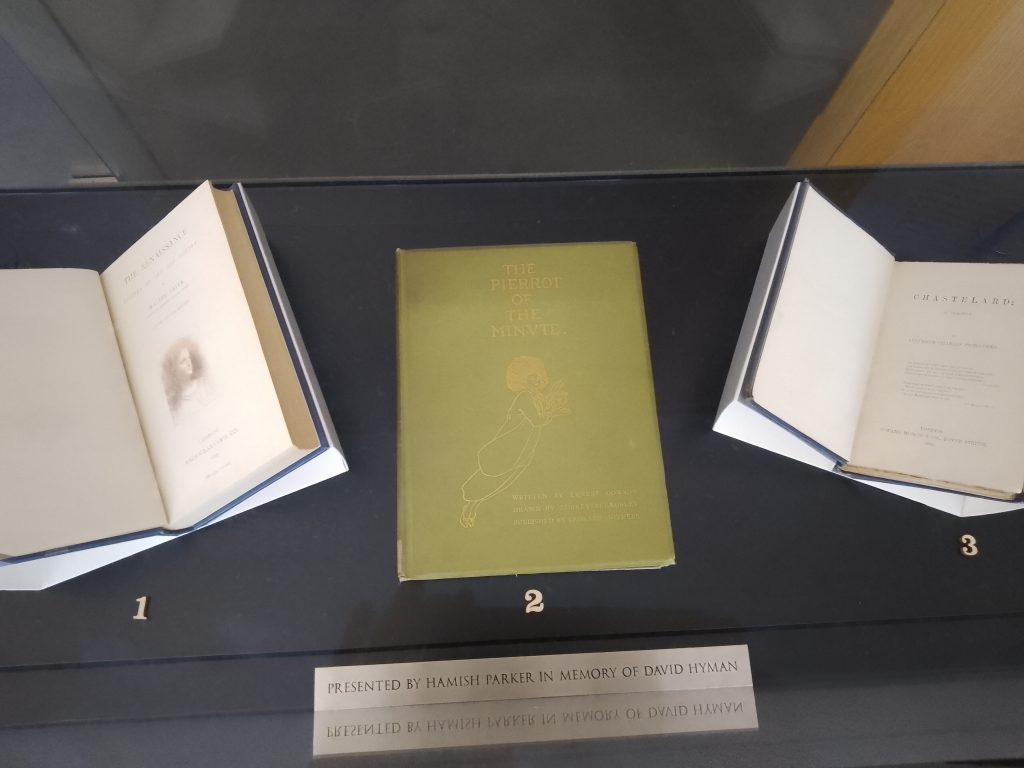
The New Library exhibition case displays Pater’s The Renaissance: Studies in Art and Poetry from 1877, given to the library by J. R. Magrath, alongside Dowson’s The Pierrot of the Minute: A Dramatic Phantasy in One Act with illustrations by Aubrey Beardsley, published in a limited edition in 1897. Also on display is Chastelard (1865) by Algernon Charles Swinburne. Swinburne’s poetry caused a stir in the 1860s, full of pagan themes and same-sex love, and went on to inspire a generation of decadent writers. It was apparently due to Dowson that the Library first added Swinburne to its collection.[6]
The exhibition in the New Library
[1] Walter Pater, Studies in the History of the Renaissance (London: Macmillan, 1873), p. xi. [2] Richard Ellman, Oscar Wilde (London: Hamish Hamilton, 1987), p. 46. [3] Mark Longaker, Ernest Dowson (Philadelphia: University of Pennsylvania, 1968), p. 26. [4]The Letters of Ernest Dowson, eds. Desmond Flower and Henry Maas (London: Cassell, 1967), p. 10. [5] Dowson to Arthur Moore (23 February 1890). Letters, p. 139. [6]Letters, p. 9.
It’s that time again! Our brilliant Library team have shared their top picks for summer reading. It’s a mix of the unexpected, the thought-provoking, and the utterly absorbing. Whether you’re chasing sun or shade, get ready to discover something you didn’t know you needed to read.
Sarah Arkle, Deputy Librarian
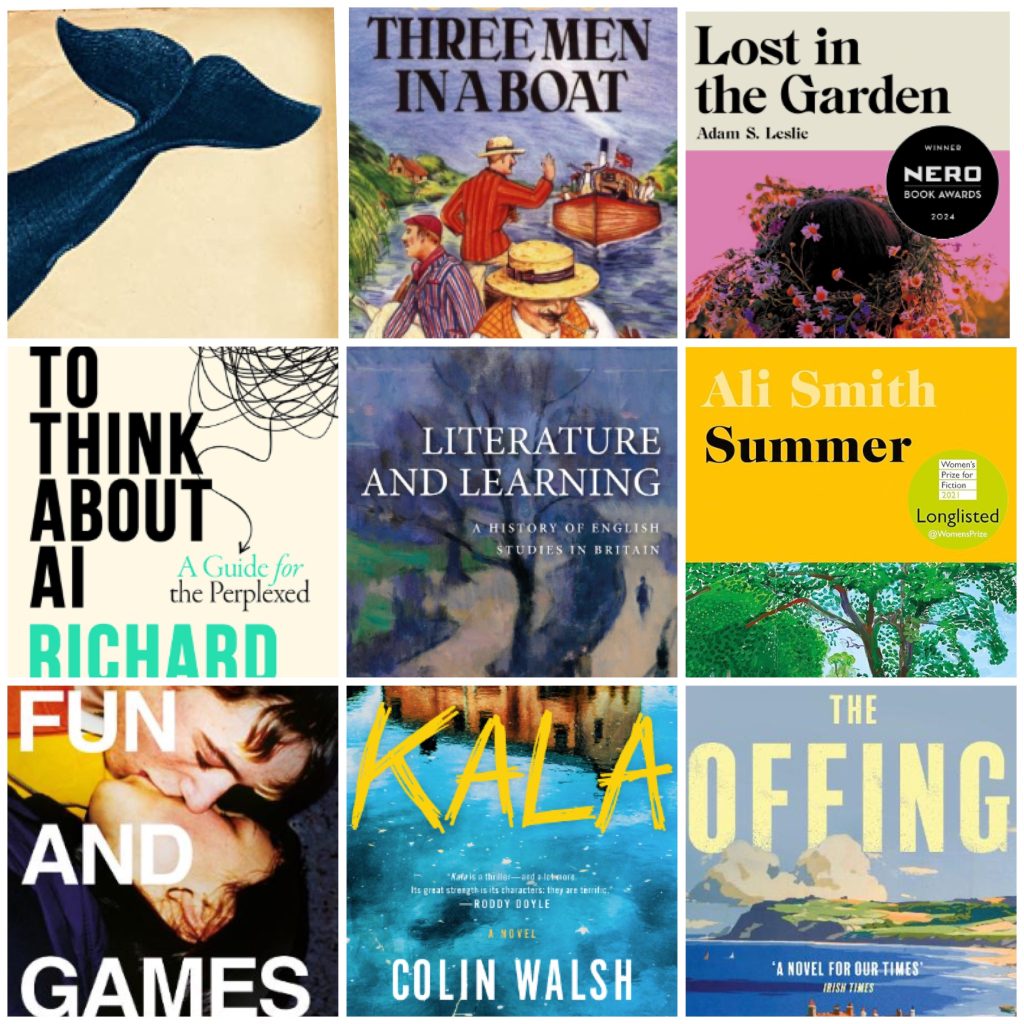
Very late to the party, I have recently got into Ali Smith; she has a very playful way with language that I really enjoy. This academic year, I’ve been working my way through her Seasonal Quartet, beginning last October with the first of the set Autumn, followed by Winter, then Spring. My first recommendation for summer reading therefore is the final instalment (unless you count the additional Companion Piece) Summer, which I am yet to read, but will be moved to the top of my TBR now we’ve reached the summer solstice. I don’t believe it is necessary to read them in any particular order as each book is quite distinct, but I chose to read them in line with each season, which has been a pleasant reading experience that I would recommend. The novels were written shortly after, and partly in response to, the political landscape we found ourselves in post-Brexit referendum in 2016, so they feel as fresh and relevant as they did almost ten (!) years ago. Don’t let that put you off, Smith’s writing is fun and hopeful, I think we can all benefit from a bit of that these days.
Smith’s writing is fun and hopeful, I think we can all benefit from a bit of that these days.
My second recommendation is a book I read a few years ago now, but remember enjoying and feels seasonally appropriate – The Offing by Benjamin Myers. I’m a big fan of Myers’ work as he sets his novels in the north of England, and The Offing is no different. It tells the story of a young man named Robert, who leaves his village in County Durham on foot and walks to Robin Hood’s Bay where he strikes up an unlikely friendship with an older woman named Dulcie who introduces him to poetry and wild swimming. It isn’t without its darker parts but it is on the whole a book filled with warmth which I read in less than a day during the 2020 lockdown, according to the little app I use to track what I’ve been reading – I suppose there wasn’t much else to do back then.
Lastly, I really loved Ann Patchett’s novel Tom Lake which I read late last summer. It’s about a woman named Lara, whose three grown up daughters are home – I think for lockdown, if I remember correctly (sorry to mention it again, though from what I recall I don’t think Covid looms large over the novel as a whole). Whilst picking cherries in their orchard, she tells them the story of a romance she shared in her younger years with a man who went on to be a famous film star. It is a bit of a departure from my usual book-based diet of horrible weird fiction and I was surprised by how much I enjoyed it. Although the book itself is technically based in spring, I think it could definitely be enjoyed on a sun lounger somewhere warm.
Matt Shaw, Librarian
You probably don’t need a College Librarian to recommend a selection of thrillers, spy novels, or other page-turners suitable for the Eurostar platform. So, instead, some possibilities from the non-fiction shelves.
The first is the wry and lively Literature and Learning: A History of English Studies in Britain by Stefan Collini. Finally, someone has come to the rescue of Q (no, not that one) and Walter Raleigh (no, not that one either). There’s also a lot on what a university is about, or has been in the past. You can also read the book online, if your Bod Card is in good order and your suitcase too stuffed for 400pp hardbacks.
On the digital front, it’s probably worth the quick run through Richard Susskind’s How to Think About AI, which provides a good framework for thinking about how to respond to inevitable questions in the hotel bar from a new acquaintance about whether your job is doomed to AI-extinction. With Susskind’s legal and academic background, it’s particularly on the money for lawyers or former philosophers; you can also take succour that no AI agent will ever enjoy the taste of the negroni you are drinking in the same way.
‘How to Think About AI’ provides a good framework for thinking about how to respond to inevitable questions about whether your job is doomed to AI-extinction.
Speaking of barstools and books, if your holiday is especially long, and you’re feeling lucky, you may be able to snag the American edition of Rumors of my Demise: A Memoir by Evan Dando before Michaelmas Term and possibly enjoy a trip back to an alt-millennium. Should this publication schedule prove over-optimistic, you’ll certainly be able to grab Catherine Clarke’s A History of England in 25 Poems before term starts, and perhaps see if Collini’s fretfulness about Eng. Lit.’s possible retreat to a shrinking enclave of a ‘smaller number of enthusiastic students and specialist teachers’ might be assuaged.
As for me, I’m looking forward to reading Emily Gee, Hostel, House and Chambers: accommodating the Edwardian working woman in book – rather than proof – format.
Felix Taylor, Library Assistant
Now that I’ve begun cycling to work and back again, audiobooks have become a new source of time-passing entertainment. As long sections of the commute pass along the riverbank, it is appropriate that my two summer recommendations are set on, or deep within, the water. Philip Hoare’s Leviathan: or the Whale, narrated by Philip Pope, is a book mostly about Herman Melville and the writing of Moby Dick, so prepare for panoramic scenes of the New Bedford whaling industry in the early nineteenth-century and the history of spermaceti oil in candles and streetlamps and even (much later) in space, due to its very low freezing point. Whaling was a dangerous but economically enriching pursuit, and Melville’s novel universalises it as man’s Shakespearean search for meaning (or revenge, or death, or anything you like). Hoare’s book is less a natural cetacean history and more of an account of a personal obsession, a love letter to Moby Dick. The autobiographical asides can seem weak at times, but it’s an engaging and well-narrated dive into the cultural impact of the whale over the last two centuries.
The other audiobook I can suggest is Jerome K. Jerome’s Three Men in a Boat – another watery-themed story, but one of travel, wit, slapstick, and a smattering of local history. Read by the veteran British actor Ian Carmichael, the short book follows three hypochondriacs and a dog who decide that a week on the Thames will heal their fragile constitutions. From Kingston to Oxford, they row leisurely (and incompetently and haltingly) downstream, stopping when they feel the urge to sample the inns and to refill their hamper. The original intention of J, the narrator, was to write up the trip into a guidebook for that stretch of the river, although this ends up being shoved to the side in favour of more exciting exploits. It’s funny, and was clearly very funny when it was published in 1889 because it made Jerome’s name and has led to sequels, adaptations and parodies.
Read by the veteran British actor Ian Carmichael, the short book follows three hypochondriacs and a dog who decide that a week on the Thames will heal their fragile constitutions. It’s funny, and was clearly very funny when it was published in 1889 because it made Jermone’s name.
Lauren Ward, Assistant Librarian
As I write this at the start of the long vac, it happens to be swelteringly hot in Oxford. In that vein, the books I’ve chosen to put forward are ones set in and about summer, though their takes on the season vary quite wildly.
I’ll start with the strangest of the three. Adam S. Leslie’s Lost in the Garden is set in an and England experiencing perpetual summer, and one that also happens to be plagued by solid, violently-inclined ghosts. In this alternate England everyone is raised with ‘don’t go to Almanby’ being an accepted piece of folk wisdom – so, of course, that’s exactly where Rachel, Heather, and Antonia decide to go. What follows is an increasingly psychedelic road-trip haunted by eerie voices crackling over shortwave radio, the jingling of ice cream vans which never appear, and, of course, the ghosts roaming the countryside. Don’t let the relatively chunky size (450 pages) of this put you off – it’s a genuine page-turner full of snappy dialogue, plenty of humour, and nostalgia for childhood summers and the unique weirdness of English village life. Read with an ice cream close at hand (trust me).
What follows is an increasingly psychedelic road-trip haunted by eerie voices crackling over shortwave radio, the jingling of ice cream vans which never appear, and, of course, the ghosts roaming the countryside.
Also nostalgic, but featuring zero ghosts, is Fun and Games, John Patrick McHugh’s debut released this year. In it, 17-year-old John Masterson spends his final summer before going away to college in Galway working mind-numbing shifts at his hotel job, going to parties, and worrying about his relationship with his coworker Amber. McHugh really captures how constantly tragic and hilarious being a teenager is, managing not to let humour get in the way of more poignant moments. You’ll laugh, you’ll definitely cringe, and you’ll most likely be glad you never have to be a teenager again. This one can be found in the General Collection at Gen McH and if you don’t trust my recommendation, it’s also been blurbed by Sally Rooney.
Finally, Kala by Colin Walsh is another piece of recent Irish fiction I’ve enjoyed immensely. It follows Helen, Joe, and Mush, who are thrown together in their hometown of Kinlough as adults after years apart. As teenagers they spent the summer of 2003 in an inseparable group of six friends, the centre of which was Kala Lannan. When Kala disappeared later that summer the group fractured and 15 years later unanswered questions remain. This is an excellent slow-burn mystery about the secrets simmering under the surface of a small, ostensibly respectable, town. More importantly though, Walsh’s characterisation of the three friends both in their youth and as adults is second to none – he has such a keen eye for the feverish nature of teenage friendships and rebellion, and captures perfectly why Kala was so important to the group. If you’re in the mood for a gripping vac read, you can find this in the General Collection at Gen Wal.
The Mystery of Cuthbert Shields, ghost of The Queen’s College Library by Felix Taylor, Library Assistant
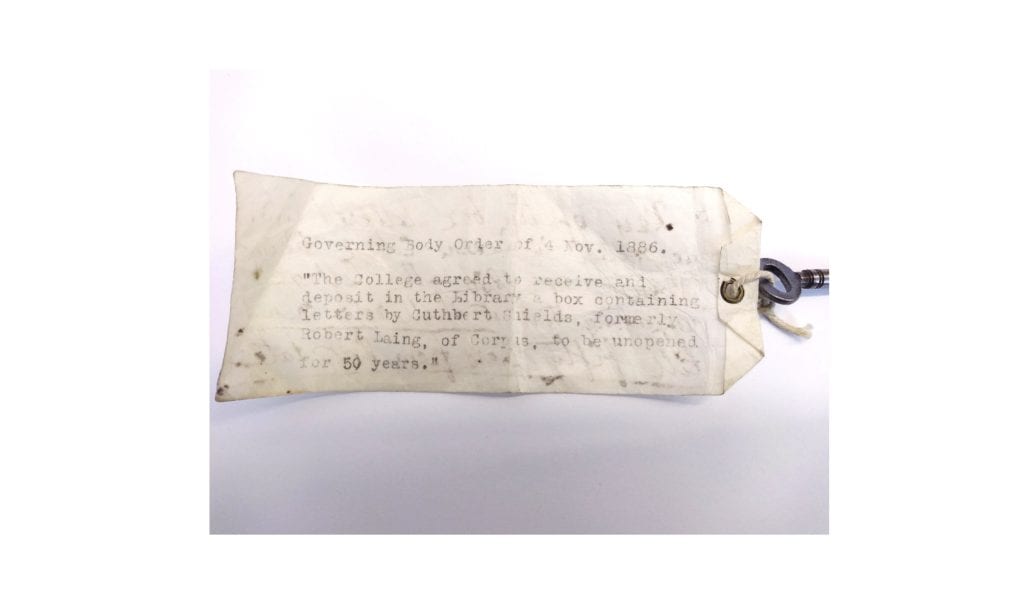
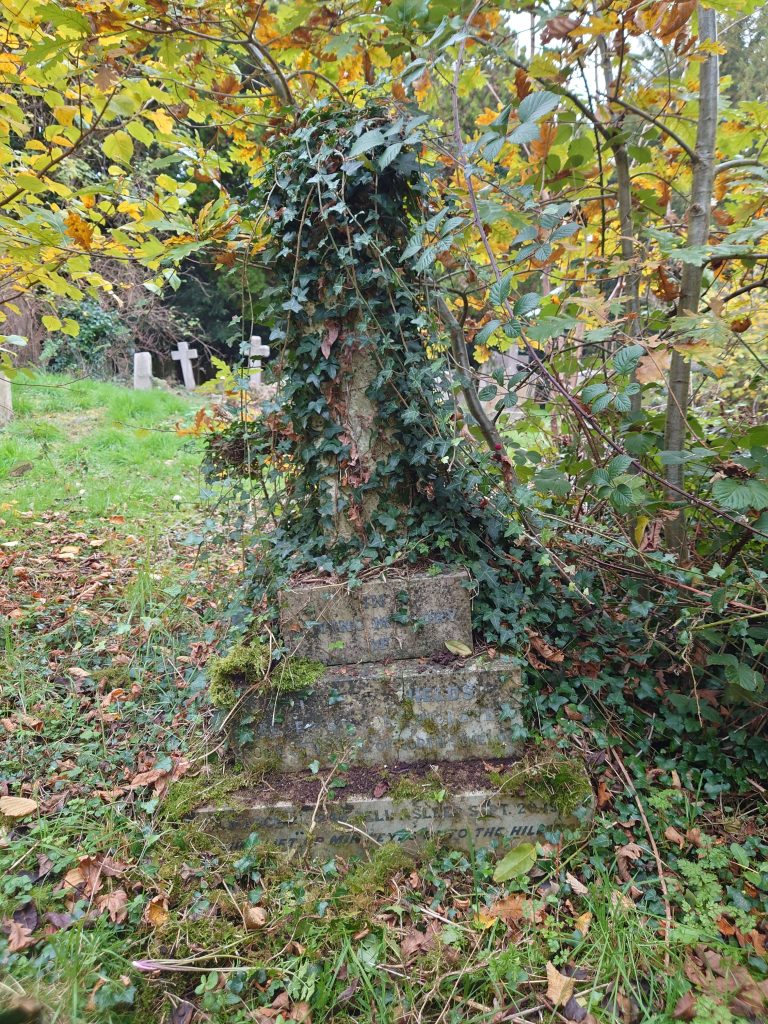
The story goes that a man named Cuthbert Shields, Fellow of Corpus Christi College, left a key and a locked tin box to the College Library upon his death in 1908. His will instructed that it was not to be opened until 50 years had passed.
For half a century a succession of Fellow Librarians waited obediently for the embargo to end, and in 1958 the box was taken to a stall at the back of the seventeenth-century Upper Library where finally it was unlocked. In attendance were the Fellow Librarian, the Bursar, and a professor, who discovered several bundles of papers, mostly letters, written in spidery black handwriting. They left, taking the box with them, but as they descended the stairs, the professor asked who the fourth member of the party had been – an old man with white hair who had been with them in the stall. Neither the Fellow Librarian nor the Bursar had seen anyone.
The next purported sighting of Shields was by Helen Powell, the College Librarian during the 1970s; according to her account in Rob Walter’s Haunted Oxford (embellished for effect, but aren’t all ghost stories?), she claimed to have seen a young student enter the library accompanied by an elderly gentleman with white hair, wearing a long coat. When confronted about this unauthorised guest, the student denied bringing anyone in with him. The old man, meanwhile, had vanished – of course.
So there we have it: the two best-known sightings of the spectre of Queen’s College Library. There have been more since, mostly rumoured and unrecorded, and his story is now part of university legend. Shields is a regular feature of the Oxford Ghost Tour operating from Broad Street, and several years ago was the subject of an episode of a folklore podcast. But who was the real Cuthbert Shields? Why did he leave Queen’s his papers? And, impossible though it is to answer, why does he haunt Queen’s and not Corpus Christi?
Robert Laing the reformer
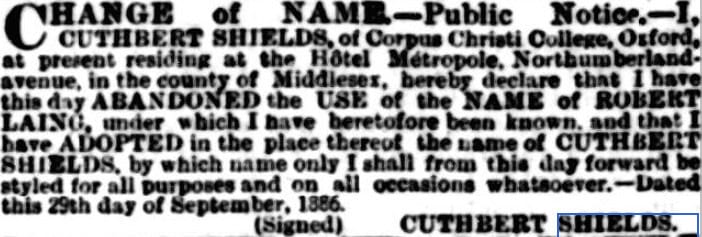
The basic facts of his life are easy enough to assemble. He was not always called Cuthbert Shields, but was born Robert Laing in March 1840 in North Shields, Northumberland (now in Tyne and Wear), the eldest son of a mariner. Laing was educated at various schools in Germany before matriculating at Wadham College, Oxford, in May 1859. He graduated with a first-class degree in Law and Modern History, and taught at nearby Radley College until he was elected a Fellow of Corpus Christi in 1868.[i]
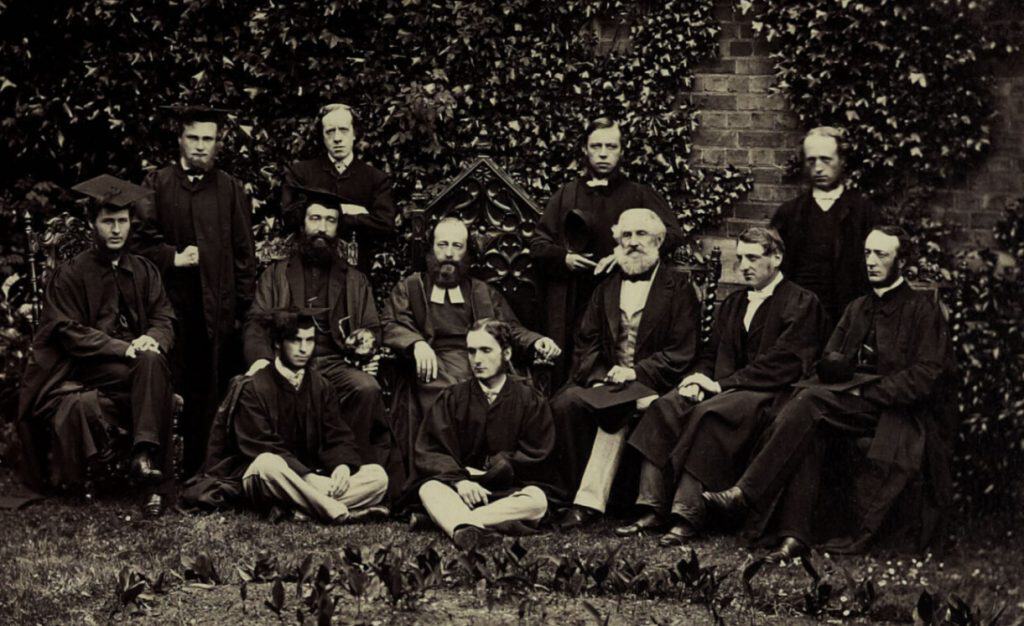
Robert Laing at Radley College in 1863 (Laing is second from left, back row).
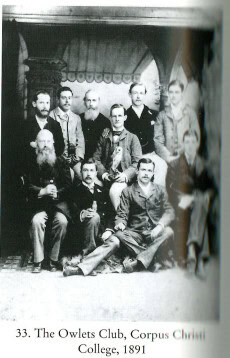
During this period Laing helped to achieve sweeping reforms of the teaching of history at Oxford. As a lecturer in Modern History, he collaborated in an intercollegiate lecturing scheme that led to the formation of a History Tutors’ Association in 1869. The scheme drew complaints from the History Professors, whose own lectures had become resultantly less popular, but eventually they conceded to the new arrangement. The ‘college lecture’ declined and died, gradually replaced by the personal tutorial. Laing himself held lectureships in nine Oxford colleges, Queen’s included. He also began contributing articles to The Quarterly Review, including a long essay on the work of the novelist George Eliot, whom he considered ‘a woman of genius, second to none in our century’.[ii] He loved theatre, and belonged to Corpus Christi’s dramatic society, the Owlets Club, where his recitals of Keats’s ‘Ode to a Nightingale’ and Poe’s ‘The Tell-tale Heart’ were celebrated.
Laing continued to advance the teaching of Modern History in Oxford throughout the 1870s. In 1875 he gave a paper (to a society whose senior member was J. R. Magrath, soon to be Provost of Queen’s), advocating for a reorganisation of the way individual subjects were taught throughout the University. ‘Colleges should once more be allowed and encouraged to act in the spirit of founders’, Laing declared, ‘to adopt the great modern subjects, and to amply endow criticism and erudition’.[iii]
Colleges should once more be allowed and encouraged to act in the spirit of founders
The paper was published the following year as Some dreams of a constitution-monger. Laing also threw his support behind higher education for women and began lecturing in Oxford and nearby towns. During a course of lectures on the French Revolution, he encountered Alice Liddell, now a grown woman, who had been an inspiration for Lewis Carroll’s Alice books. An infatuation developed that was not reciprocated. Laing became obsessed with her, even claiming to see sinister messages in daily newspapers which he connected with Alice and himself.
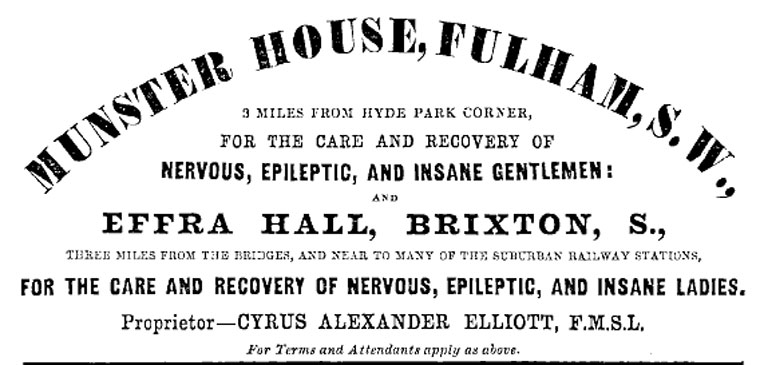
He continued to lecture until 1878 when he fled the University following a public breakdown, possibly from the combined strain of his romantic obsession and his campaigning for Liberal candidates in the parliamentary byelection (he is supposed to have shouted ‘Remember Eve!’ to a crowd outside the Radcliffe Camera). In his confessions he maintains that he was ‘driven out of Oxford’: ‘The walls of the domestic architecture of the Corpus Chapel seemed to shrink to the casings of a padded room & then expanded until the whole skyline was reached & above all Oxford congregations, there had been summoned the great congregation of the stars’.[iv] Laing committed himself to Munster House, a Fulham asylum, where he was administered to by noted physician George Fielding Blandford.
An advertisement for Munster House
The Jerusalem prophecies
Discharged from Munster House, Laing left England ‘a broken man, yet a bold man’.[v] It was at this point, possibly in 1879, that he decided to change his name. ‘Cuthbert’ because he was born on the day of St Cuthbert, the saint of the early Northumbrian church, and ‘Shields’ in reference to his native North Shields. The new surname also contained the letters ‘I.H.S.’ in reverse (an abbreviated form of ‘Jesus’ in the Greek alphabet).[vi] By the end of 1880 he was in Gorlitz, Germany, feeling ‘ill, nervous, dejected, unhappy’.[vii] From here he journeyed to Rome, and it was around this time that he began to record his autobiography or ‘confessions’ in the form of letters to his friends F. A. Clarke of Corpus Christi and Edwin Palmer, the Archdeacon of Oxford. They were rambling and conspiratorial, full of self-pity and comparisons to persecuted historical figures. ‘At Oxford, when you knew me first, the times were like those in England, in the times Becket was chancellor, or Wolsey,’ he writes. ‘Oxford had a great chance of complete reformation’.[viii]
Shields also travelled regularly to Trieste, in northern Italy, where he would meet the British explorer Sir Richard Burton and his wife Isabel (who referred to him in a letter as ‘Cuthbert Bede’). He went further east where, according to later accounts of his life, Shields spent time with Druses (being those who adhere to the Abrahamic Druze religion; this may have been where Laing picked up his belief in reincarnation), and was apparently ‘worshipped as a god’ by them.[ix]
Psychical And Supernormal Phenomena by Dr Paul Joire
But the strangest single episode of Shields’ exile happened while on a trip to Jerusalem where he made a number of prophecies that subsequently came true. In April 1885, Shields was staying at St John’s Hospice and overheard four German artists discussing their intentions to paint a panoramic view. He approached them and explained that he was gifted with second sight, and asked if they would like him to make some predictions. Shields urged the painters to write down everything he had said, which they then did. Among the predictions he went on to make was that the panorama would be a success, but that it would ‘bring detriment’ to one of the painters within 5-10 years. The painter named Krieger would marry on his return to Germany but then quickly divorce. Shields also suggested that another of the painters, René Reinike, might have been an Arab in a former life.[x]
Shields soon left the hospice, and the painters thought no more of him. But in 1891 Krieger was suing his wife for divorce, and the artists realised that many of the predictions had indeed come to pass. The incident was discussed at length in an article first published by Walter Bormann in the German periodical Psychische Studien in April 1900, and later by French parapsychologist Dr Paul Joire in Psychical and Supernormal Phenomena (1916) as an example of ‘Lucidity in the Future’ (though, Joire admits, lacking in evidence). Talk of the prophecies even circulated within spiritualist circles, and Joire’s account was reprinted in the esoteric journal Light. A decade after his death, Shields (as Robert Laing) was briefly known as a famous prognosticator.
A Different Man?
Before Shields returned to continue his Fellowship at Corpus Christi in 1886, he sent a notice to several national newspapers declaring to the world his change of name:
The newspaper notice announcing the name change
Now in his second ‘existence’ at Corpus Christi, Shields cultivated a reputation as one of the most eccentric figures in Oxford in the late nineteenth century. He seemed to take up his former position without event, and if this sudden reappearance provoked comment from colleagues, they kept it to themselves. After his return he became a member of the Tutor’s Club along with the classical scholar Robinson Ellis and the historian Charles Oman, who regarded Shields as ‘an interesting and amiable “crank”’.[xi] Though he was described as a ‘great Oriental scholar’, there is no evidence that Shields published anything during this period, except an affectionate portrait of Corpus Christi’s cat Tommy for Mrs Wallace’s Memories of some Oxford Pets (1900). He lectured on Dante and Goethe to the Oxford Dante Society in 1888 and was encouraged by his colleague John Ruskin to publish some of his historical lectures, but ultimately his role during these years was more ‘to stimulate productiveness in others than to produce much himself’.[xii]
Shields’ unusual interest in mysticism and the occult intensified following his reinvention. He had been known for telling ghost stories to his students at Radley College in the 1860s, but now, during dinners at Corpus, he delighted in turning the conversation to metaphysical subjects – Zoroastrianism, metempsychosis, ‘the evil spirits that haunted Rome’ – and had to be interrupted before he inevitably squashed the conversation.[xiii] Shields claimed to have lived many lives, and could trace these as far back as Zoroaster, the Ancient Iranian spiritual leader and founder of Zoroastrianism.[xiv]
Most theatrically, he wore an ornate ring which he claimed had been given to him by a Brahmin ‘to whom he had rendered a service’ on his travels, and which he regularly used to summon visions.[xv] When Shields desired information on a particular subject, ‘he had only to look at this ring, and then he saw a picture forming before him, like a dream’.[xvi] ‘Mr. Shields devoted himself to the study of Oriental witchcraft,’ claimed one writer after his death. ‘It was his habit to give excellent dinners to a select party of friends, and afterwards to take the floor and talk of black magic until his hearers’ ‘flesh crept’. A photograph of the Owlets Club from 1891 shows Shields with a domed head and long, greying beard. Clutching a cane between his legs, his ring just visible on his forefinger, he looks fixedly into the distance as if attending to a new vision.
A group photo of The Owlets Club, Corpus Christi College (1891)
Cuthbert and Queen’s
Shields died suddenly from an ‘internal complaint’ on 20 September 1908 and was buried in Holywell Cemetery, behind St Cross Church. Yet the question remains: why did Shields’ ghost choose to haunt Queen’s (if choice even comes into it)? Despite his 40-year Fellowship at Corpus Christi, he seems to have maintained a fond connection to the college on the High Street. His professional connection to Queen’s began with a history lectureship in the 1870s, and Shields became good friends with J. R. Magrath, the Provost from 1878. The College’s seventeenth-century Upper Library may have appealed as a space for study or even visionary contemplation of his past lives. After his death, Shields’ books were sold at auction by Blackwell’s, but he also left a large collection relating to the history of universities and the French Revolution to Queen’s, which Magrath called one of the most important benefactions to the library after the Mason bequest.[xvii] Some were given by Shields as early as 1890, and many currently sit on the shelves of the Upper Library where his name can be read on the munificentia bookplates.
Perhaps the College had acted as a refuge for Shields in the face of his mysterious persecution in the 1870s: following his return it clearly remained a place close to his heart. This is confirmed by the fact that the tin box, which is still kept by the College, was left to the College library in November 1886 – not on Shields’ death in 1908 as is usually thought, but in the very year that he returned to Oxford. It was full of his confessional letters written to Clarke and Palmer from Rome, perhaps to sure up his reputation. Governing Body minutes record the decision to accept the box and it was duly opened 50 years later, in accordance with his wishes, in 1936. But by whom, and what actually happened?
‘If the dead can haunt us, let them’, he wrote in Some dreams of a constitution-monger in 1876. [xviii] To students and staff of Queen’s, Shields, if they know his name at all, is now just a piece of college folklore, and sensational online accounts of his haunting are riddled with inaccuracies (and appear to derive from the fictionalised account given in Haunted Oxford). Either someone saw something in the Upper Library in 1936 or thereabouts – or the story of Cuthbert’s appearance was invented around the Senior Common Room fireplace and was told and retold until its origin was long forgotten. It is entertaining to speculate. More questions present themselves, such as if Shields truly believed in metempsychosis and the rebirth of the soul – and if he was preparing for his next incarnation before his death – why would he remain as a ghost? If the librarian had waited the full 50 years, as instructed, why would this trigger a haunting? When his box was opened, was he released back into his sanctuary to remain the mystical Cuthbert Shields, loitering among his books for eternity?
Late last year the Queen’s Library team managed to locate Shields’ grave at the far end of Holywell Cemetery (a map can be provided on request). We cleared the ivy and added an entry on the website findagrave.com, where well-wishers are able to leave virtual flowers. The inscription on his headstone is from Psalm 121: ‘I will lift up mine eyes unto the hills’.
Cuthbert Shields’ grave
My thanks to Wanne Mendonck at Corpus Christi College for help accessing the Pelican Record articles.
References
[i] ‘Shields, Cuthbert’, Alumni Oxonienses: The Members of the University of Oxford, 1715-1886 (vol. IV), ed. Joseph Foster (Oxford: Parker & Co., 1888), p. 1289. [ii] Bodleian Library, MS. Don e. 185, p. 35. [iii] Robert Laing, Some dreams of a constitution-monger: a paper on university and college reform (Oxford: James Parker and Co., 1876), p. 13. [iv] MS. Don e. 185, p. 12, 22. [v] MS. Don e. 185, p. 20. [vi] ‘About Men & Women’, Cambridge Independent Press (Friday 25 January, 1908). [vii] MS. Don e. 185, p. 49. [viii] MS. Don e. 185, p. 20. [ix] Cambridge Independent Press (25 September 1908). [x] Paul Joire, Psychical and Supernormal Phenomena: their observation and experimentation, trans. Dudley Wright (New York: Frederick A. Stokes, 1916), p. 348. [xi] C. O. [Charles Oman], ‘An Oxford Prophet at Jerusalem,’ The Pelican Record vol. XIV (1917-20), 187-191, p. 187. [xii] C. P. [Charles Plummer], ‘In Memoriam: Cuthbert Shields’, The Pelican Record… [xiii] C. O., ‘An Oxford Prophet at Jerusalem’, p. 187. [xiv] Mary Clapinson, ‘Shields, Cuthbert [formerly Robert Laing] (1840-1908), historian and eccentric’, Oxford Dictionary of National Biography (8 October 2009). [xv] Joire, p. 355. [xvi] Joire, p. 355. [xvii] J. R. Magrath, The Queen’s College vol. II, p. 279. [xviii] Laing, Some dreams of a constitution-monger, p. 14.
“Get weird” – Zine making with Imperfect Bound Collective
Sarah Arkle, Deputy Librarian
We’ve recently been having discussions in the Library office about exploring more ‘analogue’ communication methods with our students. Current cohorts of undergraduates experience so much of their lives through screens – as do we, as employees – that we wondered about a more tactile, tangible thing to look at, to handle, to read. Whilst most students are very respectful of the handful of rules we have in place, it must be tiring for them to receive email upon email asking them to please stop eating / vaping / littering / bringing their friends from other colleges etc. in the library.
To that end, we invited a group of local zine-makers, Imperfect Bound Collective, to facilitate a zine making workshop here in College. It was partly an opportunity for us to start thinking more practically about how we might want to put together a publication outlining library rules and information, and partly an opportunity for students to have some fun. Zine making is, as Luca from the collective put it, ‘high on self-expression and low on perfectionism’ in a way that academic work often is not, so we thought the opportunity for some low-pressure creative fun might be welcome mid-Hilary Term.
Zine making is high on self-expression and low on perfectionism in a way that academic work often is not.
To explain – “a zine (pronounced ‘zeen’) is most commonly a handmade publication often made in small circulations, printed and bound using various methods and sizes. The topics are on absolutely anything you can imagine. There are no specific skills required to make a zine, typically just a pen, some paper and an idea!”[1] The workshop began with an explanation of this, and then, with an encouragement to have fun and ‘get weird with it’ we began.
We had more options than just pen and paper. The facilitators brought their own copier/scanner with them, so library staff were able to experiment with creating patterns and shapes using objects we had to hand. Specifically, we had a large number of plastic bugs which we used to start thinking creatively about how we might want to communicate information about pests (attracted by all that food we ask you not to eat in the library).
Why do we have plastic bugs you ask? We have Kafka (and the library team’s sense of whimsy) to thank for that and they’ve been sitting in the office ever since awaiting use. Making cockroach-patterned paper probably wasn’t high on my list of things I expected to accomplish in my professional career, but I managed to turn out an adequate mini-zine with a clear and simple message: “do not eat in the library: it attracts pests”.
Library staff creations from the workshop
Whilst we spent a fair amount of time experimenting with the photocopier during the workshop, playing around with how placing and manipulating objects on the scanner bed can create interesting shapes and textures, the students in attendance favoured the collage approach, cutting from a selection of magazines supplied by the organisers and sticking to craft their zines. That’s the great thing about zines – there is no right or wrong way to go about it.
That’s the great thing about zines – there is no right or wrong way to go about it.
If you missed the workshop and are interested in learning more about the work Imperfect Bound do, you can follow them on Instagram @imperfectboundcollective. If you’d be interested in attending a workshop in College in the future, or have feedback or ideas for our plans to produce a printed guide to using the library, please get in touch with us directly by emailing library@queens.ox.ac.uk.
While we may not be dressing up as our favourite book characters for World Book Day 2025, we have asked our Library team to tell us about the books they remember from childhood that have stayed with them.
Sarah Arkle, Deputy Librarian
I grew up in what you could most politely describe as an unconventional household, so it shouldn’t shock that the book(s) which have stayed with me most from childhood are quite weird. Robin Jarvis’ Whitby Witches trilogy is a fantasy series set in Whitby which follows two foster children, Ben and his sister Jennet as they are taken in by a benevolent witch named Mrs Boston. Ben is gifted with second sight which allows him to see the dead, as well as see and speak with a community of mythical people known as Aufwaders or Fisherfolk who live around the coast of Whitby. The trilogy follows the two children navigating their new life in Whitby as their destiny becomes embroiled with that of the Fisherfolk. They battle various enemies, good ultimately triumphs over evil. There’s a fish demon, and a snake cult. The books feature fantastic illustrations by the author. It’s all great stuff.
The series has remained with me because it is tied up with all of my happiest memories from childhood. My mum read the series to me and my older brother when we were still small enough to share bunkbeds (with matching The Simpsons bedding – it was the early 00s after all), she herself perched in a very of-the-time inflatable plastic armchair. I think being read to from an early age helped foster my love of reading, a habit I’ve maintained into adulthood, and sharing in these fantastical and weird stories together is a memory I cherish. As a family we also developed a love for the town of Whitby, eventually going on to visit a few times. Once, we even went, presumably leaving our house in Northumberland incredibly early (and me skipping school for the day), to watch the construction of the Penny Hedge – a ceremony which features in the books.
Other aspects of real Whitby architecture, heritage and folklore appear throughout the trilogy, and I delighted as a child in seeing these aspects from my beloved books in real life. I gleefully skipped up the 199 steps, counting as I went, and have – well into adulthood – made many a pilgrimage to the Whitby Museum in Pannett Park to see the Hand of Glory. (I warn you, it’s a bit gruesome.) I remember walking around the town, speculating with my mum about which houses we thought might belong to the characters and feeling so excited whenever we spotted anything we recognised from the books.
I no longer own my original copies of the novels, which I believe are now sadly out of print, but I did secure myself some second-hand copies about ten years ago in a fit of nostalgia. I’m not sure what happened to mine. I suspect, like many of my childhood books, they were at some point or another – with or without my permission – gathered up and taken to Barter Books (our local second-hand bookshop growing up) to find a new home. I hope they’ve gone on to mean as much to their next owner as they have to me.
Matt Shaw, Librarian
Perhaps the most vivid reading memory from my childhood, apart from copies of the Beano read by streetlight leaking through the curtains, is getting up as early as I could before primary school to read the one-volume edition of the JRR Tolkien’s The Lord of the Rings, published by the Book Club Associates in 1971. I remember being determined to finish it before I was eight, and the almost tactile memory of escaping into another version of the world, leaning at dawn on some swivelling Habitat chairs next to our two ginger cats, as I turned page after page of thin, smooth paper seems imprinted on my mind. Less epic, but also evoking the emotion of adventure and pastoral charm is Phillipa Pearce’s Minnow on the Say (1955), with Edward Ardizzone’s illustrations helping to tell the story of the two boys, a wooden canoe (the Minnow of the title), and a quest for Spanish treasure. I think it accounts for the inflatable kayak that I sometimes drag across Port Meadow to take my son on a much smaller adventure.
Felix Taylor, Library Assistant
One book from my childhood that had an impact on my reading life and imagination was George MacDonald’s Victorian fantasy The Princess and the Goblin, first published in 1872. It tells of the eight-year-old Princess Irene who lives alone in her father’s castle, and who one day discovers an old woman spinning in the topmost tower: her great-great-grandmother. She is then chased by the goblins, a race once banished from the king’s realm, and taken into the mines where she is rescued by a young miner boy named Curdie. I don’t remember when exactly I read it, or even if I was the one reading it, but the book opened up a pathway which led to all sorts of other routes. Most likely I had been introduced to The Hobbit at some point before MacDonald, but as Tolkien took inspiration from The Princess and the Goblin for his own mountain-dwelling orcs and goblins, I was in a familiar world, one stripped back to the simplicity and strangeness of a Germanic fairy tale full of castles, tunnels, and a magic thread that will lead you home. G. K. Chesterton called it ‘a book that has made a difference to my whole existence, which helped me to see things in a certain way from the start’. Would I go that far? I don’t know, but I understand where he’s coming from. It’s a tale of fear and heroism which has stayed with me since. I definitely read the sequel, The Princess and Curdie (1883), though I have no memory of what happens.
Lauren Ward, Assistant Librarian
A book that I adored as a child and has stayed with me is Inkheart (and in fact the whole Inkworld series) by Cornelia Funke. It’s about Meggie, who loves stories, and her father Mo, who has the ability to bring them to life – literally. Their adventures across the dangerous world they enter convey all the terrors and joys of reading, and its magical ability to transport. Inkheart and its sequels are translated from the original German, a fact I was fascinated by as a child. To my ten-year-old mind translation was reserved for more “serious” matters like textbooks and things about taxes, not fantastical stories for children’s bedtime reading, so I felt lucky to have the story in a form I could read. It sparked a lifelong appreciation for translated literature – I’m currently 56 countries into a reading challenge where I attempt to read a book from every country in the world, a project which has its roots in having read Inkheart almost two decades ago.
Header image: View of Whitby harbour from the 199 stairs down to the harbour (Credit: Gyrohype)
The College’s ‘academic cluster’ theme for 2024/2025 is ‘perception’. A broad topic indeed, but the Library has nonetheless attempted to illuminate some of its aspects in a display of books in the Upper Library. An online version of the show can now be visited on the College’s website, along with several other recent exhibitions.
Ten items, ranging over five centuries, are on display. The oldest is a book printed in Basel in 1470. It is an edition of Bartholomaeus Anglicus’s Latin encyclopaedia De Proprietatibus rerum, the original text of which provided its translator, John Trevisa, with the source of the first English appearance of the word ‘perception’, meaning a sense of the divine. The newest (in terms of creation if not publication) – 1985 – is an inscribed copy of the neurologist, writer, and Old Member Oliver Sacks’ The Man Who Mistook His Wife for a Hat. As a concept, ‘perception’ had long-since shifted from the theological to the philosophical, physiological, and psychological, and Sacks’ series of medical case studies explored how our awareness of the world and ourselves is mediated by the brain and mind, often in untrustworthy ways. Much like Bartholomaeus’s encyclopaedia, Sacks’ book was a bestseller.
The Library items on display also explore a range of uses of the term between these two points, including a text that includes another Old Member’s exploration of happiness and the philosophy of perception: Jeremy Bentham’s An Introduction to the Principles of Morals and Legislation (1789). A publishing flop rather than bestseller, the promotion of happiness (and punishment by the deprivation of perceptual pleasures) nonetheless profoundly influenced social reformers and Utilitarians of the nineteenth century and later.
Visual pleasure is provided by a recent edition of Sir Isaac Newton’s Opticks. The College holds two copies of the first, 1704 edition of Newton’s investigation into the properties of light and the scientific method, but neither offer a rainbow fore-edge or the reflective cover of the edition included in the exhibition. Adlus Huxley, whose Doors of Perception (1954) is also included, might have appreciated staring into the psychedelic patterns produced. Further local interest includes a later edition of Edwin Abbott Abbott’s Flatland, printed by Basil Blackwell, Oxford in 1950. While the exhibition can be seen in two dimensions on the web at Perception: an exhibition – The Queen’s College, Oxford, it can at the time of writing still be seen by current and Old Members in three dimensions in the Upper Library. Discussion of what it means to physically perceive the display might be found in the early edition of Maurice Merleau-Ponty’s Phénoménologie de la perception (1945).
‘From the Author’: G. A. Simcox and the romantic poets
Felix Taylor, Library Assistant
George Augustus Simcox was a classical scholar, a poet, and Librarian and Fellow of the Queen’s College, elected in 1863 at the age of twenty-two. Years later, his name was in all the newspapers: ‘MR. SIMCOX’S DISAPPEARANCE’, ran the headline in the Manchester Guardian in 1906.[1] Simcox had been reported missing along the coast of Northern Ireland, where he had left his hotel to walk near the Giant’s Causeway and failed to return. His habit of reading while walking, his ‘rambling gait’, and his advanced age made it likely that he had fallen from the cliffs. ‘Dr. M’Grath [sic], Provost of Queen’s, his executor, said the College authorities and his bankers had heard nothing from him since’.[2] Having been presumed dead following weeks of searching, part of his extensive library was given by Magrath to Queen’s. 120 years on, it reveals Simcox’s deep interest in theology, Latin literature, and contemporary romantic poetry.
Born in Kidderminster, Simcox came from a literary family. He was the eldest brother of William Henry and Edith, both distinguished in their own fields. Edith is now best known for her friendship with George Eliot, but her study of early civilizations and involvement in the trade union movement meant that she was a respected intellectual and social reformer. William Henry was a theological scholar, also at Queen’s, and went on to write the first full-length biography of Barnabe Barnes, patron of William Shakespeare. During the 1870s and 80s, all three siblings were writing for some of the foremost literary periodicals of the day, including The Academy (whose editor was a Fellow at St John’s) and The Fortnightly Review.[3]
During his time as an undergraduate at Corpus Christi, Simcox was celebrated for his sharp mind and quick wit. ‘No name was better known in the Oxford of forty years ago than that of G. A. Simcox. He was regarded as the ablest man of his year. Tall, spare, and somewhat stooping … he struck you at once as a remarkable personality. But his oddity was also unmistakable’.[4] After being elected to Queen’s, Simcox began to appear as an unconventional donnish figure, mild-mannered yet eager to contribute in any way that he could to literary society. Simcox’s absent-minded presence at the university is immortalised in Oxford Sketches, a set of caricatures by illustrator Sydney Prior Hall, as a ‘drooping figure with trailing gown … strolling outside of Queen’s College and gazing upon various pebbles, straws, and trifles that lay on the pavement’.[5] These contrasting portraits of Simcox as both a keen academic, once president of the Union, and a whimsical eccentric suggest a marked change in character; it may be that the Fellowship allowed his ‘oddity’ to deepen; perhaps also his developing interest in contemporary poetry was considered unusual by other scholars.
The Assyriologist A. H. Sayce remembers Simcox introducing him to the poet Algernon Charles Swinburne, who was a guest at one of Simcox’s college lunches. Swinburne, then admired in Oxford for his early collections of taboo-breaking verse on pagan themes and same-sex love, had apparently been ‘making himself sick on a surfeit of sweetmeats’ and was unable to eat the lunch Simcox had provided.[6] Certainly Simcox would also have known Walter Pater – Queensman and burgeoning literary critic whose Studies in the Renaissance helped kickstart the aesthetic and decadent movements – and may also have been involved in the founding of the Savile Club, which he joined in 1877.[7] If his library is anything to go by, he may also have known or corresponded with William Morris and Dante Gabriel Rossetti – both of whom worked on the murals of the Oxford Union where Simcox was later president.
Simcox was himself a poet, though unappreciated by his peers. Prometheus Unbound: A Tragedy was published in 1867, a retelling of the classical myth in line with Shelley’s interpretation, begun during his first winter at Queen’s. This was followed two years later by Poems and Romances. The collection reflects the influence of Swinburne, Morris, and Rossetti, particularly the Arthurian poems ‘The Farewell of Ganore’ and ‘Gawain and the Lady of Avalon’. Simcox also admired Lord Bulwer-Lytton’s King Arthur (1851), which was part of his library. He continued to publish individual poems in The Cornhill Magazine and Good Words into the 1870s, but his enthusiasm for composing verse seems to have waned. ‘He was discouraged by the unpopularity of his books, and publishers were shy of them’, noted his friend, W. Robertson Nicoll.[8] Even before the release of Prometheus Unbound, he was doubtful about its success and warned readers of this in the preface: ‘A poem after the antique is likely to be a failure, and such failures are mischievous, because they lead us to exaggerate the difficulty of entering into a literature greater than our own’.[9] He was proud enough of Poems and Romances, however, to get at least one copy bound in expensive enamel covers. While at Oxford he wrote a two-volume History of Latin Literature, which he hoped would make his name, although it ultimately failed to sell. ‘It is to be feared,’ noted the author of his obituary in the Manchester Guardian, ‘that Simcox had developed too strongly the old academic habit of perpetual accumulation, frequent schemes of writing, and constant postponement of the pains and perils of authorship’.[10]
The three books on display in the New Library exhibition case testify to Simcox’s interest in romantic poetry. His first printing of Dante Gabriel Rossetti’s Poems (1870) is signed ‘From the Author’, suggesting that Simcox may have corresponded with the Pre-Raphaelite at one time or another. Famously, Poems contains ‘The House of Life’, the intimate sonnet sequence buried with Rossetti’s wife Elizabeth Siddal in 1862 and then retrieved after Rossetti had her coffin disinterred seven years later. Next to this is a volume of poetry by Christina Rossetti, one of several of her books owned, and presumably reviewed, by Simcox. Finally, his library contains a resplendent copy of The Works of William Blake: Poetic, Symbolic, and Critical, edited by the poets W. B. Yeats and Edwin Ellis in the early 1890s, and containing lithographs of Blake’s prints. This three-volume set was limited to 500 copies – further evidence that Simcox maintained an appreciation for art and literature throughout his varied life, mysteriously cut short.
[1] ‘Mr. Simcox’s Disappearance’, The Manchester Guardian (17th July, 1906), p. 14. [2]Ibid. [3] W. Robertson Nicoll, A Bookman’s Letters (England: Hodder & Stoughton, 1913), p. 107. [4] ‘George Augustus Simcox [obituary]’, The Manchester Guardian (21st July, 1906), p. 8. [5] ‘George Augustus Simcox’. [6] A. H. Sayce, Reminiscences (London: Macmillan, 1923), p. 39. [7] Savile Club, The Savile Club, 1868 to 1923 (England: privately printed, 1923), p. 113. [8] Nicoll, p. 106. [9] G. A. Simcox, Prometheus Unbound: A Tragedy (London: Smith, Elder & Co., 1867), vii. [10] ‘George Augustus Simcox’.
The Upper Library is such a remarkably baroque space that it is difficult, aesthetically, to stand out. But the College’s statue of Queen Philippa (1305/10-1369), which for many years has stood in the northern window, manages it with aplomb.
It’s a suitably prominent position. In 1341, the College was founded in her honour by her chaplain, Robert d’Eglesfield (c.1295-1349), and Philippa soon provided the new institution with a number of endowments to secure its future. As consort to Edward III (1312-1377), she is remembered as a wise stateswoman, noted – with probably some basis in fact – with petitioning Edward for clemency for the burghers of Calais following it siege in 1347.
The painted wooden effigy, which is roughly life-size, is thought to date from the seventeenth century (the first mention is in the Long Roll for 1658-9, when it was reaffixed to the wall in the College’s original Hall), and is based on Philippa’s tomb in the chapel of the kings in Westminster Abbey. In 1745, Provost Joseph Smith moved the effigy to a niche in his lodgings. In 1778, following a fire, she was removed to a builder’s yard on the site of what is now the Oxford Martin School before somehow making her way to a garden in Godstow. In 1891, she was rediscovered by Henry Willett, who had her restored and returned to the College, where she long has had her home on the great north window of the Upper Library.
Being on display attracts dirt and grime over time, and as part of a conservation project cleaning the shelving and books in the Upper Library this summer, it was time for Queen Philippa to be returned to her former splendour, as well as be given conservation treatment to ensure she can stand proud for another 400 years.
Following initial advice from the Oxford Conservation Consortium, the Library arranged for a conservation assessment and work by the conservator Bianca Madden, who specialises in wall paintings, sculpture, and polychrome or gilded surfaces. Taking on the role of art movers, the College’s estates team carefully wrapped the statue in conservation-grade Tyvek and placed her in a specially-constructed wooden crate, before carefully driving her to Bianca’s studio.
Here, paint analysis showed that the statue was originally brushed with a base layer of lead white with a few particles of red lead. Her red robe was painted with a layer of pure vermillion, and the cloak was painted in a cream colour using a mix of lead white and a small amount of ochre. The samples retain a layer of dirt, suggesting that this decorative scheme was in place for quite some time. At some point, this was painted over with a pale grey (a mix of lead white and charcoal black), and later still painted in pure lead white with a glaze in oil with some carbon black. Provost J. R. Magrath records the statue as being painted blue when it was at Godstow, so perhaps this is the layer of pale grey, and then a layer of Willett’s restoration. Paint analysis did not provide a definite date for the Philippa, but nothing was found to be inconsistent with a seventeenth-century paint scheme.
After this analysis, the conservation work removed the layers of surface and ingrained dirt (including bird lime), revealing the effigy’s shadows and highlights, which had been reversed by dirt. The paint layer was stabilised, and old woodworm holes were repaired, along with cracks in some of the woodwork, using lime-based fine surface filler and conservation acrylic resin.
Following this painstaking work (which was thoroughly documented), the much cleaner Philippa was again wrapped in Tyvek and bubble wrap, secured inside her special crate, and then carefully returned to pride of place in the Upper Library for a final touch up. See how she looks next time you visit the Upper Library.
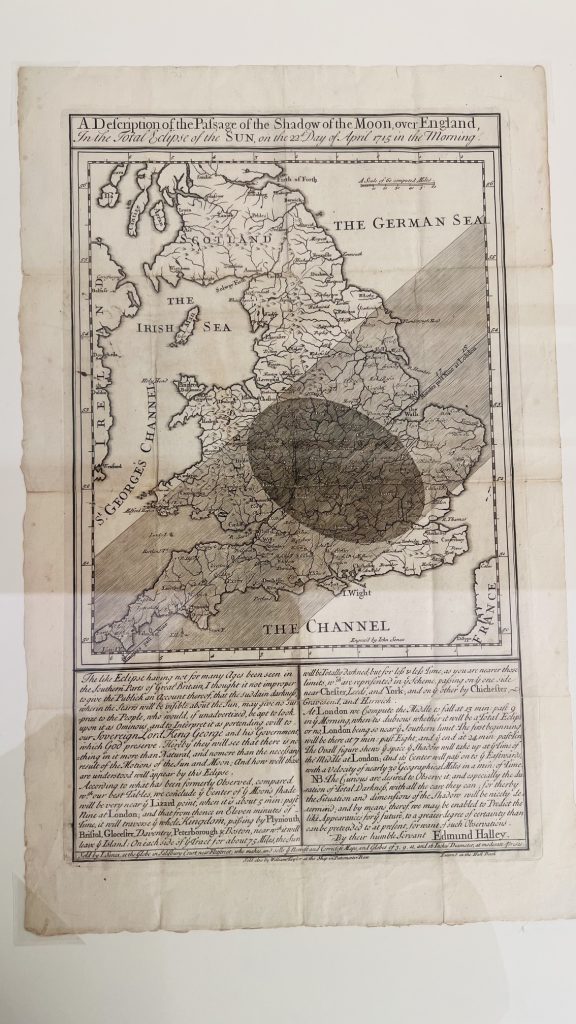
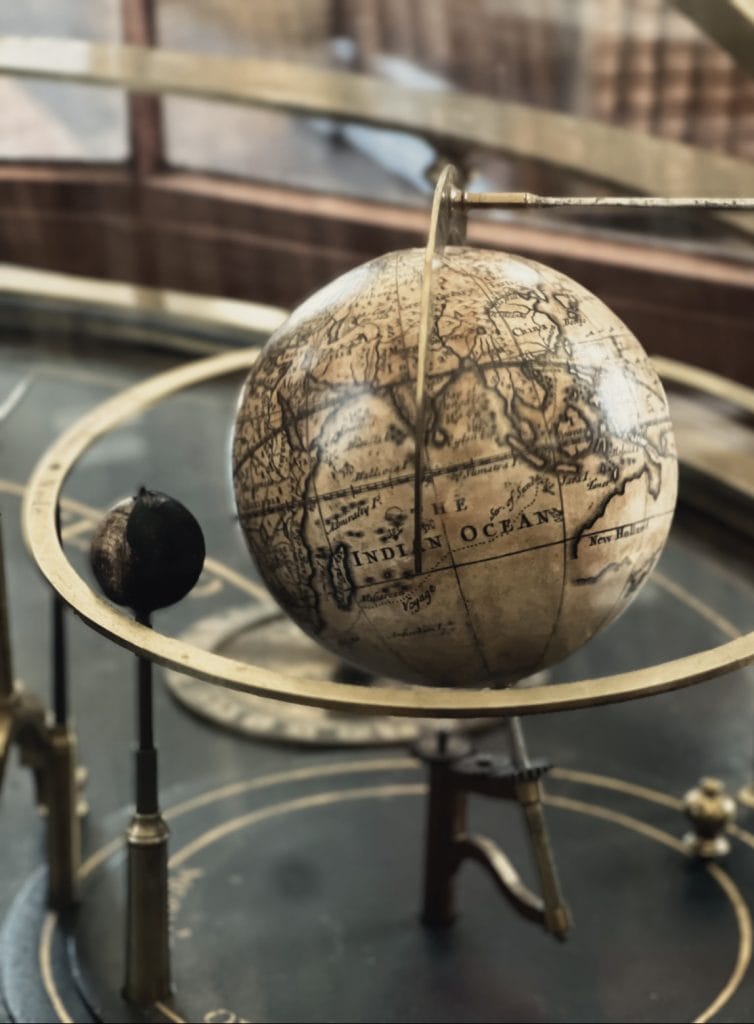
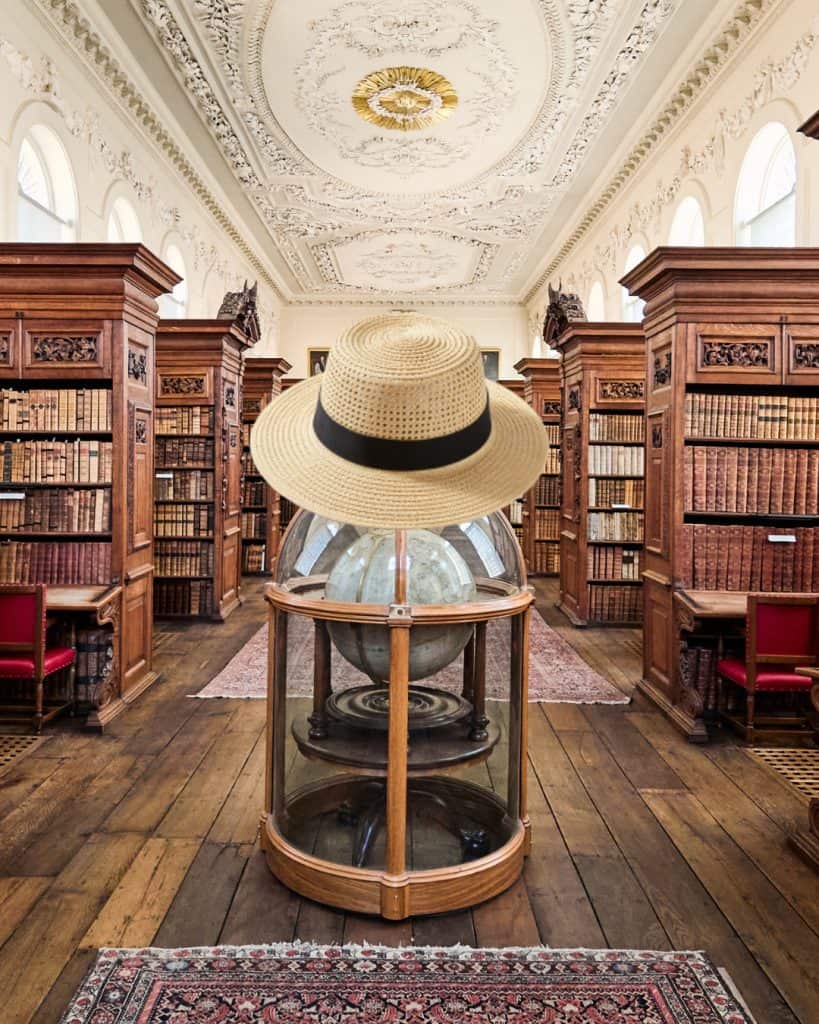
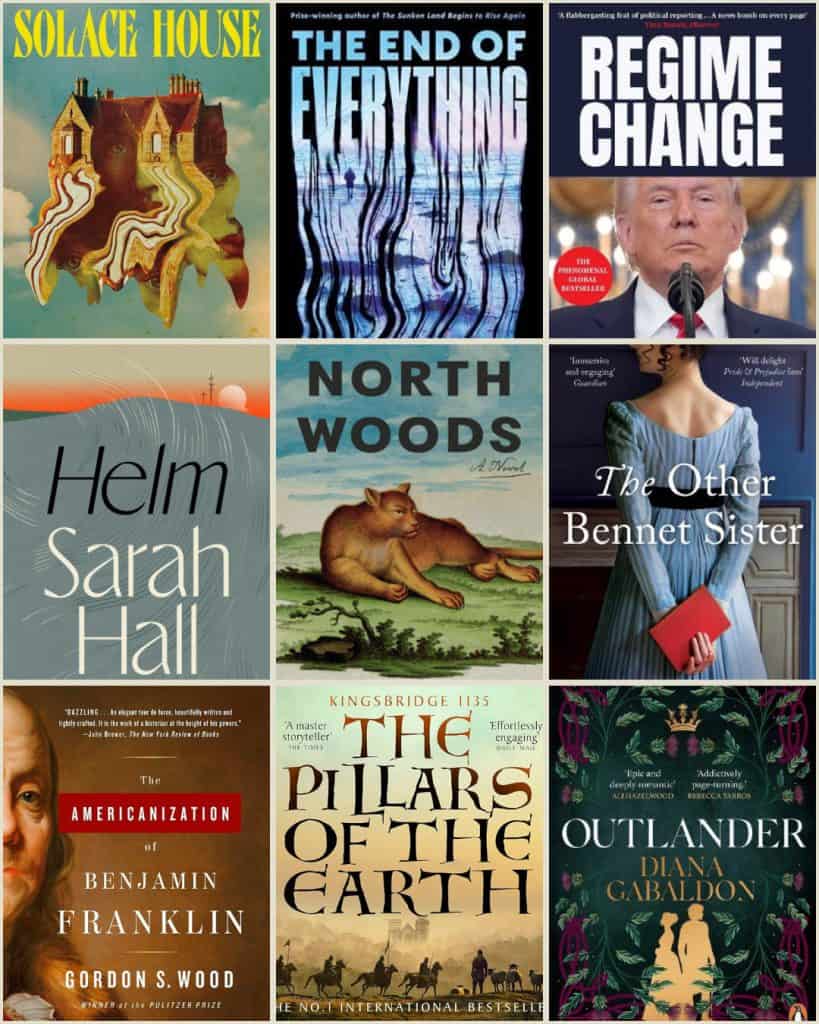
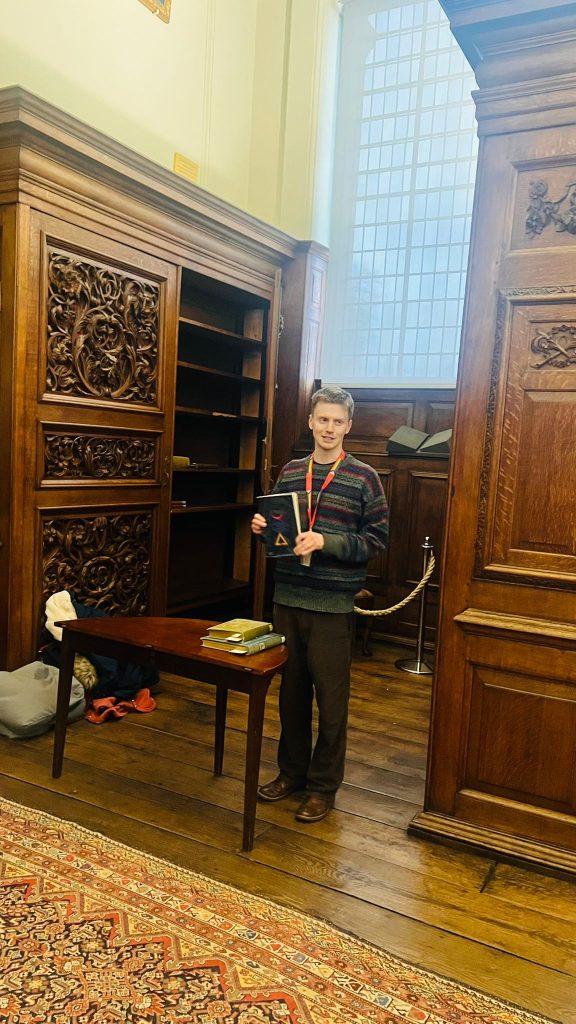
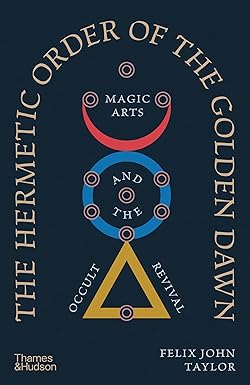
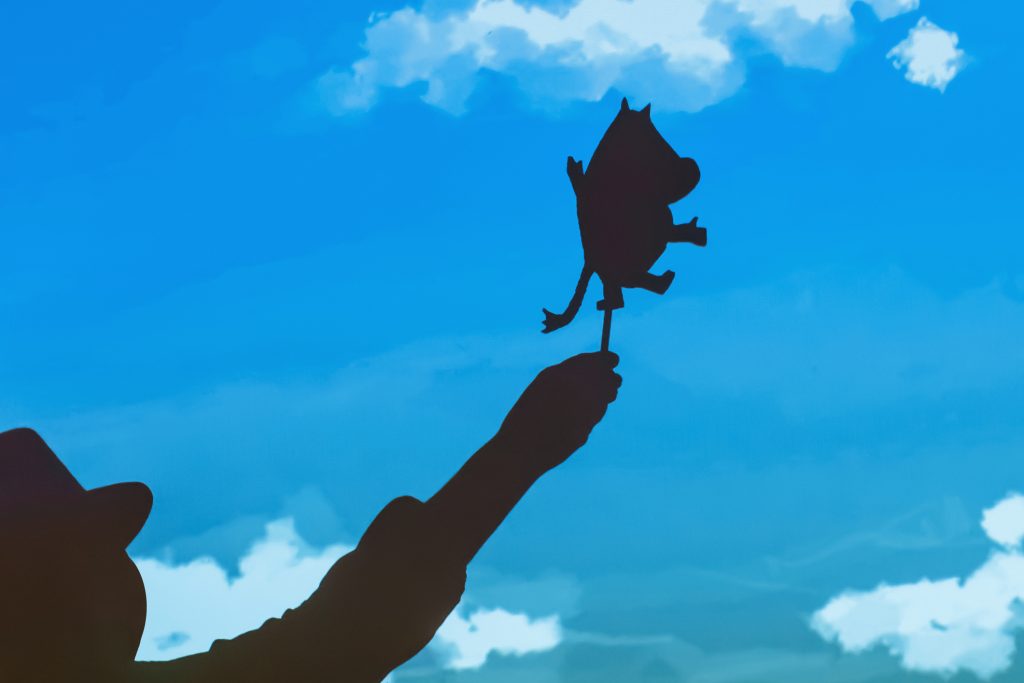

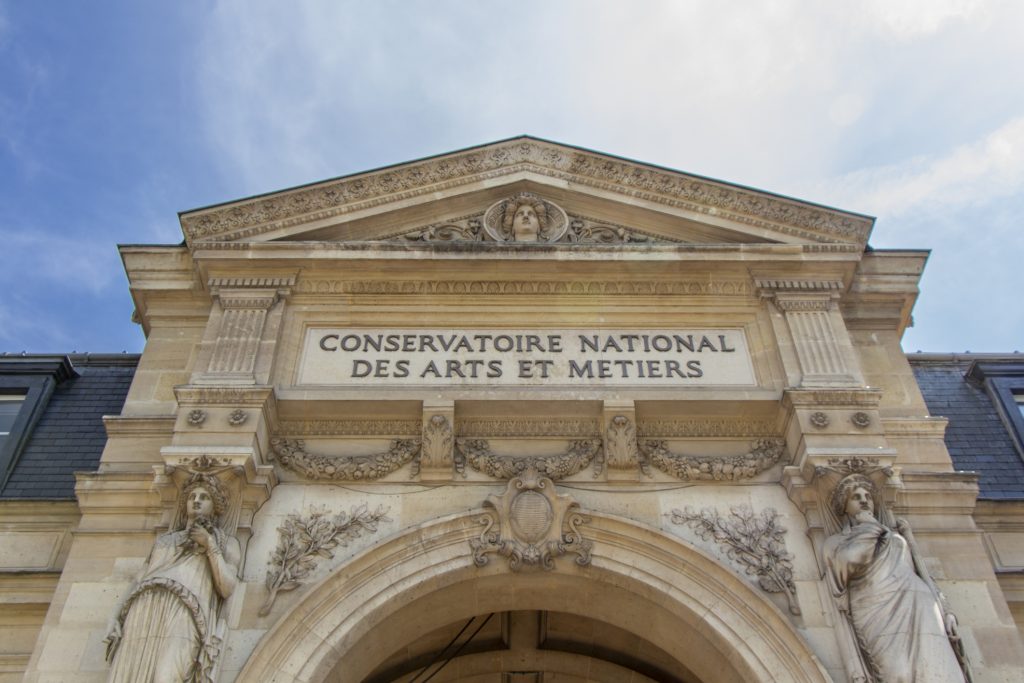

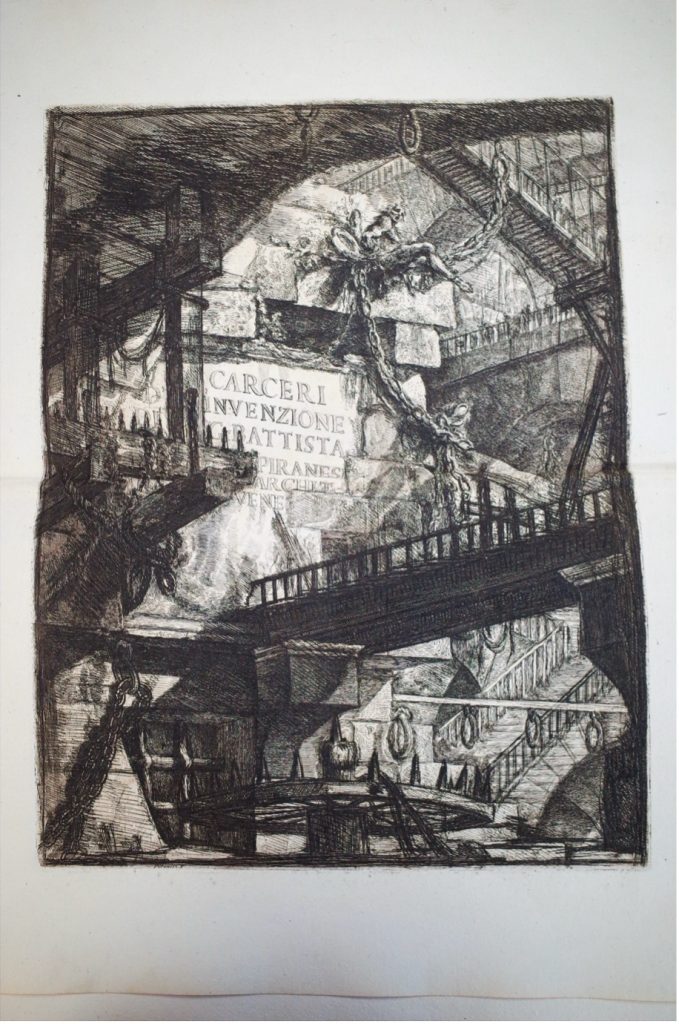
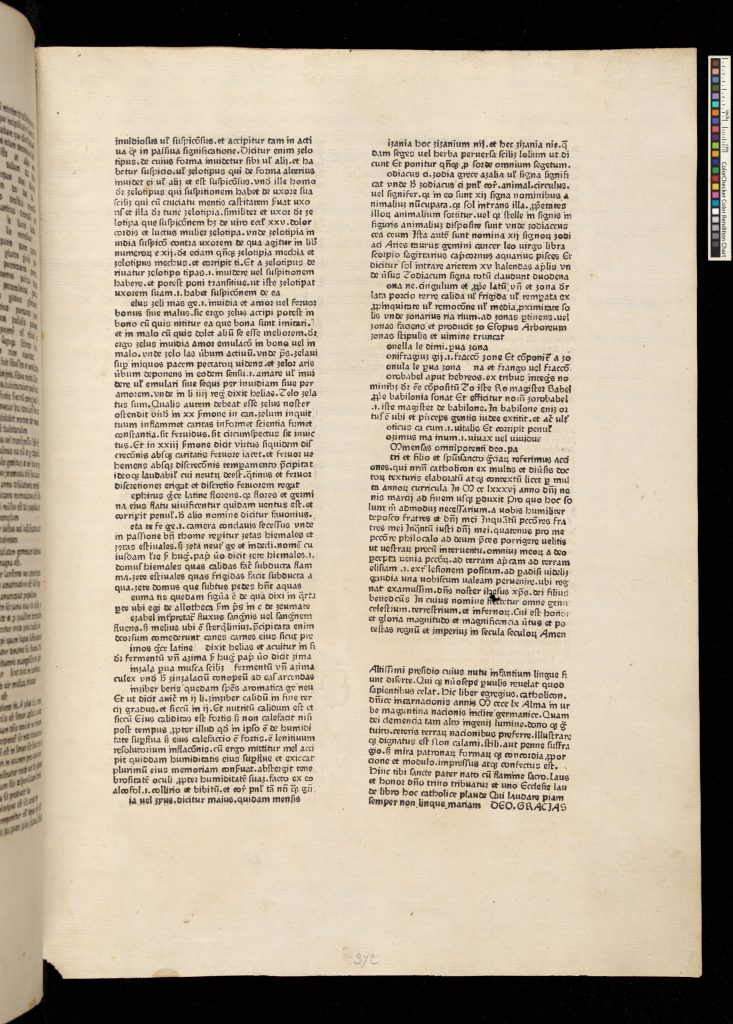
![A book page from 1613 with the title 'Double books to be exchanged according to [the] pleasure of...'](https://www.queens.ox.ac.uk/wp-content/uploads/2025/12/Double-Books-cropped.jpg)