Queen’s DPhil student Rafael Pérez Evans is presenting Brown Notes, a major solo exhibition at contemporary art gallery Mostyn in Llandudno, Wales.
Rafael, a Spanish-Welsh artist and DPhil student at Oxford’s Ruskin School of Art, works across sculpture, installation, and sound. Brown Notes develops from his DPhil project, Against Care, Towards a Crip Breakdown Materialism, and explores togetherness and defiance under the pressures of collapsing care.
The title borrows from the myth of the “brown note”: an infrasonic frequency said to cause involuntary loss of bodily control. In the exhibition, that low, unrelenting vibration gives form to state-induced fear, the acute strain of depending on systems that are overstretched and withdrawing support.
Rafael traces how pressure accumulates within communities at breaking point and how that pressure erupts as sculpture: glass is dumped across the gallery floor, stones are lifted and struck, filing towers rise and vines climb towards the skylight. Working from fractured forms of life, he approaches breakdown as both a lived condition and a potential site of liberation.
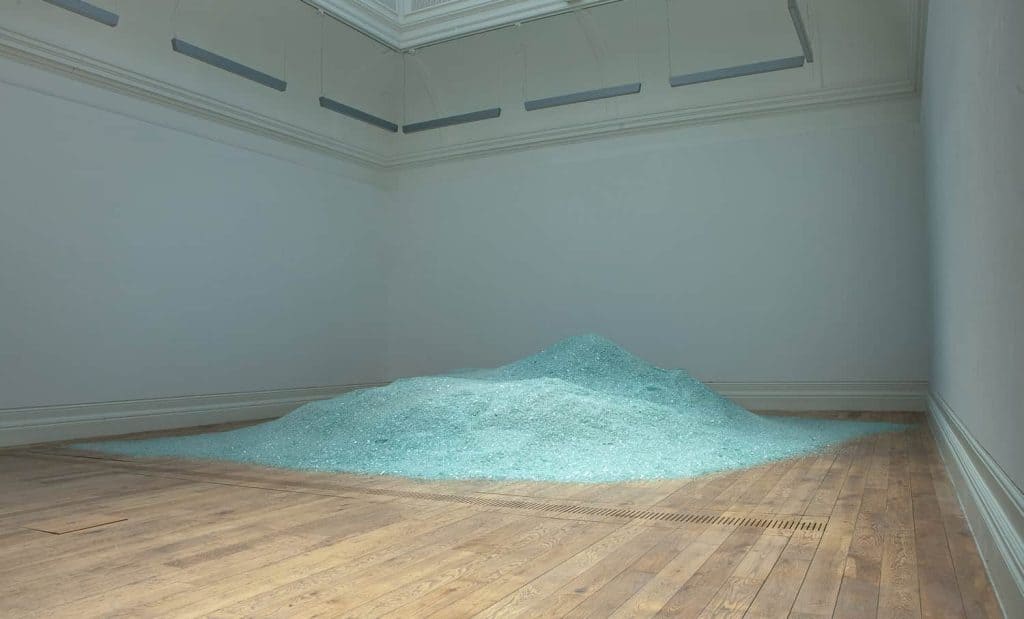
At the centre of the exhibition lies an imagined landscape of shattered glass, as if every window of every UK GP surgery smashed by patients in crisis had been gathered into a single space. The work takes as its point of departure a growing number of real incidents in which service users experiencing breakdown have broken the windows and doors of primary care buildings across the UK. Glass is a surface that lets you look in while keeping you out; its breaking becomes the exhibition’s founding image, sound and material. The pale-blue glass pile evokes an iceberg, a frozen, glacial landscape of institutional care already melting, a system broken before any window was.
At the centre of the exhibition lies an imagined landscape of shattered glass, as if every window of every UK GP surgery smashed by patients in crisis had been gathered into a single space.
These eruptions, Rafael suggests, are flashpoints of a much larger structural breakdown, in which minds and bodies are shattered by waiting for care that never arrives. The work asks which bodies are deemed useful by the state, and which are treated as surplus.
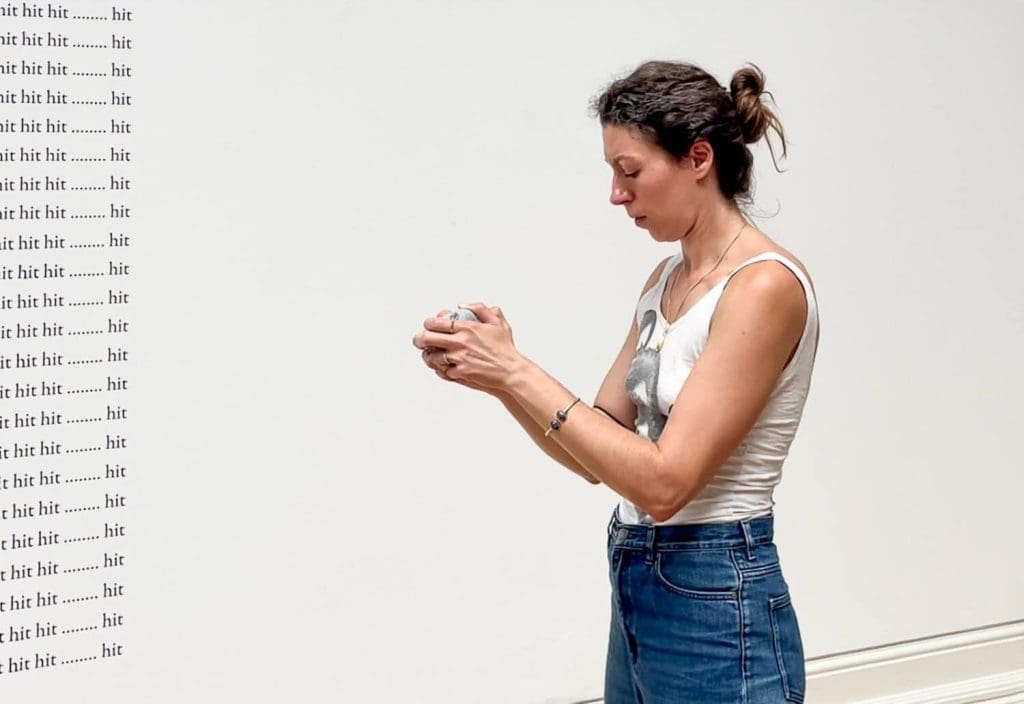
Waiting-room chairs sit beside the glass, stones resting on their seats and across the floor, ready to be picked up. Stand by Me plays quietly through a speaker, like the soft background music of a GP waiting room, while a chorus of struck stones can be heard from the adjoining gallery. Drawing on the work of the experimental socialist composer Cornelius Cardew, who turned away from the avant-garde to write open scores for non-specialist performers, visitors are invited to take up a simple score and hit stones together. Their sharp sounds join the phantom chorus circulating through the exhibition: a chorus forms for those still waiting, and for those who could not wait any longer. The song tries to shift from comfort to demand, making waiting audible, as a shared act of defiance.
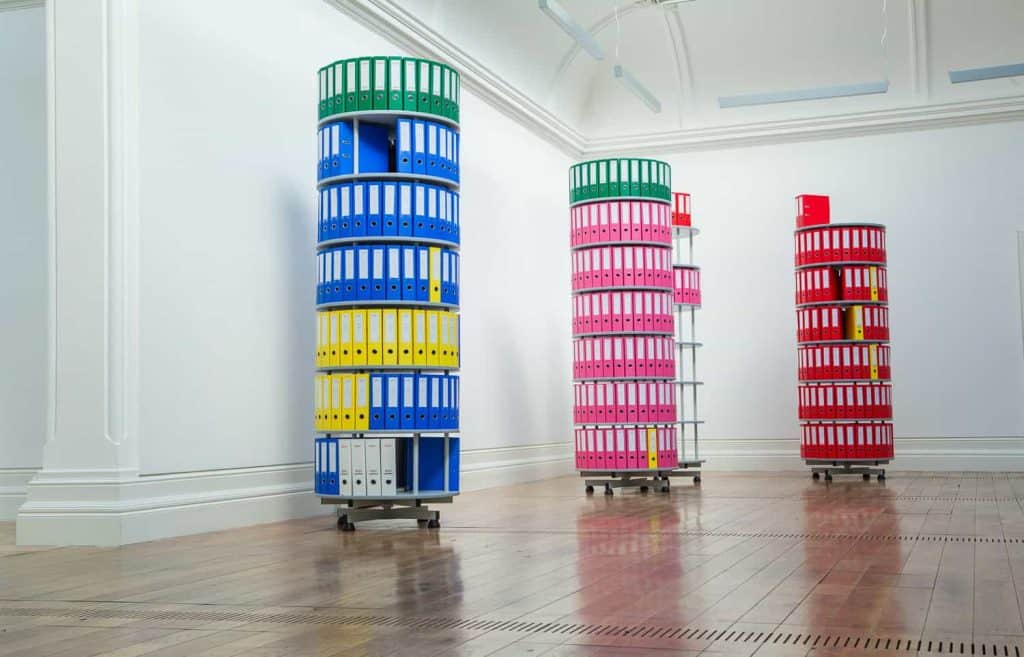
The exhibition also traces fugitive routes through and beyond failed care. Four towering coloured filing structures reconstruct the bureaucratic archive of Dignitas: blue files hold correspondence; yellow files record members removed from the register; red files hold records of resigned and deceased members; and pink, files document completed assisted deaths. Reconstructed from press photographs of the Swiss organisation’s offices, the archive is relocated, no longer held at a distance in Switzerland, but brought close to our bodies.
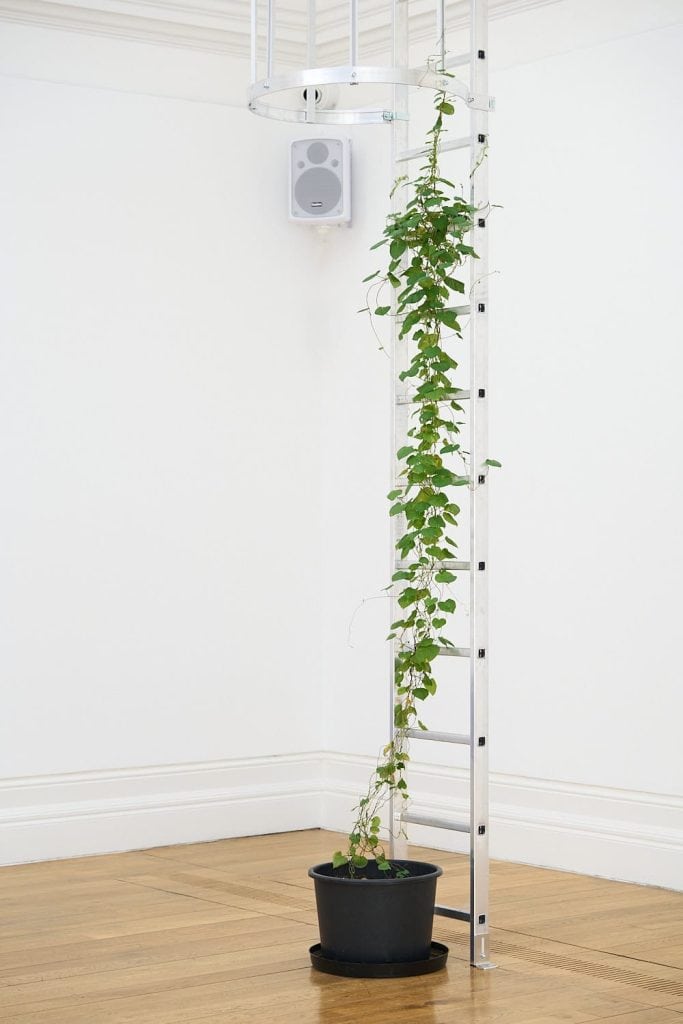
Nearby, two seven-metre emergency ladders enclosed by safety cages, of the kind fixed to institutional buildings, rise towards the gallery’s skylight: another escape route, this one towards the sun. Morning glory climbs their rungs a little further each day, reaching for the sun like a beanstalk from a children’s story. Each deep-purple flower opens and dies within a single day. This accelerated cycle evokes crip time: a bending of the imagined healthy lifespan, while the vines, holding onto whatever they can find as they climb, recall the delicate systems disabled and Mad people build in order to keep living.
Brown Notes refuses the promise of repair. To restore things to how they were would mean returning to a system that was already broken. Rafael asks instead what it might mean not to clean up: to stay with the mess, and to sing together from the ruins.
Rafael asks instead what it might mean not to clean up: to stay with the mess, and to sing together from the ruins.
Earlier this year, Rafael spoke to Queen’s about his wider research and Horizontals, his year-long exhibition at Wakehurst, Kew Gardens. In When rest takes shape, he discusses the connections between art, disability, burnout and rest, as well as how his time at Queen’s has shaped his work.
Brown Notes, curated by Kalliopi Tsipni-Kolaza, Curator of Visual Arts at MOSTYN, runs until 3 October 2026. The exhibition has attracted critical attention, including reviews in Frieze and FAD Magazine.
Header image: Glacier: Every Window of Every GP Surgery, 2026 Shattered window glass, 10 tonnes. 7.7 x 6 m by Rafael Pérez Evans.