Queen’s Germanists reflect on language, collaboration, and bringing Ingeborg Bachmann into English.
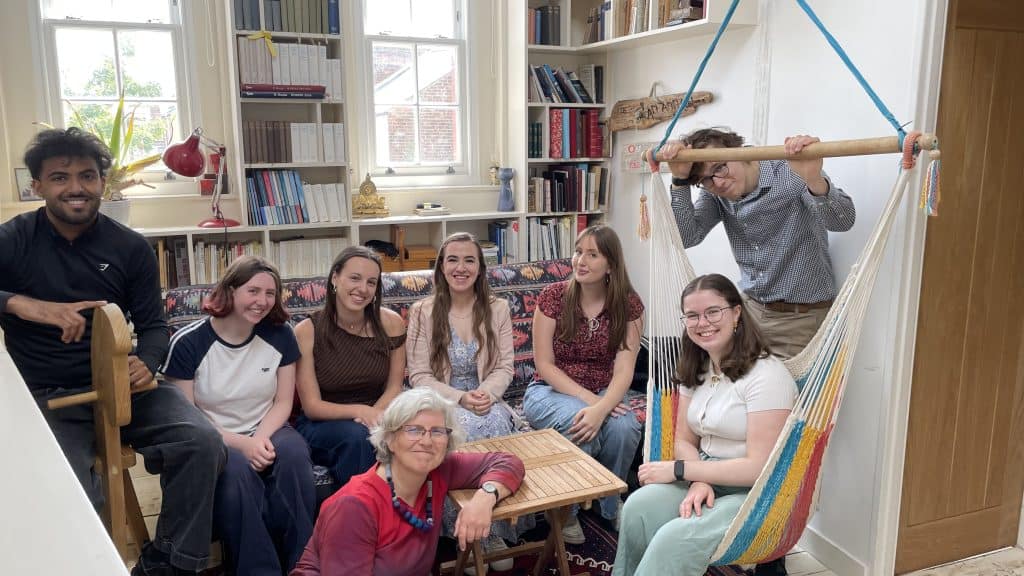
Four Queen’s students are among a group of Oxford Germanists whose translations of unfinished texts by the renowned Austrian writer Ingeborg Bachmann will shortly be published by Taylor Editions. Elizabeth Dallosso, Sam Edwards, Anna Standish, and Adesh Takhar, all second-year Germanists at Queen’s, have contributed to Fragmented: A New Translation of Selected Unfinished Todesarten Texts, a new volume bringing together translated fragments by renowned Austrian woman writer Ingeborg Bachmann. They worked alongside two students from Somerville College, with the volume edited by Dr Isabel Parkinson, Lecturer in German at Queen’s.
Bachmann is widely regarded as one of the most significant German-language writers of the twentieth century. Her Todesarten project, often translated as “Ways of Dying”, remained unfinished at the time of her death, leaving behind a body of fragmentary and complex prose. For the student translators, this incompleteness became central to the intellectual and creative task of the project.
Creative translation
The group described the work as “a welcome opportunity to explore and enjoy translation in a more creative and experimental manner”, following a first year in which their translation work had focused mainly on shorter pieces and exam preparation. Unlike the individual translation exercises more familiar from their course, this project required sustained collaboration and close debate.
The students said: “Our emphasis remained very centrally on collaboration throughout the whole process, ensuring every sentence had multiple voices and interpretations. This decision stemmed primarily from the nature of Bachmann’s writing. Unlike the texts from our first year, we were immediately struck by the complexity and ambiguity of the writing.”
That complexity often led to long discussions over individual words, sentence structures, and competing interpretations. The group found that the most challenging passages were frequently the most rewarding.
We learnt how to approach these conversations productively and it was often the most debated sections of the texts which produced the most satisfying resolutions for everyone involved.
The role of human translation
The project also prompted the students to think carefully about the role of human translation at a time when AI translation tools are increasingly common. The students were clear that no generative AI was used in producing the translation. Instead, they emphasised the value of first-hand linguistic judgement, and shared interpretation.
“In a world increasingly relying on AI translation as a quick, convenient, cheaper method of translation, projects such as this are essential in preserving the importance of first-hand translation,” they said.
Having only briefly encountered Bachmann’s writing before, the students found themselves engaging with her work primarily through the act of translation. This brought an unusually intense attention to word choice, rhythm, style, and structure.
Rather than trying to translate as quickly as possible with little external help, as we would for our usual exam practice translations, we exhausted the resources at hand because we all wanted the translation to be as good as it could be.
The value of collaboration
As well as translating the texts themselves, the students have written their own translators’ introduction for the volume, reflecting on their process, their collaborative approach, and the significance of having their work published while still undergraduates.
For the Queen’s students, the project has offered an opportunity to contribute to a published literary translation and to take part in a wider conversation about creativity, authorship, and the continuing importance of language study.
The students said: “Translating for the Taylorian Editions Writers in Residence series has broadened our perspective on the use and importance of translation as a still very much relevant and important skill. We have enjoyed the creative challenges and the opportunity to use our imagination to create something that we hope reflects the innovation of Bachmann’s writing.”
They added:
Knowing that this project will be published makes all the hard work we’ve put into this, hours spent debating individual words, staring at a screen trying to figure out what Bachmann meant, and reading around the text, incredibly worth it. We cannot wait to get a copy of the published work.
Editor’s comments on human translation in an age of AI
Editor Dr Parkinson noted that: “For every one word that has ended up in the final volume, at least twice the number of alternatives was discussed by the translators. In slowness, debate, friction, puzzlement, we found connection, humour, sometimes distaste, resonance. I hope that this thought process is visible in the finished work. I hope that it does not read like something flatly perfect generated in minutes by AI. I hope it has character, idiosyncrasies, that it invites conversation.”
In the era of AI translation and LLMs, this edition seeks to explore afresh how a human mind and voice are presented in text, how prose is constructed and translated by human minds, and what may be individual, creative, and distinct about work written and processed by humans.
The fragments and drafts of the Todesarten are extraordinarily wide-ranging, and the selection and order of texts here does not intend to represent a definitive interpretation, and certainly not to constitute an exhaustive collection of Bachmann’s thinking about, and experiments with, a mind in text. Instead, its purpose is to allow our own minds to enter into and participate in the text, as readers, thinkers, and translators – and, of course, to offer more Anglophone readers the chance to encounter Bachmann. It is a testament to the broad themes of her works, to her characteristic voice, and her absorbing narrative threads, that they can be slotted together in a new order and open up fresh resonances. As will be seen, part of the question which I and the other translators asked ourselves was what we discover about the original texts precisely by re-ordering and translating them, especially in translating different versions of the same text.
This is the heart of my own thinking on translation: what happens when we treat the process of translation – or, as in this bilingual edition, the process of comparative reading – as a distinct literary lens in itself? What do we learn about the author, about German, about English, about ourselves?
Fragmented: A New Translation of Selected Unfinished Todesarten Texts will be published by Taylor Editions as part of the Taylorian Editions Writers in Residence series.
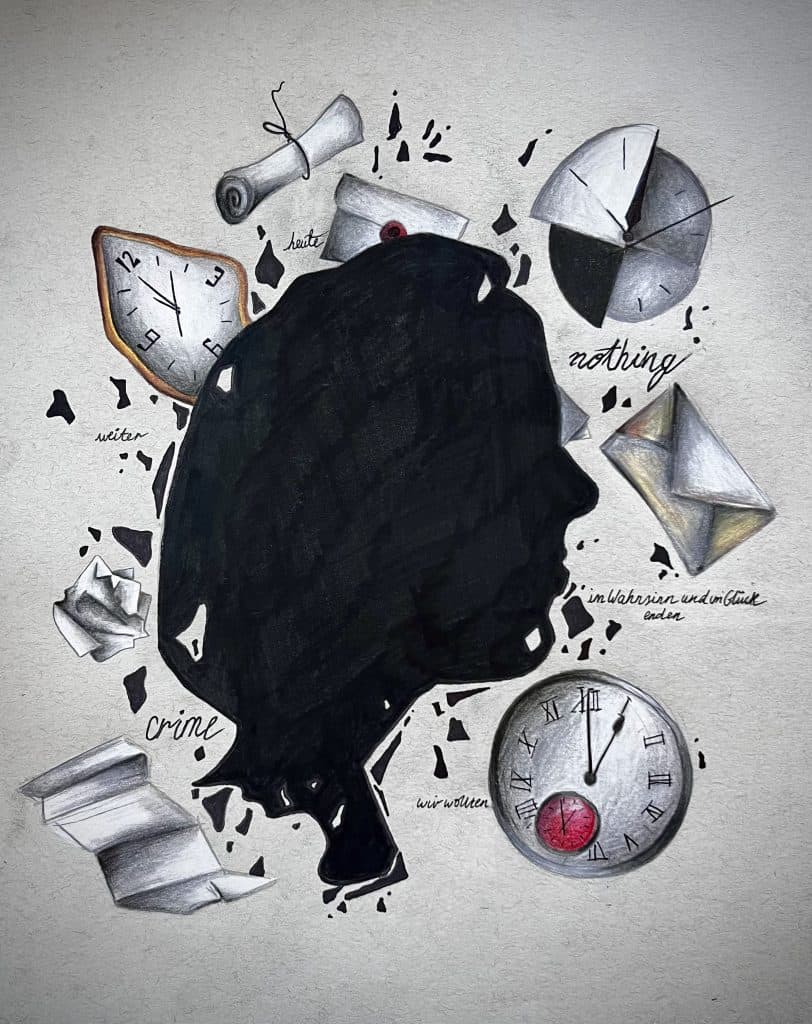
Header image: cover artwork for the book by Queen’s third-year student Emily Dicker.