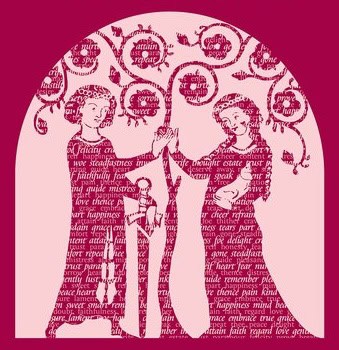
What if rhyme is not merely decorative, but a force that shapes what poetry can say?
Lecturer in English Dr Amanda Holton’s latest research turns a data-driven lens on centuries of English love poetry, drawing on a database of nearly 1,000 lyrics produced between 1300 and 1579.
Her work asks a deceptively simple question: what happens when rhyme does more than embellish a poem? In this interview, she explains how the limits of English rhyme could steer poets towards particular ideas, why “pain” became such a dominant rhyme-word, and what medieval lyrics might have in common with Large Language Models.
Your book is underpinned by a database of nearly one thousand love lyrics produced between 1300 and 1579. What led you to take a data-driven approach to poetry which is traditionally viewed as a more qualitative discipline?
I am interested in poetics, which aims primarily to provide objective description of texts rather than focusing mainly on their interpretation and contexts. A data-driven approach is a good way of furthering that aim. It means I can feel confident that the basis of the conclusions I reach are not impressionistic but are supported by evidence.
You argue, controversially, that rhyme doesn’t just decorate meaning but actively shapes it, limiting what can be expressed. Can you give an example of how a rhyme group changes what a poem is able to say?
Yes. Say a poem needs 10 rhymes for the word ‘pain’. There aren’t endless words available in the language which actually rhyme with ‘pain’, and some of those will be ruled out as unsuitable for the subject-matter. To find 10 rhymes, the poet is going to have to use quite a large proportion of this fairly small group of words.
This means, for example, that the poet is unlikely to avoid using at least one word connected with the idea of getting, whether this is ‘attain’, ‘obtain’, or ‘gain’. This inexorably leads the poem into the idea that pain is a currency, and that the lover’s pain has earned him the right to the lady – or at least to her attention. This is an idea which would not necessarily be so prevalent without the prompting of the rhyme.
You suggest that certain clusters of ideas become almost inevitable because of the limits of English rhyme. Does that mean poets have less creative freedom than we tend to assume and, if so, what do you think is the impact of this?
We tend to think people have ideas and selves which exist before and independently of language, and are subsequently expressed through language, rather than seeing language as a factor which actually shapes our selves, our ideas and our experiences. We don’t wield language with quite the level of autonomy we feel we do.
We don’t wield language with quite the level of autonomy we feel we do.
This is intensified when writing formal poetry because there are further constraints; not only is the writer negotiating with pre-existing words, structures and assumptions inherent in the language but also with factors such as rhyme, meter, stanza structure, each of which narrows the choices available. But I’m not sure it’s helpful to imagine this as a limitation on what would otherwise be complete creative freedom – and indeed in the Middle Ages we don’t see the same prizing of novelty and personal originality which became the norm later on.
It is perhaps more helpful to see poets working with their tools as part of a shared cultural experience and inheritance, the current inhabitors of a workshop which others have worked in before and will continue to work in in the future. (I show in the book that some of the rhyme-groups fundamental to my book persist strongly, with the Beatles, for example, using ‘heart: apart’ rhymes in a very similar way to earlier poets.)
Were there any patterns that surprised you when you started analysing the data?
I was surprised by the margin by which ‘pain’ was the commonest rhyme-word.
I was surprised by the margin by which ‘pain’ was the commonest rhyme-word.
Your work suggests that structure can generate meaning. Do you see any parallels with how Large Language Models operate and what might be the effect of these constraints in the way people express themselves today?
That is an interesting question. Yes, there is a parallel because LLMs predict text based on pre-existing models, and rhyming poems (especially those whose genre requires a particular register) also work with pre-existing linguistic and stylistic features. (There are set phrases as well as set rhyme groups which appear regularly across poems.)
There are differences, though. While it is true that many of the poems I discuss are entirely conventional and probably could have been constructed by an LLM, there are also many which handle the conventions with scepticism, humour or irony, confronting their inheritance and making it textured and visible. This is certainly in contrast to the blandness of the writing I have personally seen produced by LLMs.
After spending so much time analysing patterns, has it changed how you read, or enjoy, poetry?
Patterning has always been one of my main interests and sources of pleasure in poetry, but certainly a klaxon goes off now every time I see a pain, woe or heart rhyme group!