What if we could reverse the decline in MFL GCSE uptake by getting parents on board?
This was the driving question behind ‘Further with Languages: What is your languages story?’, our pilot event for Year 9 Germanists and their parents, in collaboration with the National Consortium for Languages Education and the Stephen Spender Trust. The event was held in January 2026 at Pate’s Grammar School in Cheltenham and was attended by pupils, parents, and teachers from Pate’s, Chosen Hill School, and Denmark Road High School.
Over an afternoon of interactive workshops, each building on participants’ own ‘languages stories’, our aim was to boost parental support for learning languages at GCSE and beyond. We shared reflections from a team of languages advocates, trained in literature and translation but also in law, physics, mathematics and more, and invited parents to reflect on these and their own experiences with languages. This blog post shares some of our reflections from the day alongside those of participating pupils and parents.
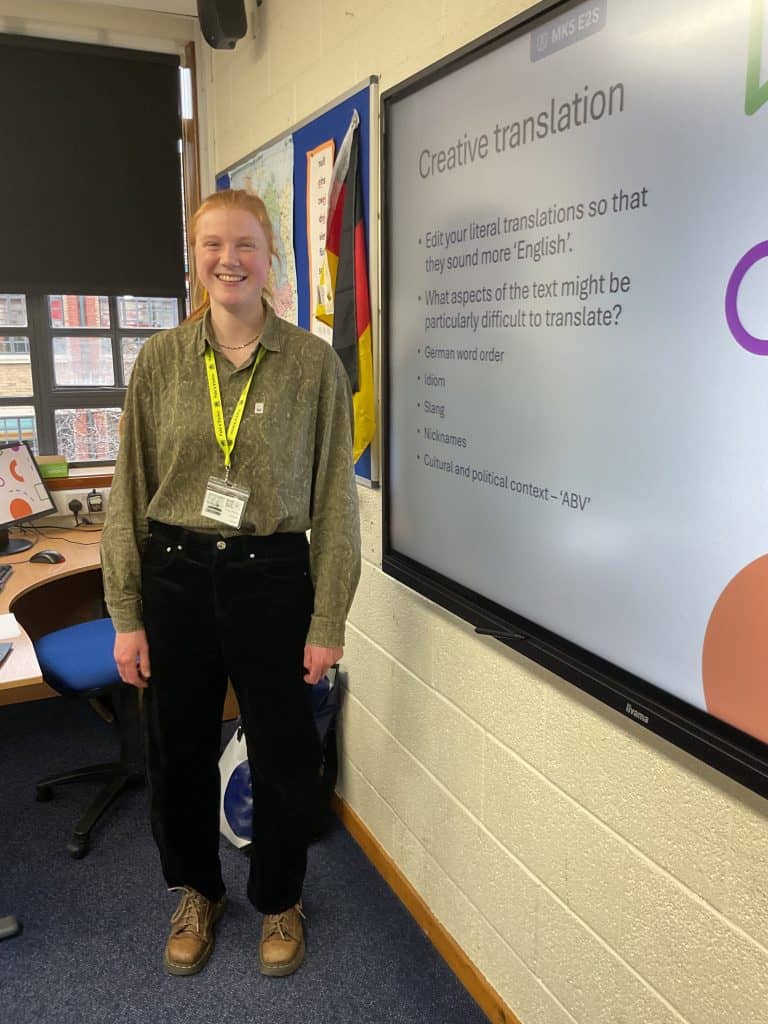
The afternoon began with two creative translation workshops in German for the Year 9s. One workshop, led by Dr Charlotte Ryland (QTE Director), focused on the poem ‘Willkommen und Abschied’ (1775) by Goethe and its contemporary use in advertising; the other workshop, led by Haley Flower (QTE Ambassador), focused on Leander Haußmann’s film Sonnenallee (1999). As with all our work on creative translation, these workshops followed the Decode – Translate – Create method: an accessible, scaffolded approach to translation developed by the Stephen Spender Trust. The workshops offered an insight into the creativity of language learning, as well as an opportunity to practise creative translation ahead of the 2026 launch of the Anthea Bell Prize for Young Translators.
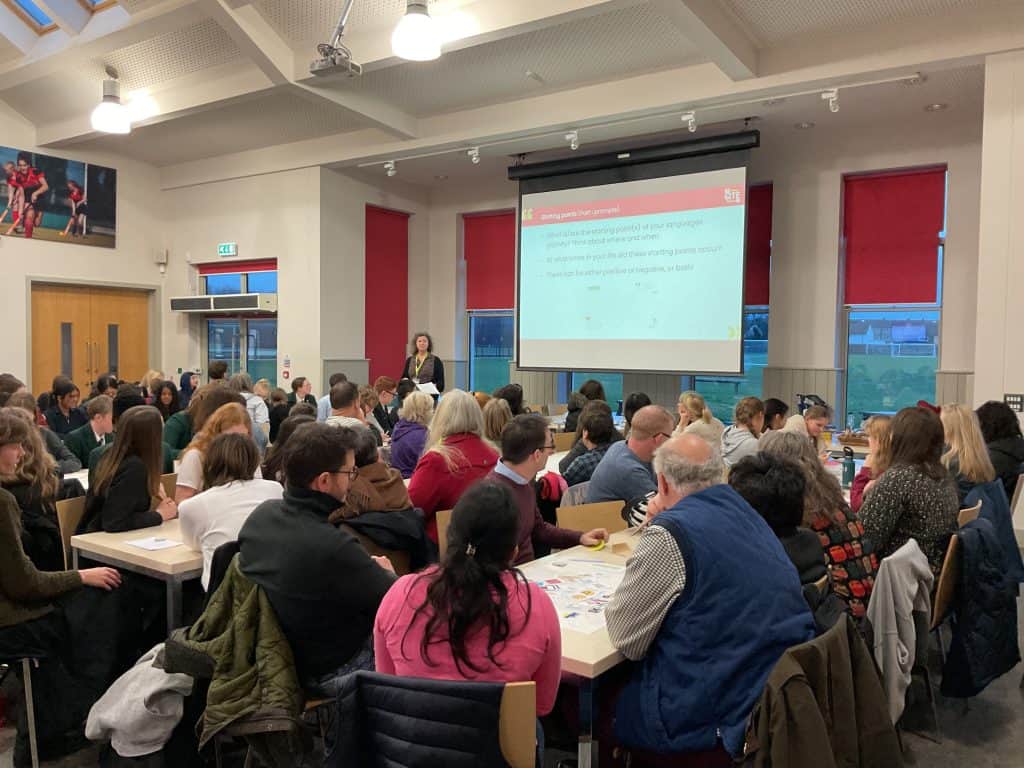
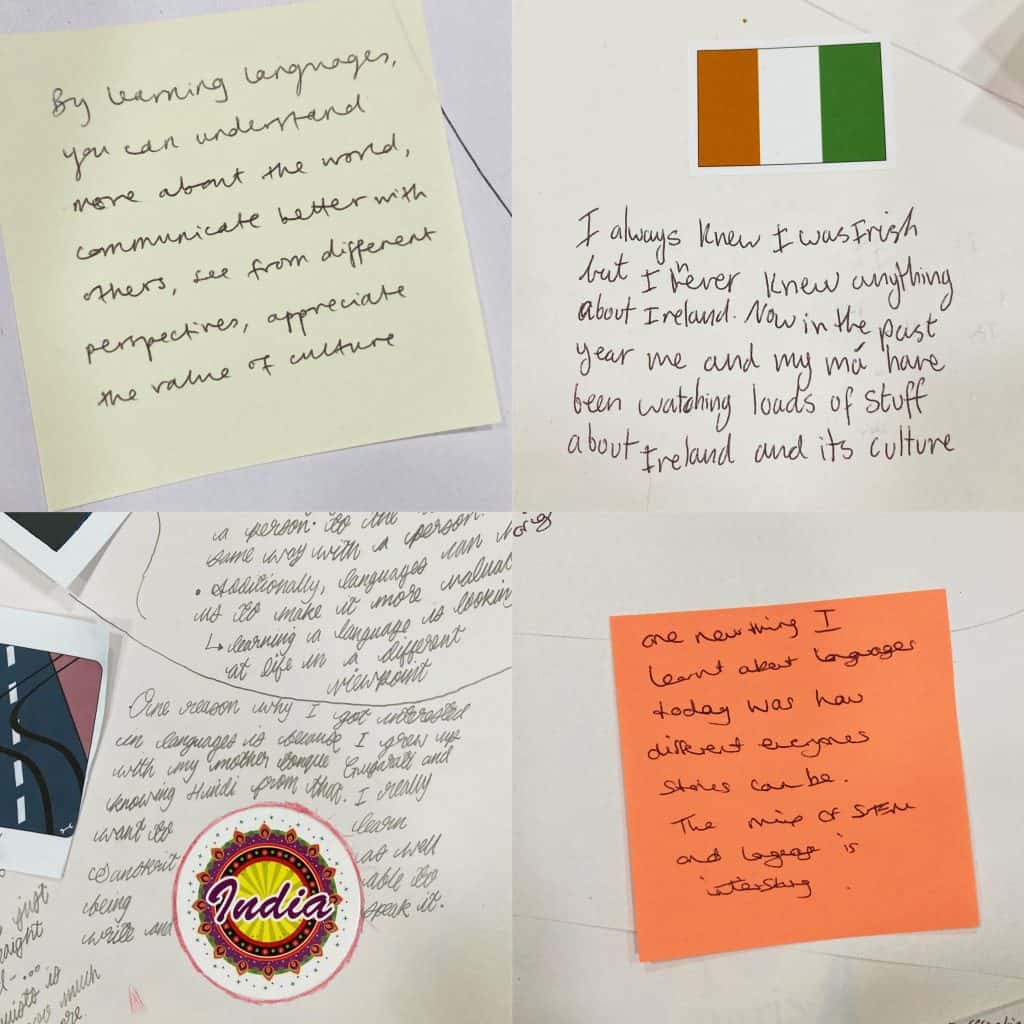
At the end of the school day, we were joined by several parents for an hour-long interactive session. In small groups, pupils and parents produced mind maps of their ‘languages stories’ through a series of reflections around three headings: ‘Starting points’, ‘Connections’, and ‘What it means to be a linguist’. The aim of this exercise was to show that everyone has a languages story while showcasing, in the words of one parent, ‘how different everyone’s stories can be’.
To begin, participants were asked to identify and describe the starting point(s) in their languages journey. Most often, these emerged in childhood through school trips, extra-curricular activities, pen pals, and holidays, but also included examples from business trips and the world of work. Many pupils and parents also highlighted their experiences with Home, Heritage and Community Languages, which included Arabic, Cantonese, Irish, Gujarati, Kurdish, Mandarin, Polish, and Telugu. Then, participants were invited to consider connections between language learning and other subjects, interests, careers, and more. Our aim was to encourage reflection on the connections that languages make possible, and on the importance – be it social, political, professional, or personal – of maintaining these connections.
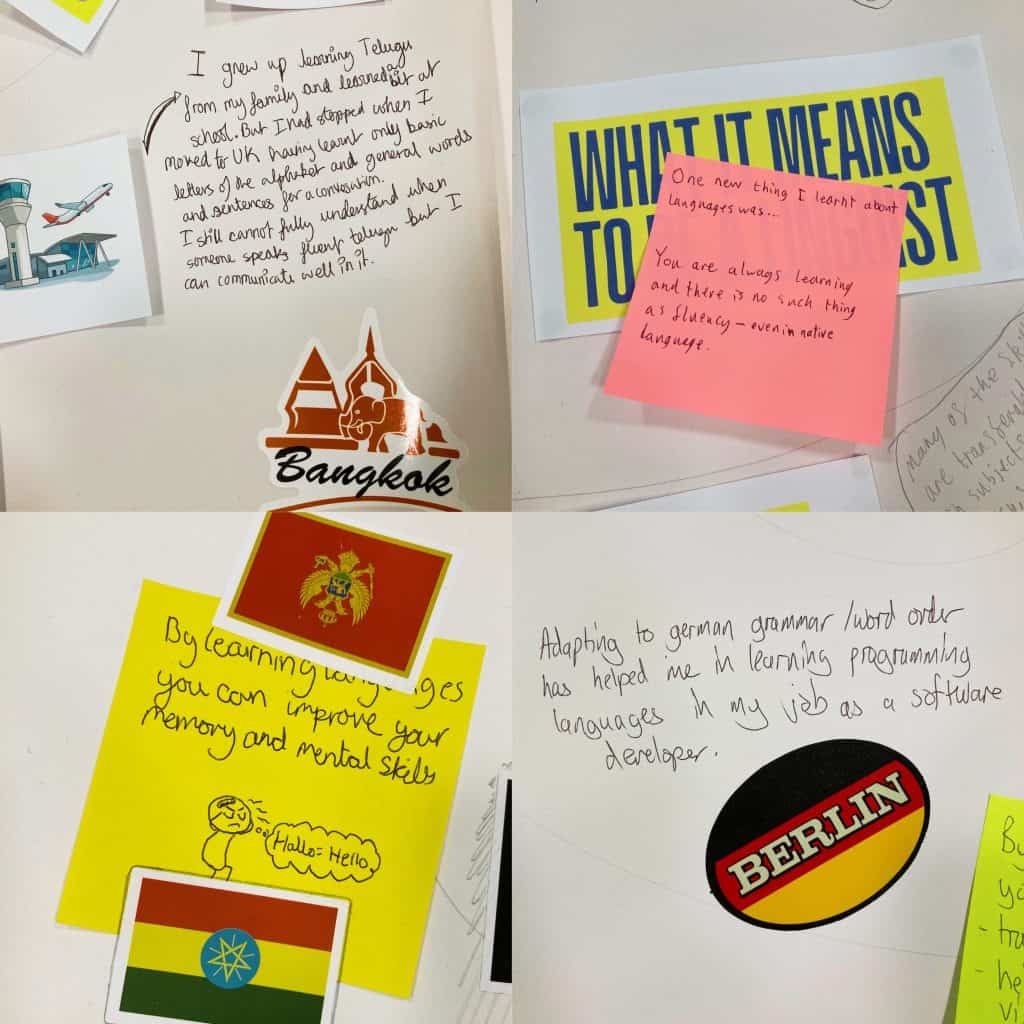
“Adapting to German grammar/word order has helped me in learning programming languages in my job as a software developer” – Parent
These discussions were followed by a speech about the value of language learning written by Kate Cooper, a partner at Freshfields Law Firm and a Queen’s alumna. Kate noted how her degree in English and French taught her ‘how to think differently—how to listen, how to interpret, how to sit with complexity, […] to read critically, to write with nuance, and to speak with confidence’. She concluded that linguists are ‘trained to see things from multiple angles, to decode meaning, and to communicate across boundaries. That’s not just useful—it’s essential.’
With Kate’s words in mind, participants reflected on the characteristics associated with being a linguist and the ways in which these map onto their own experiences. Pupils and parents brainstormed words like ‘curiosity’, ‘multi-tasking’, ‘open-minded’, ‘resilient’, ‘adaptable’ and ‘creative’. One parent wrote: ‘Perseverance. Being brave – trying out your language for the first time (and not being put off when the reply is in English)’, while another suggested: ‘By learning languages you can communicate with others, share stories, explore different cultures, understand each other, and develop your brain!’.
“One reason why I got interested in languages is because I grew up with my mother tongue Gujarati and knowing Hindi from that. I really want to learn Sanskrit as well” – Pupil
Drawing from these discussions, Emma Baxter, a DPhil student in the Faculty of Medieval and Modern Languages, gave a presentation on her experience of studying the relationship between literature, mathematics and culture. Emma explored the unique transferability and vast applicability of the skills, approaches, and ways of thinking that a person working between languages develops:
This combination of subjects often shocks people – but there is more in common between mathematics and language learning than we might first think. There is a simultaneous need for precision and creativity when studying both of these subjects.
Emma continues:
A language degree equips you with skills for other academic or professional fields, including STEM. During a languages degree, in which you study culture, literature, history, poetry, film and more, you learn how to ask meaningful questions about what you are learning and reading. You learn to think critically, and connect broader themes and ideas across different texts, mediums, time periods, and places. You learn to speak with confidence and to convey your ideas in writing, articulating yourself with both precision and flair. Those are all vital skills for a mathematician too, but those skills aren’t as thoroughly trained by a mathematics degree. And so even the study of mathematics, a field so seemingly disparate and disconnected from modern languages and literatures, can be transformed by the skills you develop through studying a language at school and beyond.
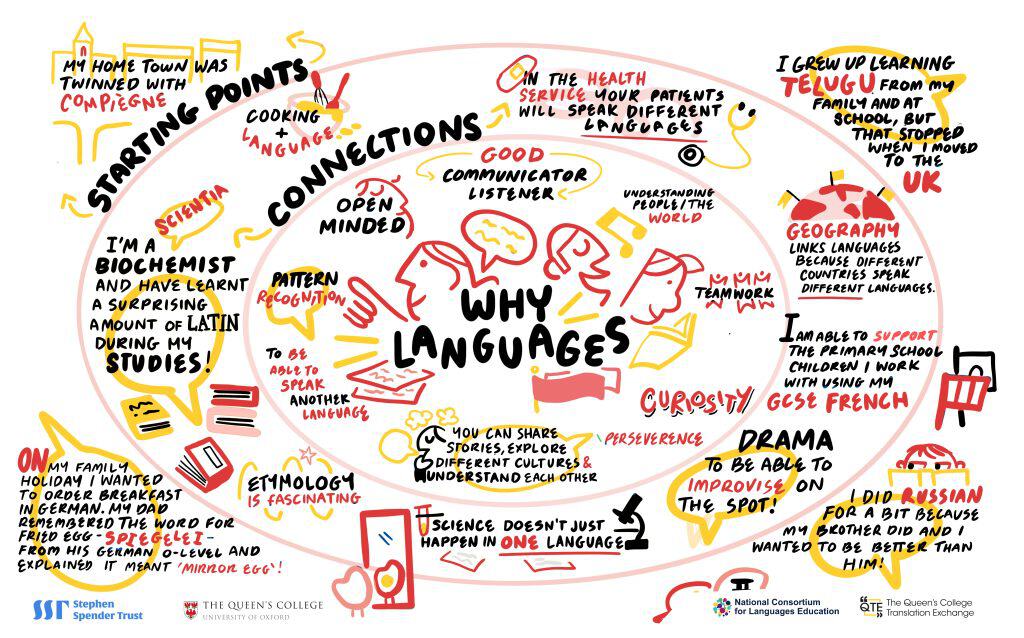
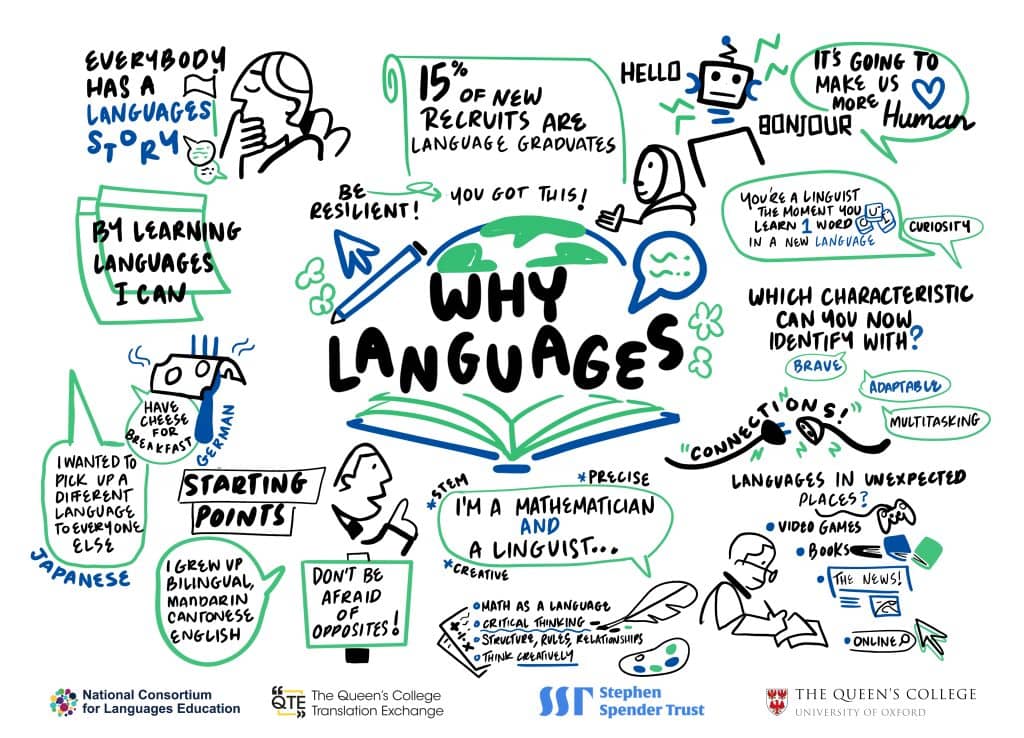
The event was live illustrated by Tom McLean, resulting in two ‘Why Languages?’ graphics that capture the day’s discussions. These graphics celebrate the breadth of languages stories shared over the course of the session – from twinned towns to bilingual beginnings, cross-disciplinary skills to intercultural experiences – making the many benefits of language learning more visible to a wider audience.
Moving forward, we plan to continue sharing ‘Why Languages?’ resources like this and running events that inspire pre-GCSE pupils and their parents to reflect on their languages stories together. Our aim is to spark authentic discussions both at school and at home around the benefits of language learning today, unveiling the worlds of possibilities (academic, professional, personal, creative, cultural) that knowing another language can open up. It is also our hope that these conversations will feed into future interactions between schools and parents – at parents’ evenings, options evenings, open evenings, and so on.
We would like to thank everyone who made this event happen, including the NCLE and SST as our partner organisations; our student ambassadors; Lorna Blacklock and the MFL teachers at the three partner schools; and the Year 9s and their parents who joined us for this event.