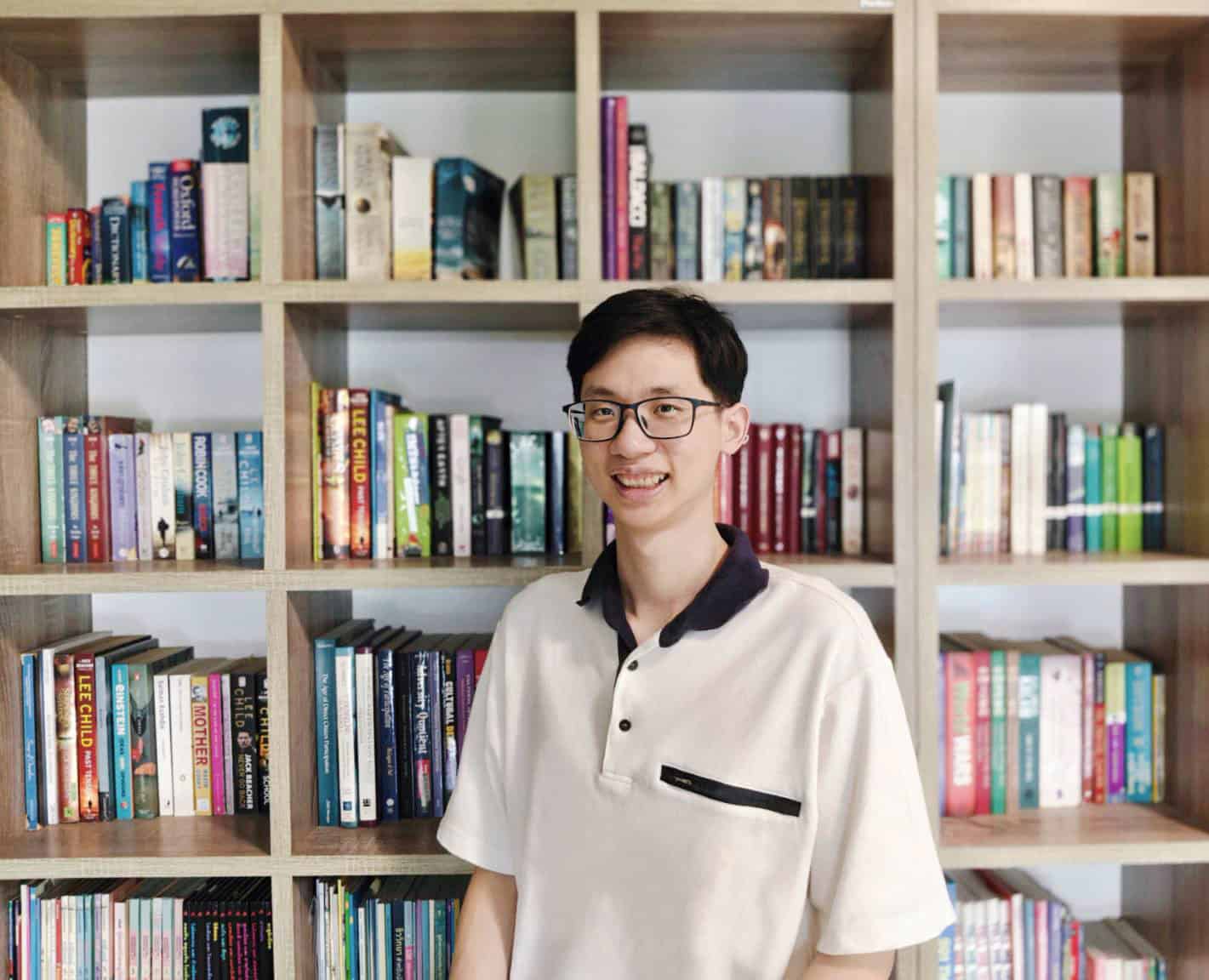
What does a Materials Science student do and where can it take you? For first-year Nikhil, the answer includes a summer internship in Tsukuba, Japan. We asked him about life in College and the subject that sits at the heart of some of today’s biggest technological challenges.
What drew you to Materials Science in the first place and why did you choose to study it at Oxford?
The sort of classic answer is that I liked both Physics and Chemistry, and didn’t want to let go of either, and I’m perhaps a bit disappointed to say it was basically the same for me! I had actually looked into some specific literature during the application process though, which confirmed that it was a topic that was really interesting but also really important for the modern age and I thought I’d prefer it over a pure science like Physics or Chemistry.
Looking back, what would you tell your 17-year-old self about choosing Queen’s?
Well, obviously that it was the right choice, but apart from that, just that I didn’t need to be too worried about whether I was going to find the right crowd or not. That was something that I was concerned about – if I’d find people in College that I’d get along well with but I’d say honestly it turned out better that I could’ve hoped for; I have an amazing community here and even the tutors are good chat and great to be around.
What does a typical day at Queen’s look like for you and which parts of it do you enjoy most?
One thing that I’ve started to notice only recently is how often you’ll bump into people you know. It’s virtually impossible not to recognise someone at your weekly shop at Tesco that you met a few weeks ago. It makes for some very nice (or awkward) moments! Another thing is just how everyone is really just a nerd at heart. I suppose that shouldn’t have surprised me but it’s always fascinating to hear about a little niche bit about everyone’s area of speciality.
If I’m feeling particularly productive, I’ll wake up in time for breakfast in College and then head over to the Materials Department for lectures through to lunchtime. I’ll either grab lunch on the way with a few course mates or in College, depending on when my lectures end before finding an appropriate library to do a reasonable amount of work in. If I have labs/choir stuff, I’ll head there immediately after, which will probably take me to dinnertime in either College or Sainsbury’s (if I’m feeling financially responsible, if not then Wasabi). Most of my nights usually end in some way or another in the Beer Cellar where I’ll lose magnificently in a game of pool, before spending a silly number of hours in someone’s room trying to convince myself that sleep is just a construct.
My favourite parts are actually not the things I’ve listed – it’s more the random side quests that I end up doing for no particular reason – like interrogating the entire library to find my charger or going on an impromptu tour of Oxford after finding my best mate. This isn’t very conducive to sticking to my schedule though…
What has the teaching experience been like, especially tutorials and practical work?
I’m a big fan of the tutorial system – doing a problem sheet in your own time and then going through it with just you, your tute partner, and your tutor is an incredibly effective way of learning. Especially when your tutor pushes the conclusions you’ve drawn and gets you to look at more difficult but interesting concepts adjacent to the content you learnt. I think that’s one of the great benefits of having an expert guide you through the learning process.
I’m a big fan of the tutorial system – doing a problem sheet in your own time and then going through it with just you, your tute partner, and your tutor is an incredibly effective way of learning.
Labs are one of those things where they’re a lot of work and not very fun when you do them, but you start to understand their importance after, especially when you’re formatting equations in accordance with Acta Materialia, my favourite bedtime scientific journal. They’re both good in different ways – one develops a theoretical understanding that comes out in labs when you get to see what you learnt in action. There’s a huge difference between studying phenomena and trying to replicate it. It’s very instructive, and Materials Science is very much an applied science so it’s very important.
You’ve secured an internship in Tsukuba this summer. Congratulations! How did that opportunity come about?
Thank you! It was a lot of emailing around to be honest. I wanted to try my hand sorting out some summer stuff early on. It turns out I did it at the perfect time and the timeline of booking flights, securing funding etc. was nice and relaxed. I think Materials Science is a niche enough subject where researchers are eager to encourage participation from students, which is why they were happy with me going over. I can speak some Japanese, so Japan was always on the cards for me in terms of future career prospects. They’ve got a great materials science discipline and solid research into nuclear fusion – the area that I’m currently interested in. In fact, I think they have the world’s largest operating fusion tokamak there right now.
What are you most excited about when it comes to living and working in Japan?
Definitely the travelling. And the food. Japanese food is my favourite and I hope I can take a lot of pictures out and about in my free time (if I get any!).
For someone considering Materials Science but not quite sure what it involves, how would you explain its significance in the world?
Great question. Materials Science is all about optimising the current materials we use through research and prediction of material properties. It’s fairly involved with your main scientific disciplines but demands knowledge from outside those as well. The key thing is that, now, most of the fundamental problems we have with new technological advancements are materials problems; we have the fundamental physics more or less sorted out (e.g. nuclear fusion, quantum computing), but our theories of materials are not developed enough to give us materials that fit the requirements for these technologies. I believe we’re going to see more breakthroughs in fundamental Materials Science before we see things like quantum computers. Hopefully soon though! Apart from the more illustrious applications, Materials Science is needed to a certain degree wherever materials are used…So pretty much everywhere!
Can you recommend a book?
The Material World by Rodney Cotterill is an amazing introduction to my subject. It literally takes you from the cosmos and atoms, really fundamental physics, to neuroscience and the idea of consciousness, and literally everything in between from the perspective of a materials scientist.