Jessica Rainey is an associate translator with the Stephen Spender Trust and an associate lecturer at Newcastle University. She is currently completing an AHRC-funded PhD examining creative translation in the classroom as a tool for engagement with language.
Using authentic texts is a foundational element of the creative translation model. These texts – originating from the second language culture for a real audience – provide the inspiration and content for each stage of the creative translation process: from introducing the themes and producing the literal translation, to sparking the possibilities for a creative version.
Authentic texts are celebrated by language acquisition researchers as rich resources for cultural awareness and for developing intercultural communicative competence (Gilmore 2007). Motivational theories about the perceived utility of a task beyond the classroom (Svalberg 2018) connect with the use of authentic texts in translation activities; here the real-world role of the translator frames the approach (Barnes 2021). Literary translation within the classroom has been shown to mobilise linguistic and metalinguistic skills (Beauvais & Ryland 2021).
But it is not just researchers who value these resources. Many students highlight the source materials as a core attraction of creative translation workshops. In an analysis of secondary data carried out for my doctoral research, authentic materials emerged as a top response to ‘The best bit was…’. Teachers also identified them as a ‘main benefit’, with one teacher noting “the wealth of authentic material that is available as brilliant teaching resources” (Stephen Spender Trust 2022).
Yet authentic texts are sometimes maligned by teachers for not neatly aligning with learning levels (Smith 2017), for being complex and therefore demoralising for learners (Bryfonski & Mackey 2023), for being time-consuming to source: “As a full-time teacher, it is difficult to find the time to source this material” (Stephen Spender Trust 2022). To support educators, resource packs have been created by both the Stephen Spender Trust and the Translation Exchange ranging from selected extracts with sample glossaries to full lesson plans.
For those wishing to source their own materials, however, perhaps to match them more closely to their schemes of work or tap in to their own inspiring interests and passions, what follows are some tips on what to look out for within a text – with examples of successful texts either from workshops or competitions, where to search for them and which text types work well for which particular purpose. Because different texts produce different results in the classroom and enable different facets of the creative translation process to be prioritised.
Tips for selecting authentic texts
Good materials for creative translation tasks contain some kind of challenge: a cultural reference, a stylistic device, humour, dialect, slang… These challenges generate reflection, discussion and are particularly important for sparking creativity. These are the elements where there are various possible solutions and a student must make choices, decide an approach, navigate a path between two (or more) cultures. But they don’t have to be all challenge. Having some sections of text that translate more readily, albeit with tweaks for naturalness, enable the students to notice grammatical and lexical differences. These sections enable the metalinguistic awareness that comes from contrastive analysis.
One of the key difficulties with sourcing materials is finding the above within a relatively short section of text (the maximum wordcount for an Anthea Bell Prize text is 200 words; for workshops, it might be 70-80 words per group; for a single lesson, perhaps only 25-35 words). The shortness of the text can be mitigated, however, by taking a whole-class approach. In fact, this can become an advantage. If individuals or small groups are translating a single section of a longer text, there is stronger motivation not only to complete the task for the team but to share the results, generating a strong sense of collective achievement.
Regarding complexity and language level, one of the great advantages of the creative translation model is its inclusivity and adaptability, via the glossary, to all learner identities and abilities. For beginner levels, all terms might be included in the glossary in the form featured in the text; for more advanced levels, fewer terms or translation options might be included, and only in the dictionary form. This means the same text can be used across multiple year groups, reducing the number of texts needing to be sourced.
Short Forms – Song, Poetry, Picture Books
The advantage of these short forms is that they are self-contained, often feasible in a single lesson and excellent for comparing translation solutions or sharing as a combined effort.
Contemporary songs are a great way of capturing attention, particularly if the accompanying video is also engaging. Songs often force creativity in rhythm and rhyme, and the availability of online fan translations can provide a useful comparative tool.
Poems with a clear form or stylistic device work well for sparking creativity since they provide a structure in which to unleash linguistic inventiveness. Poetry is also a good option for exploring literary choices through the prism of individual biographies or historical context.
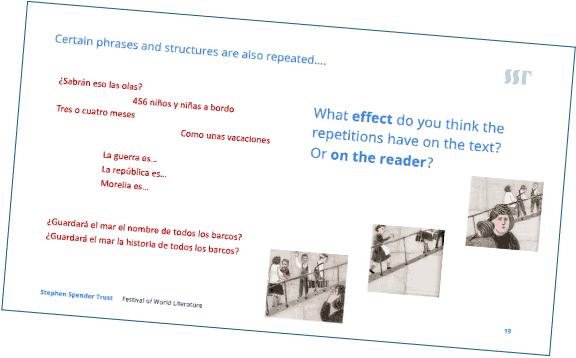
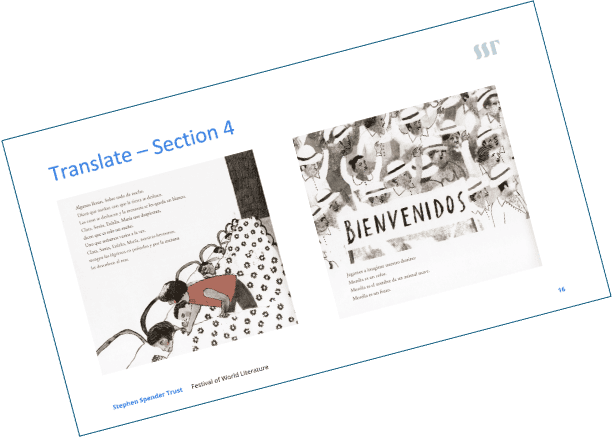
Picture books offer a visual route into a text, while the simpler narratives can help to focus attention on linguistic features. Stories rooted in historic events or regional customs can also provide a hook and means to open up cross-cultural discussions.
Examples:
- Santé – Stromae
- Escrito con L – Gonzalo Rojas; Los piratas – Rubén Darío
- Mexique: el nombre del barco – María José Ferrada & Ana Penyas
Long Forms – Scripts, Novels, Graphic Novels
The advantage of longer forms is the potential to align with learning objectives, with more abundant samples of vocabulary and syntax, as well as to expand into termly, cross-curricular or extra-curricular projects.
Scripts, like song, are good for engagement through the combined appeal of popular culture plus visual or stage elements. TV and film clips can hone listening and read-aloud skills, while translating dialogue is particularly good for discussions around naturalness.
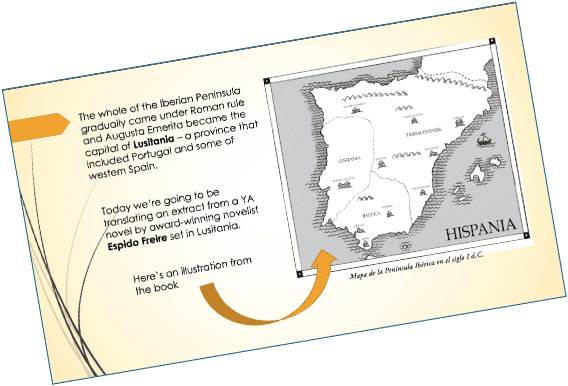
Novels are excellent for comparative analysis and language awareness since they are more likely to contain standard written language. They also offer variety: description, dialogue, poetic language; cultural, historical, geographical references…
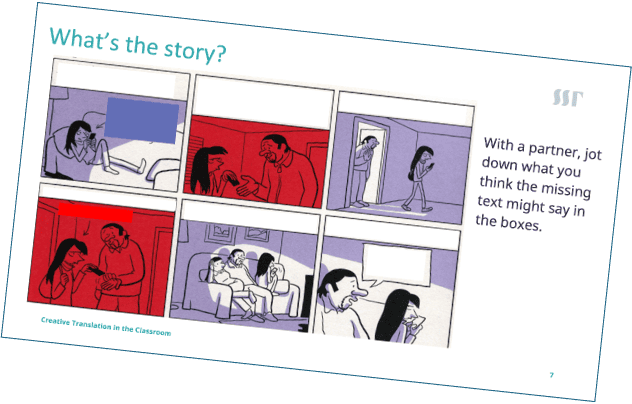
Graphic novels provide an immediate challenge with the need to align text with visual references while adhering to space restrictions. They are therefore excellent for cultural awareness and justification of translation choices. There is also fun to be had translating onomatopoeia.
Examples:
- El ladrón de palabras – Antonio de la Fuente Arjona
- El chico de la flecha – Espido Freire
- Les cahiers d’Esther – Riad Sattouf
Where to find them?
For literature, publisher catalogues can be a good place to start for overviews and intended age ranges. Specific webpages for a publication often feature samples of the first few pages. National libraries or organisations promoting literacy in a particular language can also offer good leads.
For audiovisual materials, the algorithmic search results of streaming platforms can be useful, as well as reaching out to friends or forums for recommendations. Trailers are often good self-contained sources, and the hive mind can help by highlighting particular clips.
Note: please check copyright restrictions; these often allow limited use for educational purposes but may vary across languages and cultures.
References
Barnes, K. (2021) ‘Translation in the UK language classroom: Current practices and a potentially dynamic future’, Translation and Translanguaging in Multilingual Contexts, 7(1), pp. 41-64.
Beauvais, C. & Ryland, C. (2021) ‘‘We actually created a good mood!’: metalinguistic and literary engagement through collaborative translation in the secondary classroom’, Language, Culture and Curriculum, 34(3), pp. 288-306.
Bryfonski, L. & Mackey, A. (2023) ‘Menus and maps: How can I make my classroom more authentic in terms of materials and practices?’, The Art and Science of Language Teaching. Cambridge: Cambridge University Press, pp. 266–282.
Gilmore, A. (2007) ‘Authentic materials and authenticity in foreign language learning’, Language Teaching, 40(2), pp. 97–118.
Smith, S. (2017) ‘The problem with authentic resources’, Language Teacher Toolkit: Steve Smith’s Blog. Available at: https://frenchteachernet.blogspot.com/2017/11/the-problem-with-authentic-resources.html (Accessed: 12 August 2026).
Stephen Spender Trust. (2022) ‘Creative Translation in the Classroom Dataset’. Excel. Availability: Restricted – organisational access only. (Accessed: 12 August 2026.).
Svalberg, A. M.-L. (2018) ‘Researching language engagement; current trends and future directions’, Language Awareness, 27(1-2), pp. 21–39.
This blog post was commissioned by the Queen’s Translation Exchange in Summer 2026 as part of a research series titled ‘Creative Translation and Modern Languages Today‘. For more information, visit our Advocacy and Research page.