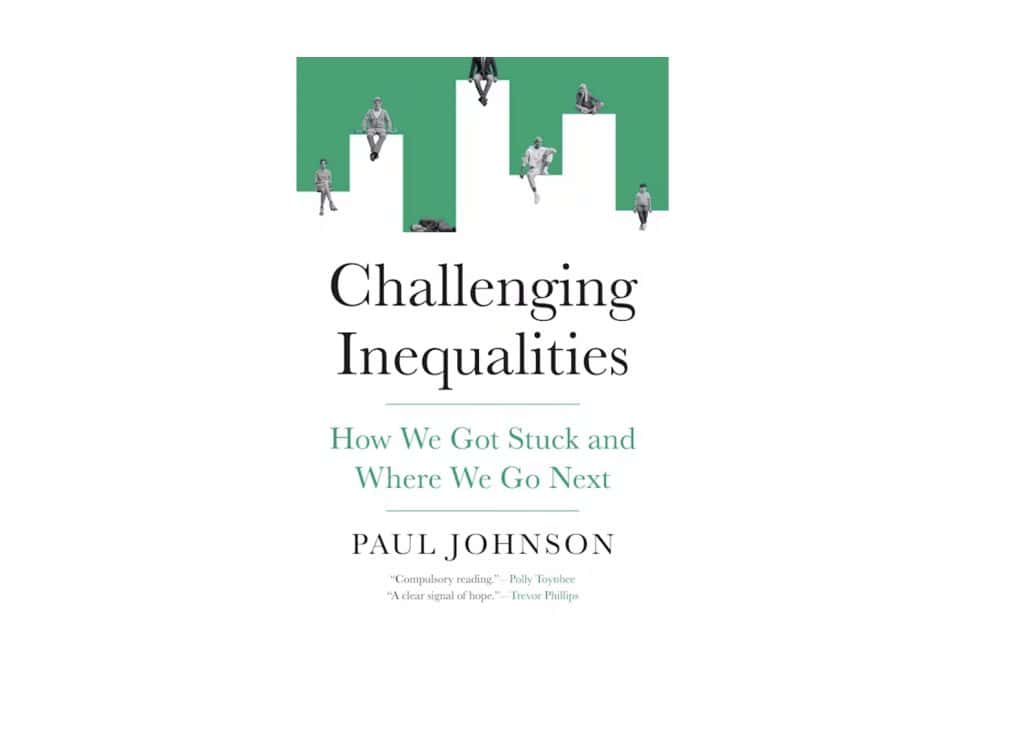
The College is pleased to share details of a new book, Challenging Inequalities, written by the Provost, Paul Johnson, and others. The book brings together leading economists and social scientists who take a rigorous and evidence-based approach to examining one of the defining issues of our time.
In this interview, the Provost reflects on the book’s central arguments, exploring how inequalities in income, health, wealth, and political influence have evolved and what meaningful action to address them might look like.
In the book, you argue that progress for equality has stalled across much of the developed world. What does “stalled progress” look like in everyday life?
It means incomes not increasing over time in the way that they have done for many decades. In the UK average earnings have barely risen in the last 20 years – the worst period for probably two centuries. As a result, the average worker is thousands of pounds a year worse off than they might reasonably have expected. At the same time income inequality has not changed much from the high levels it had reached, prior to the financial crisis. People perhaps don’t mind high levels of inequality if they are getting better off. It does not look so good when progress has stalled.
Reviewers describe the book as “uncomfortable” and even “alarming.” What’s the most uncomfortable truth about inequality in Britain today?
For me, the most uncomfortable thing is that social mobility appears to have declined. Inheritances are becoming much more important, and so people’s chances in life are becoming more dependent on their parents’ socioeconomic position rather than their own abilities and hard work. That feels to me like the opposite of progress.
When people talk about inequality, they usually mean income. You broaden that definition to include health, education, and political power: why does that matter?
And indeed wealth, which has become much more important relative to income in recent decades. It is important that we consider things other than income when thinking both about welfare and about inequality. Perhaps the worst outcomes of economic inequality arrive in the form of very different levels of health and life expectancy – there are dramatic and growing inequalities in these, and the evidence is that they reflect all the other inequalities that we experience. Political inequality, both in the sense of some people feeling alienated from the political process – those with lower levels of education, for example, are much less likely to vote at all – and in terms of political polarisation, also feels like a fundamental problem for society.
We often hear about “equality of opportunity.” You argue that’s not achievable under current conditions: why not?
When income and wealth are very unequal to start with it is very hard to ensure any kind of equality of opportunity. Of course, the education system can and does help, and governments can support poorer families, but the evidence across time and across countries is clear: the more unequal a society to start with, the lower is equality of opportunity. Better off families will, quite rightly, do the best for their children and they have more opportunity to do so than those with fewer resources.
Does economic growth need to come first before inequality can be reduced or can the two be tackled together?
Good question. I do think growth is necessary. Otherwise, we are in a zero-sum game – one person’s gain is another person’s loss. And we are not going to tackle social mobility, intergenerational inequality, or wealth inequality unless we return to economic growth. That said we can’t impose policies which may help with growth – think mass immigration, globalisation etc. – without taking account of their effects on inequality. So the two go hand-in-hand.
You suggest wealth is becoming more important than income. Are we moving towards a society where inheritance matters more than effort?
I don’t know about it mattering more than effort, but inheritance is definitely becoming more important over time. Average inheritance, as a fraction of lifetime resources, will be about double for people born in the 1980s than for those born in the 1960s. And, of course, inheritances are extremely unequally distributed.
Do younger generations have a legitimate reason to feel the system is stacked against them?
Absolutely. They are suffering from stagnant earnings, very high housing costs, less generous pension coverage, higher taxes and, for graduates, student loans. We have failed to put in place policies on housing, for example, that would clearly help in large part because older generations don’t want more development near them. More generally our politicians have been much too feeble to enact policies that will help us all, but younger generations especially.
Are governments failing because they lack solutions, or because the political incentives work against long-term change?
I think a lot of it is a combination of obvious policy mistakes – in the context of the economy I would put Brexit in that bucket – and failure to enact policies that would make a difference. Tax reform, planning reform, house building, regional policy etc.. These are all politically difficult and take a long time to bear fruit, much longer than a single parliament. We know some of what we need to do, but we don’t do it.
How much of today’s political polarisation do you think is rooted in economic inequality?
That’s a hard one. A lot of the polarisation is almost counterintuitive from an economic point of view. Labour’s support base is now quite different from a generation or two ago. Some of the divides are driven by more “cultural” issues. What I would say is that poor growth and high inequality are likely to create an unhappy electorate more willing to take a punt on newer more populist parties of both left and right.
The book is described as both analytical and solution-focused. What are the most realistic interventions governments could implement now?
BUILD MORE HOUSES.
What’s a widely accepted solution to inequality that you think is ineffective or misguided?
People are talking more and more about things like rent controls and price subsidies. These are definitely both ineffective and misguided. We know from evidence both in this country and across the world that rent controls just reduce the amount of rental accommodation available. Price controls lead to rationing by other means. There is also, understandably, a lot of discussion about wealth taxes. I would say first that we should try to make the wealth taxes we have work properly – inheritance tax, capital gains tax, council tax all need to be reformed to tax wealth much more effectively. We could levy a tax on those with very high levels of wealth, but we shouldn’t believe it will either raise a huge amount of money or dramatically reduce wealth inequality. Levy it at too high a rate and wealth will disappear abroad.
Who actually has the power to change things: governments, institutions like universities, or individuals?
We all have a role to play. In part in how we hold governments to account, but also in how we treat and engage with other people. I am a meritocrat, but that must not mean looking down in any way on people who have not succeeded in education or in our economic system. The most pernicious form of inequality is inequality of respect. Universities certainly have a role, not least in recognising their incredibly privileged position and engaging with and supporting the communities within which they exist.
The book has been praised for cutting through “noise and gobbledegook.” Why do you think discussions about inequality so often become inaccessible?
People often have little idea of what inequality actually looks like. On average people think that to be in the top 10% of earners you need to be earning hundreds of thousands. It’s actually about £75k. The top 1% is around £200k. And it is often unclear whether people are thinking of income, wealth or other aspects of life.
Are you ultimately optimistic that Britain can reverse inequalities?
If we can get the economy growing, we can do it. And we do know what we need to do to achieve that. Whether we will do the right thing I’m not so sure.
For a young person starting out today, what would you tell them about their prospects, what should they demand from society, and what can they do themselves?
Well, given that we can’t choose our own parents, invest in your own human capital and continue to do so. Remember life is (quite) long so there is time to make a difference to your own trajectory. And demand good, long-term, sensible government. And more houses…