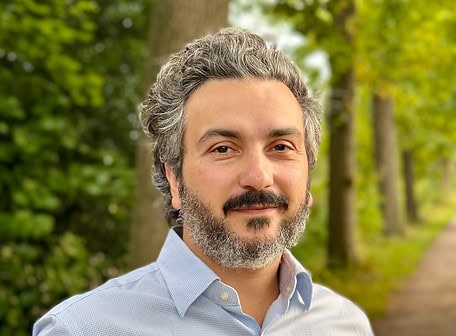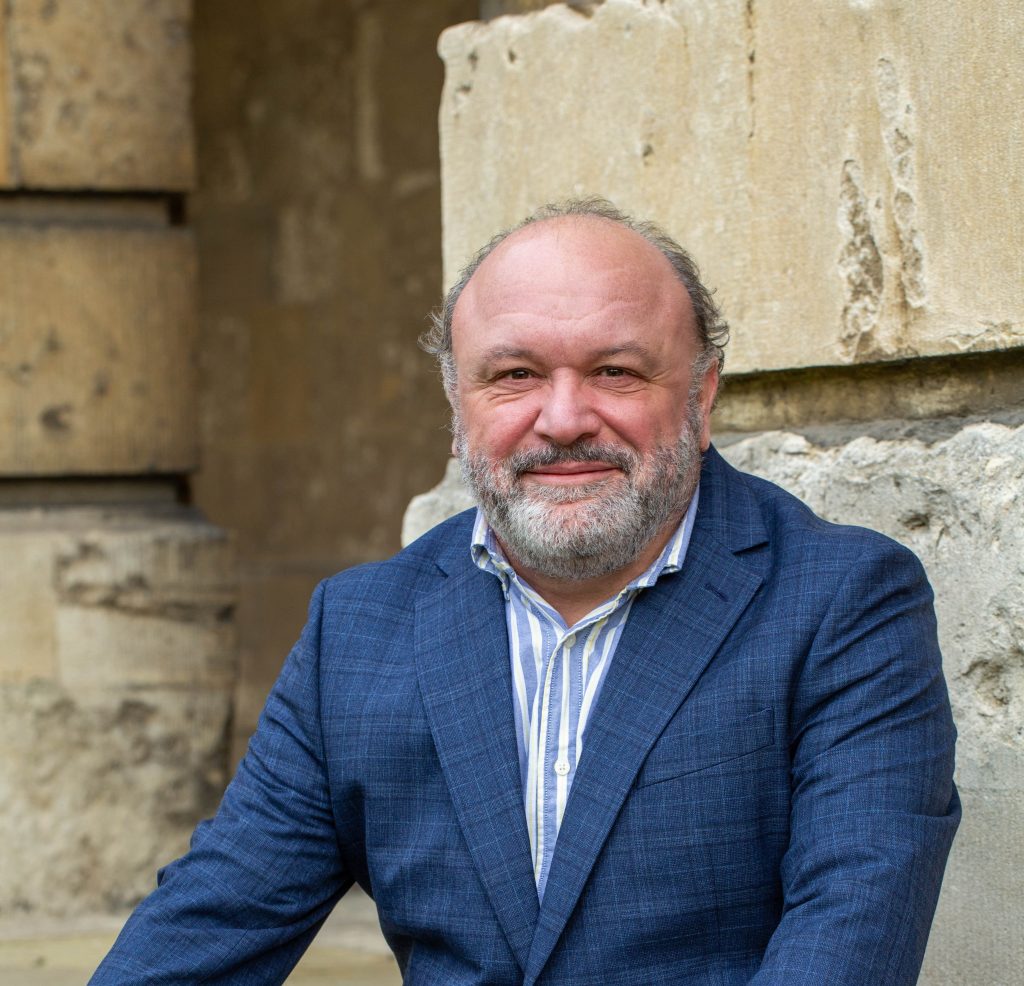
We spoke to Fellow in Mathematics Prof José A. Carrillo about his research and how, from swarms to stock markets, mathematics can help explain make sense of a complex world.
What first drew you to mathematics, and when did you realise it was something you wanted to pursue at the highest level?
In many ways, my journey began with exceptional teachers. Inspiring school educators play a decisive role in nurturing mathematical talent, and I was fortunate to encounter exactly that. I owe a great deal to both my school and my university for providing such a strong foundation. Participating in local Mathematical Olympiad competitions was another turning point: this challenged me, motivated me, and ultimately convinced me that mathematics was not just a subject I enjoyed, but a path I wanted to pursue at the highest level.
Your research uses Partial Differential Equations to model real-world phenomena. How would you explain what you work on to someone without a mathematical background?
Many systems in the world, whether in physics, biology, or even economics, are made up of vast numbers of interacting components. These might be particles in a plasma, cells in the body, animals in a swarm, or even agents in financial markets. Trying to track each individual component quickly becomes impossible due to the sheer scale involved.
This is where mathematics becomes powerful. Instead of following every individual element, we use differential equations to describe the collective behaviour of the system as a whole. These models allow us to uncover patterns, predict outcomes, and understand large-scale phenomena that would otherwise remain hidden. In essence, we move from complexity at the microscopic level to clarity at the macroscopic level.
Instead of following every individual element, mathematics uses differential equations to describe the collective behaviour of the system as a whole.


Your research spans disciplines from physics and engineering to neuroscience and social systems. What excites you most about applying mathematics across such diverse fields?
Mathematics is often described as the language of nature, a phrase attributed to Galileo that still resonates today. What excites me most is its universality. The same mathematical ideas can describe seemingly unrelated systems, from neural activity in the brain to the formation of social networks.
This ability to distil complex problems down to their essential structure is incredibly powerful. At the same time, each application requires careful adaptation. The challenge and the beauty lies in shaping mathematical tools so they meaningfully capture the intricacies of each field while revealing the connections between them.
Mathematics is often described as the language of nature, a phrase attributed to Galileo that still resonates today. What excites me most is its universality.



Many of your models explore collective behaviour, from particles and cells to neurons. What can mathematics reveal about how complex systems behave as a whole?
At the individual level, systems are often governed by relatively simple rules. But when many individuals interact, entirely new behaviours can emerge, what we call “collective” or “emergent” phenomena.
Mathematics provides a framework for bridging this gap. By moving from individual descriptions to averaged, large-scale models, we can begin to understand how patterns form and evolve. This approach helps us answer questions such as how heat distributes across a spacecraft during re-entry, how cells organise and spread in biological tissues, or how groups make decisions. It reveals how complexity arises from simplicity.
Mathematics reveals how complexity arises from simplicity.
You’ve received a number of major international honours in recent years. What do these kinds of awards mean to you personally?
Recognition from one’s peers is always meaningful. It reflects not only years of hard work, but also the collective effort behind any scientific journey. Receiving honours from institutions in Spain and Italy is especially significant to me, Spain as my home country, and Italy as a place I feel deeply connected to. These awards are both humbling and motivating.
You teach across the full breadth of applied mathematics. What do you most enjoy about teaching?
I particularly enjoy teaching differential equations and mathematical modelling, as they sit at the heart of how mathematics connects with the real world. More broadly, I believe mathematics should be approached as a unified discipline. Rigour and application are not opposing forces, they complement each other. When combined effectively, they create a richer and more meaningful learning experience.
I believe mathematics should be approached as a unified discipline. Rigour and application are not opposing forces, they complement each other.
What do you value most about mentoring early-career mathematicians?
One of the most rewarding aspects is seeing young researchers develop their own ideas and identities. Supporting them as they build their own research paths and gain independence is incredibly fulfilling. Nurturing the next generation is not only a responsibility, but one of the most important contributions we can make as academics.
Nurturing the next generation is not only a responsibility, but one of the most important contributions we can make as academics.
Looking ahead, what kinds of questions will define the next decade in your field?
The intersection of mathematics with data science, artificial intelligence, and machine learning will play a defining role. Understanding and using these technologies from a rigorous mathematical perspective while contributing to their development will be essential. This represents both a challenge and a major opportunity for the next generation of mathematicians.
How do you see the role of academies and professional societies in shaping the future of mathematics?
These institutions play a vital role in representing the discipline. They help articulate the importance of mathematics in modern society, provide informed guidance to governments and industry, and advocate for the value of scientific thinking. In many ways, they ensure that the foundational role of mathematics in technological progress remains visible and understood.
What would you say to students who may feel daunted by mathematics?
Mathematics today offers more opportunities than ever before. Its applications span an extraordinary range of fields, from academia to industry, technology, finance, and beyond. While it can be challenging, it is also deeply rewarding. Studying mathematics equips you with a way of thinking, a toolkit for solving problems, that is invaluable in almost any path you choose.
Studying mathematics equips you with a way of thinking, a toolkit for solving problems, that is invaluable in almost any path you choose.