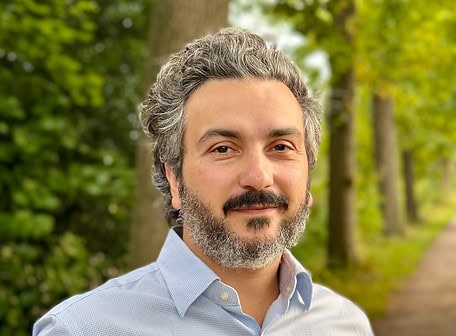
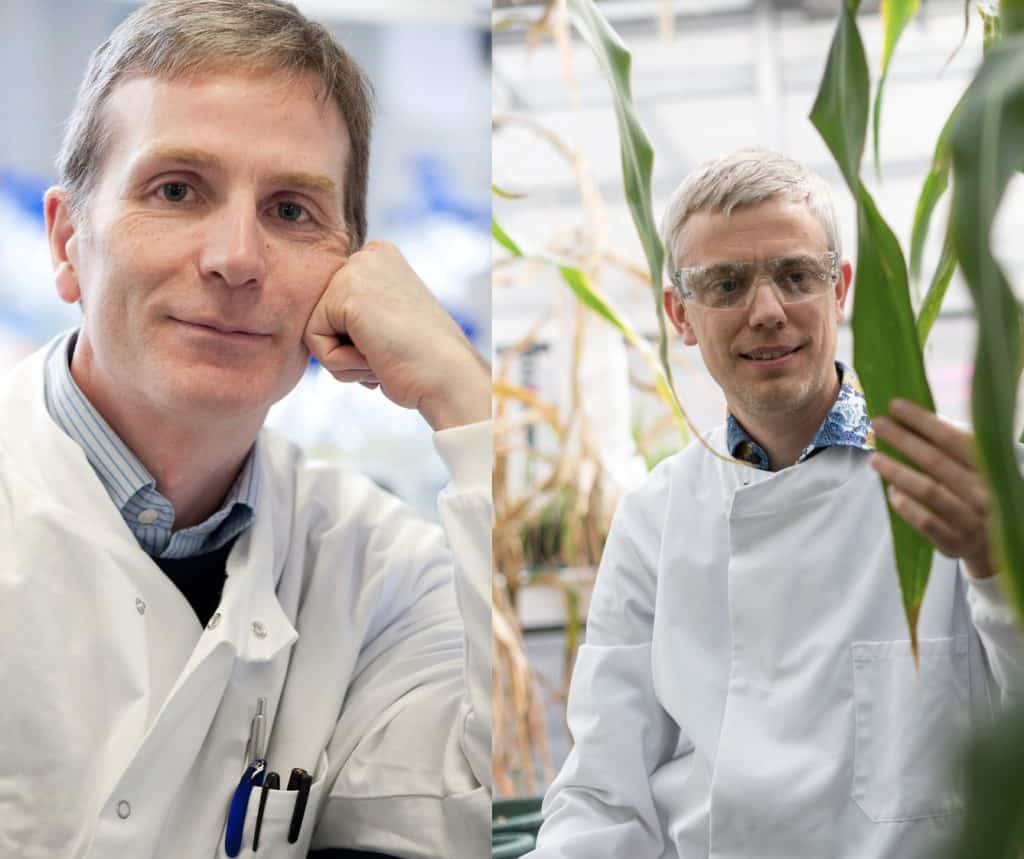
Researchers at Queen’s are playing a leading role in a new £6.7 million ARIA-funded project to rethink how we grow food. Bringing together expertise from medicine, biology, and industry, the interdisciplinary team, including Queen’s Professors Chris O’Callaghan and Steve Kelly, is developing a new synthetic biology approach to improve the yield and resilience of staple crops, such as potato and wheat, in the face of climate change and rising global demand. Prof O’Callaghan tells us more.
Professors Chris O’Callaghan (left) and Steve Kelly (right)
Your lab developed the DNA assembly platform being used in this project. Can you describe what the platform does and why it’s so significant for plant biology?
Scientists have been able to make short stretches of DNA relatively easily for several decades. However, at present it is not possible to synthesise long DNA molecules directly. Therefore, to make long stretches of DNA it is necessary to stitch together multiple shorter DNA fragments. Over time various methods have been developed to do this, but they have a series of drawbacks that have limited the creation and application of long DNA molecules. Key challenges have included the need to avoid certain problem sequences when assembling the shorter DNA fragments and the insertion of unwanted ‘scar’ sequences between the fragments that are being assembled. The techniques have also been relatively complex requiring large numbers of DNA hosts during the assembly; this in turn leads to inflexibility in the design of the assembly. This is a particular limitation in situations where it might be desirable to test for differences in the properties of DNA molecules with variations in their sequence as might, for example, occur between individual members of a single species.
Our method, known as UniClo, allows us to assemble any DNA sequence without restrictions on that sequence. It does not leave any unwanted scars between the DNA molecules being assembled and it does not require multiple DNA hosts, making it very easy to use and conferring great flexibility in the design of the assembly.
What are the biggest technical challenges involved in building and then replacing an entire chloroplast genome in a crop like potato or wheat?
Our assembly method works well now, so the main technical challenge will not be the assembly itself, but our ability to obtain the right fragments to assemble. We aim to assemble the genome from DNA that has been synthesised directly, but some DNA sequences can be challenging to synthesise, for example, if they fold up on themselves in particular ways. There is also a possibility that when the DNA is made and assembled it may undergo a process known as recombination which can alter the sequence of the DNA through process such as the deletion or shuffling of the order of sections of the DNA.
Coming from the field of medicine, how did you find yourself part of a project on plant biology and food security?
DNA sequences are surprisingly similar across the plant and animal kingdoms. We embarked on DNA assembly of large DNA molecules because we needed these large molecules for experiments related to our biomedical research interests. However, when Steve Kelly and I were discussing this, we realised that the pieces of DNA that we were making for our biomedical research were broadly similar or larger than the size of the chloroplast genome, so we should be able to make a whole synthetic chloroplast genome.
There are very important reasons for doing this. Chloroplast genomes are inherited from one parent, so it is not possible to breed plants to obtain desirable characteristics from two different chloroplasts. So, for example, if one plant from a particular species has a chloroplast that conveys drought resistance and another plant has a chloroplast that conveys disease resistance, it is not possible to breed a plant that contains a chloroplast combining these two features. However, if you synthesise a chloroplast, then you can put the DNA variants that encode drought resistance and the DNA variants that encode disease resistance into one chloroplast and so generate a plant that has both these desirable characteristics.
If you synthesise a chloroplast, then you can put the DNA variants that encode drought resistance and the DNA variants that encode disease resistance into one chloroplast and so generate a plant that has both these desirable characteristics.
This project brings together expertise from biology, medicine, synthetic DNA technology, and industry. What have you learned from working outside your immediate academic discipline?
Teamwork and humility. It has been great fun working with people outside my usual discipline and very educational. I now know much more about plants that I did originally. We all work together and have regular friendly meetings. It is always humbling to realise how much expertise people have in areas that you know very little about. That is one of the great things about working in a multi-disciplinary college!