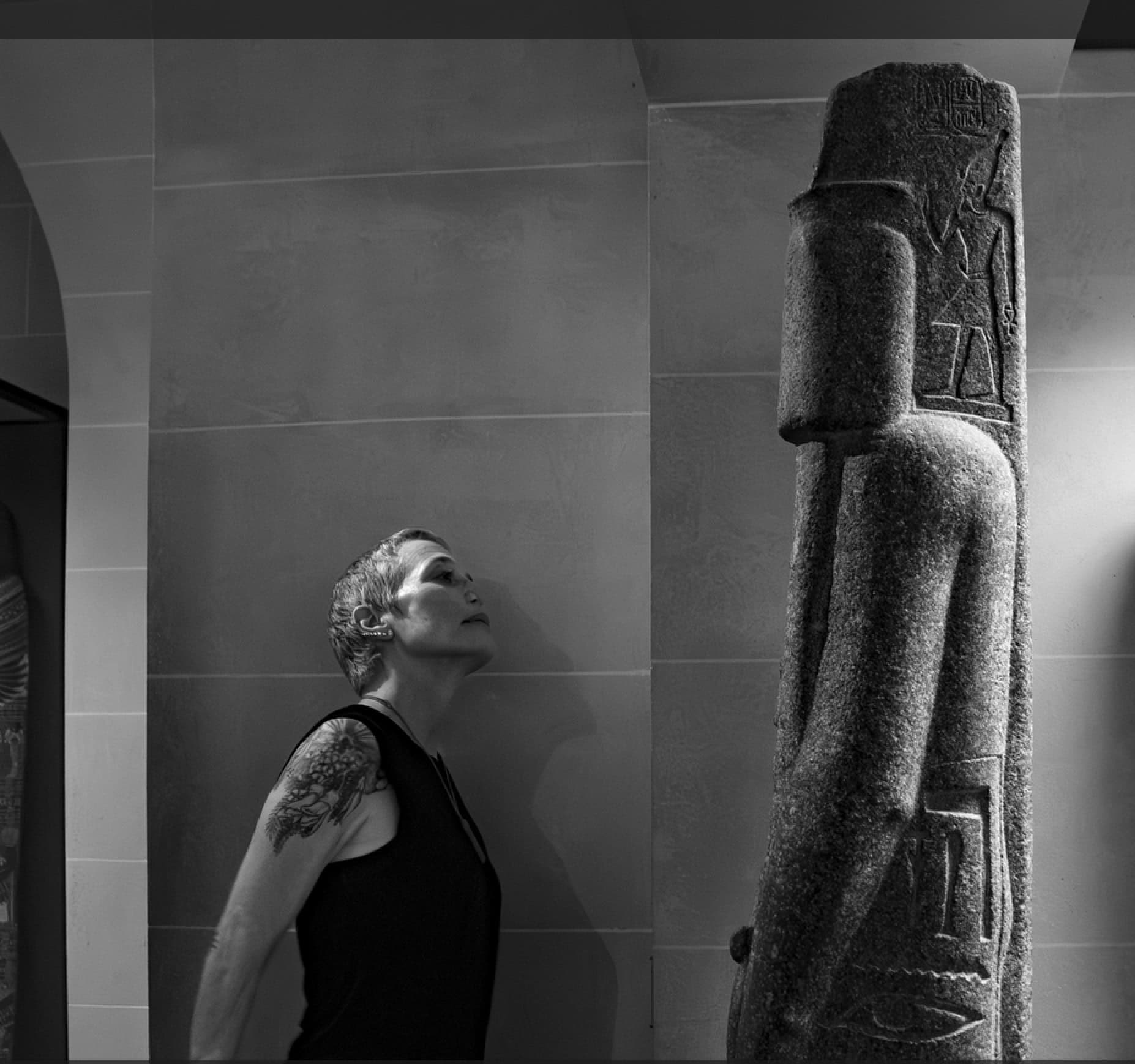
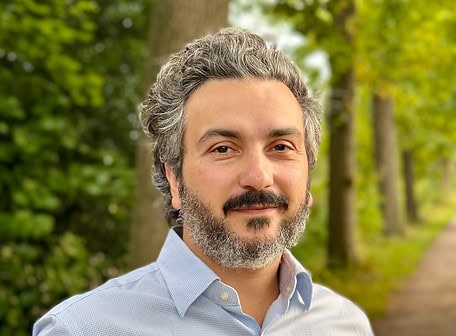
Professor Richard Bruce Parkinson has devoted much of his career to showing how poems written four thousand years ago can still move us.
From two decades at the British Museum, to his new commentary on the Egyptian poem, The Life of Sinuhe, he has sought to bring ancient voices into the present.
As a child, Richard Bruce Parkinson, Professor of Egyptology at the Faculty of Asian and Middle Eastern Studies and Fellow of Queen’s, was fascinated by his father’s books on Egyptian art.
He recalls:
The pictorial and visual nature of the script really intrigued me. It was a shock to realise that ancient poetry could still speak to us like modern poetry.
That realisation carried Richard from his undergraduate studies at Oxford, through 20 years at the British Museum, and back again. At school, Richard was torn between studying English literature or Egyptology at university.
‘In the end I decided that as a native English speaker I could manage English literature on my own more easily than I could explore Egyptian poetry,’ he says. This choice brought him to Queen’s, where he completed his undergraduate and graduate studies.
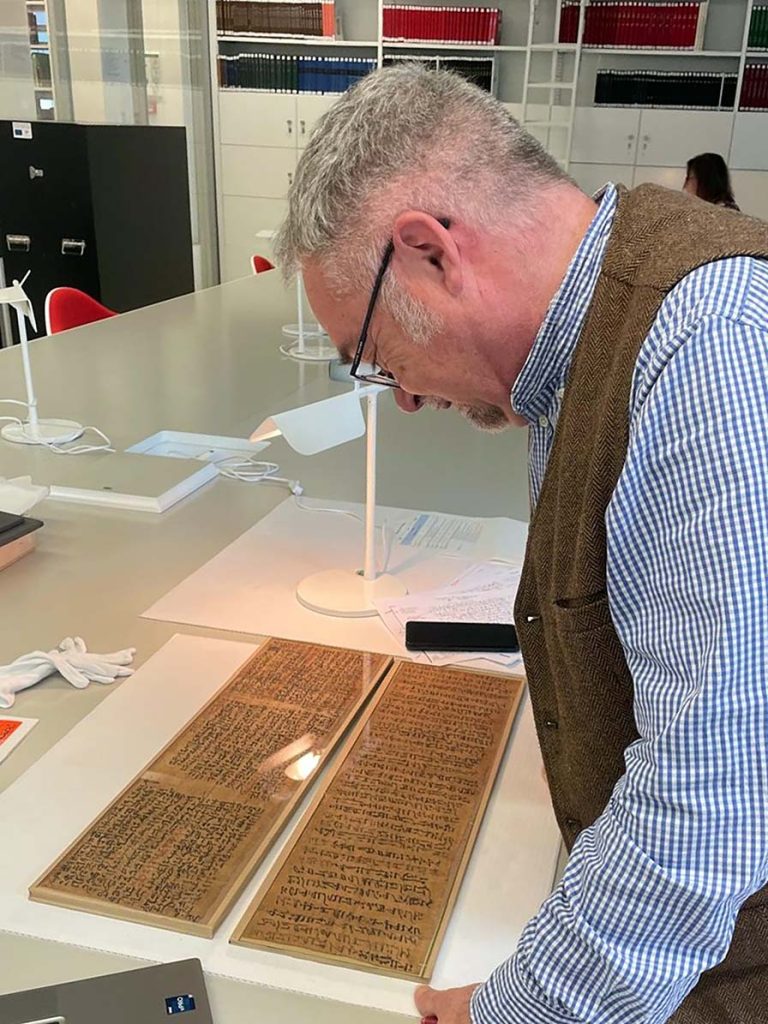
His first permanent job was at the British Museum, initially as a graphics officer. His father, an art teacher, had trained him in drawing, and that combination (someone who could both read and copy inscriptions) got him the post. He stayed for over 20 years, becoming curator of papyri and written culture.
Working with artefacts and manuscripts really gives you a sense of their materiality. With a papyrus, you get to know the mistakes a scribe makes, the corrections, even an accidental fingerprint… and this humanises the ancient text. I’m a dreadful typist and some scribes’ handwriting is appalling, so we have a common ground in that sort of incompetency.
Unable to do fieldwork in Egypt due to Type 1 diabetes, he valued the experience of handling artefacts every day, which changed how he thought about Egyptian texts; he learnt not just what they said, but how they were made and read.
Those years also showed him the value of collaborative team-playing, something that he appreciates very much in the current Egyptology subject-group at Oxford.
He also speaks with delight about working alongside conservators and designers. ‘Watching somebody doing something well is just such fun,’ he says. He has enjoyed working with the Bodleian Libraries’ team on an exhibition about the Tutankhamun archive: ‘There was complete collaboration and complete trust; it was such a joy, and a rather nostalgic experience for me’.
It’s a joy that still influences his research today. For Richard, a poem is the result of a network of authors, copyists, performers, readers, commentators, and conservators who all help create the meaning.
When Richard returned to Oxford as Statutory Professor of Egyptology, his aim was to work on The Life of Sinuhe, a poem from around 1850 BC.
‘It’s the text I really became an Egyptologist to read,’ he says.
This masterpiece of Egyptian poetry tells of a courtier who panics at the king’s death and flees Egypt. He prospers in exile but never feels at home. Only through the mercy of the new king does he return to Egypt to be buried with honour.
For all its fame, no one has produced a full commentary on the poem since 1916. ‘That seemed rather careless given it’s universally acknowledged to be the greatest surviving work of Egyptian literature,’ Richard says.
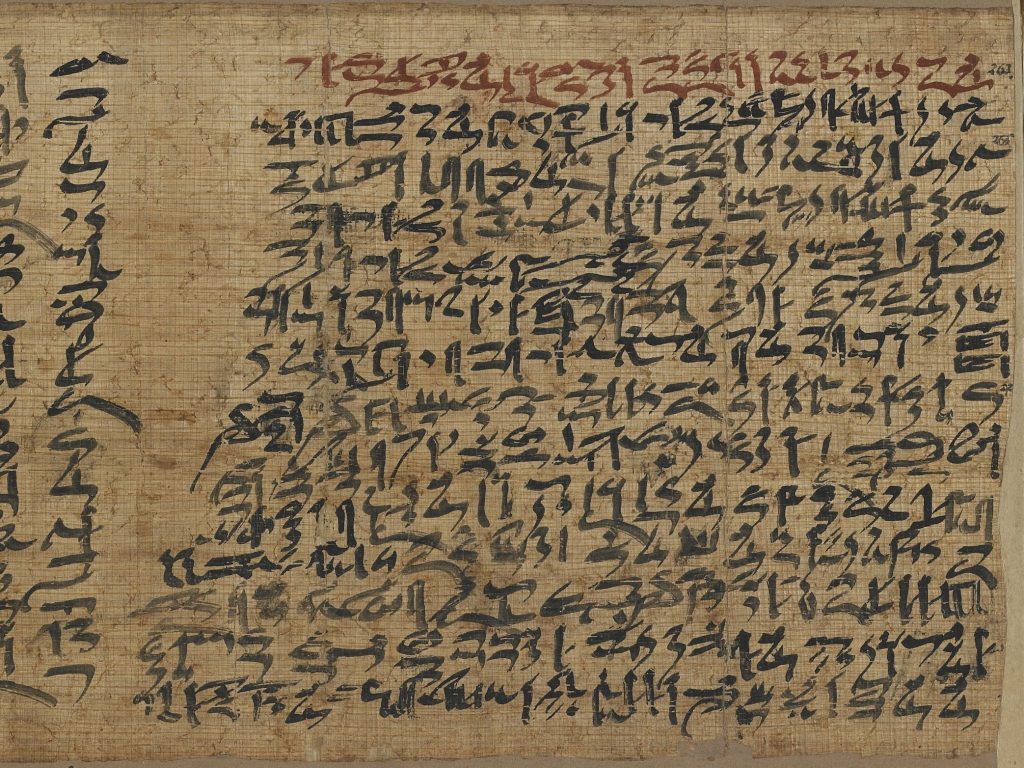
Over the past decade, and with the help of a British Academy / Leverhulme Trust Senior Research Fellowship between 2024 – 2025, he has written a commentary of around 1,000 pages, re-examining every verse in the light of new philology, archaeology, and performance, checking parallel passages and trying to chart the effect of word after word, in order to suggest some of the responses that the poem was intended to produce.
For Richard, the fascination of Sinuhe lies in its portrait of a human voice. ‘One of its core themes is the differences between the official way a person has to describe his own life and the actual experienced reality,’ he says. ‘And, in this case, the life doesn’t go wonderfully well.’
He feels an affinity with its troubled protagonist. ‘I can relate to Sinuhe’s sense of uprootedness, his struggle to find an identity and a real home.’ Having left the northeast of England for Oxford as a teenager, he knows what it is to feel out of place.
Richard has always believed that poetry is more than text on a page. He has worked with the actress and author Barbara Ewing who has recorded a recital of Sinuhe as part of the project. The experience had a profound effect: ‘The text we take two months to read in class takes 40 minutes in performance and the emotional intensity is overwhelming.’
Barbara’s performance also showed how much of the poem’s power lies in its silences and pauses, the meanings underneath the words. ‘It’s continually about what cannot be said. Why did he flee Egypt? He can’t explain it. But that is exactly what poetry does: it lets the unspoken rise to the surface.’
Listen to Barbara’s performance of Sinuhe
His commentary, then, is designed very much as a ‘reader’s commentary’, one that brings together the scribe’s handwriting, the cultural and archaeological contexts, the landscapes, performance insights, and also students’ contributions from his classes.
For him, teaching and research run in parallel: ‘Every time you read a poem in a class with students, you have to read it again yourself as if for the first time, and I think teaching is very inspirational.’
Above all, he wants it to bring the poem back to life and foster a sense of empathy:
I want readers to smile, to weep – simply to feel what others have felt.
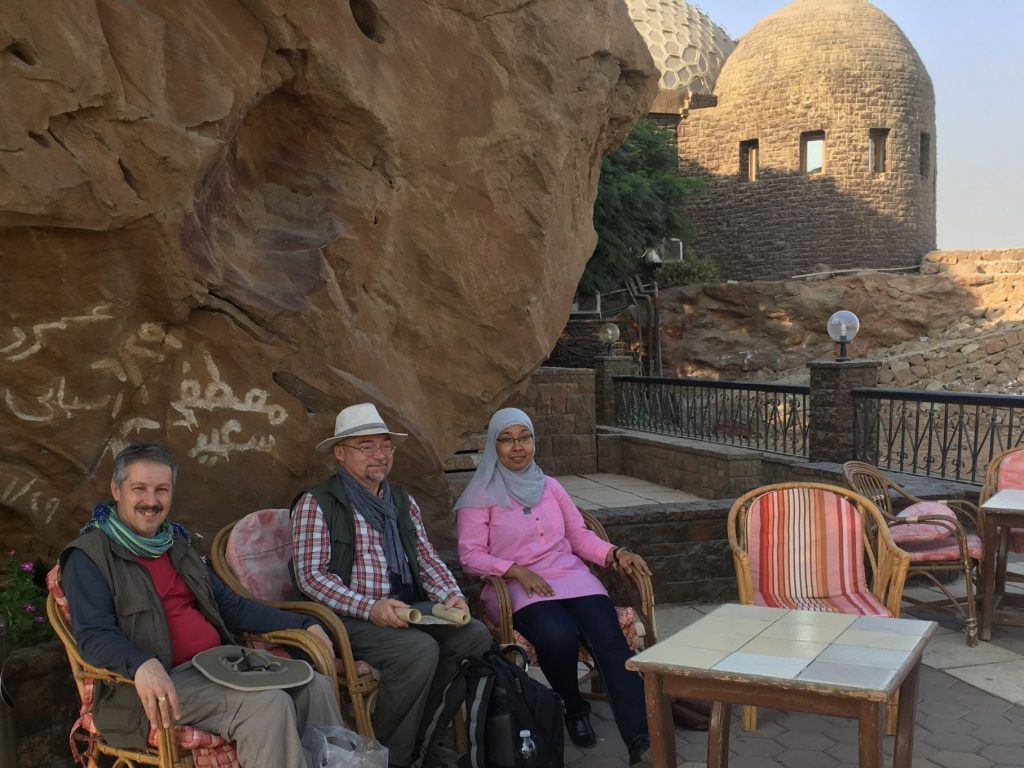
Oxford has been both a home and challenge.
The College, with its long Egyptological tradition and northern roots, has always been an immensely supportive home for Richard, he says. But he admits he has often felt uncomfortable elsewhere in the University. ‘I’m a gay diabetic northerner; working here has made me feel more vulnerable because of my sexuality and disability than I ever did growing up in Thatcher’s Britain.’
That experience has shaped his view of what really matters in scholarship. ‘Confidence is an overrated academic virtue. What we need when approaching ancient poetry is humility, not a sense of entitlement’. It is, he suggests, one lesson of Sinuhe, which is about a man forced to confront and live with his own failings.
Richard’s work has rarely stayed within neat boundaries. His time at the British Museum taught him to think materially as well as textually; his collaborations with actors showed how performance shapes texts. He has employed what he calls a ‘queer philology’, looking for non-normative voices in narratives, alternative endings and ambiguities.
‘Egyptian poetry often celebrates the untoward’ he says. Richard has also written widely on queer history, including the best-selling and influential A Little Gay History based on the British Museum’s collections.
Although Sinuhe has been a major project, Richard is already looking ahead. He will be continuing his work with mathematician Professor Christopher Hollings at Queen’s, exploring the history of ancient Egyptian mathematics. ‘I used to curate the Rhind Mathematical Papyrus at the British Museum,’ he says. ‘Thanks to this friendship, I’m finally understanding what it’s about’.
I want people to read the commentary and then throw it away. I want them to go back to the original text and try to feel for themselves what the ancient audiences felt.
Oxford University Press has asked him to prepare a revised and updated edition of the Oxford World Classics anthology of Egyptian poetry, which he published early in his career in 1997.
Egyptology, he notes, has developed enormously since then: ‘we’re a very young discipline, and our knowledge of texts has advanced rapidly; looking back, I’m proud to realise that quite a few of the advances are due to people I’ve supervised.’ Revisiting the book, he adds, will be ‘exciting to see how much better we understand the poems than 30 years ago.’
Richard argues that ancient poetry should not be regarded as a museum piece but as living expressive culture: ‘in reading, we can experience another culture in its own words, to see it from inside. And poetry also confronts us with ourselves, showing us the possibilities of experience beyond our own narrow world.’
After ten years of work, Richard is clear that his commentary is only a bridge to the poem itself. ‘I want people to read the commentary and then throw it away. I want them to go back to the original text and try to feel for themselves what the ancient audiences felt.’
With thanks to the original source: Pulse, Oxford University.