As the Queen’s College Translation Exchange enters its eighth year, we are taking time to look back and reflect on our successes in 2025.
This year, over 22,000 students aged 11-18 took part in the Anthea Bell Prize for Young Translators and we judged 5,000 entries across the Prize’s six strands: French, German, Italian, Mandarin, Russian, and Spanish. 2025 was the inaugural year for the Russian strand, which saw excellent engagement from pupils at varying stages of study (from ab initio to A Level) at over 70 schools in the UK. Since the announcement of the winners for 2024-25, we have continued to develop our free teaching resource packs (including PowerPoints, student worksheets, and teacher’s notes), and now have over 100 packs across all levels of the prize.
“Our experience of the Anthea Bell Prize for Young Translators has been extremely positive. After taking part for the first time last year, multiple students chose to join the competition again this year, which already shows how motivating and inspiring they have found the process. I’ve noticed a real shift in how students now approach translation tasks in GCSE lessons: they are far more engaged, intrigued, and willing to experiment.”
Anthea Bell Prize Teacher, 2025
Elsewhere at the Translation Exchange, our 2024-25 cohort of Creative Translation Ambassadors completed their four-part training programme and our 2025-26 cohort began theirs. Each year we welcome student linguists from across faculties – including Modern Languages, Asian and Middle Eastern Studies, History, Philosophy, Classics, Linguistics, Psychology, Politics, Economics, Mathematics, and Materials Science – into the team. In small groups, they develop creative translation workshops and deliver them in schools across Oxfordshire and elsewhere. This year’s cohort of students speak French, German, Spanish, Italian, Portuguese, Catalan, Dutch, Scots, Icelandic, Norwegian, Swedish, Danish, Polish, Russian, Arabic, Hindi, Gujarati, Mandarin, Cantonese, and Japanese between them. As part of our work with students at university-level, we also led training sessions for PGCE MFL students in Oxford and a cohort of student linguists at the University of Cambridge.
“I really enjoyed taking part in the Creative Translation Ambassadors Training Day, especially as someone who does not study a language-related subject at Oxford. […] I particularly enjoyed participating in the second workshop, where I learned how to translate a poem from Arabic to English using the Decode, Translate, Create method of creative translation. I was amazed by the fact that I could make sense of the full text at the end of the workshop even as someone who has never learned any Arabic previously.”
Shuaichu, Creative Translation Ambassador 2025
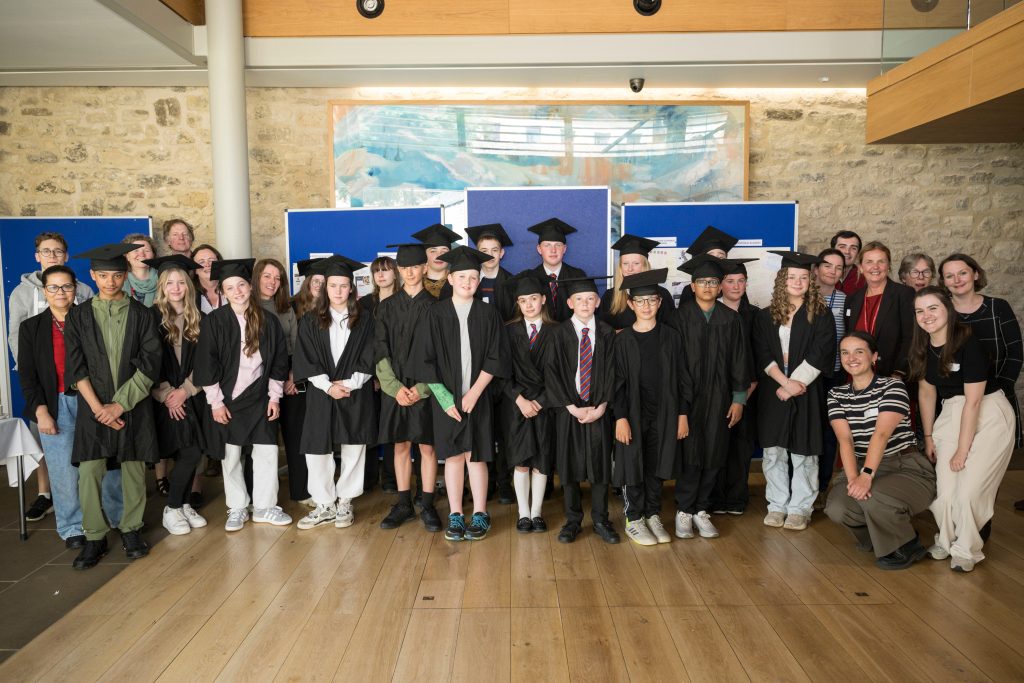
In January, we welcomed a new cohort of Year 8 students from Rochdale and Blackpool into Think Like a Linguist, a programme that helps young learners to make informed choices about languages at GCSE, and which is delivered collaboratively by a number of key partners. Over five interactive sessions, the students reflect on a different aspect of language learning and are invited to consider the question, What does it mean to think like a linguist? from unique perspectives. Recently, this year’s pupils joined us at Queen’s for celebration days to mark their graduation from the programme. The days included creative translation and beginners’ language workshops with our Ambassadors, an exhibition of the pupils’ posters, a roundtable for teachers led by QTE Director Charlotte Ryland, and a graduation ceremony featuring gowns and mortarboards.
“Thank you for all the work that you put into making this cycle of ‘Think like a Linguist’ such a success. The event was an amazing experience for our students. They thoroughly enjoyed it and took a lot from it.”
Think Like a Linguist Teacher, 2025
Over the course of the year, we held and collaborated on many events in Oxford. We hosted nine Translation Exchanges at Queen’s, including three masterclasses with writer and translator Polly Barton, in which students workshopped translations from languages including Icelandic, Japanese, Byzantine, and Ancient Greek. We also brought creative translation to the Faculty of Medieval and Modern Languages’ Annual Teachers’ Conference, organised this year around the theme of ‘Collaboration and Connections’. We were delighted as well to host the Feminist Translation Network for a translation slam and a symposium on pedagogy, and to welcome Nicol Hochholczerová and translators Julia and Peter Sherwood to Queen’s for a series of events on translating from Slovak.
Alongside our support for teachers and pupils in classrooms across the UK, we have taken our policy work to a deeper level. With funding from Oxford Policy Engagement Network, Charlotte Ryland led a research project on raising the profile of languages expertise amongst government departments, and continued to work on cross-sector collaboration with The Languages Gateway, the British Academy, the Department for Education, and other stakeholders. Recent outputs in our policy work can be found here and here, including articles on decolonising the MFL curriculum and working with ARIs, co-developed with Jack Franco, Marie Martine, and Sarah Schwarz.
QTE has featured widely in national press and we have begun to collate these features here. Highlights include Charlotte Ryland’s recent articles for the Higher Education Policy Institute and the Journal of Languages, Society and Policy, as well as features by the University of Oxford, National World, and The Times.
“If we have access to a form of education that stands to raise a generation of individuals able to think for themselves, and to do so on the global stage, then what are we waiting for?”
Charlotte Ryland (QTE Director), 2025
We are looking forward to a new year at the Translation Exchange, as 2026 brings the sixth Anthea Bell Prize competition (opening on 2 February – register here!) as well as new collaborations with the National Consortium for Languages Education, the Swire Chinese Language Foundation, the German Screen Studies Network, and the Stephen Spender Trust. Until then, we would like to sincerely thank all who make our work possible, and to wish everyone in the QTE community a wonderful festive period!